
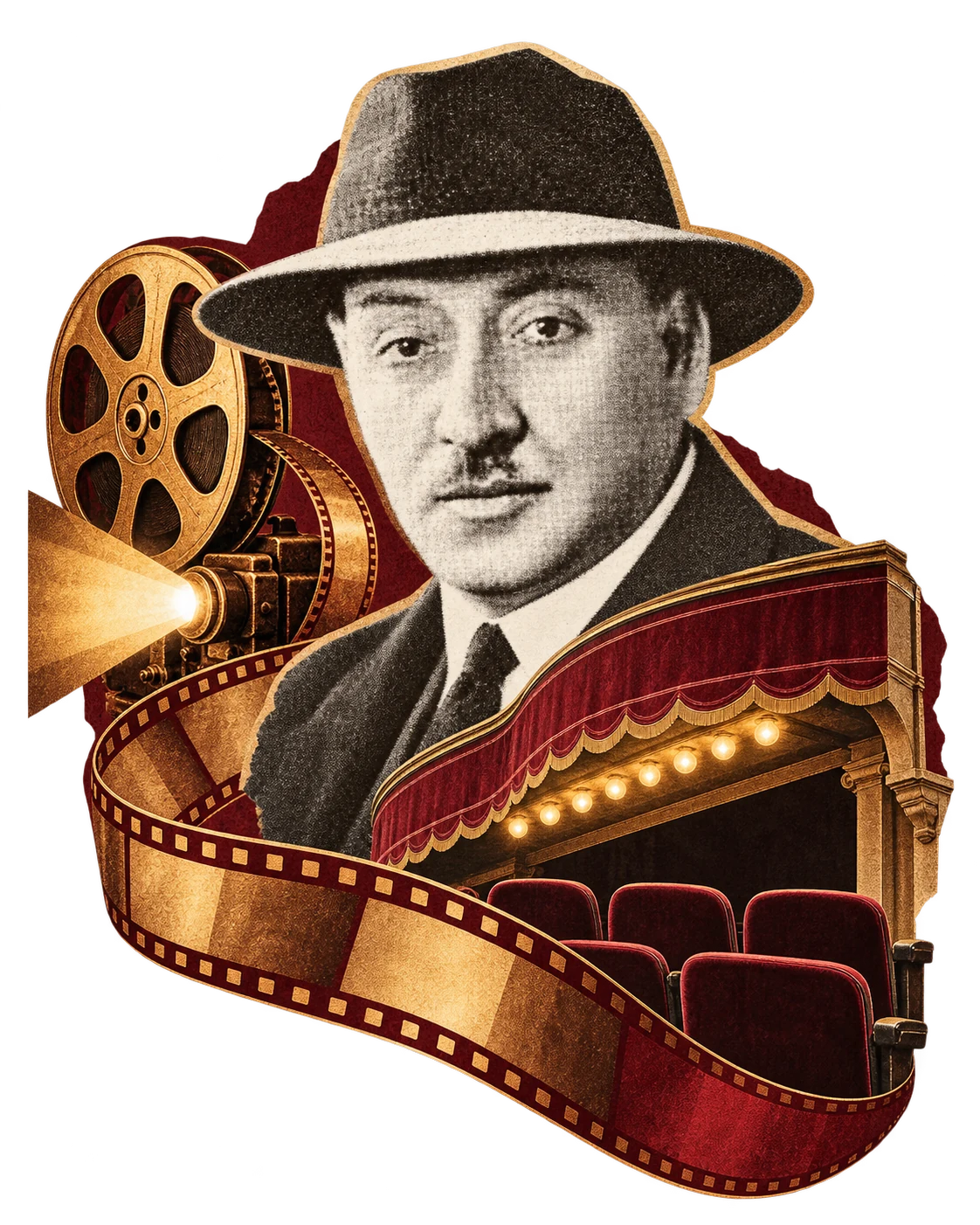
In the 1920s, quite a few wealthy Jews contributed to the establishment of settlements and the development of industry in Israel, but only a handful decided to immigrate and tie their fortunes to the country's uncertain future.
Moshe Greidinger 2018 was not the beginning of the Greidinger family's story. Brothers Moshe (Mooky) and Israel (Sherry) Greidinger, owners of the Cinworld cinema group, completed their £2.7 billion cash acquisition of the American cinema giant Regal. The Greidinger brothers run the world's second-largest cinema empire, comprising 9,500 screens in some 700 cinemas, with annual turnover of 15 billion shekels. Only one competitor now stands in their way - AMC, the leading American chain in the field. This was not the family's first breakthrough in the cinema industry. As early as 1982, Kalman Greidinger, Mooky and Sherry's father, was the first in Israel to move away from the old cinema model - a large auditorium with many seats and a huge screen - to a multiplex with several smaller auditoriums, fewer seats, and smaller screens. He first put this model into practice at the Rav Hen cinema in Tel Aviv. They prospered, and 15 years later Kalman's sons began taking their first steps abroad, first in Hungary and later expanding into other Eastern European countries. In 2006, Mooky and Sherry Greidinger floated their company, Cinema City International, on the Warsaw Stock Exchange in Poland at a valuation of around $340 million. (The Greidinger family did not use that name in Israel, since the Edri family had given the same name to its cinema complex in Glilot.)
In Israel, the family operates the Rav Hen cinema chain as well as the Yes Planet chain. The family is also involved in film distribution through Forum Film, which began operating in 1967. After conquering Eastern Europe, they turned to Western Europe, and in 2014 the family's businesses merged with the Cinworld group - the leading cinema chain in Britain and Ireland - together becoming Europe's second-largest cinema group. Following the merger, the company was listed on the London Stock Exchange.
In the 1920s, wealthy Jews were active in the country. Some were involved in purchasing land, mainly in the Sharon region, establishing settlements, preparing orchards, and more. Among them were Nathan Straus, an American Jew and one of the owners of the Macy's department store chain, who contributed to the establishment of the city of Netanya, named after him; Sir Alfred Moritz Mond, a wealthy English industrialist who contributed to the establishment of the Tel Mond area, named after him; the British Lord Israel Moses Sieff, one of the owners of Marks & Spencer, who also contributed to the establishment of settlements in the Sharon and to the founding of the Weizmann Institute, initially called the Sieff Institute; and Baron Félix de Menasce of Egypt, who also contributed to the establishment of settlements in the Sharon. They all conducted business in the country but continued living in their countries of origin. At the same time, a few wealthy Jews decided to immigrate and make their homes and business centers here. Unfortunately, most of them failed and lost their fortunes, which is why Moshe Greidinger's story is so exceptional.
Moshe Greidinger's Arrival in the Land
Moshe Greidinger was born in 1886 in Iași, Romania. At the age of 14, he went to England on his own and began working as an assistant in a trading house. Moshe was intelligent, hardworking, ambitious, and had an excellent business sense. As he grew older, he went into food imports and egg trading, becoming one of the biggest in England. Once he was established, he married Rebecca, and in 1924 their first son, Kalman (nicknamed Kent-Kenny), was born. He was named after Moshe's father. A year after his son's birth, Moshe visited the country for the first time, fell in love with it, and decided to invest there. In 1927, he bought about 1,100 dunams near Kfar Saba from the Shanti family of Qalqilya and established a huge agricultural farm there, which supplied fresh produce to the residents of little Tel Aviv. He dedicated the farm to his beloved father, Kalman, and named it Kalmania. Moshe approached Israel Rokach, then deputy to Meir Dizengoff, the mayor of Tel Aviv, and asked him to find someone to manage the farm. Rokach recommended Baruch Ben-Ezer (Raab), son of Yehuda Raab, one of the founders of Petah Tikva and the colony's first guard. At the time, Baruch was managing Aaron Aaronsohn's experimental farm in Atlit. When the Aaronsohn family began engaging in espionage as part of the NILI underground, Baruch felt that his life was in real danger. He preferred to leave and take a job at Kalmania, which under his management became the largest and most successful agricultural enterprise in the country during the first half of the 20th century.
In 1928, construction began on buildings at the farm that would later serve as a machine house, a cowshed, and a two-story residential building with a kitchen and dining room. A water reservoir, filled from a well dug on the site, was built, and within two years orchards had been planted, along with new tropical crops such as avocados, persimmons, bananas, and mangoes. Moshe paid his workers higher wages than was customary at the time, and they received benefits unheard of in the country, such as health and life insurance. Graduates of the agricultural schools at Kadoorie, Mikveh Israel, Pardes Hanna, and Nahalal came to work at the farm. Because of its remoteness and isolation, the farm served as a training base for Haganah members, who were disguised as agricultural workers.
During the 1929 riots, Arabs attacked the farm, and it began to decline. Moshe fell ill and decided to sell it. Moshe Bucholtz, who was then the farm's administrative manager, feared that it would be sold to Arabs and turned to Avraham Herzfeld, one of the founders of the Ahdut HaAvoda party and among the initiators of the Histadrut, for help finding a solution. Herzfeld approached Moshe and persuaded him to donate the farm and its lands to the institutions of the workers' settlement movement. Some of the land was transferred to the Jewish National Fund, which allocated part of it to the Tzofit moshav and part to the Sde Warburg moshav. The farm operated for about a decade, and its site is now within the grounds of Beit Berl Academic College.
From the Farm to the World of Cinema
It was a partition intended to separate women and men, brought to the Western Wall by Jews, that sparked the 1929 riots, also known as the Tarpat riots. Most wealthy Jews froze their investments and watched events unfold anxiously, but Moshe Greidinger saw this crisis as an excellent opportunity to immigrate and deepen his investments here. At the height of the riots, Moshe immigrated with his wife Rebecca and their five-year-old son Kalman (Kent-Kenny), and they lived at Kalmania. When he fell ill, the family moved to Tel Aviv, and a few years later they moved to Haifa, where Moshe began to pursue his great love of cinema and films, building the Ein Dor cinema, the first in the city. His grandson Moshe, named after him, later recalled: "1929, the year of the economic crisis, was a wonderful year for cinema. During a crisis like that, it's nice to go into a cinema for two hours and forget your troubles." In 1935, Moshe built the Armon cinema, the most magnificent cinema of its day. It had 1,800 seats, private boxes and a balcony, and even a retractable roof.
At the same time, Moshe established the Yafora factory, with its Mitz Paz brand. He was chairman of the board of Tel Aviv Credit Bank and was also involved with the Eastern Company for Bonded Warehouses Ltd., Haifa Builders Ltd., the Adir cooperative society, Beit Hadar in Tel Aviv, the Greidinger and Werner firm in London, the Yavne settlement company, Pardes-Syndicate, the Eretz Israel Shipping Company, the Eretz Israel Refrigeration and Supply Company, Jaffa-Orange, the Amir Association, the Laitoritz Company, and the Farmers' Bank. He was also one of the managers of the Port of Tel Aviv and treasurer of the Zevulun Seafarers' Association, and this is only a partial list. Moshe did not seek honor or publicity. He believed in getting things done, spoke little, and was known for making brief, to-the-point remarks.
Moshe Greidinger died at the age of 60, two years before the establishment of the state. He left five children and bequeathed most of his businesses to his only son, Kalman (Kent-Kenny) Greidinger.
Kalman and the Continuation of the Empire
Although Kalman was only five when he immigrated with his family, those close to him described him as an English gentleman. In the early 1980s, a group known as the Eisenberg Boys took control of Yafora, which was owned by the Greidinger family, after buying a large stake in its convertible bonds. From that point on, the family decided to grow, with the ambition of becoming number one in the world. Kalman married Dalia, who was born in the Neve Tzedek neighborhood of Tel Aviv, founded by her grandfather Shimon Rokach. A leading chemist who managed factories in her field, she published articles in scientific journals, and several patents are registered in her name.
Today, the empire is led by Moshe (Mooky) and Israel (Sherry), Moshe Greidinger's grandsons, with whom we began our story...
תגובות
עדיין אין תגובות.