
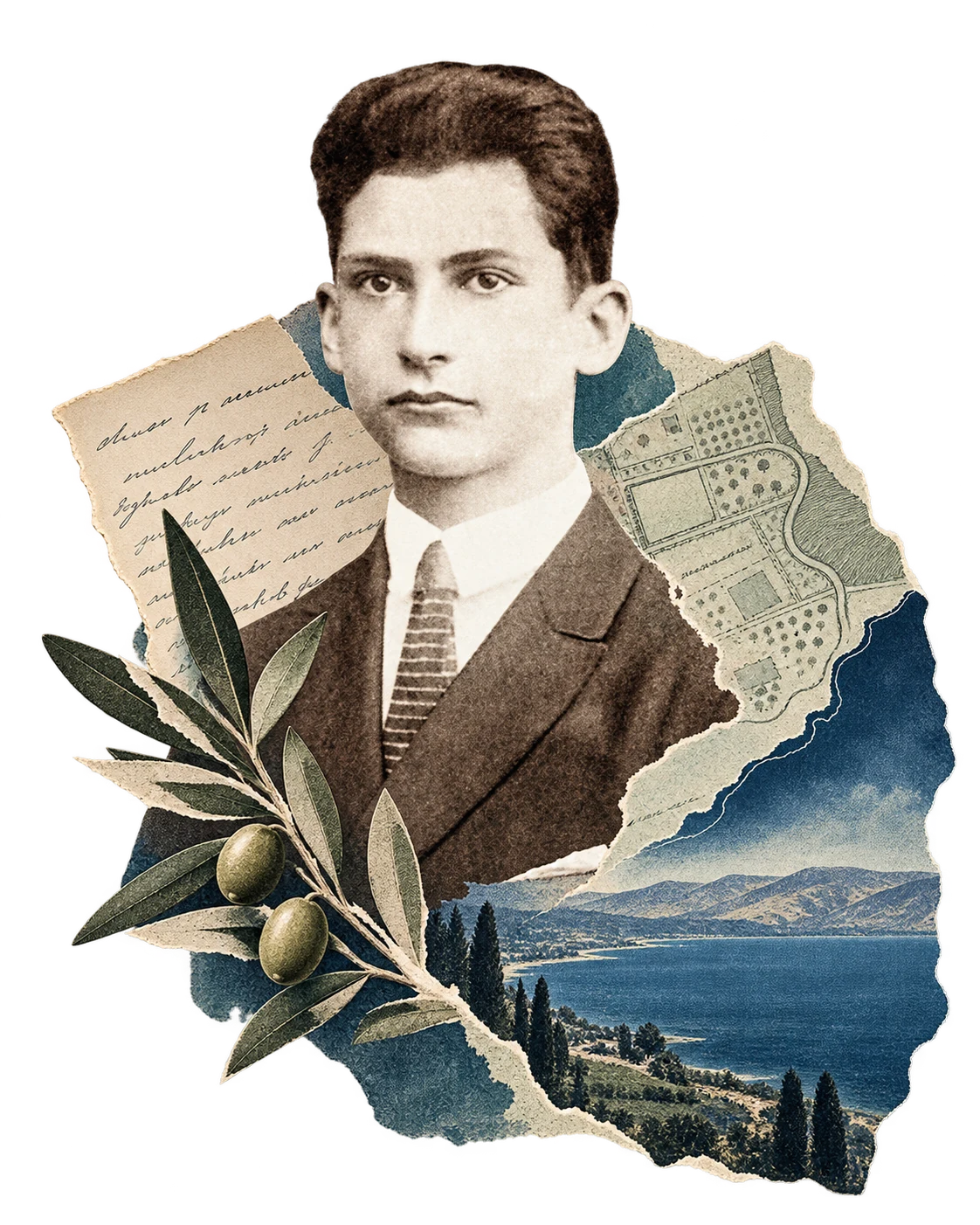
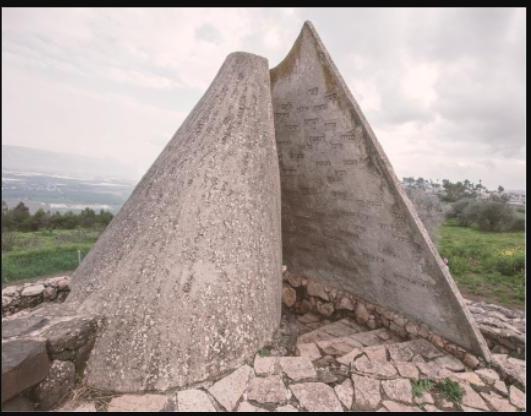
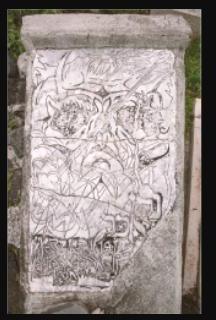
This is one of the strangest gravestones in the pantheon of the Second Aliyah - the Kinneret cemetery. The gravestone tells the tragic story of Ernest Pollak, a Zionist bourgeois who immigrated to the Land of Israel and discovered the vast gap between dream and reality.
The Zionist Transformation of Ernest Pollak
This is one of the strangest gravestones in the pantheon of the Second Aliyah - the Kinneret cemetery. The gravestone tells the tragic story of Ernest Pollak, a Zionist bourgeois who immigrated to the Land of Israel and discovered the vast gap between dream and reality.
He was neither Natan nor a farmer. He was born Ernest Pollak in the Austrian city of Salzburg in 1900. His father, Ludwig, a second-generation subject of the Austro-Hungarian Empire, was an assimilated Jew and a senior municipal official who dreamed that his son would become a doctor.
Ernest Pollak had no plans to fulfill his father's dream. Even as a child, he showed intellectual leanings, and spent most of his time reading Schopenhauer, Kant, Hegel, Marx, Nietzsche, and others. He was especially interested in bohemian circles and preached passionately about modesty, purity of body and soul, and abstinence from sex before marriage - until he met Dora Schwarz. Dora was an Austrian Jew, a strict vegetarian, a married mother of two boys (Hugo and Raphael), and an ardent Zionist active among Jewish youth. She organized a small group of young people, including Ernest, and introduced them to the central tenets of Zionism: rejecting life in the Diaspora, returning to work on the land, and immigrating to the Land of Israel.
Thus, within just a few months, when he was only 18, Ernest Pollak underwent a radical transformation - from an intellectual to a genius, from a bewildered eccentric to a zealous Zionist socialist, certain of his path and his future.
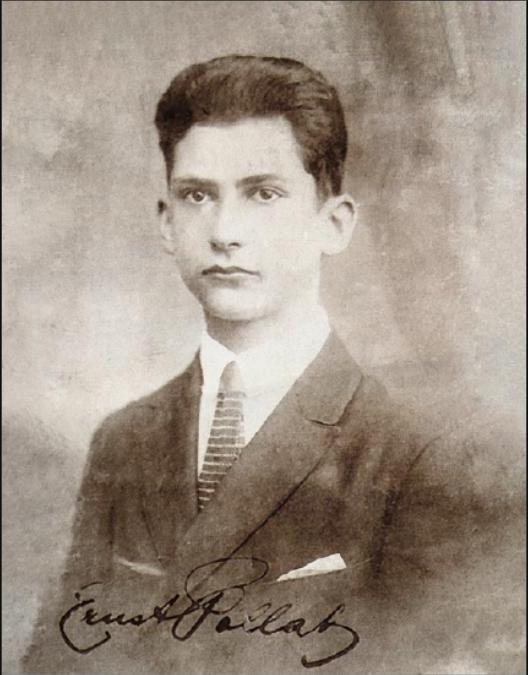
About a month before his matriculation exams, Ernest abandoned his studies, burned his books, and changed his name to "Natan the Farmer" - a name that expressed his dreams: to be broad-minded like the wise Nathan, and a farmer who worked his land, redeemed his soul, and remade himself in the image of the new human being created by working the land.
Ernest's father refused to sign the documents needed to issue his son's passport, and Ernest responded with a mysterious illness: "His temperature rose to a life-threatening level, and a strange rash spread over his body. The doctors, unable to find a clinical explanation for the illness, persuaded the father to grant his son's wish," wrote Dan Hamitzer, the grandson of Ernest's sister.
The Road to Beitanya
In 1920, the first members of the Third Aliyah arrived in the country - the first graduates of the Hashomer Hatzair movement. During their first months in the country, they lived in makeshift labor camps such as Umm al-Alaq and Beitanya Illit. Ernest set himself the goal of joining the group of young people who dreamed of establishing an agricultural farm on the slopes of the Poriya hills, overlooking the Sea of Galilee.
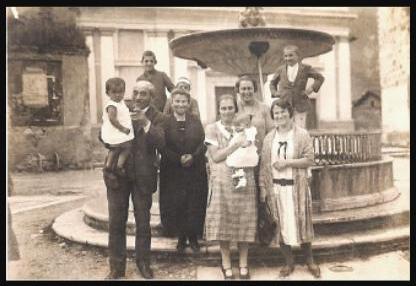
Once his passport was issued, Ernest-Natan recovered and set out for the country to join the group. On January 24, 1920, he arrived in Jaffa. Tel Aviv seemed to him the most beautiful place in the world, and he wrote to his parents: "Everything is in bloom, and the air is fragrant and intoxicating. The people!!! Everyone is wonderful. All you hear here is Hebrew. The children, the builders, even the bank employees - imagine that - speak Hebrew. I stayed in a wonderful hotel; the food is delicious but very expensive. Breakfast - 15 grush."
He went on to write: "I am filled with deep contempt when I think of the foolish bourgeois sitting around aimlessly in loathsome Europe... It makes me laugh, Father, when you mention things like matriculation and studies. You apparently don't understand where your son is or what he is here for... Nothing matters except agriculture... I have a good command of Hebrew and am beginning to take an interest in Arabic... But how I pity all of you, sitting there and living without knowing what for..."
After three days of inspection and monitoring by a government health official, Natan was sent by the labor office, at his request, to Beitanya Tahtit, which had been founded before the war. He later moved to Beitanya Illit. There, in a few tents, lived a group of Hashomer Hatzair members: 26 young men and women from Galicia, inexperienced, seeking to shape a new person in a new society - cleaner, more idealistic - in a new land. The Beitanya Illit group believed in self-fulfillment that could overcome the constraints of history and reality.
The group also included Meir Yaari, the oldest among them, nearing 24, and David (Dolek) Horowitz; the young Arie Allweil was their leader. "Yehudka Yaari sang. They put on plays. There were also painters and musicians, and they danced a lot." The group members planted olive trees on the mountain slopes, intoxicated by the writings of Freud and Nietzsche, and without any practical experience, shelter, clothing, or food. They championed uninhibited sexuality and political activism, and lived in the spirit of Eastern romanticism. The atmosphere in the camp was tense. The pressures were terrible. Individual lives were subjected to aggressive intrusions and demands bordering on voyeurism, all in the name of "togetherness."
The story of Beitanya Illit became a founding myth of the Hashomer Hatzair movement and was even dramatized in Yehoshua Sobol's play Night of the Twentieth.
In February of that year, Natan wrote to his parents: "Dear parents... Well, I am happy, happy! You cannot imagine how happy... Beitanya is enchanting. The settlement is near Kinneret, near Degania. Everything is full of palm trees and citrus groves. The mountains are all around us and the blue lake lies opposite. In the distance is snow-capped Mount Hermon, which is higher than the Alps... I have changed my name to Natan Ikar; please write to me using this name only. Yours, Ernest."
Ernest-Natan, his hands calloused from fieldwork, kept up a correspondence with his parents and his two sisters, Trude and Greta, and declared that he had found the right path in life: "I am floating in happiness: my health is good, my face has filled out, and the climate is doing me good."
He fell ill and was hospitalized in Safed: "The hospital is modern and clean. The doctors are wonderful, and I found books written in German. I have started reading again." He continued to preach zealously against any departure from the rigid line that had taken shape among the Beitanya workers: "Nothing matters except work and agriculture." When Natan recovered, he went looking for work in Rosh Pina, and did not return to the Jordan Valley because of the harsh conditions and malaria. "The happy farmer," Ernest, continued to fall ill, and with no home and no solution, the new path he had wanted to follow was blocked.
The Death of Natan Ikar
On December 3, 1920, a gunshot rang out in the middle of the night, sending the Beitanya guards running toward the northern fence of the farmyard. Natan Ikar's body lay there. Natan Ikar had taken his own life at the age of just 19. Beside his body lay the gun and fragments of sentences he had written:
"...Ever since I came to life, I have found it hard to bear the contradiction between desire and action... Only today, after years of indecision... do I feel strong enough to do it... You did not know and did not suspect anything, because I shut you out. I was hidden from you. Do not mourn. You should have mourned me while I was alive... Now I will be happy... Everyone betrayed the cause... They led me astray... I see no hope or justification for a world like this... Do not cry or torment yourselves over me; on the contrary, laugh... I was a victim of the corrupt forces of capital... There is no longer any place for love and purity... I see no point..."
Ernest Pollak was not buried under his original name, but under the name he had adopted when he immigrated to the country: "Natan Ikar." His gravestone was painted by Arie Allweil, a member of Beitanya Illit and later one of the founders of the Tel Aviv Museum.
Greta, Natan's sister, immigrated to the country and was the grandmother of the pilot, puzzle-maker, and artist Dan Hamitzer. In 1981, Dan Hamitzer investigated the affair and reached the far-reaching conclusion that the group had been nothing but a (satanic) cult led by Meir Yaari. Its members had strange fates: Dov shot himself in the head because of his love for Sarah; one went mad, and another became an extreme vegan. God appeared to one of them, who then went to study at a yeshiva in Mea Shearim, while his friend became a communist and moved to Russia.

תגובות
עדיין אין תגובות.