
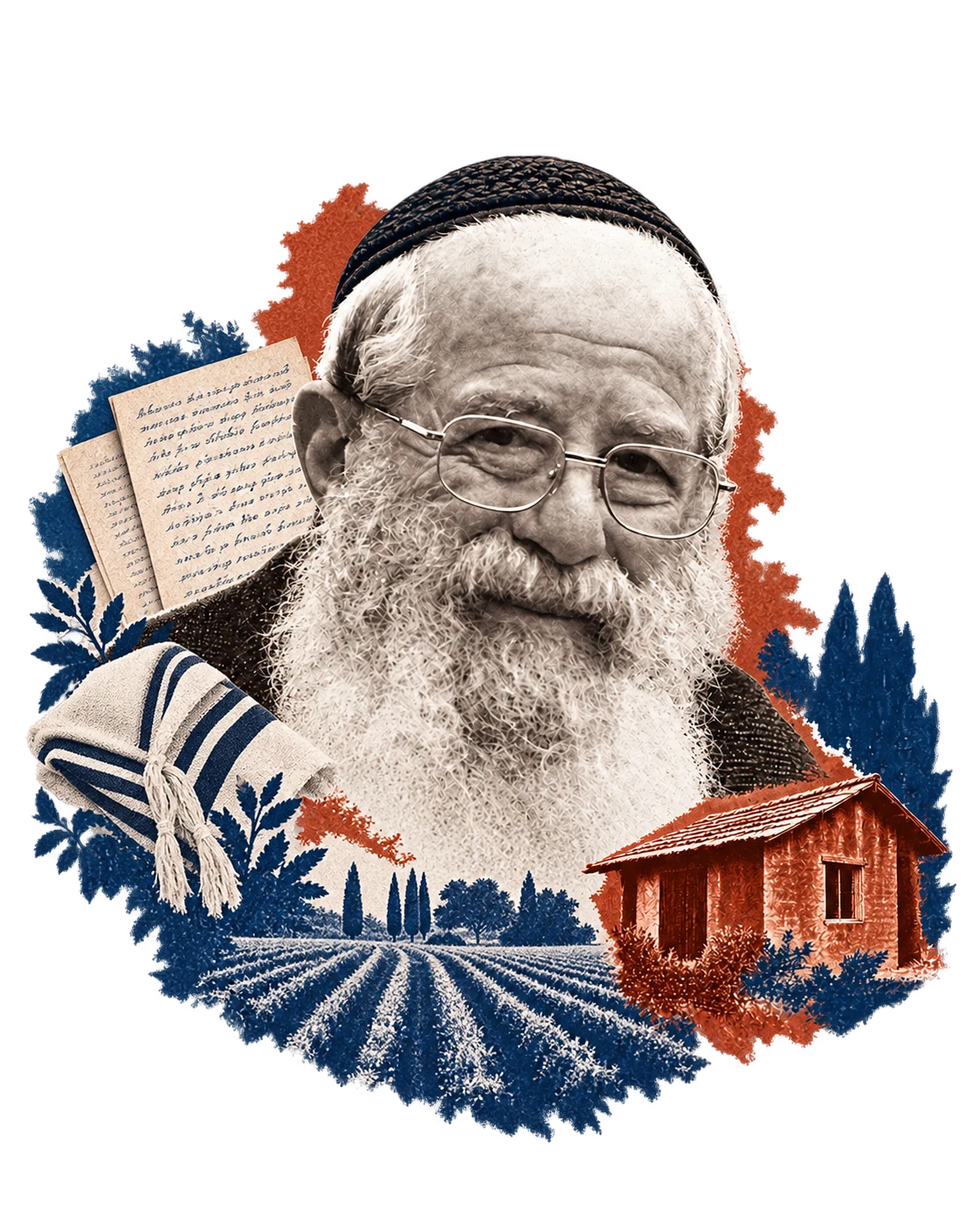
A Hasidic rebbe who wore both a shtreimel and a knitted kippah, a Hashomer Hatzair youth leader, and a historian who chose an unexpected path at the crossroads of his life.
Hasidic Roots and a Zionist Path
At the age of 18, Israel Friedman reached the first crossroads of his life. A year after receiving his rabbinical ordination, he joined Hashomer Hatzair, a Zionist-socialist youth movement known for its secularism. During his time in the movement, he drifted away from religion, became an ardent Zionist, and believed that Hashomer Hatzair could bring together Judaism, humanism, and Zionism. At the same time, the Communist storm was sweeping up Jewish youth in Romania, and this did not escape his notice. Ion Antonescu took power after King Carol II abdicated and left for Portugal. Israel's wisdom and kindness, and the admiration he inspired in the youth members, made him the head of the local branch. At the start of World War II, Romania was Hitler's ally, and Jews were condemned to hardship and deprivation; their agricultural property was nationalized. Israel was drafted into the pro-Nazi Romanian fascist army as a military chaplain with the rank of an officer. On the High Holy Days of 1942, he served as cantor for the Jewish soldiers in the Romanian army. He moved with his grandfather to Bucharest, where he took part in underground Zionist activity led by Israel Levanon, who was married to his cousin. It was there that Friedman first met his future wife, Tzipora.
Israel Friedman was born in 1923 in the Romanian town of Buhuși. From a young age, he had a private tutor, Rabbi Yaakov Mordechai, and studied languages and sciences with other private teachers. As a descendant of the Hasidic dynasties of the Great Maggid of Mezeritch and Rabbi Israel of Ruzhin, his future as the town's rebbe was a foregone conclusion. His maternal grandfather, Rabbi Menachem Mendel of Bohush, a rebbe renowned throughout Romania for performing miracles, was Israel's greatest hero. Though he lost his mother at the age of nine, he had a beautiful and happy childhood: "I remember my childhood as a magical time, with a garden and birds." As someone expected to lead the community one day, he was accustomed from a young age to caring for others and taking charge, as he later recalled: "Every birthday, they would bring me a newborn lamb as a charm for protection. I would raise it until my next birthday. On my birthday, they would take the lamb from me, by then a year-old sheep, slaughter it, and distribute its meat to the poor. I would be very sad, because I had grown attached to the lamb. But then they would bring me a new one."
Tzipora, his future wife, was born three years after Israel, in the city of Grosswardein (now Oradea), near the Hungarian border. She was the daughter of Rabbi Chaim Meir Hager, the fourth rebbe in the Vizhnitz Hasidic dynasty, known as the Imrei Chaim. At the age of 17, Tzipora was smuggled out of the ghetto: "The non-Jew who smuggled us out took us to a tavern, dumped us there, and ran off. We walked barefoot, like non-Jewish peasant women. But people saw our pale feet and started laughing - they saw through the disguise. There was a fear that they would turn us in, but in the end, by God's grace, we managed to get there. Father's Hasidim in the town of Arad received word that I had reached the Romanian border. They took me to Arad, and then to Bucharest." Tzipora did not see her family again until the end of the war.
In 1946, Israel and Tzipora immigrated to Israel, each by a different route. Israel came illegally on a ship carrying Jewish refugees, which was intercepted, and its passengers were taken to the Atlit detention camp. Tzipora's immigration was legal because her sister held citizenship under the British Mandate. Tzipora learned that Israel was being held at the Atlit detention camp, and when she visited him there, their love was rekindled. A few months after that meeting, they married in Nahalal, in a ceremony conducted by the moshav's Yemenite rabbi.
Toward the end of that year, Tzipora's father arrived in Israel and founded a yeshiva in Tel Aviv, headed by Tzipora's brother. When he met the newlyweds, he asked them to move to Bnei Brak and help him establish the Vizhnitz community in Israel. But the couple had other ideas, and their way of life did not accord with the father's wishes, leading to a rift between Tzipora and her father. Rabbi Chaim Meir Hager returned to Europe and gathered the children who had been entrusted to monasteries and farmers during World War II. He returned to Israel with three hundred children and established the Vizhnitz community in Bnei Brak.
From the Kibbutz to a Mission and a Doctorate
Israel Friedman reached the second crossroads as a married man. Israel and Tzipora joined the founders of Kibbutz Reshafim in the Beit She'an Valley, a Hashomer Hatzair kibbutz. In the valley's blazing sun, they struggled to sustain a settlement in the Land of Israel. During the War of Independence, Israel fought to defend the young settlement against Iraqi forces coming from Jordan. He worked in the cowshed and as a shepherd at Ein Harod, and volunteered to mentor Youth Aliyah groups. The couple served as the kibbutz's secretaries, and two of their children were born there. Their way of life at the kibbutz did not allow them to celebrate their son Menachem's bar mitzvah there (his full name was Menachem Mendel Moshe Leib, after Israel's two grandfathers), so the celebration was held at a yeshiva in Tel Aviv. Israel and Tzipora lived at Kibbutz Reshafim for 18 years.
In 1961, Tzipora learned that her father, Rabbi Chaim Meir Hager, was suffering from a brain hemorrhage and had been hospitalized. When she went to visit him after a long estrangement, and after her father had been disappointed by the path she had chosen, Tzipora decided to repair their relationship. She moved with two of her children to the Vizhnitz housing complex in Bnei Brak and cared for her father. The move from a secular kibbutz to an ultra-Orthodox city was difficult for her, but after about six months she found the right balance and decided to join the religious kibbutz Sa'ad. All this time, Israel remained in his educational role at Reshafim, and the family reunited on weekends at Kibbutz Sa'ad.
Israel Friedman's third crossroads came in 1964, when the family went to Marseille as emissaries for the Jewish Agency. In France, Israel changed his surname to Ben Shalom, in honor of his father. For years, Israel taught Judaism in Marseille, and before the Six-Day War, he organized demonstrations in support of Israel.
After the war, the family returned to Kibbutz Sa'ad. Israel, now Ben Shalom, was already 41 when he began studying history. At the age of 57, he submitted his doctoral dissertation on the House of Shammai. The dissertation was published as the book The House of Shammai and the Zealots' Struggle against Rome. "The innovation in this work is the discovery that the resistance movement against Roman rule, which culminated in the revolt that brought about the destruction of the Temple, emerged from the school of the House of Shammai," wrote Professor Aharon Oppenheimer. Israel thus added the title of doctor to his name. He later taught at Tel Aviv University, and then at Ben-Gurion University and Sapir College in Sderot.
Jerusalem, Leadership and Legacy
When Kibbutz Sa'ad was privatized, Israel understood that the time had come for the next change. He was already 81, but still full of energy and generosity. Thus he reached the fourth crossroads of his life. The Ben-Shaloms moved to Jerusalem, and for the first time since childhood, they lived in a city. There, they joined Beit Yisrael, an urban kibbutz made up of secular and religious members. Israel knew both communities well and knew how to speak their language. At the urban kibbutz, he became a rebbe - the Rebbe of Pashkan, named for the Romanian town where his grandfather founded a Hasidic community. He taught Hasidic thought and Gemara at the pre-military academy in Gilo and at the study hall established in the neighborhood by his son Hoshea and daughter Sarah'le. He later also taught at the social-action hesder yeshiva in Netivot, founded by his son Shmuel and headed by Shmuel together with Rabbi David Assoulin. Israel Ben Shalom was considered an unusual rebbe because his court included a mix of secular Jews, religious Zionists, and ultra-Orthodox Jews. "There is one thing common to everything I have done in my life," he once said. "I did it all with self-sacrifice."
Rabbi Israel Friedman Ben Shalom, a socialist Zionist and historian, died at the age of 93 on May 1, 2017, a symbolic date by any measure: International Workers' Day and Israel's Independence Day. At his request, no eulogies were delivered.
All of Israel and Tzipora's children - four sons and a daughter - followed in their parents' footsteps and became Zionists and social activists: Dr. Menachem Ben Shalom, author of Hasidim and Hasidism in the Second Temple and Mishnaic Periods, is a lecturer at Sapir College and the Achva Academic Campus. Brigadier General Hoshea Friedman Ben Shalom, who took the title of Rebbe of Pashkan after his father's death, served as Chief Reserve Officer, commander of the Carmeli Brigade, and head of the pre-military academy at the urban kibbutz Beit Yisrael. In 2011, on the country's 63rd anniversary, Hoshea lit a torch in recognition of his service as a combat soldier, brigade commander, and educator. Yirmiyahu Friedman Ben Shalom is one of the founders of the urban kibbutz Reshit. Shmuel Ben Shalom is a social activist in the development towns of the Negev. He founded the Yeruham hesder yeshiva in Netivot and girls' study programs. In 2006, on the country's 58th anniversary, he lit a torch in recognition of his work. Their only daughter, Sarah Apelbaum, is also active in public life and helped establish the study hall in Gilo.
תגובות
עדיין אין תגובות.