
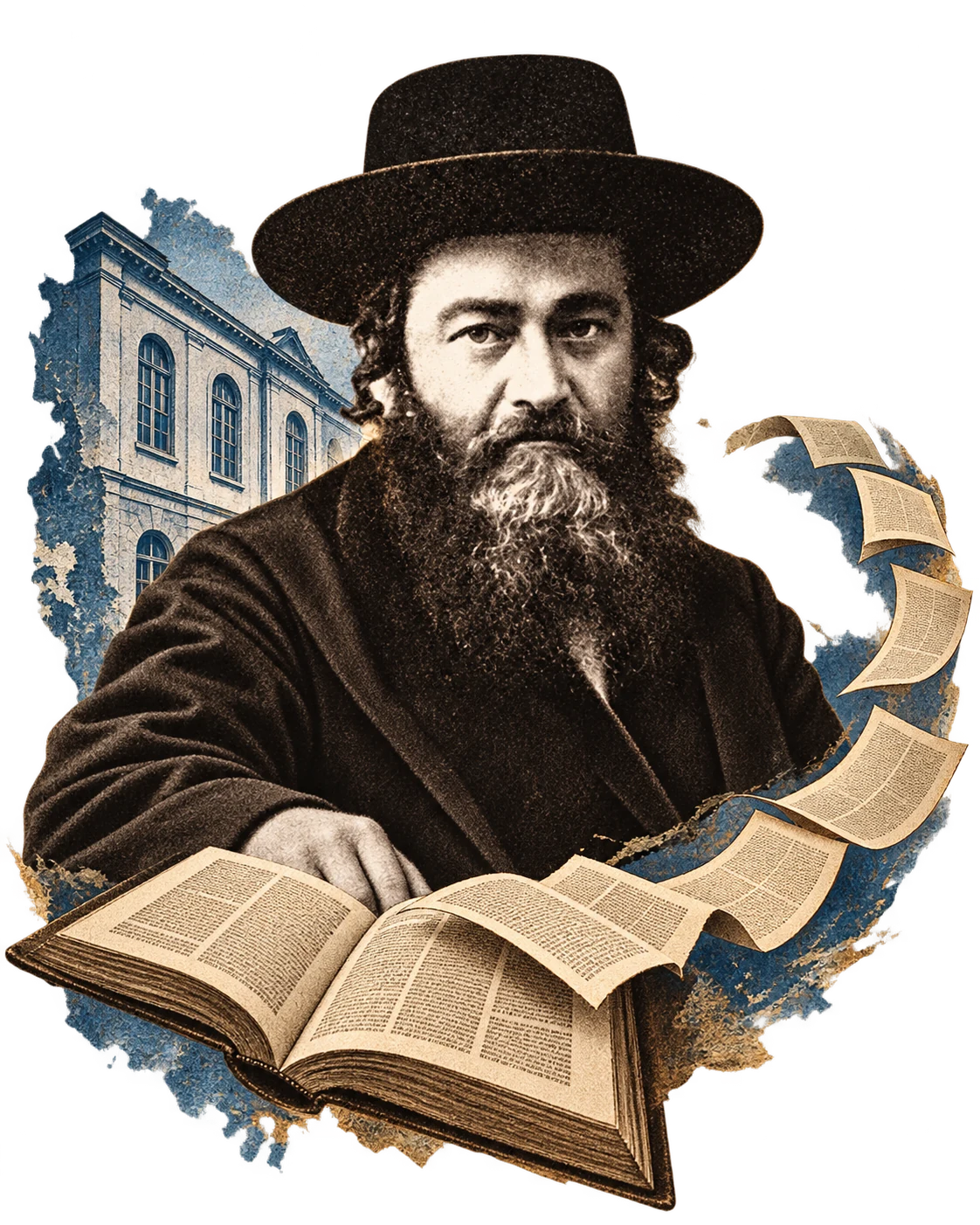
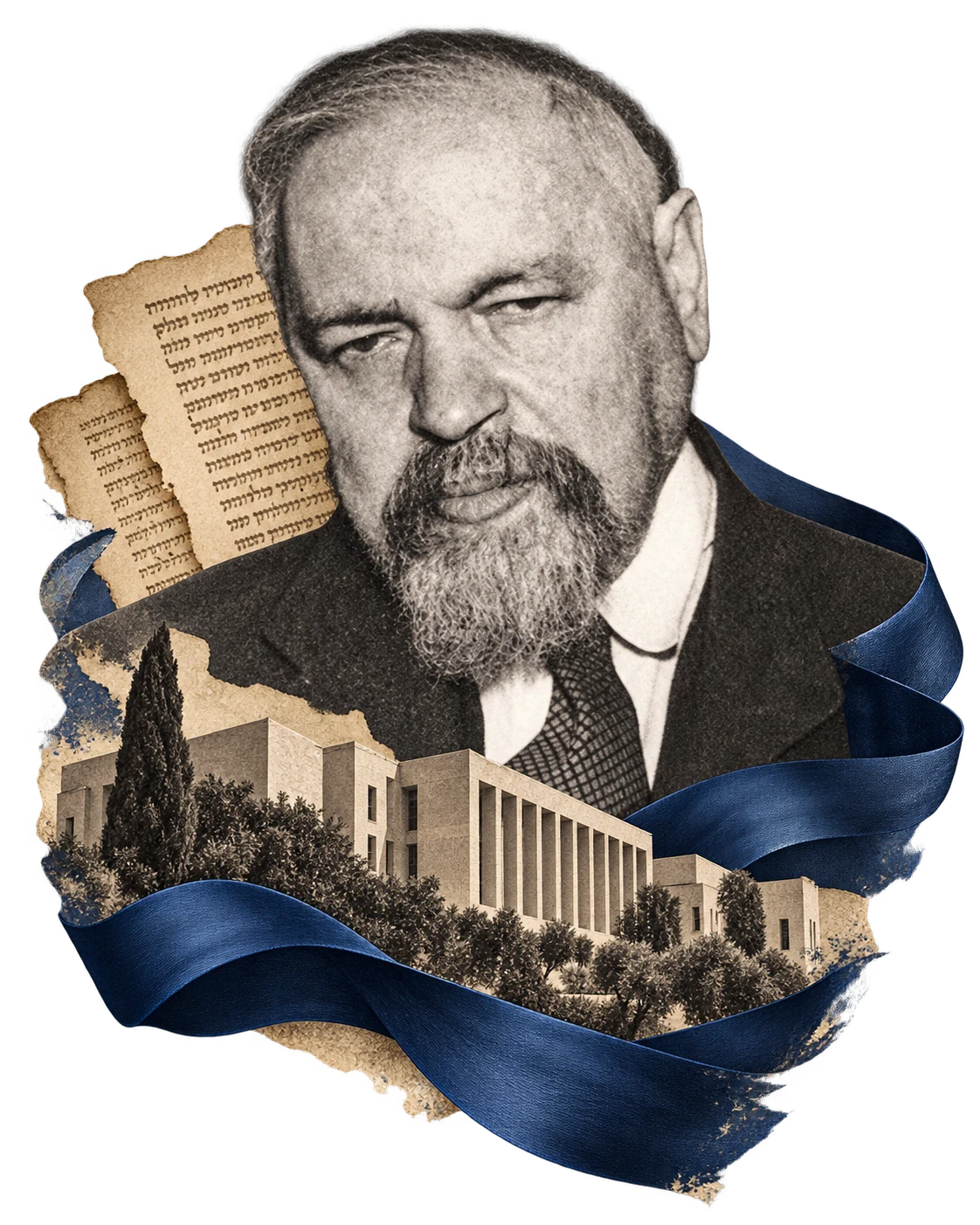
The "prince" of a distinguished rabbinical family. He was ordained as a rabbi at 15 and later represented Jews in the Polish parliament, but his influence was felt most strongly in the way yeshivas were run and through the Daf Yomi.
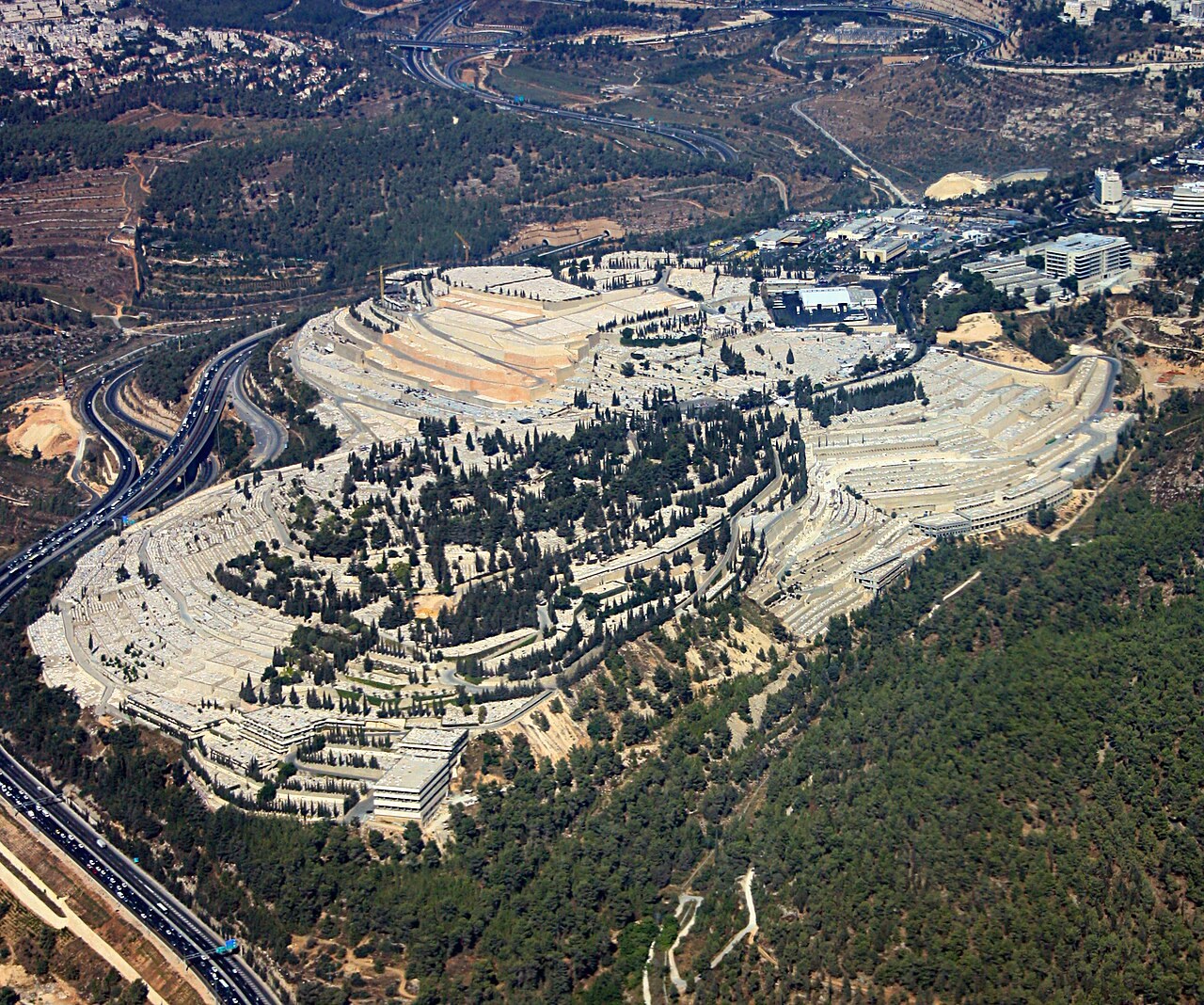
On a winter's day in 1958, a large, quiet, sorrowful procession set out from Bikur Cholim Hospital in Jerusalem. The sound of weeping accompanied the coffin along Jaffa Street and on to Har HaMenuchot. Dignitaries and leading Torah scholars delivered eulogies. It was the deceased's second burial. Twenty-five years earlier, he had been buried in Lublin, in a cemetery desecrated by the Nazis, where, by a miracle, his grave had remained untouched. On the tenth anniversary of the State of Israel, Rabbi Meir Shapira's brothers exhumed his remains and buried him again at Har HaMenuchot.
Rabbi Meir Shapira was an unusual figure in the Haredi community. He brought new, revolutionary ideas to a society that rejected every innovation. His approach to issues that had troubled Torah-observant Jews throughout the generations led him to devise original solutions. For centuries, Torah scholars had studied in modest little rooms. When they heard of a renowned rabbi in a particular city, they would travel there and join his class. The students were responsible for their own food and lodging. To support themselves, they took jobs that barely provided enough to eat and often came with humiliating treatment. The most common job was guarding shops at night. They slept in the shop and watched over it, then in the morning were searched to make sure they had stolen nothing. From the shop they went straight to the study hall, and when night fell, they returned to work at the shop. This situation went on for years, until Rabbi Shapira came up with the idea that a yeshiva should provide for all its students' needs, regardless of their financial circumstances, so they could devote their time to study. The first yeshiva to adopt this idea was the Chachmei Lublin Yeshiva, which Rabbi Shapira founded in his city. The same model had been in use at the University of Oxford since 1167, but this privilege was granted only to students of distinguished lineage and means.
Daf Yomi
The second innovation associated with Rabbi Shapira, and the best known, is the Daf Yomi: "A Jew is traveling, a tractate of Berakhot tucked under his arm. He travels for two weeks from Israel to the United States... At last, when he sets foot on American soil, he enters a study hall and finds Jews studying the very page he studied that day, and joyfully joins them."
The idea of the Daf Yomi rests on several important principles. First, in every place around the world, everyone would study the same page on the same day. That way, any Jew, anywhere in the world, could enter a study hall and find a study partner for that page. The second principle enabled all Jews to study every page of the Talmud (the six orders - 2,711 pages in all) every seven and a half years. The first cycle began on Rosh Hashanah in the year 5684 - until then, some tractates had not been studied at all. The Daf Yomi did those tractates a kindness and restored their standing. The third and most important principle was to create an uninterrupted routine of daily study.
Many fascinating stories have become associated with the idea of the Daf Yomi. One of them tells that when Rabbi Shapira was a child, he had no teacher suited to his abilities. When his parents found a suitable teacher, he was supposed to arrive by train the next day. "I was a little boy," the rabbi later recalled, "and I stood on the platform with my mother. We waited a long time for the train. At last, we heard the clatter of its wheels, and the locomotive arrived with a loud whistle, pulling the carriages behind it. We stood there, impatient to see the man, but to our great disappointment we saw merchants, clerks, ordinary folk, and, of course, many non-Jews. But when my mother asked around among the passengers, she learned that the teacher had not come. My mother was terribly disappointed and said to me sadly, with a heavy sigh, 'Meir'le, what a shame. We are going home empty-handed. Your teacher hasn't come.' 'It's all right, Mother,' I comforted her. 'There must have been some mistake, and he'll come tomorrow.' 'Nein, mein Kind' (No, my child), my mother cried from the depths of her aching heart, 'do you know what one day without Torah means?!' 'From then on,' Rabbi Meir Shapira recounted, 'that sentence sank into my consciousness: "One day without Torah?!" The idea was engraved in me from an early age: Torah must be studied every day.'"
Another story relates that when no teacher suited to his talents could be found, his father approached the town's rabbi, Rabbi Shalom Moskowitz, the Rebbe of Shotz, and asked him to take on the task. He agreed to take the boy under his wing and teach him alongside his own sons, who were older than him. Young Meir shared with the rabbi's sons his dream that one day all the Jewish people would study the same page of Gemara, giving Jews throughout the diaspora a shared language. The rabbi's sons responded dismissively: "Dreams are just empty talk. No one has managed it until now, so how do you think you will succeed?!" From time to time, Meir would grow excited about his dream all over again, and the boys would brush it aside and dampen his enthusiasm. Years passed, and the dream became reality. One day, a rabbi approached Rabbi Shapira at a train station and told him that he was married to the daughter of the Rebbe of Shotz, and that she congratulated him on his great success in spreading Torah. The rabbi, who remembered her from childhood, asked to meet her. At their meeting, he said to her: "Do you remember when we were little children, and I spoke to you and your brothers about my dream of the Daf Yomi, and you would dismiss what I said and dampen my enthusiasm? I don't hold it against you, because at the time we were only little children. But I have one request of you: you are an educator, entrusted with the education of the children of Israel. Remember: never belittle a child's dream! If I had been like everyone else, and broken when people mocked me, do you know what the Jewish people would have lost?! Can you imagine the Jewish people without the Daf Yomi? So I ask you from the bottom of my heart: never mock a child's dream. A Jewish child can go far if he has a dream..."
The idea of the Daf Yomi was first proposed at a conference of Agudath Israel held in August 1923. At first, there were people who opposed the idea, as well as those who doubted Rabbi Shapira's ability to realize his vision: "Do you really imagine that a Yekke from Frankfurt and a Ger Hasid from Warsaw, a Jew from Casablanca and a Jewish merchant from New York will all study the same page of Gemara?" they challenged him. "Indeed they will," Rabbi Meir replied. "Look at the page of Gemara: the Talmud was written in Babylonia; beside it is printed Rashi's commentary, by a son of Ashkenaz-Germany; next to it is the commentary of the French Tosafists; below it is the commentary of Rabbeinu Chananel from North Africa; and in the margins are references to Maimonides, a son of Egypt... If all of them, despite their disagreements, were able to join together to create the wondrous work that is the Talmud, we too can do the same."
Only after Rabbi Shapira received widespread support from Rabbi Yisrael Meir Kagan (the Chofetz Chaim), Rabbi Avraham Mordechai Alter (the Rebbe of Ger), and later from Breslov Hasidim, with the support of Rabbi Ben Zion Apter, did the Daf Yomi become part of the religious community's obligations. The study cycle began anew every Rosh Hashanah.
His Childhood and Early Path
Rabbi Yehuda Meir Shapira was born on the seventh of Adar (the day of Moses' birth and death) in 1887 in northern Romania, into a long and illustrious line of rabbis. His father was Rabbi Yaakov Shimshon Shapira, and his mother was Margala, daughter of Rabbi Shmuel Yitzchak Schor, one of the leading rabbis of Galicia. The young Meir had time to study Torah with him. His family lineage goes back to Rabbi Moshe of Speyer (from whom the family name was derived). Rabbi Meir received rabbinic ordination from his grandfather at the age of 15. When he grew up, he married Malka Toiva, daughter of Rabbi Yaakov David Breitman. After their wedding, the couple moved to Galicia, where Rabbi Meir founded the Tiferet HaDat association, which was responsible for addressing religious issues in the city where he studied.
By the age of 23, Rabbi Shapira was already the rabbi of the community of Liniany in Ukraine. As soon as he took up the position, he arranged for repairs to the mikveh and improvements to Sabbath observance, but he saw education as his main responsibility. In place of the shack that had housed the cheder, Rabbi Shapira built a magnificent building where students studied Torah alongside a trade, and he turned his home into a yeshiva for select students destined to become teachers. By then, his reputation had spread, and he received many requests from different communities to come and serve as their rabbi. Rabbi Shapira chose to accept the offer of the rabbinate in Sanok, a large city in central Galicia, because he knew that the local community's spiritual condition was in danger. In Sanok he made changes to kashrut practices and, as in Liniany, improved the mikvaot and Sabbath observance. He also built a Talmud Torah called Bnei Torah, where some 250 children studied.
His energetic work and radiant personality made him one of the leading figures of the time, so it is no surprise that he volunteered to represent all the Jews of Poland. In 1922, Rabbi Shapira was elected as an Agudath Israel representative to the lower house of the Polish parliament, which had the authority to pass laws. For five years, he worked to protect the community's interests. At the same time, he served on a committee in the Ministry of Religious Affairs that approved rabbinical appointments across Poland. Two years later, he began establishing the Lublin Yeshiva.
The founding of the yeshiva also met with quite a few opponents, for various reasons. The first was the innovation itself, which ran directly counter to Hasidism, one of whose principles was "anything new is forbidden by the Torah." Rabbi Meir Shapira's yeshiva was a major breakthrough: a yeshiva that not only taught its students but also provided for all their needs. The second reason was financial. Many wealthy Jews supported the Lublin Yeshiva, diverting donations from other yeshivas, which did everything they could to thwart its establishment.
Yeshivat Chachmei Lublin
The establishment of the yeshiva in Lublin began in 1924, when Rabbi Shapira was appointed rabbi of Piotrków, Poland. During one of his visits to Lublin, he noticed an empty lot at 57 Lubartowska Street. He tracked down the owner, Rabbi Shmuel Eichenbaum, and shared his dream of founding a yeshiva and restoring the former glory of the Chachmei Lublin Yeshiva (first established in 1515). Rabbi Shmuel was enthusiastic about the idea and gave him the land as a gift. That same year, on the eve of Lag BaOmer, the cornerstone was laid in an impressive ceremony. Rabbi Shapira traveled to the United States to raise funds for the yeshiva's construction, then visited several communities in Poland and Lithuania to develop the curriculum - a new curriculum suited to the yeshiva's novel character, unlike anything that had come before. It took Rabbi Meir seven years to complete the fundraising and construction, and in the summer of 1930 the building was inaugurated in an impressive ceremony attended by some 20,000 Jews from Poland and beyond. When construction was complete, the rabbi moved to Lublin, and his cousin, Rabbi Moshe Chaim Lau (who later perished in the Holocaust), took his place as rabbi of Piotrków.
The Lublin Yeshiva admitted students from the age of 15 until they married, and offered two levels of qualification. Students who studied Yoreh De'ah received a Yoreh Yoreh certificate, while those who completed the entire program received the title Tzurva MeRabbanan. Admission exams were demanding. Among other things, applicants had to know a large number of tractates, totaling more than 400 pages of Gemara. They were also required to be proficient in the books of the Mishnah and the laws of the Shulchan Aruch. A student admitted to the yeshiva received rabbinic ordination within four years. Ordination was traditionally granted on the seventh of Adar, the birthday of Moses and also of Rabbi Meir Shapira. The yeshiva attracted the very best students. Each class had 400 students, and it produced a long list of well-known rabbinical graduates. It was the most magnificent yeshiva in Poland and took pride in its rich Torah library of some 22,000 books. Maintaining it required a great deal of money, and Rabbi Meir Shapira devoted much of his time to raising it. The first class of students graduated from the yeshiva in 1934, but the rabbi did not live to see it.
The yeshiva stood for nine years, at the end of which, to everyone's grief and sorrow, it was set ablaze.
"It was a source of pride for us to destroy this Talmudic academy, which was known as the largest in Poland. We threw all the Jews' holy books outside and set them on fire. The flames raged for a full twenty hours. The Jews of Lublin stood around and wept, but a military band was brought in, and the cheerful notes of military music drowned out the Jews' wailing." This is how the Nazi German youth newspaper Deutsche Jugendzeitung described the yeshiva's bitter end.
In 2004, the building was returned to the Jewish community. Over the next three years, it was renovated and restored, and turned into a Jewish hospitality center. Today, thousands of Israeli teenagers visit the site after touring the Majdanek extermination camp, as part of the Journey of Life program run by Israeli high schools.
The Last Dream and the Legacy
His longing to immigrate to the Land of Israel was his second dream. Asked why he had not fulfilled it, he replied: "I have the strength to go to the Land of Israel, but where does one find the strength to leave the Land of Israel?!" After the yeshiva was established, he decided to immigrate to the Land of Israel and began making preparations, but his sudden death cut that dream short. In October 1933, while negotiating with the Lodz community to become its chief rabbi in return for covering the yeshiva's debts, he died of typhus at the age of 46. Rabbi Meir Shapira and his wife had no children, but he always said that the Daf Yomi and the Lublin Yeshiva were his two children.
At the end of the war, these "children" enjoyed a renewed flourishing. The Chachmei Lublin Yeshiva was established again in the Zikhron Meir neighborhood of Bnei Brak, named in his honor, and the Daf Yomi is now studied by tens of thousands of Jews around the world. A square in Jerusalem was named after him, as were streets in various cities. There are also streets named after his life's work, bearing the name "Daf Yomi."
It is worth mentioning that another talent with which Rabbi Meir Shapira was blessed was music. He composed quite a few melodies, some known within the Haredi community and others beyond it. The most famous is "Utzu Eitzah." Rachel'eh Likvernik, Rabbi Shapira's sister, is the grandmother of singer-songwriter Shlomo Artzi.
תגובות
עדיין אין תגובות.