
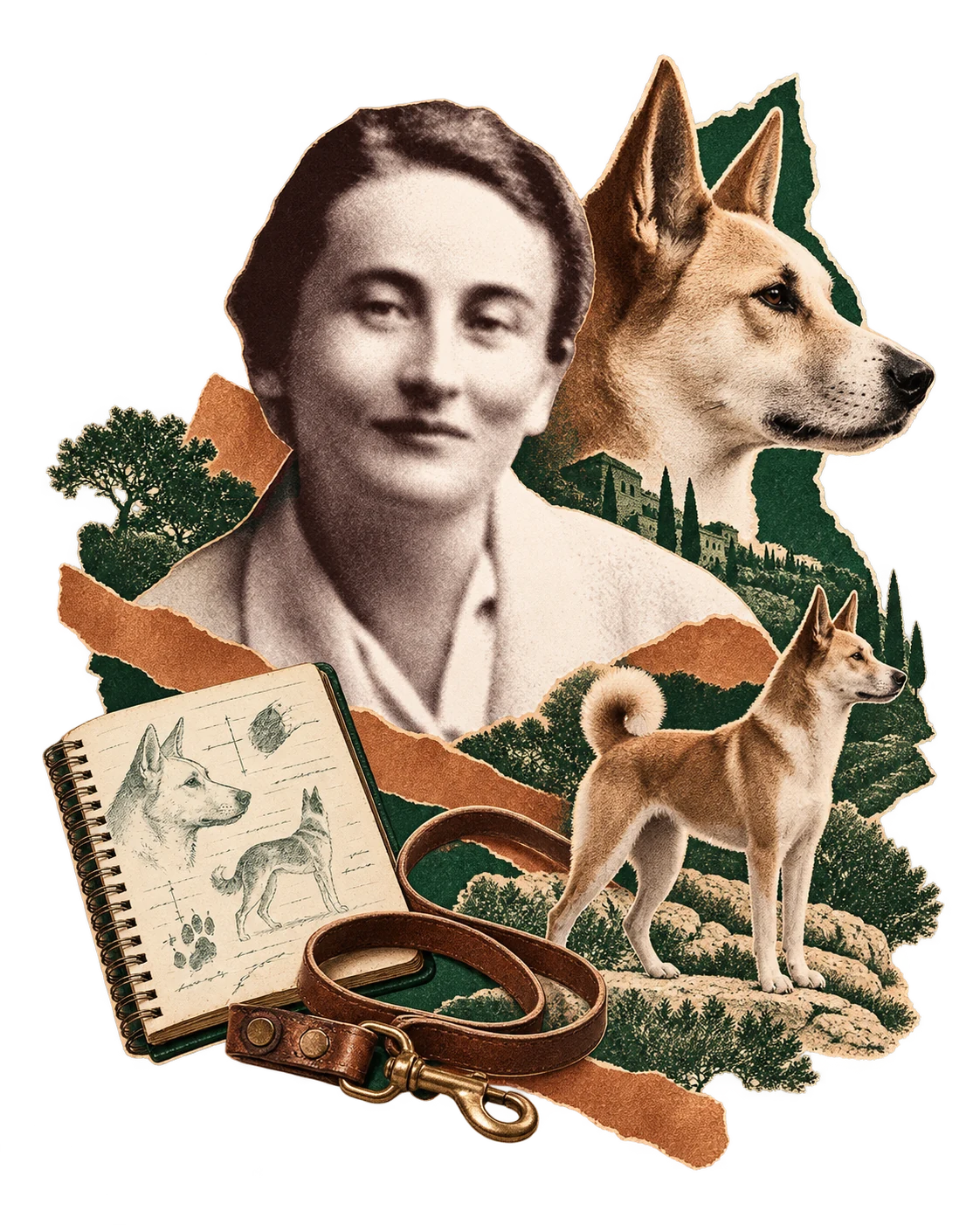
Hitler, despite knowing she was Jewish, sent a car to collect her - not to take her to an extermination camp, but to enlist her help for the Nazi army. She was also the one who defined Israel's national dog breed.
Escape from the Nazis
When Germany invaded Austria in 1938, the Menzels were summoned on Hitler’s orders. "One Friday, when the day was short, Hitler's armies arrived in Austria, and that very morning an order came from Hitler to bring my husband and me in a luxurious car to one of the German army camps. The order was accompanied by a document stating that we would be given a hut where officers lived, equipped with every possible comfort, so that we could conduct research on dogs for the German army," Rudolfina wrote. Fortunately, they received help from a family friend who was the SS officer in the city of Linz: "He helped us escape and cross the border, and watched us until he was sure we were out of danger." Rudolfina and her husband immigrated to the Land of Israel with several Boxer dogs. Years later, she wrote to a friend: "Even today, it is hard to understand how the Nazis managed to control the German people. Later, once the regime had become established, fear probably prevented resistance. But how could educated intellectuals fall victim to this mad Führer? Only animal psychology can provide an answer."
The famous couple are also mentioned in Leah Goldberg's book My Friends from Arnon Street, which tells the story of Sheda, a dog sent from Austria to one of the farms in the Hefer Valley along with other guard dogs. "There in Vienna, there was a couple who bred and trained guard dogs and police dogs for the Land of Israel. Since the dogs were intended for this purpose, their trainers spoke to them only in Hebrew. Some of those dogs never made it to the Land of Israel, because the Vienna police coveted them and bought them from their owners. But since those dogs understood only Hebrew, the Austrian policemen had to learn all the Hebrew commands so the dogs would understand them. Those policemen had no choice, even though many of them were Nazis and hated Jews. And so Sheda's relatives spread Hebrew culture abroad." A German newspaper wrote that "the Zionist researcher couple are indirectly and deliberately forcing Germans to speak Hebrew." A few years before her death, Rudolfina spoke about that period: "During the Second World War, I suffered greatly from knowing that my students in Austria and Germany were using the knowledge they had gained from me to use dogs to exterminate members of my own people and of other peoples."
Childhood and Studies in Vienna
Rudolfina was born in Vienna in 1891 to a well-to-do Jewish family. When she was four, she was bitten by a puppy. "Other children would have developed an aversion to dogs and a lasting fear of them. I developed an attachment to dogs and a fondness for them," she recalled, and from then on she fell in love with dogs. Her parents "would not allow these dirty, filthy creatures to bring mud in from the street and onto the expensive carpets in the apartment," so she used her pocket money to pay neighbors who agreed to let the dogs she had collected from the street into their homes. She studied at the University of Vienna, where she earned doctorates in psychology, biology, and biochemistry. She was also active in the Zionist movement through the Herzl Zionist Students' Association. At 24, she worked as a psychologist and married the man she loved, Rudolf Menzel, an internist. The couple moved into a grand villa in Linz, a city Hitler planned to turn into the cultural center of the Third Reich and to build the Führer Museum in its center.
Rudolfina's true love was dogs. In the 1920s, the couple founded the first school of its kind in their home, training dogs for attack, defense, guarding, and tracking, and put Rudolfina's knowledge of psychology to use in their research. "Since our youth, we have made friends with many animals. Our friendship was not expressed through cuddles and pampering. A pet is not a friend, but a kind of living doll. Friendship means living together, working together, and understanding one another... Our first friends were, of course, dogs. Friendship with a dog is the shortest and easiest way for someone who wants to approach the animal world beyond their own species." The couple wrote these words in their book On Dogs, Cats, and Other Friends. The Menzels' research and training manuals were translated into many languages and earned them an international reputation as experts.
In the Jewish community where they lived, the couple were regarded as odd: "My wife and I were considered 'freaks' by members of the (Jewish) community in Linz because of our way of life and our work, which they saw as very strange and exotic." Jews abroad were afraid of dogs: "Most of us are city dwellers, and our grandparents were city dwellers too. In our veins runs the blood of many generations who spent their entire lives amid the suffocation of cities, and of many generations before them who never left the alleys of the ghetto. They were far removed from the land and from animals. Every animal was strange to them, and strangest of all was the dog. The dog belonged to the world of the gentiles, of the nations of the world. It served as a companion and helper to the persecutors and oppressors. At the landowner's command, it would attack and drive away the Jewish peddler. The dog was a companion to the rulers who held the fate of the Jews in their hands, for good or ill." The Menzels saw themselves as the new Jew, someone who was not only unafraid of dogs but harnessed them to serve his needs, and, beyond that, carried out a Zionist mission. In 1927, Vienna's Chief Rabbi, Zvi Peretz Chajes (after whom several streets in Israel are named), visited them and was impressed by their work. He was astonished to see that the dogs had been trained to respond to commands in Hebrew: "Sit," "Come," "Attack," "Stay," "Down," and others. To him, this was not merely a symbol of the revival of the Hebrew language, but of Hebrew reaching even the mouths of dogs.
Training Dogs in the Land
As early as the 1920s, Rudolfina made contact with leaders of the Jewish community in the Land of Israel. She described how dogs could help guard the settlements and offered to help train them. In 1932, she received a letter from Yitzhak Ben-Zvi, then chairman of the National Council, inviting her to immigrate to the Land of Israel and train the dogs herself. Two years later, at the invitation of Yaakov Pat, one of the Haganah commanders, she came to the country for the first time, going straight to Kibbutz Yagur, where she held her first training course for guard dogs. Later, she ran similar courses in Tel Mond, Na'an, Merhavia, and Degania. Throughout this period, Rudolfina turned down a prestigious invitation from the Pavlov Institute in the Soviet Union (named after Nobel Prize-winning scientist Ivan Pavlov, who studied and developed classical, or Pavlovian, conditioning).
In 1938, Rudolfina and Rudolf Menzel immigrated to the Land of Israel and joined the Haganah. They organized a course in training dogs for guarding and defense at Ramat Yohanan, and later moved to Kiryat Motzkin, where Rudolfina founded the Institute for the Study and Training of Dogs. The Haganah's canine unit also operated at her dog school. After the establishment of the state, it became part of the IDF, and today it is called Oketz. Writing about the contribution dogs make to security services, Rudolfina said: "Not many people know or appreciate the great value of a dog in a modern army... Few know that one guard dog can take the place of four soldiers on guard duty. In addition, a good guard dog is better than a person, because trained commandos can approach a soldier at his post until they are right under his nose and overpower him, while a dog will detect any stranger approaching from far away... We know of cases in which an enemy ambushed a reconnaissance squad and opened fire from just a few meters away. If a trained patrol dog had accompanied such a squad, it would have alerted them to the ambush in time, and many casualties could have been avoided."
She worked to develop breeds for different purposes and was the one who defined the Canaan Dog breed, which was recognized by the Israel Kennel Club and has since been considered Israel's national breed. The Canaan Dog was later also recognized by the Fédération Cynologique Internationale.
Rudolfina Menzel also encouraged others to adopt dogs and enlist them in pioneering work. She reached out to members through the kibbutz movement's newspaper, writing: "Here in the Land of Israel, our people have found their way back to the land, and the time has come for us to return to the dog as well. Here, working with dogs is pioneering work in the fullest sense of the word, and so we appeal to you, the rising generation. Help us reclaim the dog for our people... Anyone who has not yet overcome the ghetto fear of dogs is not a new Jew, even if he was born in this country. Our call is addressed to the new Jew. Our call is addressed to you. Make way for a new kind of pioneering, for reclaiming the dog in the service of building our country."
War Dogs and Guide Dogs
During the Second World War, Moshe Sharett approached the Menzel couple and asked them to train many dogs for the war effort of the Allied armies overseas. Some of the dogs she trained served in the British Army, in His Majesty's Service. The following obituary for one of them appeared in the British Middle East Command's monthly journal: "Simi, veteran war dog and terror of Middle Eastern thieves, is no more. Death came suddenly, when he was only four years old. During his two years of service, he was responsible for 83 arrests. Six of those arrested died of the wounds he inflicted. Simi was so enthusiastic that it sometimes took him two or three days to recover after an operation. He was a large-looking dog - at his heaviest, he weighed 39 kg - but his heart was immeasurably larger. We share, from the bottom of our hearts, the grief of Gura, his mate... Signed: Commander of the War Dog Training Institute, Middle East." Simi was born at Kvutzat Kinneret and named Amit. He was trained by Rudolfina, who made it a condition that the dogs she trained would never be used to attack Jews. "I must say they kept their promise," Rudolfina recalled.
After the war ended, the couple also began training guide dogs for the blind. The first dog they trained was disabled himself: a Boxer who had been seriously wounded in the leg at one of the outposts. "She was a wonderful, extraordinary woman, a ball of energy. She spoke quickly and worried about and took care of everything," recalled Mrs. Julius, a resident of Kiryat Motzkin who helped the couple. "She loved the dogs dearly and could talk about them for days on end. The dogs were her whole life. She and her husband had no children or relatives here - only each other and the dogs. Since their names were so similar, Rudolf and Rudolfina, she called him Rudy and he called her Dolfi."
Those were happy days for them. "We managed to fulfill our childhood dreams in our own lifetimes," Rudolfina wrote. "We managed to emerge from grief and disgrace and become a new, healthy, stable people. In everything living around us - young people, orchards, and settlements - there is a part of our work... Nothing more could be asked for."
Alongside her work at the institute, Professor Rudolfina Menzel taught animal psychology at Tel Aviv University in the 1960s and became the first woman to hold a professorship at that university. She held three Ph.D. degrees, in psychology, biology, and biochemistry. In 1966, her name was entered in the Jewish National Fund's Golden Book in recognition of her significant contribution to the Zionist movement. Rudolfina died in 1973 at the age of 82. Her husband Rudolf, who was the doctor for the oil refineries, died shortly before her.

תגובות
עדיין אין תגובות.