
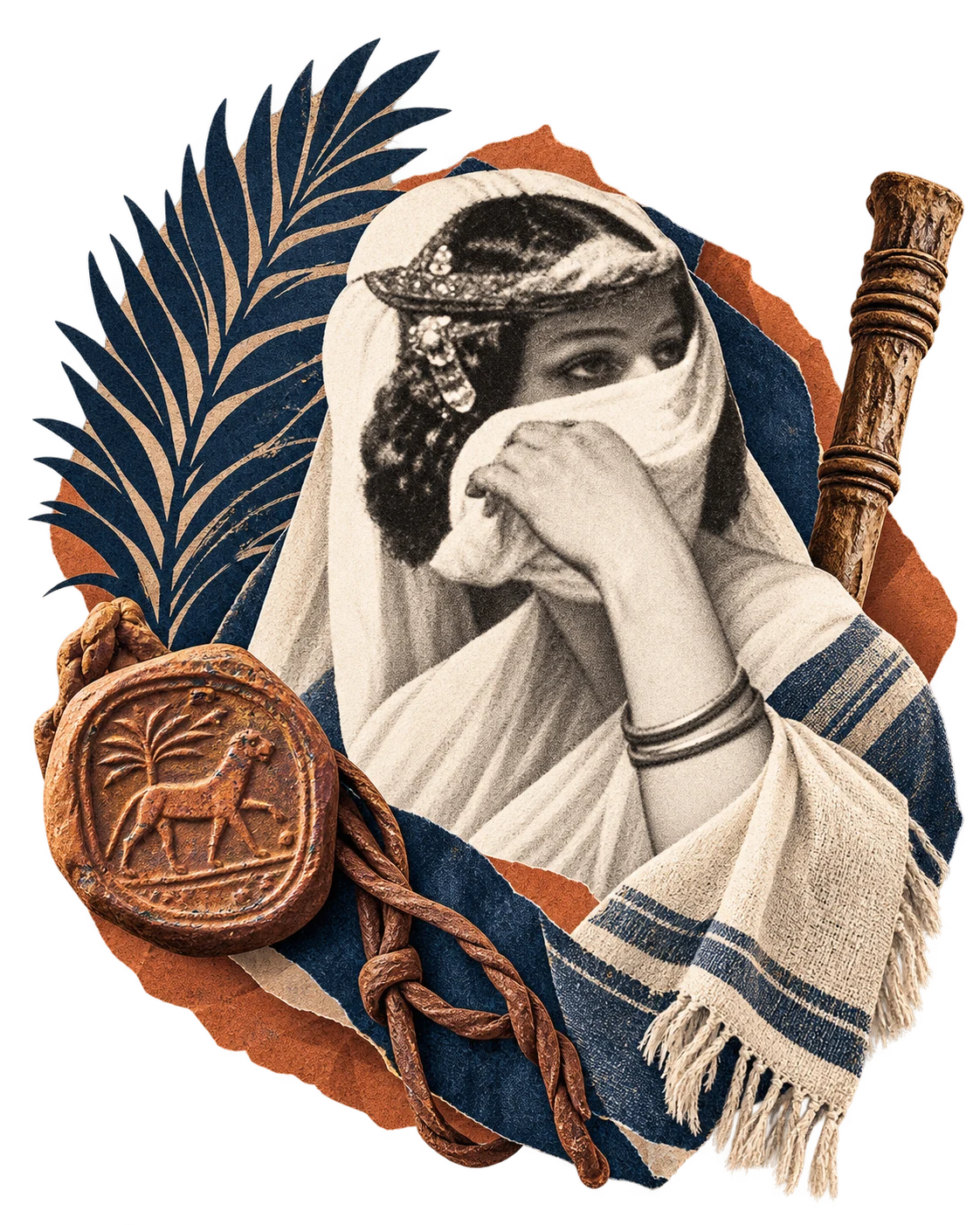
It seems that, in the distant past, women named Tamar shared a common thread: they turned the heads of men who could not control their urges, sinned, transgressed serious prohibitions, and even risked their lives. This time, a world tour through the name.
Tamar
Tamar and Judah
A woman named Tamar is mentioned for the first time in the Book of Genesis, chapter 38, verse 10. The story opens with the sentence: 'And Judah took a wife for Er his firstborn, and her name was Tamar.' Judah had three sons: Er, Onan, and Shelah. Er, Judah's firstborn, married Tamar, but sinned against the Lord and died. According to the law of levirate marriage, the dead man's brother was to marry the widow and have children to preserve the dead man's line. Unfortunately, Onan spilled his seed on the ground (hence the verb 'to masturbate'), a grave sin for which Onan died.
Tamar was sent to her father's house to wait for Shelah, Judah's youngest son, to grow up. But as time passed, she began to suspect that Judah did not really intend to marry her to his son. Meanwhile, Judah's wife died. Her name is unknown, and she is called the daughter of Shua ('And Judah saw there a daughter of a Canaanite whose name was Shua, and he took her and went in to her'). This marriage was forbidden by Jewish law ('You shall not intermarry with them' - referring to the Canaanites).
When the period of mourning was over, Judah went to visit his flocks' shepherds in Timnah (identified with Tel Batash near Beit Shemesh). Tamar, having heard that Judah would be passing nearby, disguised herself as a prostitute, seduced Judah, who did not recognize her as his daughter-in-law, and slept with him. Three months later, Judah learned that Tamar was pregnant, and decreed that his adulterous daughter-in-law be put to death. Tamar showed Judah the items he had left with her as a pledge against the payment he was supposed to give her for her services. Judah understood that he was responsible for Tamar's pregnancy and revoked his judgment. Tamar gave birth to twins: Perez and Zerah. 'And these are the generations of Perez: Perez begot Hezron ... and Boaz begot Obed. And Obed begot Jesse, and Jesse begot David' (Ruth, chapter 4, verses 18-22). In other words, David's ancestry begins with forbidden intermarriage, passes through Tamar's story, and continues with the story of Ruth the Moabite convert, his great-grandmother.
And Another Tamar...
And another Tamar...
The next time Tamar is mentioned in the Bible is in the story of Amnon and Tamar:
Amnon was King David's firstborn son, who fell in love with his beautiful half-sister Tamar. He pretended to be ill and persuaded her to come to his room and serve him his meal. His sister agreed to his request, and then he raped her. It should be noted that when Tamar realized what he was planning, she suggested, 'Now therefore, I pray thee, speak unto the king; for he will not withhold me from thee.' But he would not listen to her voice, and being stronger than she, he forced her and lay with her (II Samuel, chapter 13, verses 11-14). In other words, she asked him to seek permission from King David, her father. It is clear that sexual relations between siblings and half-siblings were forbidden by biblical law. Some commentators claim Tamar was using a ploy to buy time and calm Amnon, while others argue that in royal families, such as those of the pharaohs and the Incas, this was an accepted norm. In any case, Amnon knew that her brother Absalom would seek to avenge her dishonor. After carrying out his deed, Amnon drove her from the house (II Samuel, chapter 13, verses 1-14).
The Legend of the 'Amnon and Tamar' Flower
In contrast to the painful story above, here is the story of the beautiful flower 'Amnon and Tamar'.
The Russians called this flower 'Ivan da Marya.' A Russian folk tale tells of a brother and sister whom cruel fate separated in childhood, but whose paths crossed again when they were grown. Unaware of their family connection, they fell passionately in love. When they eventually learned who they were, they wished to die. God took pity on the couple and turned them into a single flower. Inspired by this legend, the poet Shaul Tchernichovsky suggested naming the flower Amnon and Tamar. The English followed a similar path and called the flower Jack and Jill. Thus the beautiful flower came to bear the names of famous couples.
And in Other Contexts...
And in other contexts...
The Muslims ruled India for many years, and while there they made a sweet drink from the fruit of the Indian date, called Tamr Hindi in Arabic (some spell it tamarindi). In Medieval Latin it was TAMARINDUS, from which came the Spanish and Italian TAMARINDO, and similarly the English TAMARINDI. Thus the Semitic word 'tamar' made its way into European languages thanks to the drink.
Waving a palm branch, like a salute with one's hand raised high, was customary in the ancient world as a sign of honor to a victor and praise for excellence. The ceremonial nature of palm branches led to the expansion of the 'commandment of palm branches' at the Sukkot festival. Christians celebrate the Sunday of Easter week, the day Jesus entered Jerusalem, with processions carrying palm fronds; hence the name Palm Sunday. A pilgrim returning from the Holy Land with the palm frond he had carried in that procession was once called a 'Palmer.'
For those wondering about the double meaning of the English word date, which means both 'calendar date' and 'date fruit' - and who wonder whether a romantic date takes its name from a prearranged time or from the fruit's sweet taste - here is the answer: 'date' and 'interview' both come from datum ('given, fixed in advance' in Latin), whereas the date fruit is simply a shortened form of the aforementioned dactulus.
Let us end with the alchemist's words, as Paulo Coelho writes: 'Perhaps God did not create the desert except so that man could delight in the sight of palm trees.'


תגובות
עדיין אין תגובות.