
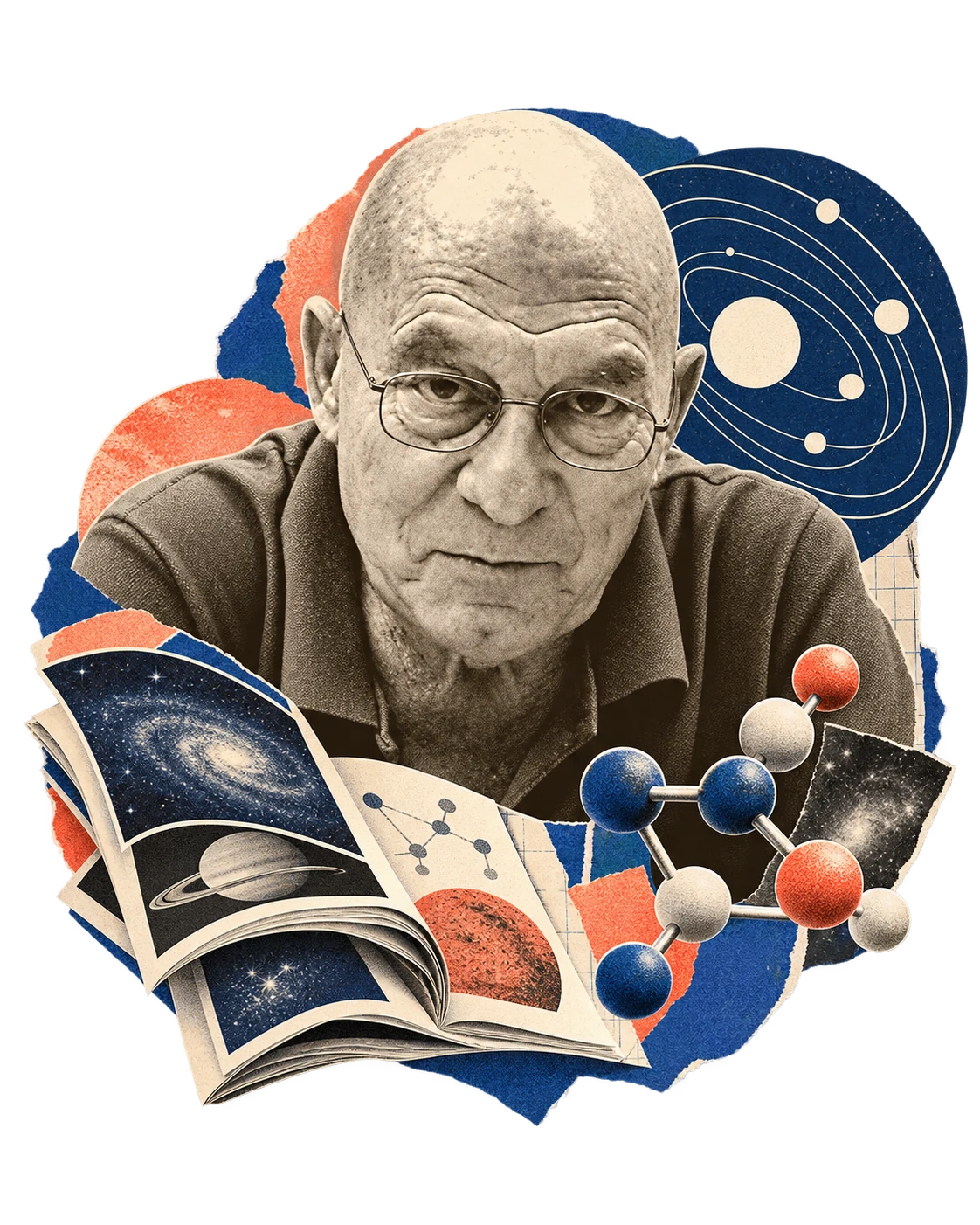
A budding priest who belonged to the Fascist youth movement and gave the Nazi salute, he would be remembered as one of the most intelligent people to bring science and thought to the general public, despite not completing even ten years of schooling.
The new director-general who walked into the Ministry of Science in 1993 was a highly unusual choice. He did not meet the basic criteria, such as holding academic degrees or having completed the required years of schooling. The person who invited him to the ministry was Minister Shulamit Aloni, then Minister of Science and the Arts, who had received a letter of recommendation from Professor Asa Kasher stating that Tzvi Yanai's education was equivalent to at least five A.M.s. His new position was one of the high points of Tzvi Yanai's life. As soon as he took office, he set priorities for the country's research budgets, favoring research with economic potential over abstract research. A year later, he explained: "The national pie is not suited to the needs of a country that aspires to be at the forefront of global technology... Roads, bridges, and sewage systems were a major driver of economic growth in the late nineteenth century. Today, at the end of the twentieth century, the strength of countries is determined by their ability to develop and operate dynamic infrastructure rich in science, information, and technology."
Between Fascism and Orphanhood
It is hard to believe, but as a child, the director-general of the Ministry of Science wore the uniform of Mussolini's Fascist youth movement and gave the Nazi salute, just like the Nazis in Germany. Years later, he would say: "The Fascist regime was the best thing that could happen. My mother bought me De Amicis's 'Heart,' and I was captivated by the book. It is a thoroughly Fascist book. The homeland is the mother. I myself was in the Fascist youth movement, and Mussolini was a role model. I have a picture of myself in uniform, giving the Nazi salute. We had a strong sense of pride in our group."
He was born in Italy in 1935 as Sandro Toto, in the small port city of Pescara, on the Adriatic coast. His father, Kalman Toto, was a Christian opera singer of Hungarian origin, and his mother, Yutzi Galambosh, was a Jewish dancer from Hungary. The two never married and performed together throughout Italy. "My mother was a beautiful woman, eighteen years younger than my father, elegant, with a shapely figure, light hair, and incredible legs... Her breasts were too small for her to be sexy, but she was blessed with that indefinable gift of nature commonly known as 'chic.'"
Sandro was the youngest of four children. He had two sisters, Fiorenza and Lizetta, and a brother named Romolo, a year older than him, about whom Sandro knew very little. When World War II broke out, his father was deported to Hungary, where he died, and his brother disappeared. His mother worked as a translator for the German army and raised the three children while concealing her Jewish identity. In early 1944, his mother died, and Wehrmacht soldiers arranged for her to be given a Christian burial. "She was lying on her back," he recalled. "Her eyes were closed. A light-colored blanket was stretched over her body. Someone pushed me from behind, urging me to approach the bed and kiss my mother. I was afraid death would rub off on me, but I knew I had to do my duty. Her face was yellow and her forehead was cold. She was thirty-two when she died, but looked younger than her age."
By the age of eight, Sandro was an orphan with neither parent. German soldiers who helped Sandro and his sisters provided them with food and shelter and took him to a monastery. Years later, he recalled: "I was a model seminarian. As a child, I had no problem with the Catholic God. God was everything good in the world. In the Gospels, in the words of Jesus, there is a great deal of compassion, grace, and love for the weak. As a child, you feed on those stories. The Church did not stand between Jesus and me. I was connected to Jesus just as I was connected to Mary and the apostles, in an immediate, powerful bond."
From the Monastery to Palestine
At the end of the war, soldiers of the Jewish Brigade searched for Jews wherever they went. When one of the Brigade's units reached Padua in northern Italy, its soldiers learned that three Jewish orphans who had survived the Holocaust were in nearby Monselice. One of the soldiers, Ernest Spitz, wrote to the orphans' uncle in Mandatory Palestine, Pali Galambosh (Shaul Yanai): "We would like to know your intentions regarding them, as their uncle. For now, the children are being supported by very kind people, but not on any organized basis... You, as their uncle, are the only person who can bring these children back to Judaism. The JDC and we, the Palestinian [Land of Israel] soldiers, are willing to give this goal a chance, since it may be possible to send the children... to Palestine."
After receiving the uncle's approval, Mordechai Shipman, another soldier from the unit, set out for Monselice with permission to take the children. On July 1, 1945, Shipman wrote to Galambosh: "Parting from them was very, very difficult... because they are beautiful, intelligent, and endlessly likable."
Shipman wrote that the children had survived thanks to their teacher, Ida Brunelli-Lenti (later named Righteous Among the Nations), and the local judge and priest, who forged identity papers for them and placed them in an educational institution run by nuns. Despite this, Shipman wrote, "It seems to me that this was a time of immense suffering for them, because in addition to being homeless, they also endured Allied bombing, starvation, and destruction." It was then that Sandro first learned he was Jewish: "Something inferior, only a little above the Gypsies, whom everyone saw as thieves and child kidnappers, people who paid little attention to cleanliness."
Nine-year-old Sandro was summoned to appear before the head nun at the educational institution where he lived. "The summons itself was surprising and even worrying, since until that morning I had never seen her or known her name. When I entered the office, she was standing beside a black wall board, with two British soldiers in uniform beside her. She motioned for me to come closer and said that the soldiers had come to take me to my uncle in Palestine. Then she spread a map on the board and pointed with a pointer to a pink spot on the eastern shore of the Mediterranean Sea... No one had asked my opinion about any of the earlier decisions, either: my father left home without my consent, my mother died without asking what I thought, Ida brought me to Monselice without consulting me, and now these two soldiers were going to take me to Palestine. This time, though, I found it hard to hide my concern. The map was at a very large scale, and the pink spot the head nun pointed to was tiny, not even large enough for two feet to stand on. I realized that when I got to Palestine, I would have to stand on one leg and then the other so I wouldn't get one foot wet in the sea." Later, he described his feelings at the time: "The Brigade practically snatched us from the monastery and took us to the Land of Israel. On the way, we also stopped in Castiglion Fiorentino. The people there looked at us strangely. We had been under the Germans' protection, had gone north with them, and now we were coming back with the British. I felt there that I had betrayed the Germans, the Italians, and Fascism."
At one of the Brigade's camps, Sandro Toto was given the name Tzvi. He said goodbye to the Brigade soldiers in Rome, and in July 1945 he came to the Land of Israel with his older sisters aboard the immigrant ship Mataroa. In the Land of Israel, Sandro-Tzvi adopted the surname Yanai, the Hebrew name taken by his uncle, Shaul Yanai. At the age of ten, Tzvi was settled in Kibbutz Ramat David, but life there was not easy for him because he did not know Hebrew and had not been circumcised, which led the children to tease him. He was later circumcised, learned Hebrew, and replaced his Catholic faith with what he called the "kibbutznik religion." "Speaking the truth, working, and serving are values that have stayed with me to this day, and I owe the kibbutz my thanks for them," he said.
From Ramat David to the Paratroopers
Near the end of ninth grade, he dropped out of school and went to work in the cowshed, where he piled manure. At seventeen, he enlisted in the paratroopers and trained as a parachuting instructor. The army was very important to him. In the paratroopers, he met a large group of legendary heroes, including Danny Matt, commander of the Parachuting School; Yoav Shaham; brigade commander Ariel Sharon; Micha Ben Ari (Kapusta); Shraga Tal (Topol); Eliyahu Ben David (Sagman); and Rafael Eitan (Rafoul). In 1956, he went with them to the Third World Parachuting Championships in Moscow, despite having no experience with that kind of parachuting and no suitable equipment. As a result, they came in last. After a year of career military service, he left the army, but returned as a reservist during the capture of the Golan Heights, and fought with the Paratroopers Brigade in the Yom Kippur War.
After leaving the army, he worked a variety of temporary jobs suited to someone without an academic degree. Among other things, he worked in fishing, at salt ponds, and in a spinning mill. He answered an advertisement for a job at an advertising agency, and from there moved to IBM Israel, one of the agency's clients, where he became editor of 'Machshavot,' IBM's promotional publication for clients. One day, he included interviews with Aharon Meged and Yeshayahu Leibowitz on the question of life and death. The clients were enthusiastic, and little by little Tzvi pushed the advertisements aside in favor of writing on science and ideas. Under his editorship, 'Machshavot' became a prestigious, sought-after journal, distributed free in 15,000 copies. Those who received it were considered members of an exclusive club of curious people interested in science. The journal redefined Tzvi Yanai, and at the age of thirty-five he entered the public eye as a man of science and a sought-after lecturer. "Science was as far from me as east is from west. I had no access to it and no understanding of it. What interested me were plays, films, and books in general. Little by little, as I worked on this journal, my curiosity began to grow. First I became interested in technology, and then moved from technology to pure science. It happened by chance," he said.
The journal enabled Tzvi Yanai to organize annual conferences, 'Machshavot Ba'al Peh' ('Thoughts Spoken'), which drew large audiences. One thing led to another, and in 1984 he hosted the television program 'Sifurei B'dim' ('Fabricated Stories') and an interview program about ideas and science called 'Dvarim B'Go' ('There’s Something to It'). At the same time, he hosted radio programs about scientific discoveries. In 1990, Yanai left IBM and turned to writing books. One of his most successful books was 'Yours, Sandro,' in which he described his life through a correspondence with his lost brother. He won the Sapir Prize for the book, and when he received the award he said: "I don't consider myself a writer. I have become absorbed in scientific writing, developing scientific theories, and trying to decipher the secret of reality. That's a much bigger challenge than writing novels. This book came out unintentionally." He later also wrote 'Too Late,' which likewise deals with his family's history.
The boy who nearly became a priest settled accounts with God: "The fact that I don't know something doesn't mean I'm willing to let God into the arena. Even religious people who work in science, and there are quite a few of them in Israel too, don't include God in their calculations. God has to prove to me that he exists, and he still hasn't done so. I'm quite willing to live in a world without final answers, a world without knowledge, but I'm not willing to live in a world with God... If I could, I would sue God at the International Court of Justice in The Hague. He has committed crimes against humanity." There is no doubt that the two of them, Yeshayahu Leibowitz and Tzvi Yanai, helped make Israel a country where laypeople have such great interest in science, philosophy, and culture.
Tzvi Yanai battled cancer for several years and died in December 2013 at the age of seventy-eight. "A person is not buried, only his body is buried," his family had engraved on his tombstone.
His partner, Dalia Hochberg, worked hard to establish a website that brings together all his writings (https://thinkil.co.il/). On the fifth anniversary of his death, the alley near his home in Ramat Gan was named Yanai Lane.
תגובות
עדיין אין תגובות.