
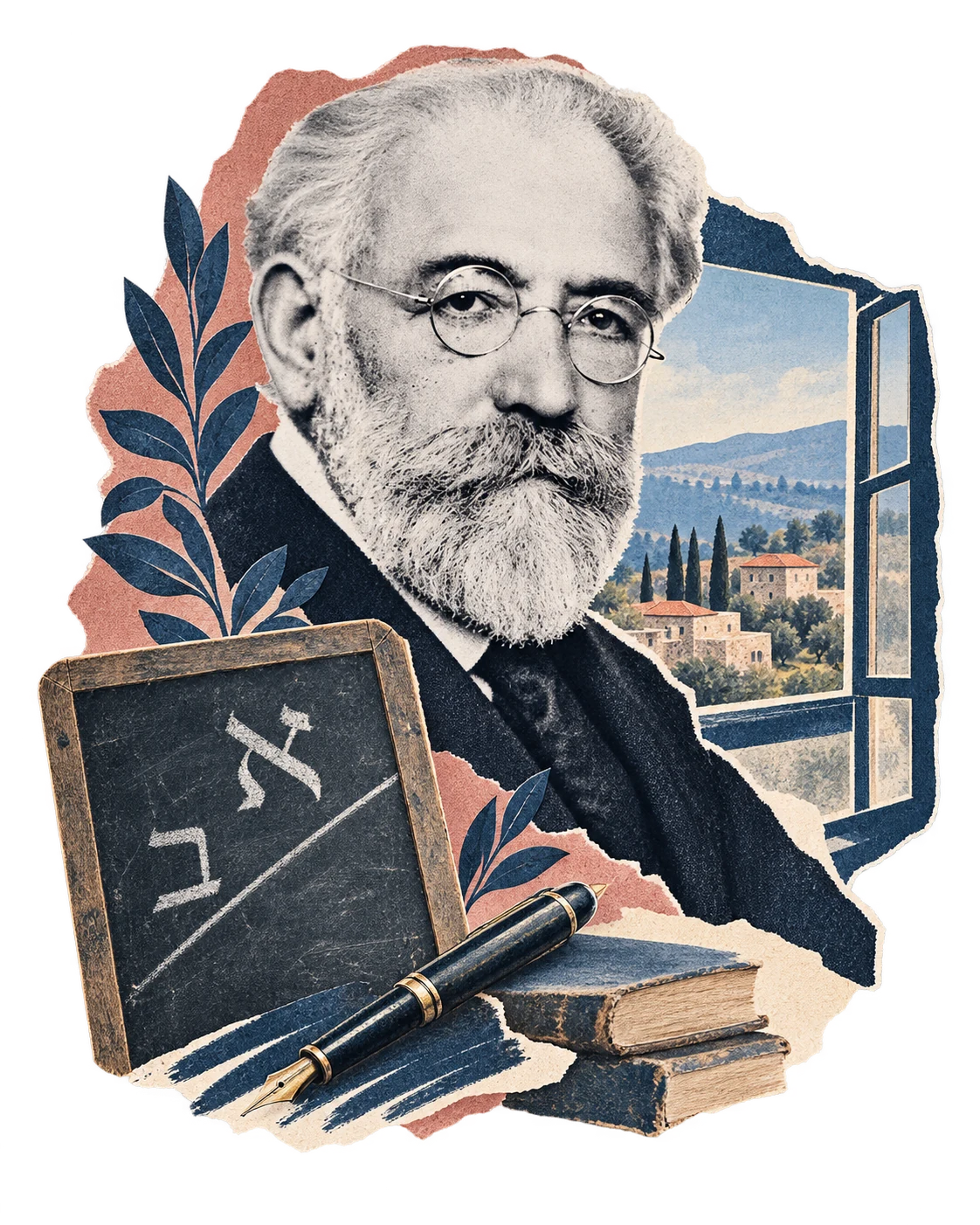
A sacred mission on his shoulders, beautiful Hebrew on his lips, and a vision in his eyes. Yitzhak Epstein Sometimes it seems that what is has always been. But that is not the case. At the time, there were no curricula, and Hebrew was not spoken by everyone; it was reserved for prayer and religious study. Yitzhak Epstein was a pioneering revolutionary, one of those First Aliyah settlers who dreamed big and made their dreams come true. He did not arrive in the Land of Israel as a linguist or educator, but as a manual laborer. Before long, he understood that his calling lay not only in working the land, but also in bringing the Hebrew language back to life.
A Man of Mission
Epstein was a man who swam against the current, but always for the common good. Wherever he felt that someone needed to “take responsibility,” he simply became that person. In Safed, Rosh Pina, Metula, and even Thessaloniki in Greece, Epstein took on the task out of a sense of mission, and his influence could be felt everywhere he went.
He was an exceptional figure not because of what he did, but because of how he did it. He demanded more of himself than he demanded of his students, and insisted on precise, authentic, beautiful Hebrew. He believed in the power of language and saw it as a national, cultural, and educational tool.
Yitzhak Epstein was born at the end of 1862 to a religious family in a small town in Lithuania (now Belarus). He inherited his love of Hebrew from his father, Nahum, who taught Hebrew, and his Zionist fervor from his older brother Zalman, one of the earliest advocates of the love of Zion and Zionism. Yitzhak wrote in his memoirs: “From my youth, I showed a bent for teaching. Learning any truth gave me pleasure, and explaining it to others gave me twice as much delight.”
As a teenager, Epstein went to study in the big city of Odessa. At the same time, he continued to study Hebrew and read Hebrew literature, under the guidance of the writer Moshe Leib Lilienblum. At the age of 21, he began studying agriculture and became one of those who believed agricultural labor could create a new kind of person: healthier, more upright, and more connected to the land. Yitzhak first saw the shores of the country in 1886, when he arrived as part of a group of six young men sent by the Odessa branch of the Hovevei Zion movement, at Baron Rothschild’s expense. They were to train in agriculture and later instruct new settlers, replacing the French instructors. The group first arrived in Zikhron Ya'akov, where Epstein worked clearing stones from fields and building the road up the hill to the colony. From Zikhron Ya'akov, he moved to Rosh Pina and began working in the flower and ornamental-plant nursery at Yesud HaMa'ala, which was intended to supply the perfume industry. Under his instruction, dozens of workers from Safed worked there, most of them Mizrahi Jews, and from them he learned Arabic. Four years later, Epstein moved into teaching. He married Rachel, daughter of Yosef Weidenfeld, his student from Rosh Pina, and went to teach in the Galilee settlements of Rosh Pina, Safed, and Metula.
The Hebrew Teacher
At that time, the Hebrew language was just taking its first steps. There were few Hebrew teachers, and books were hard to come by. Epstein decided this was his calling, even though agricultural work paid more than teaching. Years later, he wrote in his memoirs: “I never attended an elementary school and never read anything about education or teaching, psychology, or the art of teaching. The theory of education and its history had yet to be born for me.” He devised a way to teach Hebrew, including how to speak it, and coined new Hebrew words, among them: heredity, activity, observation, sensitivity, phenomenon, consciousness, relief, active and passive, and to function.
Yitzhak Epstein detested the use of foreign words in Hebrew: “Mixing languages aroused in me something like a feeling of ugliness; I abhorred hybrids... A foreign language should be taught through observation of the natural surroundings, so that to some extent the student gains not only words and expressions, but also new impressions and newly formed, clarified concepts.” He adopted the Eastern pronunciation and accent and taught “Hebrew in Hebrew.” The results were impressive. Everyone admired his students for their clear, correct accent, which he had given them, and his reputation spread. He received quite a few offers to teach. When he taught in Metula, students came to him from faraway places too, including Zikhron Ya'akov, Rosh Pina, Jerusalem, Haifa, and Mishmar HaYarden.
Teaching “Hebrew in Hebrew” was not unique to Yitzhak Epstein; what set him apart was his attempt to teach Hebrew through songs. He did not wait for poets to write songs for him or composers to set them to music. In his book, Epstein published five children’s songs that he had written and composed for the students of the school in Rosh Pina. These songs spread among teachers and were taught in the first Hebrew kindergartens in the country.
Epstein also nurtured the Galilean dialect, which was depicted in Shlomo Sheba’s play “Days of Gold.” At the very beginning of the play, a Galilean character arrives in Jaffa and speaks with a local man named Mishka. Their exchange hinges on the pronunciation of the Hebrew letter bet, a distinction lost in English:
Galilean: Pardon me, sir, where is there a cookhouse? / Mishka: What? / Galilean: A cookhouse, a place where people eat. / Mishka: I hear you’re a Galilean, one of those crazy fellows? / Galilean: I’m from the Galilee, but I’m not crazy. / Mishka: Say “house.” / Galilean: House. / Mishka: Say, “The flies are circling in the milk.” / Galilean: The flies are circling in the milk. / Mishka: Stubborn Galilean.
The hard pronunciation of the letter bet was the most distinctive marker of the Galilean dialect. The sentence “The flies are circling in the milk” became a familiar joke in the Jewish community. Like dialects found in other languages, this way of speaking did not develop gradually; it sprang from Yitzhak Epstein’s fevered imagination. He insisted that the letter bet always be pronounced as a hard bet. “We were taught to speak with emphasis,” one of his students explained. “At school, they tried to get us to emphasize the hard bet and the hard peh. Actually, I don’t really know why. I think they wanted to give the people of the Galilee a distinctive tone. They spoke that way in the colonies, and we still speak that way, almost to this day.”
Yitzhak Epstein was one of those people who were never satisfied with their achievements, however great, and this drove him to keep learning and improving. In 1903, he went to study at the University of Lausanne in Switzerland, where he specialized in psychology and pedagogy in order to improve his teaching methods. Five years later, he was invited by Alliance Israélite Universelle (Kol Yisrael Haverim) to head the large Talmud Torah school in Thessaloniki. Within two years, the institution had become a modern school with a Hebrew foundation. His lectures at clubs captivated everyone who heard them, both for their beautiful Hebrew style and for his polished French. Epstein did not stop at the school gates: he organized events and breathed Zionist life into the local community. Young people connected with him, and many of them immigrated to the Land of Israel under his influence. It was a brief but powerful period. For the people of Thessaloniki, it was “the Epstein era,” and they remembered it with affection.
Yitzhak Epstein entered the Israeli pantheon and earned a place of honor not only as an important teacher and educator, but also as one of the first to put into writing the question of our relationship with the Arab inhabitants of the country.
The Hidden Question
At the time, the most important and influential periodical was the monthly journal HaShiloah. “A monthly periodical for literature, science, and matters of life,” as Ahad Ha'am, its editor, described it. The journal was read over a “cup of tea” - it was funded by Kalonymus Ze'ev Wissotzky, Russia’s leading tea manufacturer, a devoted lover of Zion and ardent supporter of Ahad Ha'am. In 1907, Yitzhak Epstein published the essay “A Hidden Question,” which became part of the Israeli canon.
The essay opens as follows: “Among the difficult questions bound up with the idea of our people’s revival on its own soil, there is one question equal in weight to all the others: the question of our relationship to the Arabs. This question, on whose proper resolution the revival of our national hopes depends, has not been forgotten, but has vanished entirely from the minds of the Zionists, and in its true form it is scarcely mentioned in the literature of our movement.” Epstein goes on to note that “from the day the national movement arose until now, Zionist activists have never stopped taking an interest in the country’s institutions and laws, while the question of the people who live there, its workers and its true masters, has yet to arise, either in practical affairs or in discussion... We pay attention to every matter concerning our country; we debate and argue about everything, praise and condemn everything, but we have forgotten one small thing: that in our beloved land there is an entire people, rooted there for hundreds of years, who have never intended to leave.” Epstein drew a parallel: “As we feel the full force of our love for our ancestral homeland, we forget that the people living there now also have a feeling heart and a loving soul. The Arab, like every person, is bound to his homeland by strong ties.” (I recommend reading the entire essay from the perspective of time, because one gets the feeling that a prophet wrote it.) Epstein had already presented these same ideas two years earlier, in a lecture he gave to the Ivriyah association on the occasion of the Zionist Congress in Basel.
The fingerprints of this essay can be seen in the thinking of Zionist leaders who came after him. All the Zionist leaders who shaped political thinking from the founding of the state shared one thing: they thought of the Jewish state as a multinational state, or even as a state within a broader framework, like a state within the United States of America. In an essay he wrote in the newspaper Rassvet (Рассвет) in 1926, Jabotinsky made clear that “the future of Palestine should be established, legally, as a binational state... and not Palestine alone. Every country with an ethnic minority, even the smallest, must, according to our deepest convictions, be a bi-, tri-, or quadrinational state.” In 1930, Ben-Gurion wrote in his essay “Premises for Establishing a State Regime in the Land of Israel” that “the Land of Israel will be a federal state... in such a way that at no time will there be Arab rule over Jews or Jewish rule over Arabs in the country.”
And yet, when the authors of the Nation-State Law wrote that “the State of Israel is the nation-state of the Jewish people,” and that “the exercise of the right to national self-determination in the State of Israel is unique to the Jewish people,” it sounded reasonable, and it was clear to everyone that Israel is the nation-state of the Jewish people, and that the establishment of a “Jewish state” had been the Zionist movement’s goal from the moment it was born.
His Legacy for Generations
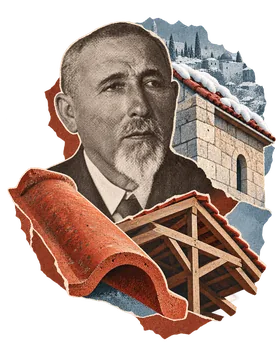
In 1926, Yitzhak Epstein’s grandson was born in Haifa’s German Colony. He was the son of Epstein’s daughter, Tehiya, a pianist, and her husband, David Steinberg, son of Yehiel Michael Steinberg, founder of the roof-tile factory [the Red House]. When the couple asked Yitzhak to suggest a name for the baby, he gave them the name Aluf, and the translation of the surname Steinberg is Haraven. In time, Aluf Haraven worked for Military Intelligence, the Mossad, and the Ministry of Foreign Affairs (Aluf was married to the writer Shulamit Haraven, and his daughter is the writer and journalist Gil Haraven).
In 1905, Yitzhak Epstein warned: “Let us not provoke a sleeping lion. One spark will escape, and become a fire that will not go out.” Haraven saw this as a prophecy that came true, and noted that his grandfather understood that “sooner or later, the problem of relations with our Arab neighbors would confront us in all its severity, and the way to deal with this question is on the basis of recognizing the rights of the neighboring people... recognizing the Arabs as a people with whom we must reach an agreement, or else we will find ourselves in bitterly hostile relations with them. Recognizing that Jewish settlement causes hardship for the Arabs, who lose their lands as a result, and that we must confront this hardship and try to find a solution to it.”
Aluf Haraven inherited from his grandfather not only his name, but also his humane worldview. Eighty years after his grandfather’s speech, Haraven wrote that most of its ideas remained relevant: “We are still struggling to recognize a neighboring people and its hardships, and to overcome ignorance and prejudice about the Arabs and our relations with them.”
Aluf Haraven wrote many books and articles on Arab-Jewish relations in Israel and on Judaism. In some of them, he expressed his vision of establishing a “human state,” in which human dignity would be at the heart of the relationships among its constituent groups: men and women, new immigrants and native-born Israelis, Israelis and foreign workers, security forces and civilians, Jews and Arabs, and Israeli citizens and their Palestinian neighbors.
Haraven ended his essay with the question: “Will our future be a violent conflict like Bosnia, with brutal violence between its different national and religious groups, or a civil peace like Finland, a state of the Finnish people and all its citizens, in which the Swedish minority participates effectively and on equal terms in civic life, and where civil peace prevails?” “This is the great and difficult question facing Israel as it approaches the twenty-first century.”
When he returned to the country from Thessaloniki after World War I, Yitzhak Epstein was already a holder of a doctorate in literature and pedagogy, and well known in the Land of Israel and the Jewish Diaspora. He was appointed director of the Levinsky Teachers' Seminary, but soon gave up the honor because his path was that of an emissary, not a person of authority. He returned to his love of the Hebrew language and devoted himself to improving it. He wrote a daily column in the newspaper Davar aimed at improving the language and correcting common mistakes in spoken and written Hebrew. When Jerusalem Radio was established, he was invited to be a Friday-night announcer, and for years his pleasant voice and traditional cantillation brought listeners the weekly Torah portion and the Haftarah.
Yitzhak Epstein was Eliezer Ben-Yehuda’s contemporary, companion, and faithful successor in the revival of the language. Eliezer worked tirelessly to revive the language, while Yitzhak Epstein devoted his life to improving speech and reviving pronunciation. But unlike Eliezer Ben-Yehuda, Epstein never received the recognition he deserved.
Yitzhak Epstein died in 1943 at the age of 80 and was buried in the cemetery on the Mount of Olives. A teachers' seminary for kindergarten teachers in Jerusalem and a street in Tel Aviv are named after him.
תגובות
עדיין אין תגובות.