
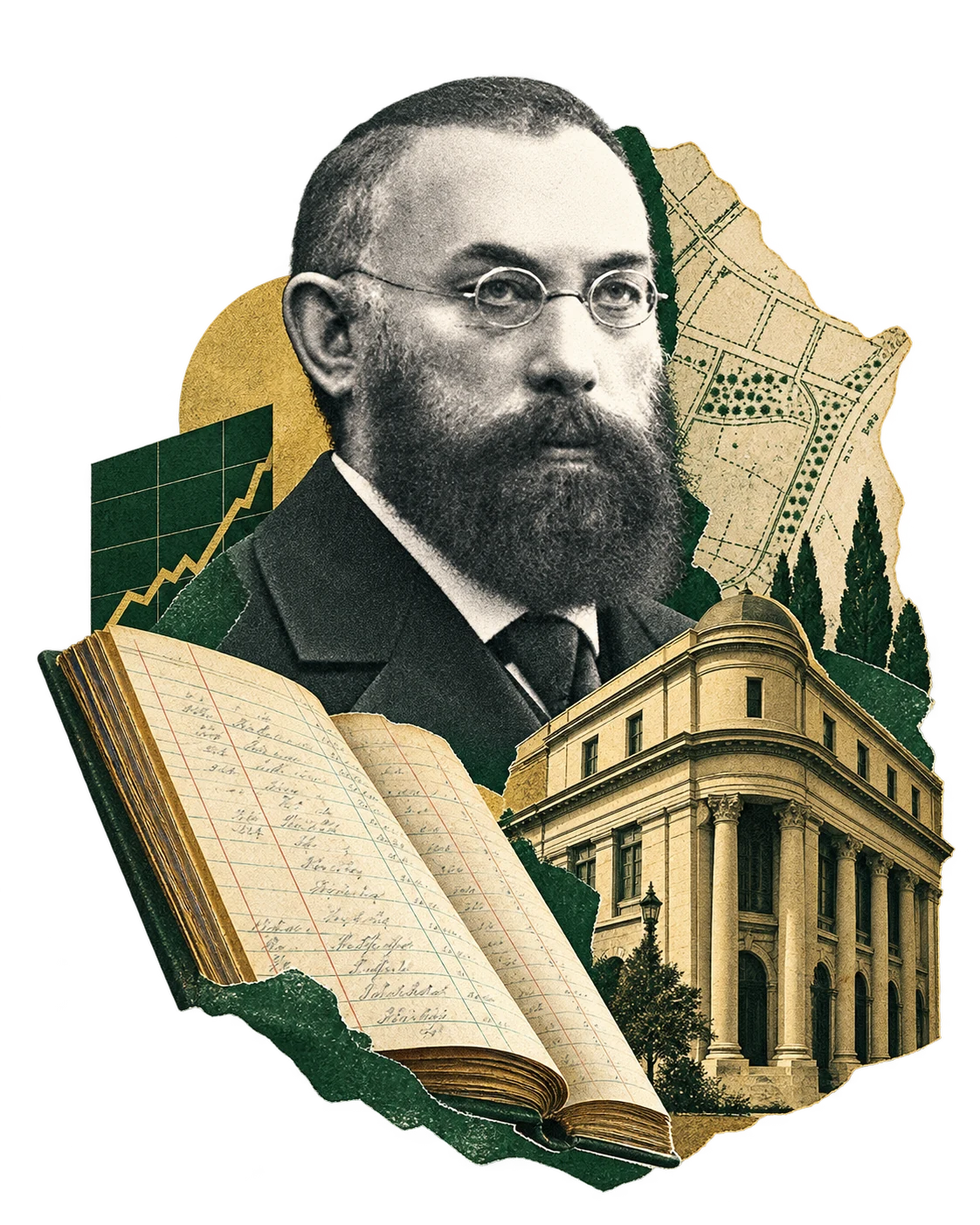
Herzl knew that to realize his vision, he needed money, organization, and a partner who could turn that vision into reality. If Herzl was known as "the visionary," then it would be fitting to call this man "the one who made it happen."
The Vision of the Zionist Bank
Coming from a family of bankers, Herzl knew that realizing his vision of a modern economy for the Jewish people required a financial institution that could turn the vision into reality: "The Zionist movement needs an effective financial institution run with integrity in order to achieve its aims. The Zionist movement must free itself from dependence on philanthropists’ generosity." In March 1899, Herzl established the Jewish Colonial Trust in London. It issued founding shares held by a council of 23 governors representing the Zionist Organization. Herzl chaired the council, and David Wolffsohn was appointed chairman of the board of directors. Practicing what he preached, Herzl invested the largest sum of all, using his wife's dowry to purchase 2,000 shares worth 2,000 pounds sterling. Nevertheless, the company failed to raise the funds it needed.
This failure led to the establishment of the Anglo-Palestine Company (APC, the initials of its official English name), a subsidiary of the Jewish Colonial Trust. The company's aim was to become the first Zionist bank and to operate as a bank, using financing and credit methods customary around the world. Its purpose was not limited to banking; it also undertook initiatives and investments in maritime transport, communications, real estate, urban development, and infrastructure in the Land of Israel. The company's first office in Israel opened in Jaffa in August 1903, operating as a bank headed by Zalman David Levontin (Z.D.L.), who served as its general manager.
Levontin Shapes the APC
As soon as he took up his position, Zalman David Levontin encountered many difficulties imposed by the Turks, who sought to restrict him because they saw the bank as an expression of national-Zionist expansionist ambitions in the Land of Israel, which was under their rule. Another challenge facing Levontin came from the Jewish residents of the Land of Israel themselves, who until then had lived on donations. Now they not only had to ask for a loan, but also repay it according to a set schedule and with interest. In the summer of 1903, the first branch opened in Jaffa, not far from the clock on Ajami Street (today 18 Yefet Street). A year later, a branch opened in Jerusalem, and in 1905 the third branch opened in Beirut. This branch marked a turning point for the bank, as Levontin wrote: "From the day we established our branch in Beirut, the banks in Europe stopped looking upon us as a charitable institution and began treating us as a bank." At that very moment, the bank was on the verge of bankruptcy. Its lifeline came from the Zionist Dutch banker Jacobus Kann, who granted the bank a loan that allowed it to continue operating. By the outbreak of the First World War, additional branches had opened in Hebron, Haifa, Safed, Tiberias, and Gaza.
Zalman David Levontin brought about a revolution in banking in the country through the loan system. Until then, lending had depended on "the lender's courage and valor," as he put it. For the first time, Levontin required borrowers to provide collateral, as was customary in the Western world. Such collateral sometimes consisted of a lien on work tools, future crops, or the goods themselves. He required it from everyone, without exception, even from the Turkish governor of Jerusalem, who pledged his tax revenues from the Hebron district. The collateral system reduced the risks of lending and lowered interest rates, encouraging farmers to take loans and increase the yield of their labor.
The bank also served as a secure archive for the documents of the colonies. Thus, Rabbi Kook stipulated that an exact copy of Petah Tikva's land register should be kept "in a special iron safe at the APC Bank in Jaffa, with the key held by the head of the colony committee."
Another area in which Zalman David Levontin brought about a revolution was the status of the "clerk." At the time, clerks were seen as crude, insensitive enforcers. To change the image of the clerk, Levontin decreed that Hebrew would be the language of service and conversation at the bank - a novelty at the time. He compiled the "Book of Procedures," bringing together the rules for the work. He ensured that employees received fair wages, established job security in the workplace, and founded the first provident fund in Israel, to which the bank and its employees were required to contribute a fixed sum each month. When an employee could no longer work because of illness or retirement, the fund paid that employee's salary.
Levontin filled key positions with employees from well-established and well-known families in the country at the time, including the Mani, Elishar, Rivlin, Slonim, Ben-Tovim, Shlush, Horowitz, and Hasson families. Zalman David Levontin brought Eliyahu Sapir on board, describing him as an expert in land acquisition "with a passionate desire in his soul to redeem the land." In 1909, the bank provided the essential guarantees for the establishment of Tel Aviv. The land on which the first Hebrew city was built was purchased by Zalman David Levontin and his deputy, Yehuda Shlush. Later, they purchased the lands of Ben Shemen and Hulda, land near Petah Tikva, the land on which Degania would eventually be established, and land in Rehovot, Gedera, Ness Ziona, Kfar Tavor, and Kfar Hittim. Levontin also planned to buy land in Transjordan, Syria, and Sinai. In his visions, he saw a Greater Land of Israel, but the First World War disrupted his plans.
Zalman David Levontin was a Russian subject when Turkey was at war with England and Russia. The Turks ordered the bank, which was registered in England, to cease operations. Levontin consequently left for Egypt. An excellent businessman, he turned this harsh decree into an opportunity and established a branch of the bank in Alexandria. The branch served the thousands of refugees expelled from the Land of Israel to Egypt who held accounts at one of the branches of the Anglo-Palestine Bank. The Egyptian branch enabled them to withdraw money against their deposits at the bank's branches in the country. Levontin wrote: "Under the laws in force, we had no obligation whatsoever to make payments in Egypt... But I could not leave those who had their money in our bank to go hungry or to beg for a slice of bread... This work of mine was extremely difficult, because many depositors nevertheless demanded all their deposits and refused to understand that the APC had no obligation to them, and that I was going beyond the letter of the law by paying them their deposits. They would quarrel with me and make my life miserable."
In May 1951, all the assets and liabilities of the Anglo-Palestine Bank were transferred to a new company called Bank Leumi le-Israel Ltd.
The Founding of Rishon LeZion
Zalman David Levontin immigrated to the Land of Israel twice, in 1882 and in 1903. The first time, he came on a mission for the Hovevei Zion association, representing his city to buy land for the establishment of a colony. That same year, Petah Tikva fell apart, and no colonies remained in the country. As he looked more closely into the matter, he realized that the failure had resulted from intrigue, disorder, and deception. To advance the purpose of his visit, he met with the founders of Petah Tikva and with the leaders of the Templar colonies in the country. He then wanted to see the entire land with his own eyes and decide where a colony should be established. In the meantime, he prepared a report for the association's members, writing: "The land is good and fertile... Lemon and orange trees can be planted there... cotton bushes, mulberry trees to expand silkworm cultivation, roses and flowers to be dried for medicinal and confectionery purposes - all these pursuits can yield a good return for those who undertake them... We have hope of living there, for we shall surely go up and possess it, and we shall surely prevail!" Levontin's first choice was a large, fertile plot in the Gaza region, but the deal did not go through. A month later, his uncle Zvi Hirsch Levontin came to the country. He was a wealthy Jew with no children. Zalman Levontin persuaded him to buy a tract of land on which a colony would be established, as a memorial to him. The two, together with others, bought the lands of Ard el-Ayoun Kara, not far from Jaffa. The colony of Rishon LeZion was established there. "The place was desolate. There was no house, not even a hut or a watchman’s shelter in the melon patch, and not a tree or a person - only thistles and thorns grew around us. The many foxes in this desolate place howled. I fired my rifle two or three times to frighten them away, took off my coat, spread it on the ground, and sat down to regain my strength and wait for our friends to arrive... I thought of the mighty Samson, who fought the Philistines here... I thought of the blood of my ancestors, shed here, on whose graves I may have spread my coat. I felt a profound love for this place... This place is my home and my resting place... How can I find the strength to work for this cause when my pockets are empty?" This is how he described, with deep emotion, that first night he spent on a hill in the newly purchased land of Rishon LeZion.
Zalman David Levontin was one of the founders of Rishon LeZion. He lived there alone for six months while his family remained in Russia. He took part in building the houses, digging the well, and planting the first vineyards. He was appointed head of the colony committee, but resigned and left the country following disputes among the settlers over land and property. Twenty years later, he returned to the country as manager of the Anglo-Palestine Bank.
Rishon LeZion was not the first Jewish colony founded in the Land of Israel. Petah Tikva and Rosh Pina came before it, but were soon abandoned because of the hardships of life there. They were reestablished after Rishon LeZion was founded. Rishon LeZion was distinctive because it was the enterprise of Hovevei Zion, who saw their work as driven by a national purpose. This contrasted with the founding of Petah Tikva and Rosh Pina, which had been established for religious reasons. Zalman David Levontin served as a bridge between the Old Yishuv, which had been living in the country, including families such as the Shlush and Amzaleg families, and the members of the First Aliyah who arrived from Europe.
From Childhood in Russia to the Legacy
Zalman David Levontin (Z.D.L.) was born in the city of Orsha in White Russia to a family of Chabad Hasidim who owned property. He studied general subjects and languages. As an adult, he became one of the first members of the Hibat Zion association in Russia. He connected with the Zionist idea as a child, and as an educated adult, he sought a way to realize it. His personal motivation was the humiliation he suffered when the doors of the hotel where he had sought lodging were shut in his face simply because he was Jewish. Above all, however, it was the national humiliation inflicted on his people when a wave of pogroms broke out in Russia in 1882. These humiliations drove him to initiate an association for settling the Land of Israel. Those who answered his call were Jews from his hometown of Orsha and the large city of Kharkov.
At the beginning of 1882, at the age of 26, he immigrated to the Land of Israel on his own initiative to buy land for the association's members, but also because he had separated from his wife, who had returned to her parents' home after claiming that he was not sufficiently devout in his religious observance. At first, he planned to settle in Jerusalem, but soon discovered "that there is no peace in the holy city, for quarrels and strife reach up to the heavens... Therefore, I resolved to return... to Jaffa and make my home there."
Some of the success of Rishon LeZion can be attributed to a cooperative established at Zalman David Levontin's initiative - a temporary partnership to cultivate all the land. Each member contributed to a shared fund an amount determined by the size of his plot, and in return for his work received one and a half francs a day. This arrangement had two opposing effects. On the one hand, it motivated every landowner to work, but on the other, it cost more than hiring wage laborers. According to Zalman David Levontin, the arrangement "greatly benefited the settlement, since almost all the settlement’s members were involved in its management, before they had even built their homes... Gradually, they began building houses. Rishon LeZion began to develop and could be seen from afar, its houses built with good taste and judgment, in the style of European homes."
In 1913, Zalman David Levontin summed up ten years of work as the movement's banker and wrote: "As I considered my views on the affairs of the settlement... I organized the APC's operations on the following foundations." He listed the bank's activities in this field: redeeming the land - purchasing land in the Land of Israel from north to south; improving the situation of the colonies by providing loans to farmers in need of them; loans for building houses in cities and colonies, for both work and education; helping establish loan funds and cooperative associations, including associations involved in growing citrus fruit for export; long-term loans to agricultural enterprises and for private needs; efforts to increase bank deposits, both private and public; expanding business relations "with non-Jews," meaning Arabs; and establishing bank branches in Jaffa, Jerusalem, Haifa, Safed, Tiberias, and Hebron, as well as outside the borders of the Land of Israel, in Beirut, Lebanon. All this, he proudly noted, while maintaining commercial relations "with the great banks in all the countries of the world, and they trust us."
On January 1, 1925, at the age of 69, Zalman David Levontin retired as head of the bank, but remained a member of its board of directors until his death in 1940, at the age of 84. Zalman David Levontin left behind a large and productive family of professionals, including company directors, doctors, painters, engineers, lawyers, community activists, and, of course, bankers. He wrote his memoirs in three volumes under the title To the Land of Our Fathers. The moshav of Sde David is named after him, and several cities, including Rishon LeZion, which he founded and where he is buried, have a street named after him (Levontin or Z.D.L.).
תגובות
עדיין אין תגובות.