
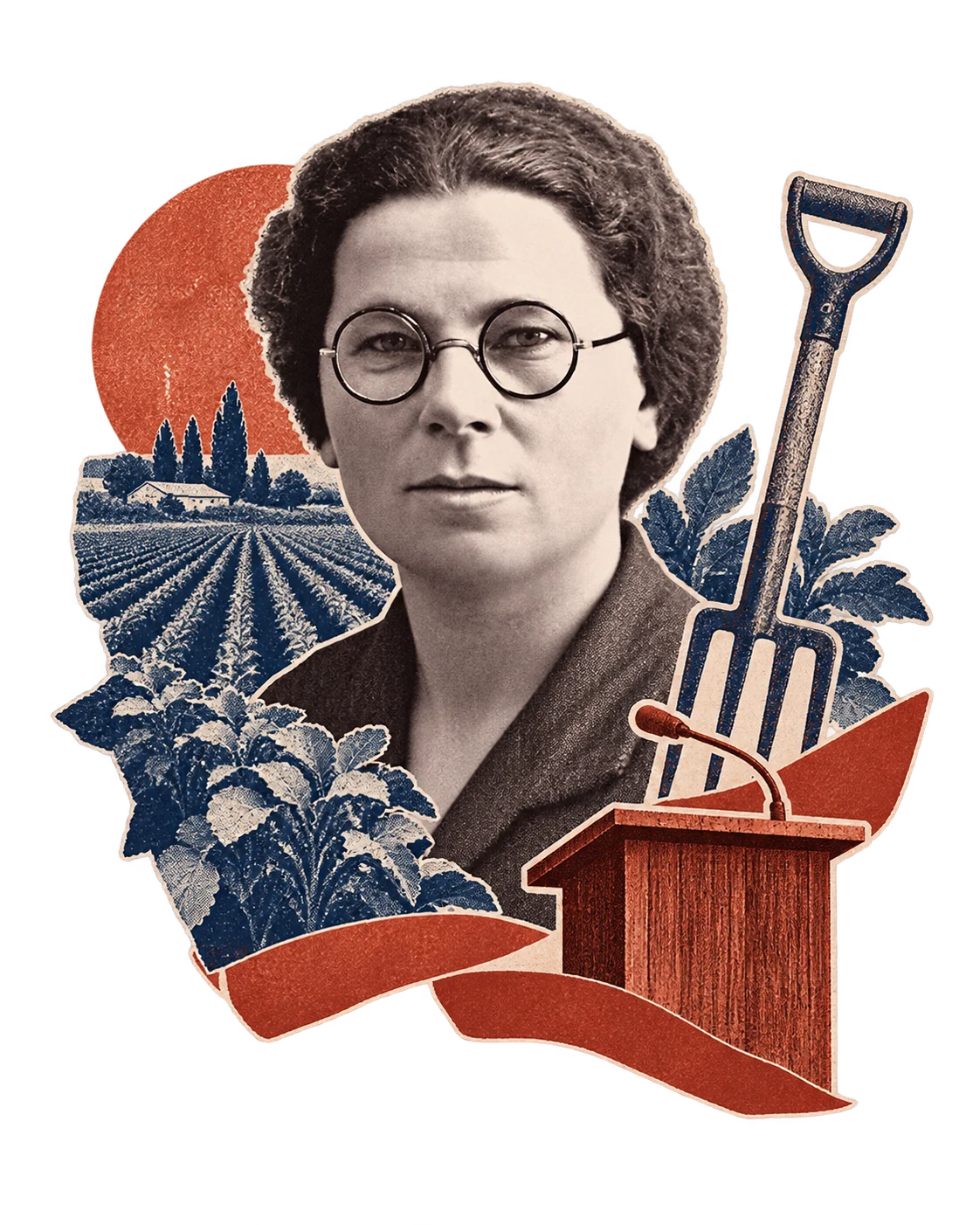
She founded a settlement in the Land of Israel, fought for all women, and battled corruption among public employees and the gap between them and the workers.
From a Visit to the Land to Aliyah
In 1908, Judah Leib and his sister Odile visited the Land of Israel. They visited the new colonies of Rishon LeZion, Rehovot, and Ness Ziona, then continued on a tour of Jerusalem's holy sites. The experience of the visit led Odile to change her name to Ada and decide to immigrate to the Land of Israel. In preparation, she began studying to become a teacher. From a young age, she stood out for her sharp tongue and keen mind. She was a curious, self-taught, charismatic girl who could rally others to her causes.
At first she settled in Jerusalem, and later went to work at the ultra-Orthodox Frankfurt institution in Petah Tikva. There she realized that the ultra-Orthodox way of life did not suit her, and that she would remain religious as she had been. In one of his letters, her brother wrote: "She cannot bear the fear of Heaven."
The Mission in Safed
Because the standard of education in Safed was low, some 150 Jewish girls had to study at the Christian missionary school. In 1914, Ada was asked to help resolve the situation, and she recruited her friend Fruma Makler for the task. As she wrote: "We knew that a great task had been entrusted to us: to teach the children of Safed the Torah of Israel." For Ada, this mission was a pioneering undertaking through which she could promote the Hebrew language, bridge the divide among residents, and advance women's status within the religious community. For example, despite the risk of losing her job, she fought for women's right to take part in the Lag BaOmer celebration of Rabbi Shimon bar Yochai: "We were told that ever since the disaster that occurred years ago (1911), when the walls in Meron collapsed and caused the deaths of several people, the ultra-Orthodox of Safed had declared that the disaster happened because men and women had visited Meron together, which was an act of licentiousness. They therefore proclaimed a ban and a strict prohibition on women visiting Meron. When we heard about it, we were horrified. I stated clearly and unequivocally that I would go up to Meron despite the ban. Our few friends in Safed, such as the clerks at the Anglo-Palestine Bank branch, the pharmacist, and others, led by Mr. Karniel (head of the school committee), warned me that I might thereby bring about the destruction of the Hebrew school, which they had worked so hard to establish... When we arrived in Meron, we mingled with the crowd again. We noticed that the ultra-Orthodox who came near us recoiled in revulsion, as if they had encountered something impure. We were three women among thousands of men... We turned toward one of the houses and entered a large room. I went in first. The only person in the room was a Jew with long sidelocks. When he saw me, he was horrified, clasped his head in both hands, and began running back and forth across the room, shouting: 'A ban, a woman! A ban, a woman!...' We returned safely to Safed. Yet this whole incident did not lead to our dismissal or to the destruction of the school. The people of Safed understood that it was better to let the matter pass in silence. From then on, the ban was completely broken, and the women of Safed visited Meron every year and enjoyed the Lag BaOmer celebration, with no trouble or outcry."
Odile Fishman Maimon was born in 1893 in Bessarabia (then part of the Russian Empire), to a religious Zionist family that took pride in its descent from Maimonides and therefore added the name Maimon to its surname, Fishman. She grew up on stories about the Land of Israel and eagerly devoured every tale that arrived from the new colonies. She read the newspapers from the Land of Israel and aspired to become a pioneer there. In 1908, she spoke at a Zionist gathering in Markulesti, Bessarabia, impressing her listeners so much that people said of her, "She has a man's head" - hardly a compliment, one can assume. Later, she joined the Bnot Zion association.
From Agricultural Pioneering to Labor Struggles
Her work in Safed and the success of establishing the school brought her to public attention, and in the summer of 1914 she returned to Tel Aviv and received several job offers. Ada, who saw herself as a true pioneer, looked for agricultural work, a field associated with pioneering at the time. With World War I underway, the number of jobs declined, and women were the first to suffer. Ada then joined Hapoel Hatzair, one of the two workers' parties founded by members of the Second Aliyah. She tried her hand at picking crops in Ness Ziona, but the work lasted only two weeks, as the locusts that had descended on the country battered the farmers and brought work to a halt.
At Passover in 1917, as the British advanced toward the Land of Israel, Jamal Pasha, commander of the Turkish army's Palestine front, decided to expel some 9,000 residents of Tel Aviv because he considered them a fifth column. After her expulsion, Ada moved to the colony of Yavne'el, where she and other deported women organized into work groups. At the end of the war, Ada devoted all her energy and time to organizing her fellow women workers and women in general, whose hardship she knew and with whom she sympathized.
In the summer of 1918, a dispute broke out at the Goldberg orchard, not far from Tel Aviv, between the foreman and the women who worked there. Orchard work was seasonal, and the foreman claimed that since pruning was unnecessary, the women were being employed out of pity and their wages were simply charity. Ada took up the fight and called a strike at the Goldberg orchard. At the same time, Ada and the women reached an employment agreement with the farmers of Be'er Ya'akov, who supported Jewish labor. But the women did not show up for work, so Ada quickly recruited workers from the nearby Yemenite neighborhood. They answered the call and walked to Be'er Ya'akov - a seven-hour journey on foot. When the farmers realized the workers were Yemenite, they decided to change the terms of the employment agreement and pay them less than they had promised the Ashkenazi women workers. With time running short and the farmers realizing that the crop was in danger, they gave in to Ada's demands. She made it clear to them that there was no difference between Yemenite and Ashkenazi women. Later, Ada took part in the Yemenite Conference as one of the representatives of the workers' camp and negotiated in other labor disputes in which people tried to exploit women workers.
In 1919, Ada left agricultural work for an office job in the treasury department of her party's newspaper, Hapoel Hatzair, working with Y. H. Brenner and Yosef Sprinzak. "The work being offered to me is far more important than what I do in the orchard," she told herself, justifying the move from agriculture to office work.
One of the important initiatives in which Ada was active was the establishment of a training farm for women workers at Mikveh Israel, like the Young Women's Farm established in the Kinneret courtyard, where women studied agriculture. The initiative faced challenges, such as whether the students would be single or married, whether the directors of Mikveh Israel would agree to accept women workers, what their wages would be, and more. In the end, a one-year employment contract was agreed upon (1918- 1919), with an option to extend it. Although the contract was not extended, Ada fulfilled her dream of establishing a farm for women workers.
When she realized that she herself also needed agricultural training, she decided to move to Holland to study. She first traveled to London, where she spent about two months attending meetings of the Zionist Executive Committee, then continued to Paris for ten days of party activity. In Holland, she was bitterly disappointed when the Dutch farmers whose farms she was supposed to work at refused to employ her because she was a woman, and she returned to the country.
Her work with women laborers and her familiarity with the Yemenite community spurred her to establish an organization that would represent them within the newly founded Histadrut. The organization would define what it meant to be a woman worker and fight for their rights and for equal pay with men.
Another of Ada's visions was to establish an agricultural settlement where women would learn agriculture, work the land, support themselves, and generate profits. She had already conceived the idea by 1923 and raised it in the newspaper of the Women's Workers' Movement, but several questions remained unresolved: where the settlement would be established, how large it would be, how long the women's training would last, and more. She first presented the proposal publicly at a WIZO conference, and in 1928 Mrs. Selma Margalit Margolis, chair of WIZO Romania, announced that the Histadrut would fund the settlement for its first four years.
The dream became reality, and the farm trained and provided work for hundreds of women. Life on the farm was not easy, as Ada said: "Their lot is not to be envied." Ada sharply criticized the various institutions: "Zionism has not fulfilled even a fraction of its obligation toward the thousands of pioneer women who come to the country with a burning desire to devote all their energy to the work of building... It has not created the proper conditions that would allow thousands of pioneer women to train for work through training institutions, or ease their struggle to adapt to work in its various branches, in the village and in the city."
At the beginning of 1932, the first group of trainees arrived at the farm - twelve women, including Ada and her sister. Ada described their first Sabbath at the farm: "We all gathered around a primitive table, in the light of a small kerosene lamp. On it were a white tablecloth and wildflowers from our soil, a bottle of wine, and a cake - provisions for the journey from the Council of Women Workers." Ada built a good relationship with the residents of the surrounding Arab villages and earned the respectful nickname "Sheikha Ada." As time passed, the farm expanded, and its official opening was set for April 1932, the day the first citrus tree was planted in the orchard. Ada named the place Einot, after the two springs within its grounds.
For the opening ceremony, Shaul Tchernichovsky wrote a poem:
And gentle girls, exiled from their lands,
Bring freshness and tranquil repose,
And are scattered among the furrows of Einot,
To become skilled, their hands well trained,
And Ada and her shadow serve as their models.
The women workers faced many hardships: heat, meager income, and above all, severe malaria. During World War II, the place was transformed from a farm for women workers into an agricultural school, which took in groups of young refugees who had survived the extermination camps, as well as refugees from Syria, Turkey, Greece, Bulgaria, and elsewhere. Einot School still operates as an agricultural school today.
Writing, Politics and Legacy
Ada understood that this was an important period in the history of the Jewish people, and that she herself was helping to create it. Alongside her agricultural and educational work, she began writing. In 1929, she published a book titled The Women's Workers' Movement in the Land of Israel, 1904 to 1929, a kind of historiography accompanied by data on the development of the economic and political activity of women workers in the Jewish community. The book was written in Hebrew and translated into Yiddish, German, and English.
The final chapter of Ada's life was devoted to political activity. In 1930, the Mapai party was founded, and Ada joined it, believing that the party had a moral duty to create conditions for women to participate in every sphere of life. During the 1940s, she worked tirelessly on several fronts: Einot village, the Mapai party, the Histadrut, the Women's Workers' Movement, the WIZO leadership, and the national institutions, all during one of the most turbulent periods in the years leading up to statehood. Ada also worked on one of the most important issues of the time - immigration to the Land of Israel - and was appointed head of the Histadrut's immigration department. After the establishment of the state, she served as a Mapai member of the Knesset in its first and second terms. She introduced several important bills, including raising the legal age of marriage for women (after seeing that Yemenites tended to marry off their daughters at a young age), the Women's Equal Rights Law, and the conscription of women into the IDF. On these issues, Ada represented all the women of Palestine-Eretz Israel, Jewish and Arab alike, as well as women of every community. She also addressed integrity and probity among public employees. She opposed raising Knesset members' salaries, arguing that they were not above the people but elected public servants who should regard their work as a mission. She also opposed the law granting Knesset members immunity. Ada refused to accept the salary increases to which she was entitled by law and donated the accumulated sums to the state treasury.
In her final years, Ada Fishman Maimon lived in "an abyss of bitterness," as a friend testified. The world moved on, and new party activities emerged, leaving her behind. Ada died on October 8, 1973. She never married, by ideological feminist choice, and died without children. She was buried in Degania Bet.
In her will, she asked that no settlement, street, or building be named after her, and this may be one reason her work has faded from our memory. Despite her request, a room at Einot was named after her. The person who did her justice and brought her story to the fore was Bat Sheva Margalit Stern, who wrote the biography Revolutionary, a title that aptly describes the essence of Ada Fishman Maimon.

תגובות
עדיין אין תגובות.