
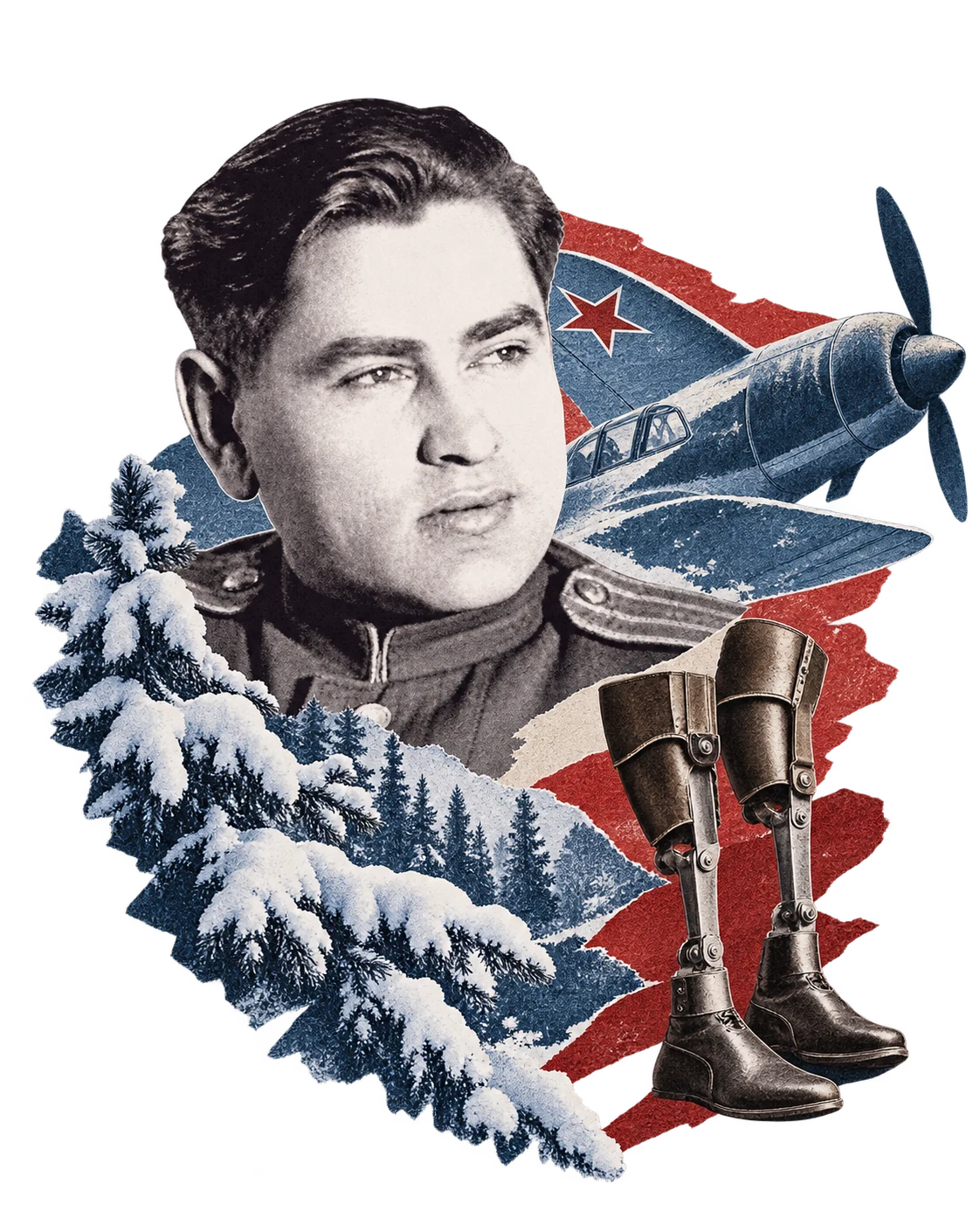
The incredible story of the amputee pilot
A few weeks ago, I told the story of Sir Steuart Robert Douglas Bader, planting clues to this article for the astute reader.
The Red Army, too, had an amputee pilot. He, too, was highly regarded, and this, too, is a story of determination and heroism.
The Story of Alexei Maresyev Petrovich
This is the story of Alexei Maresyev Petrovich.
Alexei Maresyev was born in the town of Kamyshin on May 20, 1916, the youngest of three sons of workers at a wood-processing plant. After graduating from vocational school, he worked at the plant, where his parents also worked. In 1937, he enlisted in the Red Army. He first served as an aircraft mechanic and was later sent to flight school. After completing his training, he was promoted to junior lieutenant and stayed on at the school as an instructor.
After the German invasion of the Soviet Union in June 1941, Alexei asked several times to be transferred to the front to fight instead of teaching. He wanted to be alongside his students in battle, not in a comfortable room far behind the lines. Only in August 1941, after the Germans had advanced toward the city, when danger was right at the door and the German soldiers' sweat could almost be smelled, was Alexei sent to the front along with the other flight instructors. He fought as a pilot in a unit flying Yak-1 interceptor aircraft.
On April 4, 1942, during a bomber escort mission, Maresyev suddenly felt a powerful blow. He knew his plane had been hit by Luftwaffe interceptor aircraft. He had practiced emergency landings hundreds of times: shut off the fuel valves, find a landing site, line up into the wind, and lower the flaps. Everything had to be done quickly, before the plane reached the ground - and he had to keep calm. But the landing was much too fast, and Maresyev was badly injured in the legs. They were crushed inside the wreckage of the plane. Now he had to get away from the plane quickly, before the fuel caught fire and before the rising column of smoke gave away his location to the enemy. And most important: "Just don't let them capture me!" Alexei Maresyev thought. And indeed, he managed to escape from the plane. He found himself wounded, abandoned, hungry, and feverish in a snowy forest clearing, with a terrifying bear looming over him. Only after he killed the bear "with the weapon in his hand" - for there is no determination in the world like that of a Soviet pilot - did Maresyev feel the joy of life throughout his body, even as his legs burned.
He had no idea where he was, but despite his crushed feet he decided to walk, hobble, and crawl across the snow. Along the way, he found the bodies of soldiers. A blizzard swept over him; he crawled and fainted, came to, crawled a little farther, lost track of the days, and finally found his way to a half-destroyed village - but a Soviet village. He arrived there proud of his victory over the enemy: "Our fighters gave them a thorough thrashing here. They beat them so badly, dealt them such a blow, that they won't come back here again. There was a terrible battle here. Countless numbers of them fell! Terrible!"
The Injury and the Return to Service
The villagers take the broad-shouldered, warmhearted Russian hero into their care, wash his wounds, and return him to his base, bleeding and feverish. But Maresyev wants to go back to fighting the enemy, and if possible, immediately. Instead, he is taken to a magnificent hospital in Moscow, and the terrible day arrives - "Amputation! The word echoed in his ears like a catastrophe." Both his legs must be amputated, without anesthesia. Alexei, ever the hero, refuses to despair. "I seem to have become a little shorter," he jokes with the nurse instead of losing consciousness. Even so, Maresyev sinks into despair, thinking that "a pilot without legs is like a bird without wings, which can indeed live and peck at seeds, but will never be able to fly." Encouraged by a wounded man, a veteran Communist who was sharing his hospital room, he began to hope that perhaps he could fly again despite his disability. To return to flying as a fighter pilot, he had to contend with bureaucracy and the disbelief of various officials in the Soviet military and its air force.
The best specialists fit him with advanced prostheses, and Alexei throws himself energetically into the recovery process. He teaches himself to walk, run, and even dance Russian dances for extended periods. To convince the relevant officials that he is capable of returning to service, he also learns to fly without legs.
He appeals to the air force, demanding to be returned to active flying duty. The Russian air force commanders were highly skeptical of a pilot with amputated legs, but, like their English counterparts, they too were won over.
In June 1943, Maresyev joined a unit flying La-5 interceptor aircraft, which was sent to the front in the Kursk area. He took an active part in the Battle of Kursk, and in July 1943, over several days of fighting, he succeeded in shooting down three German planes. His story spread throughout the Soviet Union after an article appeared in the newspaper Pravda, written by journalist Boris Polevoy, who had visited Maresyev's squadron. During the war, Maresyev flew 86 combat missions and shot down 11 enemy planes (4 before his injury and 7 after returning to service following his injury).
Maresyev was awarded several medals: Hero of the Soviet Union, the Order of Lenin, the Order of the Red Banner, the Order of the October Revolution, the Order of the Patriotic War, First Class, and the Order of the Red Star. In 1946, Polevoy's book A Story About a Real Man, which tells Alexei Maresyev's story, was published. The book was translated into Hebrew and was highly successful. In 1948, it was adapted into a film and even won the Stalin Prize.
Maresyev became a famous figure throughout the Soviet Union and the countries of the Eastern Bloc, chiefly thanks to Boris Polevoy's book, which was required reading in high schools. He often appeared at various celebrations and frequently gave talks to school students. Few of our Russian-speaking brothers and sisters are unfamiliar with him.
Alexei Maresyev died of a heart attack on May 18, 2001, about an hour before the start of a tribute event marking his 85th birthday, which Russian President Vladimir Putin was also expected to attend.
תגובות
עדיין אין תגובות.