
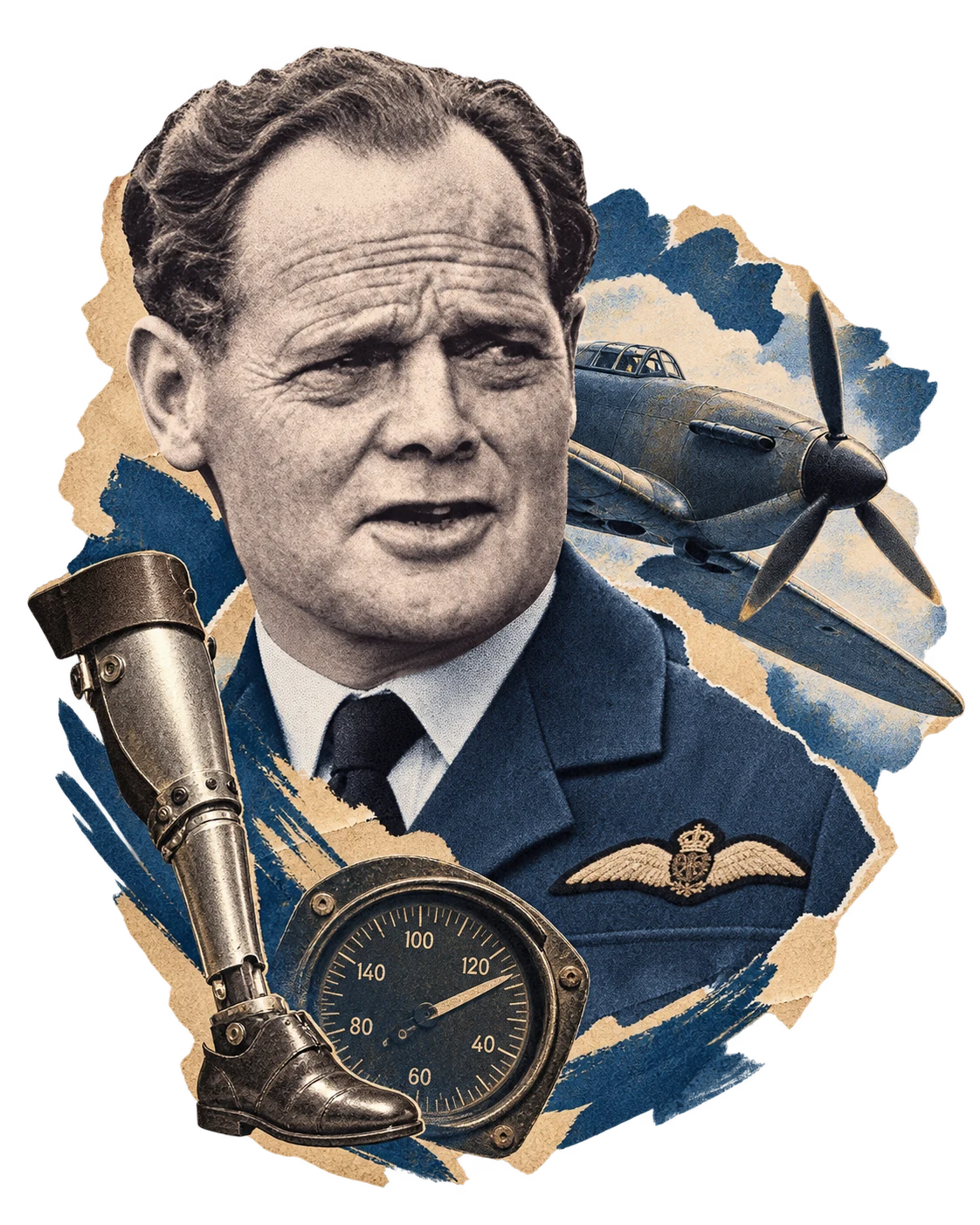
The story of a whole man.
His Childhood and the Attraction to Airplanes
Britain's Royal Air Force pilots have won many accolades since Winston Churchill declared that "Never in the field of human conflict was so much owed by so many to so few." This was in August 1940, during the Battle of Britain between the RAF and the Luftwaffe, the German air force. The image of a "pilot" as a fit, brave, handsome officer with keen senses is true in most cases. An active pilot with a disability seems an unimaginable paradox. And yet, throughout history, it has happened more than once.
This is the story of Captain Sir Stuart Robert Douglas Bader. Douglas was born in London on February 10, 1910. His father, Frederick, was a municipal engineer, and when Douglas was just a few months old, his parents went to work in India. They thought India's hot climate would not suit the very young Douglas, so they left him in England until he was two years old. Frederick Sr. died during the First World War, and his mother, Jessie, remarried.
His mother's second marriage did not affect Douglas. He spent most of his time with his aunt, Hazel Bader, and her husband, Lieutenant Cyril Burge, an adjutant at the Royal Air Force flying school. It was in Hazel and Cyril's home that Douglas developed his intense love of aircraft and flying, a love that would last all his life. Such a love is not unusual, and is common among most pilots. When people talk about flying and aircraft, their excitement grows and they speak faster. Like most pilots, Douglas was an outstanding athlete at his school in Oxford, and after becoming a cadet in Cornwall, he represented the college in boxing, cricket, hockey, and rugby. At the ceremony for the presentation of the college's Sword of Honor, one of the students said of him: "To us, Bader is a kind of god, playing every game imaginable and an outstanding player on every team."
In 1930, on completing his studies at the college, Douglas was invited to join the Royal Air Force.
Douglas was a gifted pilot and earned a place of honor in the squadron's four-pilot aerobatic team. He was utterly fearless and pushed his biplane beyond its limits. On December 14, 1931, after logging about 500 hours of flight time, he performed loops below the permitted altitude during a demonstration flight. He brought his plane down to a height of just nine meters; one of its wings struck the ground and the plane crashed. Miraculously, Douglas survived. The doctor, Dr. Leonard Joyce, had to amputate both of Douglas's legs.
Rehabilitation and the Return to Service
No one expected 21-year-old Douglas to survive the operation, but he had a fierce will to live and deep determination. During his grueling rehabilitation, he met the love of his life, Thelma Edwards; they married in 1935. Douglas was given two artificial metal legs (prostheses) and had to learn to use them. He was told he would need crutches to help with his recovery and should get used to them because he would never be able to walk without them. Douglas replied, "On the contrary, I'll never walk with them" - and so it was: he never used them. He relied on his reflexes, coordination, and willpower. After leaving the Royal Air Force, he began working for an Asian oil company and, since he could no longer fly, made do with wild rides in a sports car specially adapted for him.
When the Second World War broke out in 1939, Douglas immediately tried to re-enlist in the Royal Air Force. His application was initially rejected on the grounds that no regulation allowed someone in his condition to fly. He promptly replied that no regulation prohibited him from flying. But when England desperately needed pilots, Douglas climbed aboard the Harvard, the Royal Navy's advanced trainer, and within minutes proved that flying was like riding a bicycle: a few rolls and loops showed that he was a born pilot, even if he was an amputee. In November 1939, Douglas joined the Royal Air Force as a full-fledged pilot, and on his very first day he hurried to perform the maneuver that had nearly cost him his life eight years earlier: flying upside down at grass-top height. He was later assigned to No. 222 Squadron as its commander. In this role, he returned to flying and scored his first kill. This achievement earned him command of the "Canadian" No. 242 Squadron.
The demoralized Canadian squadron was not enthusiastic about its new commander, a man with amputated legs. To show the pilots who they were dealing with, Douglas performed a complex aerobatic routine in a Hurricane, winning their immediate admiration and unwavering loyalty. In the fierce aerial battles raging over England and the English Channel, the squadron shot down dozens of German fighters and bombers, with Douglas himself recording 11 kills.
In 1941, Douglas Bader was appointed wing commander. The Royal Air Force then launched a major offensive over France, forcing the Germans onto the defensive. Bader's wing escorted bombers, hoping that Luftwaffe interceptors would engage British aircraft in aerial combat. In August of that year, Douglas's plane was shot down over northwestern France during a major battle between aircraft from his wing and those of the Luftwaffe's 26th Wing. Douglas managed to shoot down two Messerschmitts before he was shot down himself. According to German pilots' accounts, he was shot down by a German pilot. According to Douglas's own account, the damage resulted from a collision between his plane and a German Messerschmitt. In any case, Douglas found himself inside a spinning Spitfire. He tried to open the canopy and jump out, but one of his prostheses got stuck in the cockpit. Spinning between sky and earth, he managed to detach the prosthesis from the stump and parachute to safety. He landed unhurt and spent the rest of the war in a German prisoner-of-war camp.
While in German captivity, Douglas asked to send word to the British to drop off a replacement prosthesis for his right leg, to replace the one lost with his plane. In a surprising move, the Germans agreed to pass on the message, and some time later the British dropped a prosthesis for him in a container during one of their bombing raids.
The prosthesis was slightly damaged on landing, but the Germans repaired it and delivered it to Douglas, who was then being held in the hospital. They had not quite understood the extent of their mistake. He secured it to his right stump and, when no one was looking, walked normally out of the hospital in an attempt to escape. He was, of course, caught, but continued to maintain a cheerful, rebellious spirit in the prisoner-of-war camps to which he was transferred, earning great respect everywhere. Eventually, when the Germans had had enough of him, they decided to transfer him to Colditz Castle, which was supposed to be "escape-proof."
Douglas tried to escape so many times that the Germans had to take away his artificial legs. A huge outcry followed, and the Germans' embarrassment led them to return them to him. Douglas immediately tried to escape again and was caught by the Germans once more. He was still in Colditz Castle when the Americans liberated the camp. After his release, he returned to England and was appointed group captain. When the war ended, Douglas saw no reason to remain in the military during peacetime and joined the aviation department of a civilian company called SHELL OIL. The job came with an important benefit for him: his own plane.
In the early 1950s, British author Paul Brickhill, who specialized in writing about aviation, wrote Douglas Bader's biography, which became a bestseller in Britain and around the world. The book, Reach for the Sky, was also translated into Hebrew.
In 1976, Douglas was awarded the Order of the British Empire for his service, the encouragement he gave to amputees, and his work on behalf of people with disabilities. Around this time he developed a heart condition, and his heavy workload made it worse. Douglas died of a heart attack on September 5, 1982, at the age of 72.
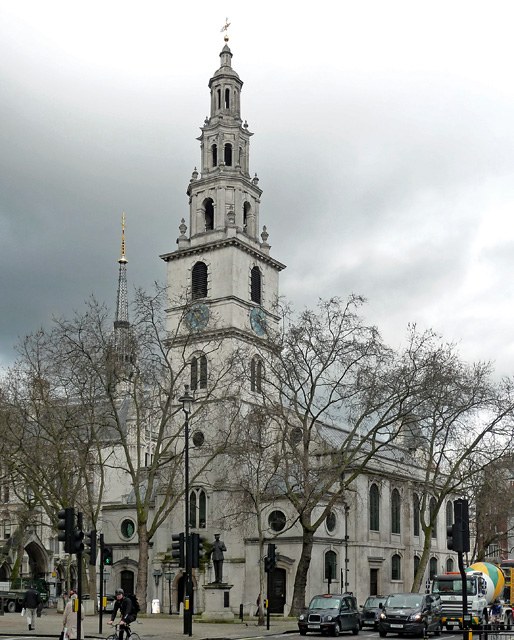
Douglas Bader's prosthetic legs are on display at the RAF Museum in Stafford.
תגובות
עדיין אין תגובות.