
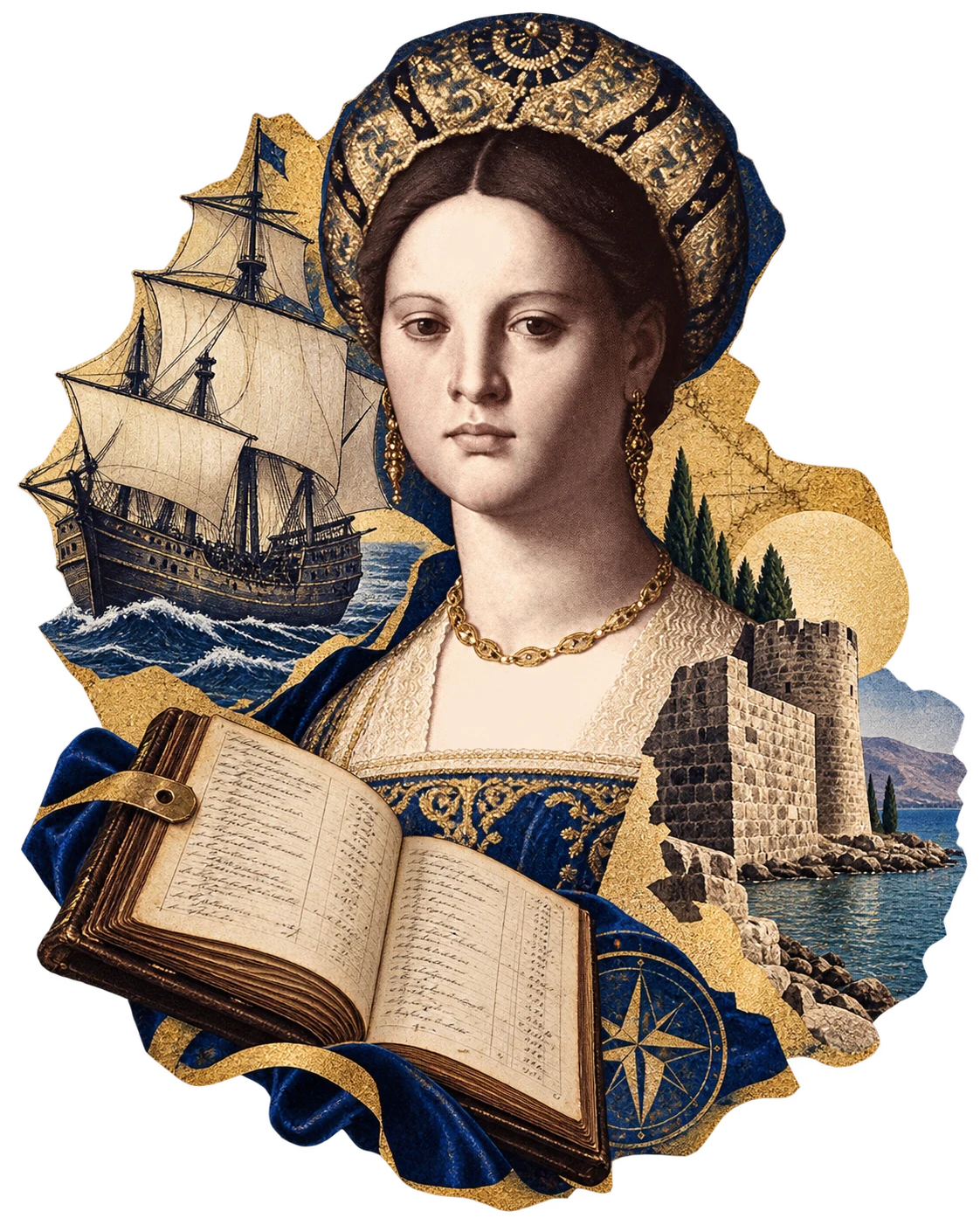
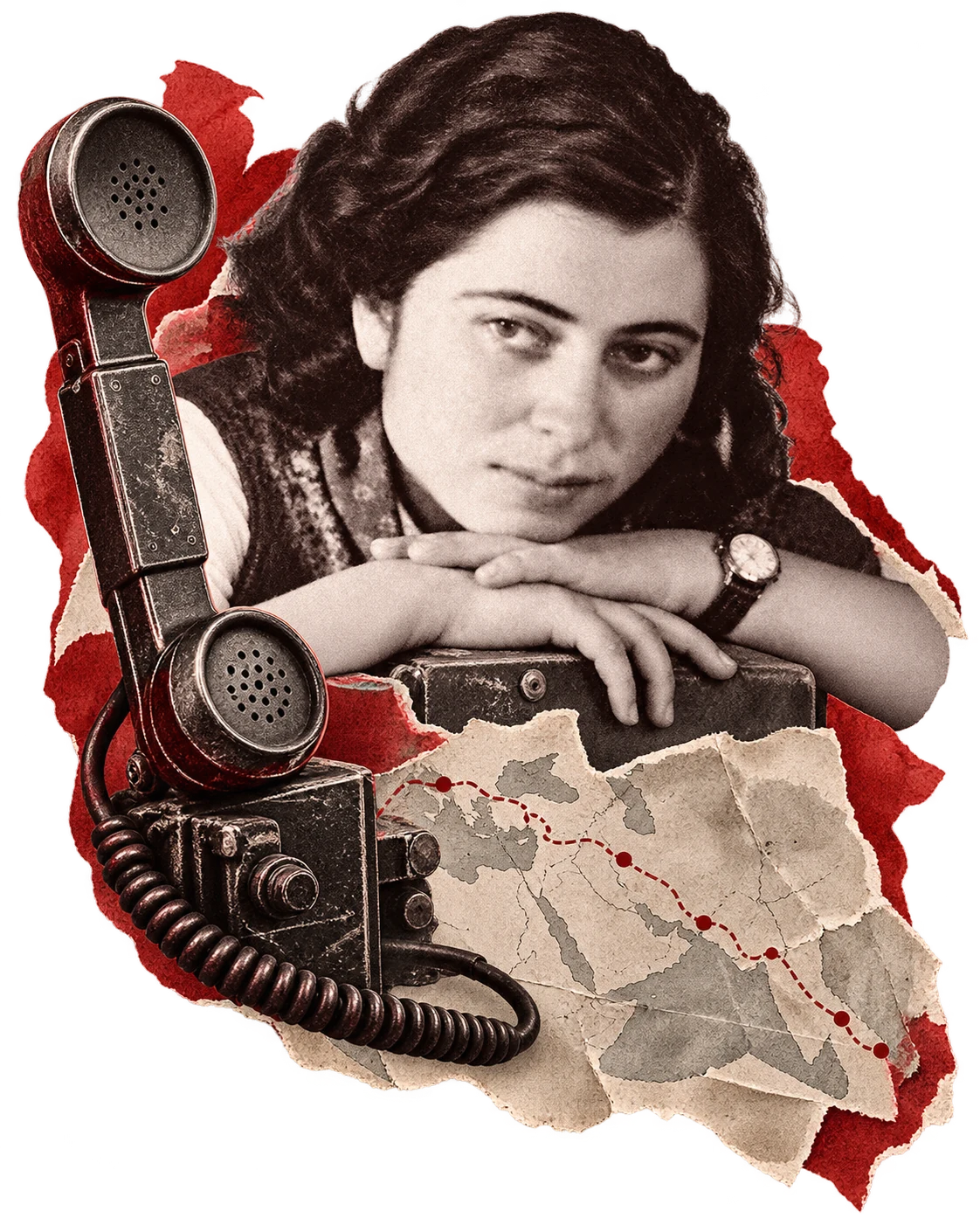
The wealthiest woman in Europe, she was ahead of Herzl in envisioning a Jewish state and ahead of Baron Rothschild in donating to establish settlements in the Land of Israel. She was the only person to openly wage war against the pope.
The Roots of the Mendes Family
The family’s roots go back to Don Abraham Benveniste of Soria, who served as treasurer and tax collector of Castile, alongside his cousin, Don Joseph Nasi, who was the chief rabbi of Castilian Jewry. Sixty years later, in 1492, as Columbus set out on his voyage, the expulsion of the Jews from Spain began. Don Abraham’s grandsons negotiated with the king of Portugal, and in the end 120,00 Jews from Spain went into exile in Portugal in exchange for a great deal of money. In Portugal, Don Abraham’s great-grandchildren became conversos and were known as Mendesh, and later as Mendes. Among the exiles were businesspeople, writers, doctors, intellectuals, and others. The flight of this human capital from Spain affected its future, and the country declined from its former greatness; some say that the effects of this exodus are still felt today. The brothers went their separate ways: one moved to Portugal and the other to Antwerp, Belgium, but they continued to run their businesses together. They built a financial empire, amassing wealth through a monopoly on the import of black pepper from India, then known as “black gold.” The company grew, and many branches opened across Europe. The brothers founded the Mendes Bank, which lent money to kings to finance their wars and to popes.
“Conversos” (converts) and “Marranos” (Spanish for “pigs”) were among the names given to Jews in Spain and Portugal who were forced to convert to Christianity. These Jews continued to observe Jewish commandments in secret and, for fear of assimilation, made sure to marry among themselves. The Mendes (Nasi) family did the same.
Discovering the Jewish Identity
Beatriz de Luna Gracia was born in Portugal in 1510 to a Jewish family whose members were converts who had fled Spain. She was baptized as a Christian, but the Jewish name she was given was Hannah Gracia Nasi. Her father was Dr. Agostino (Samuel) Micas, a physician who taught medicine at the University of Lisbon. At a young age, she understood that her parents’ trips down to the cellar were a secret that could cost them their lives. As she approached her twelfth birthday, her parents told her that on that day she would go down to the cellar with them. When the long-awaited day came and she descended into the cellar, her heart pounded. After a few minutes, as her eyes adjusted to the darkness, she saw that the room contained a few books, and that beneath a small lamp stood a cabinet covered by a curtain. When her parents drew back the curtain and opened the cabinet, she saw the Torah scroll, which told the story of her ancestors and, above all, served as the ethical guide of her faith. From that moment on, she began to wonder what mission she had been born to fulfill. Beatriz de Luna was enchanted and decided to secretly embrace the faith of her ancestors.
At eighteen, she was married in an arranged match to Francisco (Tzemach) Mendes, Don Abraham’s grandson and a member of the Benveniste family. He was then forty-eight, and they had one daughter, named Reyna. Beatriz de Luna loved and admired her husband, but their happiness ended seven years later, when he died in 1536. Beatriz de Luna was left a widow at twenty-six, with a young child to care for. After the Christian burial ceremony, Beatriz returned to the cemetery at night and tearfully bade farewell to her husband and the members of her family buried there. She promised her husband that she would carry out his will and take his remains to Jerusalem, then said goodbye to him forever. After her husband’s death, King João III of Portugal, coveting her wealth, demanded that she place her daughter Reyna in the royal court so that she could receive an excellent Catholic education. The king planned to marry Reyna to one of his associates and use the marriage to take control of Beatriz’s wealth. Beatriz de Luna understood the great danger and moved to Antwerp with her younger sister Brianda and her daughter. Together with her brother-in-law Diego (Meir, Francisco Tzemach’s brother), she continued to manage the businesses she had inherited, at a time when most women could neither read nor write. The young Beatriz de Luna controlled an enormous variety of businesses that required extensive knowledge and intelligence, including banking, real estate, international trade, maritime transport, and more. She lived in lavish palaces, maintained a vast staff of servants and advisers, and was in contact with leading merchants and many rulers.
The Rescue Network and the Escape
Alongside managing the businesses, Diego and Beatriz worked to save Jews and their property from the persecution of the Inquisition and to resettle them in neutral countries. They used their connections and paid bribes to smugglers who took Jews to countries such as Tunisia, Algeria, Morocco, Russia, and Brazil. The smuggling network was exposed when they smuggled the wife of the king of Portugal’s physician and her four sons to the Mendes home in Antwerp, from where they were taken to Salonica. One of the sons, who had been raised as a Christian, had a change of heart and informed on them, and Diego was arrested. Diego was released only after enormous bribes had been paid and Henry VIII, King of England, testified that Diego was a devout Christian. After his release, Diego married Brianda, Beatriz de Luna’s sister. They had a daughter named Gracia, but to distinguish her from Gracia, the heroine of this story, she was given the nickname Chica (little one). Life in Antwerp was dangerous, and the family decided to flee. While they were planning their escape, Diego died, leaving a clear will that Beatriz de Luna should continue to manage his businesses and also become the guardian of Gracia Chica.
Queen Mary, sister of Emperor Charles V, who also ruled Antwerp, became Beatriz’s closest friend. Her only daughter, Reyna, grew up to be a beautiful young woman whose dowry fired the imagination of every prince in Europe. One of them was Francisco, Prince of Aragon, who approached Emperor Charles and promised him a fortune if he arranged a match with Reyna. The king asked his sister Mary to arrange the marriage, and Beatriz realized that she had no choice but to flee Antwerp. She came up with a brilliant plan. Her nephew and business partner, Don Joseph Nasi (a great-grandson of Don Joseph, Abraham’s cousin), staged Reyna’s “abduction” to Venice, and her “furious” mother set out after her to rescue her. Later, at Beatriz’s instruction, Don Joseph was sent to Antwerp to bribe Queen Mary and Emperor Charles and suppress the whole affair.
Brianda, Diego’s widow, had not been involved in managing the businesses her husband left behind, and devoted most of her time to the pleasures of life in bustling Venice. She leaned toward Christianity, and when Jews began to be persecuted in Venice as well, Beatriz de Luna decided to move to the Duchy of Ferrara, which was tolerant toward Jews. Brianda wanted to continue enjoying life in Venice and was enraged that her husband had left her no share of his inheritance. She informed the authorities that her sister Beatriz de Luna was Christian only in appearance and secretly continued to observe Jewish law. She also said that her sister planned to flee and take her bank’s fortune with her. The authorities arrested Beatriz de Luna Gracia, confiscated her property, and took her daughter Reyna and her niece Gracia Chica to a convent to receive a Catholic education. Beatriz de Luna appealed to the kings of Europe for help, but they, like the Venetians, saw it as an opportunity to avoid repaying their loans and ignored her. Help came from her nephew, Don Joseph Nasi, who used his connections at the Ottoman sultan’s court. The sultan issued the Venetians a clear ultimatum: release her and return her property. Faced with the sultan’s immense power, they gave in.
Beatriz moved to Ferrara, where, for the first time, she openly declared her Judaism and took her Jewish name, Dona Hannah Gracia Nasi. In time, she became known as Dona Gracia, or “the Lady.” She later reconciled with her sister Brianda, who, along with her daughter, also openly declared her Judaism and returned to her Jewish family name, “Nasi.”
The Boycott of Ancona
One of the most important events in Jewish history took place during the papacy of Paul III (1534-1549). With his approval, a group of wealthy converts who had returned to Judaism moved from Portugal to the major port city of Ancona in Italy. He was even pleased by their arrival and promised them protection and freedom. In 1555, Paul IV came to the papal throne, after the death of Pope Marcellus II, whose papacy lasted only 22 days. Paul IV became known for his cruelty and religious fanaticism; even within the Church, some called him “the madman.” Paul IV disregarded Paul III’s decision and ordered the Jews seized and their property confiscated. He had them interrogated in the Inquisition’s torture chambers and sentenced them to death by burning. Among those condemned to death were Dona Gracia’s agent, Jacob Muso, and another agent, Isaac Argaz of Ragusa. At first, an attempt was made to raise money to ransom the Jews. When, in an unusual move, the pope refused, they turned to Dona Gracia for help. Joseph ha-Kohen, who lived at the time, wrote of this event: “In Constantinople there is a great woman, greater than the other conversos, named Beatriz. She went to King Suleiman and pleaded with him, and he sent word to the wicked Paul: ‘Release your men.’” In March 1556, the sultan sent a letter to Paul IV, warning him not to dare lay a hand on his “subjects.” He also hinted, not subtly, that the fate of Christians living in the Ottoman Empire depended on the pope’s response. At this point, the city’s Christian notables also appealed to the pope, asking him to move the Jews to another city and not harm them. They made this appeal because they feared the pope’s decision would damage their trade relations with the Jews. Efforts to free them came to nothing, and 24 Jews (23 men and one woman) were burned at the stake in Piazza della Mostra, in the heart of the city. Years later, it was written: “To this day, in Ancona, on the Ninth of Av, they recite a lament for the martyrs who died, composed by Rabbi Mordecai ben Elijah Tzablanis or Rabbi Jacob di Zano.”
In response, Dona Gracia and Don Joseph Nasi placed the port of Ancona under a boycott, an action known as the “Ancona boycott.” They announced that their ships would not dock at the port and moved their operations to the port of Pesaro. The boycott drove Ancona into bankruptcy. The boycott and its consequences became the talk of the day around the world, since it was extraordinarily bold to wage a war against the most powerful man in Europe, the pope. Quite a few rabbis supported the daring move, but others opposed it. Rabbi Basola, Ancona’s rabbi, feared the consequences and called on people not to join the boycott, since it endangered all the Jews of Italy under the rule of the “mad” pope. The rabbi of Pesaro, on the other hand, called for support for the boycott: “You are called upon to make financial sacrifices for this campaign, while your brothers did not hesitate to be burned alive. Know and remember that the great sacrifice you may be called upon to make in support of the boycott is nothing compared to the Jewish heroism of our tormented brothers, burned in the flames by the enemy of the Jews.” The pope acted quickly to limit the damage and exempted ships wishing to dock in Ancona from paying docking fees. The Jews’ prayers were answered, and in 1559 Pope Paul IV died. Nevertheless, the affair did not end there. The prince of Pesaro, realizing that the boycott was not working, expelled the Jews from his state, but the port of Ancona never regained its former glory.
In 1559, a succession struggle began over the rule of Sultan Suleiman the Magnificent, between his sons Selim and Bayezid. During this sensitive period, Don Joseph Nasi maintained ties with both brothers, but he favored Selim, who appointed him his foreign minister. At the same time, Dona Gracia moved into her new palace in the elegant suburb of Galata, in the European quarter of Constantinople. Forty armed horsemen accompanied her entrance into the city, and a procession of splendid carriages escorted her to her palace. Don Joseph Nasi was joined by his brother Samuel, and the two were described as tall, elegant, and strong men. Reyna fell in love with Don Joseph, the man who had supposedly “abducted” her to save her, while Brianda’s daughter, Gracia Chica, fell in love with his brother Samuel. The two women set one condition for the brothers, who wished to marry them: that they fully return to Judaism. The brothers agreed, and despite their advanced age, underwent circumcision. In Constantinople, twenty years after the death of her beloved husband Francisco, Dona Gracia fulfilled her promise and brought his remains to the Land of Israel, to the Valley of Jehoshaphat in Jerusalem.
Dona Gracia built synagogues, yeshivas, and hospitals in Constantinople. One of the synagogues she built in Izmir still stands and is named “La Senora” after her. The fact that the synagogue is called only “the Lady,” without her name being given explicitly, attests to her prominent standing among Spanish Jews.
The Vision for Tiberias
After establishing her position in the Ottoman Empire, Dona Gracia set herself a new goal, anticipating Herzl’s vision by 330 years and Baron Rothschild’s support for settlement in the Land of Israel. Like Herzl, she understood that the solution to the Jewish plight lay in establishing Jewish settlements in the Land of Israel. The rabbis she admired, Rabbi Joseph Caro, author of the Shulchan Aruch, and Rabbi Berab, who tried to revive the practice of rabbinic ordination, already lived in Safed and taught a small community of students.
In 1561, Dona Gracia and Don Joseph Nasi petitioned the sultan for permission to lease land in Jerusalem. The sultan did not approve their request, but did allow them to lease the lands of Tiberias, then a poor, insignificant town with a few small villages around it. Their idea was to establish a settlement with an economic foundation based on agriculture, industry, and trade. Ships were sent to Venice and Ancona to bring Jewish craftspeople. They began building homes and a synagogue, and planted mulberry, date, and orange trees, as well as pines. The foundations of a textile industry and the export of dates and oranges were laid, and a wall was built around the city to ensure the Jews’ safety.
Dona Gracia planned to move to Tiberias and spend her final years in the atmosphere of the Land of Israel, on the shores of the Sea of Galilee. The Portuguese Pantaleão de Aveiro, who visited the Land of Israel around 1565, reported: “I heard from several Portuguese Jews about a Portuguese woman who fled this kingdom with great wealth, which gave her much power and influence and made her name famous in these lands, and about how she bought the city of Tiberias... They said that next summer she would come from Constantinople with all her family to live in Tiberias, along with all the Jews who wished to follow her.” News of her arrival filled the Jews with hope, because they believed that once they settled there, the Messiah would have to come as well. In 1564, construction of the wall was completed, and the city was ready to receive the new settlers. The Jews who had been expelled from Spain, moved on to Portugal and then to Italy, and were now in safe places such as Turkey, Tunisia, and Algeria, did not want to take another risk and rebuild their lives in the Land of Israel. Only a small handful made their way to the city. These settlers suffered attacks by Bedouins, and a few years later only a very small number of Jews remained in the city.
Dona Gracia, whose life had been full of tension, wandering, and unremitting struggles, grew weak and old. In 1569, Dona Gracia died in Constantinople at the age of 59. Streets in various Israeli cities and a lookout above the city of Tiberias were named after her.
Don Joseph Nasi was appointed by Selim as governor of the Greek islands conquered from Venice and was given the title Duke of Naxos. He moved to Cyprus, and the sultan seized his vast property.
תגובות
עדיין אין תגובות.