
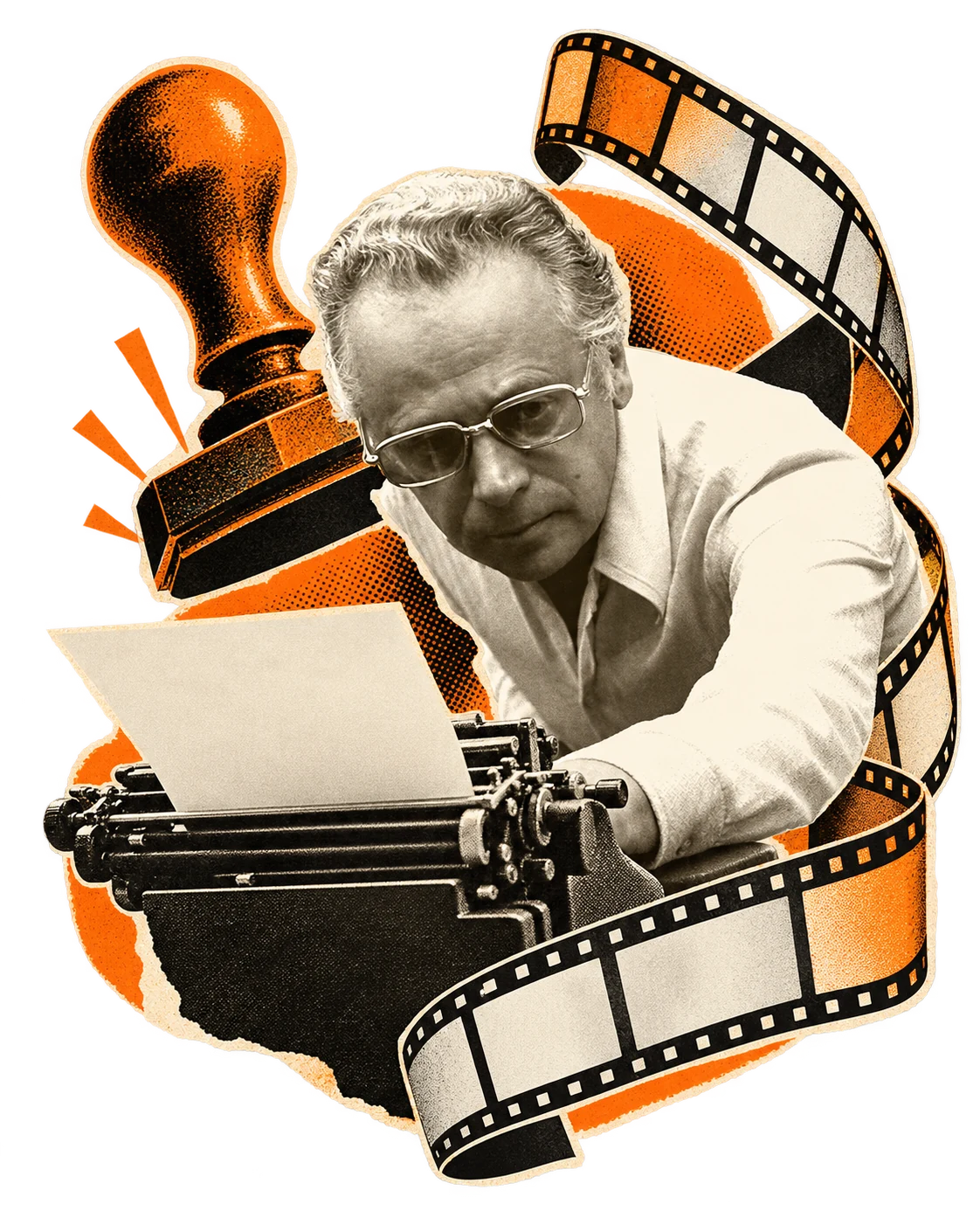
I hereby inform you that this entry may make you laugh (read this opening in a thick Hungarian accent). And what's more, it's about a phenomenal creator who made an entire generation laugh, wrote 50 books, was a newspaper columnist for about 30 years, wrote, directed and produced 7 films, and won dozens of awards. Ephraim Kishon In May 1952, the following announcement appeared:
Kishon's Satirical Humor
"To the masses, I hereby announce publicly, to all whom it may concern, that a new column has opened here, and will appear daily at exactly the same time as the newspaper. The column is written in a humorous, all-party spirit, for the success of the state in our time. But since humor, too, is naturally divided into several factions, types and currents, it is worth showing the ordinary person how to recognize the kind of humor he will encounter every day in this column. So, according to all the experiments, if the interested reader understands nothing in the column but laughs anyway, it means he has encountered pure humor; if he neither understands nor laughs, then this is grand satire; and if he both laughs and understands, then he has read an old Yiddish joke."
For about 30 years, the column "Chad Gadya" appeared. It was a witty humor column in which Ephraim Kishon poked fun at various tradesmen, Histadrut officials and politicians, all with a razor-sharp tongue. Some of these columns give the impression that he predicted the future, and remain just as relevant today as they were back then.
Ephraim Kishon survived two of the worst regimes in human history - the Nazi regime and the Soviet regime. Kishon was born in Hungary in 1924 and immigrated to Israel in 1949. He had not grown up with Hebrew culture or the Hebrew language, but mastered Hebrew in a short time and made it his livelihood. His talent stands out especially when compared with Alterman or Bialik, who were also new immigrants, but unlike him, they had grown up immersed in Hebrew culture, and by the time they came to Israel, Hebrew was already familiar to them.
Once he had mastered the language and bent it to his purposes, his books began to be translated in the late 1950s. To date, they have been translated into 37 languages, including Braille, and in some of those languages, the books even became bestsellers. His book in English, "Look Back Mrs. Lot," was the "Book of the Month" of The New York Times, and the critics compared him to Sholem Aleichem and Mark Twain. In Germany, he was chosen as the country's most-translated and most-read foreign author, making his translator wealthy. Ephraim Kishon is considered the most widely read Hebrew author, and his books have sold more than 40 million copies around the world.
'Partachia Without End'
In Israel, Kishon encountered Palmach-style humor and Yiddish humor, and created a distinctive humor of his own, critical of the state and its institutions, yet also full of appreciation, as in the following piece: "Partachia Without End"
"At the eastern edge of the Mediterranean basin, around Dizengoff Street, lies a small but great republic: Upper Partachia. The climate of this land is extremely subtropical, and humidity and taxes are especially high there. As a result, a new kind of population has emerged, with a distinctly Galician-Oriental outlook: the famous tribe of the Partachians. The average Partachian can be identified by his special talent: at three-thirty, he has to be in Haifa. What's more, he is late... If you can find him, it is usually in places with a sign reading 'Absolutely No Entry.' If a little Partachian enters a place, he immediately touches everything to see if it's real. He sees a sandwich and takes a bite; he sees a button and turns it. He likes to rummage around. In pockets, in drawers, in noses... The Partachian eats noisily, walks noisily, talks noisily. He complains about the noise. If his television set whistles, after a year he calls the repairman. The repairman says, 'Try lifting one side.' He lifts it, and the noise stops. He puts a matchbox under the left side of the set. If the noise starts again, he changes the box. Or hits the set. On the side and on top... The Partachian language has a rich vocabulary of expressions. 'It'll be all right' means disaster. 'Count on it!' hints that something is impossible. 'In a moment' means two hours. 'A day or two' means a year. 'After the holidays' means never... In war, he usually wins. The Partachian drives his tank in the wrong direction because he dozed off for a moment, beats the enemy soundly, comes back, and wins... He's really a good fellow, the typical Partachian."
From Sobibor to Hebrew
Ephraim Kishon's life story could easily fill a 20-episode television series. He was born in 1924 as Franz Hoffman. His talent became apparent at an early age. At 16, he was an outstanding student, but Hungary was then swept by antisemitism, which forced him to stop his studies. At 20, he was imprisoned in a concentration camp in Hungary and taken to the Sobibor extermination camp in Poland, from which he managed to escape. Kishon returned to Budapest and hid with his father and sister in the cellar of their neighbor, Yosef Gabrovitz. For this act of rescue, Gabrovitz was awarded the title Righteous Among the Nations. On the back cover of his book "Scapegoat," which deals with the Holocaust, Kishon wrote: "They made a mistake. They left one satirist alive." Years later, his son said: "Once, on German television, they asked Dad how he had become the best-known Jewish satirist. With uncharacteristic modesty, he answered, 'We had lots of talented people, but you killed them all, and I was lucky enough to survive.'"
Just when it seemed the nightmare was over, the Soviet regime took its turn. During this period, he published humorous articles under the name Franz Kishont. His free spirit told him that he had to flee Hungary, and so, in 1949, Ephraim and his wife Hava disembarked from the ship Galila. In Israel, a Jewish Agency official gave him the name Ephraim Kishon, and the couple were sent to the Sha'ar HaAliyah transit camp near Haifa. There, they shared an apartment with a large family that had immigrated from Morocco. Just a few tents away lived Ze'ev Revach's family. Years later, Revach would play the lead in one of Kishon's most famous plays. Ze'ev, from Morocco, was then 12, and Ephraim, from Hungary, was 26 - both were new immigrants.
From the transit camp, Ephraim and Hava Kishon moved to Kibbutz Kfar HaHoresh. He worked there as a janitor, and later recalled: "I discovered that it took no more than an hour and a half to scrub the toilets. In the time left over, I could study Hebrew from old grammar books." From Kfar HaHoresh, they moved to Tel Aviv, where he turned the language into a profession. He first worked in the print shop of the newspaper Davar, where he met Chaim Topol for the first time. Topol was then 14. Their paths crossed again later, when Chaim Topol headed the Nahal troupe and recruited Kishon to write the sketch "Saadia and Welfare Assistance," later renamed by its better-known title, "Sallah Shabati." To critics who claimed he was racist and portrayed Moroccans as inferior, he replied with one word: "Kadakhat" ("fever") - or, more precisely, "Kadahet."
Just two years after arriving in Israel, his first book, "The Immigrant Who Gets Under Our Skin," was published. In it, his talent for playing with language became clear: "These teachers, the arrogant ones, drunk on the intoxicating wine of the Hebrew words in their bellies, are all afflicted with a disease of juggling. They are forever dazzling their pupils with the magic of Hebrew, and if we ask them, for example, how to say 'I am coming' in Hebrew, the Einstein of Hebrew grammar immediately rolls up his sleeves and says: 'Ani ba' means that I am going to you, but don't confuse it with 'niba,' which means prophesied, as in the prophecy 'The prophet prophesied' (Isaiah 67:25); and you mustn't replace 'the prophet' with the word 'navi,' which means 'we will bring,' as in 'we will bring the book here,' for example. And immediately he asks something from what we have already learned: What is a 'lavi'? A lavi is a horned wild animal! We all answer in unison. And now the great hunt begins. 'Then what is a tzvi?' A tzvi is a little animal that has, um... a bone shirt!' someone blurts out. 'Aha!' says the teacher in Hebrew. 'Then what is a tzav?' I point to my right side and proudly say, 'That's a side!' He looks at me with a compassionate smile. 'Then, Ilonka, what is a tzad?' Ilonka is the most diligent student. 'Tzad,' she answers, blushing, 'is a command.' 'A command,' says the teacher in despair. 'Then what is a tzav - you, Sandor!' Sandor: 'A tzav is' - he points to his back - 'the back side of a person.' The teacher swallows hard, but doesn't give up. 'Sarah! What is a back?'"
Less than three years after immigrating, he was already a columnist for the newspaper Maariv. Four years after his arrival, Habima Theatre staged his first play in Hebrew, "His Reputation Precedes Him," and it was a great success. For the first time, there was a writer who dared to take a jab at Mapai rule. A dialogue like "Which party do you belong to, sir? - I don't belong to one; I already have public housing!" was a novelty in those days. Kishon excelled not only at writing. He was also an excellent chess player, a goldsmith, a painter and a talented billiards player. The Israeli billiards championship is held in his name.
Some of the columns he wrote were turned into excellent films. This was the case with a 1952 column in the newspaper Davar about a man who escapes from a mental hospital and digs a canal on Allenby Street. Seventeen years later, the film "The Blaumilch Canal" was made from the column. In 2014, Guri Alfi created a stage adaptation of "The Blaumilch Canal" and took issue with the criticism of Kishon, who was right-wing, and the claim that his works had not stood the test of time. Guri said: "Kishon was driven crazy by the lack of recognition at home, so he got himself an 'export certificate.' It was sarcasm worthy of the man, but there was a lot of bitterness in it. All his life, he suffered because his work was classified as second- and third-rate culture. A million people saw 'The Blaumilch Canal'; 'Sallah Shabati' went on for a thousand performances, but the establishment wasn't convinced. Because he wasn't sociable, nice, ingratiating and left-wing enough."
Switzerland and the Return to the Center
In the 1970s, stung by the criticism, Kishon moved most of his activities to Switzerland. Only in the 1990s did he return to the center of the Israeli consensus, with his support for the Oslo Accords.
Kishon made five films. He was the first Israeli to earn an Oscar nomination for an Israeli film, "Sallah Shabati," and also for his film "The Policeman." His films won Golden Globe Awards.
"Someone once asked me, 'Sir, what language do you dream in?' I said, 'I dream in Hebrew with Hungarian subtitles.' I know English very well, and I write and lecture freely in German, so there's a bit of a jumble, like my whole life. I'm not Hungarian, and I'm not a Sabra, and I'm not Swiss or German at all, and least of all am I a citizen of the world. Nonsense. I'm Israeli."
In the country's fiftieth year, he wrote the following column: "This is such a small country that its area on the world map isn't big enough to write its name inside it. This is the only country in the world built by its taxpayers abroad. This is a country with unlimited borders. This is the narrowest country in the world; this is the country of troubles. This is a country where mothers learn their mother tongue from their children... This is a country where people write Hebrew, read English and speak Russian. This is a country where every citizen has the right to express an opinion, but there is no law requiring anyone to listen. This is the most advanced country in the Middle East - thanks to its neighbors... This is a country that separated religion from the state, and ever since, religion alone has ruled it... This is a country that overcame the Arab boycott but not the municipal sanitation workers' strike... This is a country that is an inseparable part of its trade unions... This is a country where people don't expect miracles, but take them into account. This is a country whose existence is in constant danger, but whose residents get ulcers from the neighbors upstairs... This is a country where every person is a soldier, and yet every soldier is a person. This is a country that is fifty, but as wise and experienced as a twenty-year-old... This is the only country I can live in. This is my country!"
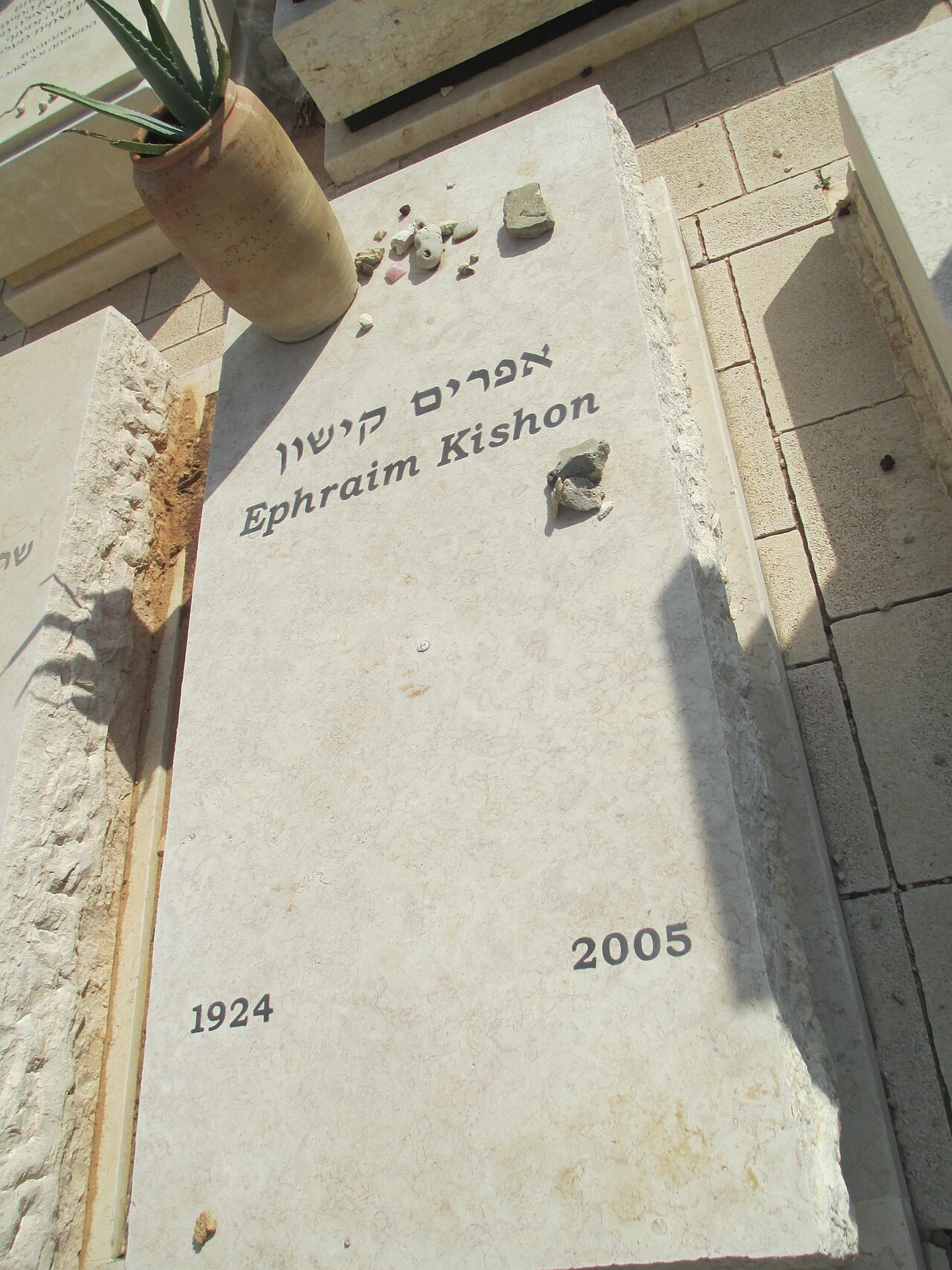
Ephraim and his first wife, Hava, had a son, Rafi, who became a veterinarian. With Sara, his second wife, he had Amir and Renana. In 2005, he suffered a heart attack and collapsed in the shower at his home in Switzerland. His wife rushed to him, and he managed to say, "I just sat down for a moment to rest" - those were his last words. Ephraim Kishon died at the age of 80, lucid and still full of vigor. He was buried at Trumpeldor Cemetery in Tel Aviv, leaving behind 3 children, 6 grandchildren and an enormous body of work that still makes us laugh today.
תגובות
עדיין אין תגובות.