
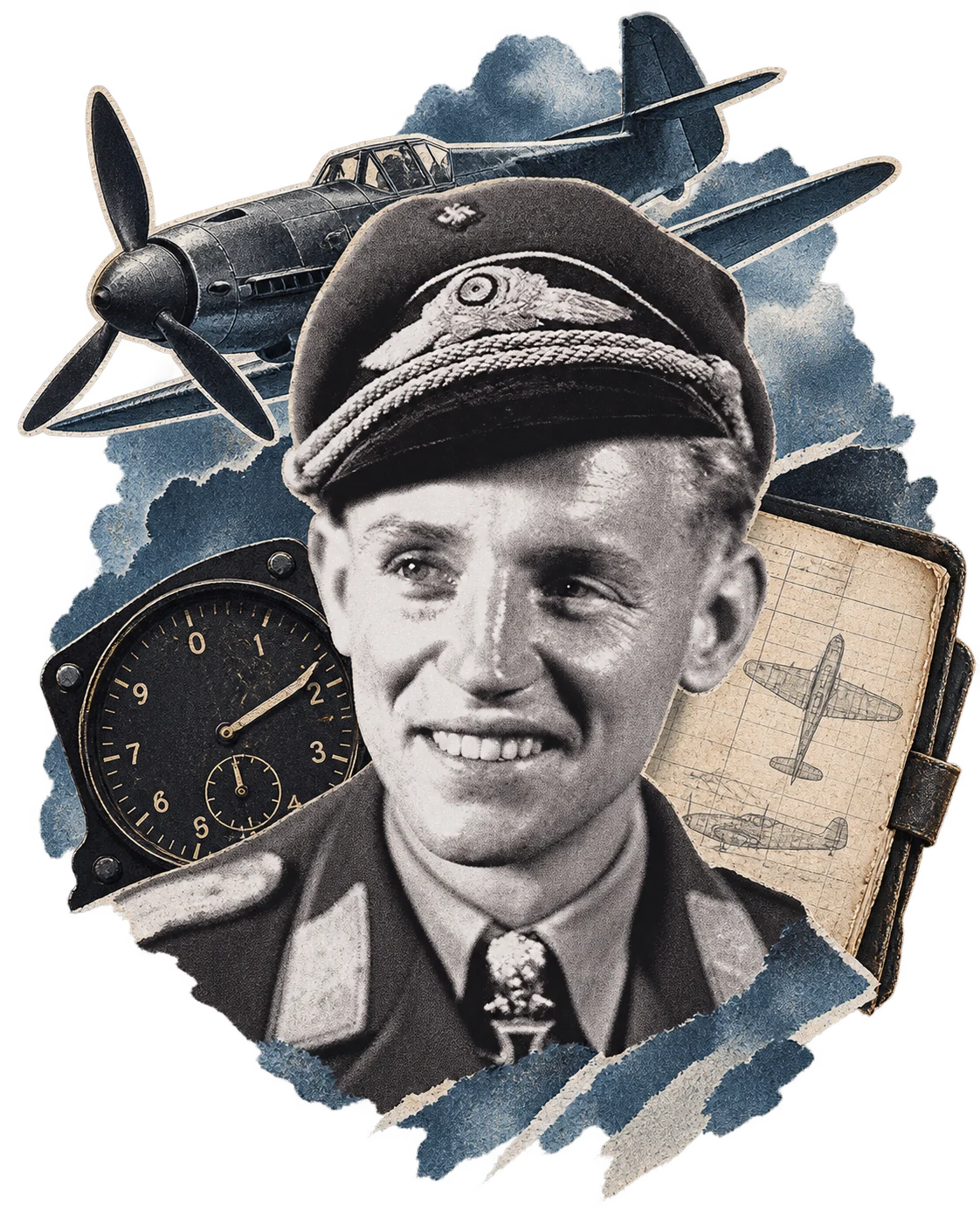
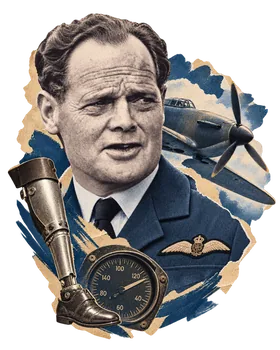
A few weeks ago I wrote about Douglas Bader http://bit.ly/2KaObpT, the legless pilot who bravely fought against the Luftwaffe - Nazi Germany's air force. This week we'll cross the lines and tell the story of one of the Luftwaffe's pilots, a remarkable aviator who was held in high professional regard by Allied pilots. "The Kid," "The Black Demon," "The Blonde Knight," "The Black Satan" - these were just some of the nicknames given to him.
Erich Alfred Hartmann
Childhood and the Connection to Flying
Let me begin by saying that although our surnames are the same, and even the first letters of our first names are the same, and although we also share a connection to flying, we are not related in any way. He belonged to the Nazi forces, while I am fortunate to be descended from one lone branch of the family that immigrated to the Land of Israel when Hitler came to power. All the other branches of the family tree, including its trunk, were wiped out by the Nazis and their collaborators. Erich Hartmann was born in April 1922 in the German state of Württemberg, to a father who was a doctor and a mother, Elisabeth Wilhelmine, who was a pioneer of glider flying. He inherited his love of flying from his mother. She was his glider instructor and taught him about winds and thermals and how they affected a glider; she taught him about wing profiles and the lift formula and how they applied to flight. And when Alfred managed to master the glider, moving on to an airplane was only natural.
Aerial Combat on the Eastern Front
In 1936, his mother was one of the founders of a flight school, where Hartmann, then 14, worked as a flight instructor. In January 1942, he enlisted in the German air force, the Luftwaffe. Three months later, he received the rank of Leutnant (second lieutenant), and by August 20 he had qualified as a pilot of the Messerschmitt Bf 109, the Luftwaffe's main fighter aircraft.
In October 1942, Hartmann was assigned to a German fighter squadron stationed on the Eastern Front.
The squadron commander, Major Hubertus von Bonin, placed him under the supervision of Oberfeldwebel Alfred Grislawski during his first days in the squadron. After several days of training and simulated aerial combat, Grislawski said that although Hartmann still had much to learn about air combat tactics, he showed good piloting skills.
His first mission was on October 14, 1942. He described it in an interview in 1993, the last he ever gave: "Well, Rossmann and I were on our flight, and Rossmann radioed that he had spotted ten enemy aircraft below us. We were at an altitude of 12,000 meters, and the enemy was far below us. I couldn't see anything, but I followed Rossmann, and then we came upon them... I opened the throttle all the way and left Rossmann to fire at one of the planes. My shots missed, and I nearly collided with the aircraft. Suddenly, I was surrounded by Soviets. I turned to hide in a low cloud and escape. On top of that, the low-fuel warning light came on. I knew I was in trouble. I had broken every air force rule and expected to be thrown out. In the end, I was sentenced to three days of work with the ground crews. It gave me time to think about what I had done."
Hartmann scored his first victory over a Soviet aircraft on November 5, 1942, and by the end of the year he had added another victory to his record.
In July 1943, Hartmann shot down seven Soviet aircraft in the Battle of Kursk. By August 1943, he had reached 50 victories, and that same month he added another 48 to his record. He was promoted to the rank of Hauptmann (captain), and in August 1943 he was captured by the Soviets after his plane was shot down, but managed to escape his captors and return to the German lines. He described the incident this way: "I felt that something had hit my plane. I made an emergency landing in a field and was immediately captured by Soviet soldiers. I pretended to be seriously wounded. They believed me and laid me on a stretcher, which they loaded onto a truck. During one of the attacks, the guard got down to protect himself, and I took the opportunity to jump off the truck. I found myself in a large field of tall sunflowers, where I tried to hide as I ran. My escape was discovered, and they began chasing me and shooting at me. I found a small village occupied by the Russians and hid there until nightfall. I woke up at night and began following the Russian patrol. The patrol disappeared behind a hill, and then I heard gunfire. That was the sign that I was near the German border. I waited for the Russian patrol to return and tried to cross the lines into German territory. As I was trying to do so, one of the German sentries shot me, badly wounding my leg." After a short recovery, Hartmann returned to flying. In October 1943, he shot down another 33 Soviet aircraft and received the Knight's Cross from Hitler after reaching a total of 148 victories. By the end of the year, his tally had reached 159.
In March 1944, Hartmann's tally reached 202 victories. The Soviet command put a 10,000-ruble bounty on his head, and Soviet pilots knew his call sign: "Karaya One." A black tulip was painted on his plane, and Soviet pilots who recognized its insignia began to flee aerial combat when they saw it. For this reason, the plane was assigned to young pilots; simply flying it deterred enemy pilots from engaging them in combat.
Hartmann scored his 300th victory on August 24, 1944, after shooting down 11 aircraft that day. After this achievement, he was grounded by Hermann Göring, head of the Luftwaffe, who feared the negative effect on pilot morale if Hartmann were shot down in aerial combat. However, after Hartmann protested, he managed to return to service as a fighter pilot.
At the beginning of 1945, Adolf Galland (a German ace with 103 victories and a Luftwaffe general during World War II) offered Hartmann a place in Germany's first jet squadron, but Hartmann refused and insisted on staying with his current unit. At the end of the war, Hartmann and his unit surrendered to the United States Army. By the end of the war, Alfred Hartmann had become the most successful flying ace in history, with 352 victories. During the war, he flew 1,404 operational sorties, fought in 825 aerial engagements, made 14 emergency landings, was captured once, and managed to escape. In August 1944, he was awarded the Knight's Cross of the Iron Cross with Oak Leaves, Swords, and Diamonds - one of the highest decorations in Nazi Germany, awarded to only 27 combatants. At the end of the war, his medal cabinet held the Knight's Cross, the Iron Cross First Class, the Iron Cross Second Class, and the German Cross in Gold.
352 aircraft - an unimaginable number. That's roughly half the total number of aircraft in the Israeli Air Force today, and about 100% of the French Air Force's fighter aircraft. There were several reasons Hartmann was able to reach this astonishing number: Until late 1941, the Germans enjoyed a significant advantage over the countries they attacked. The tactic he developed, "See - Decide - Attack - Break off," worked well for the German air force. As he put it, most of the pilots he shot down did not know what had attacked them or where it had come from, giving the Luftwaffe an absolute advantage in both numbers and quality.
At the beginning of 1942, the British Royal Air Force began bombing German territory. The bomber formations arrived in enormous groups, sometimes containing more than a thousand aircraft. For German fighter pilots, it was a "feast." The phenomenon intensified after the Americans joined the war. Luftwaffe pilots had little difficulty intercepting enemy aircraft, especially large, heavy bombers packed to the brim with fuel and bombs. Allied fighter pilots had to fly far in the hope of encountering enemy aircraft, but Luftwaffe pilots found themselves facing aerial combat right on their doorstep, and in enormous numbers.
Another significant reason was the severe shortage of German pilots, which grew worse as the war dragged on. As a result, each pilot flew an enormous number of sorties compared with any other pilot at the time. None of this is meant to diminish the abilities or skill of Luftwaffe pilots, but it does help explain the number of victories they managed to claim.
Captivity and the Belated Exoneration
After he was captured, Hartmann was handed over to the Soviets by the Americans. He was accused and tried for war crimes, and suffered harsh treatment in captivity. Nevertheless, he refused to admit his guilt. The Soviet authorities' attempts to bring him over to the communist camp failed. While he was in captivity, his three-year-old son died, a son he had never met...
In 1955, after ten and a half years in Soviet captivity, Hartmann was released and returned to West Germany. He joined the newly re-established West German Air Force and served in the first German squadron made up entirely of jet aircraft. To refresh his skills and train on the German Air Force's new American aircraft, he was sent to the United States for a period of training.
In 1996, three years after his death, Russia cleared Hartmann of the war crimes charges and stated that his conviction had been illegal.
תגובות
עדיין אין תגובות.