
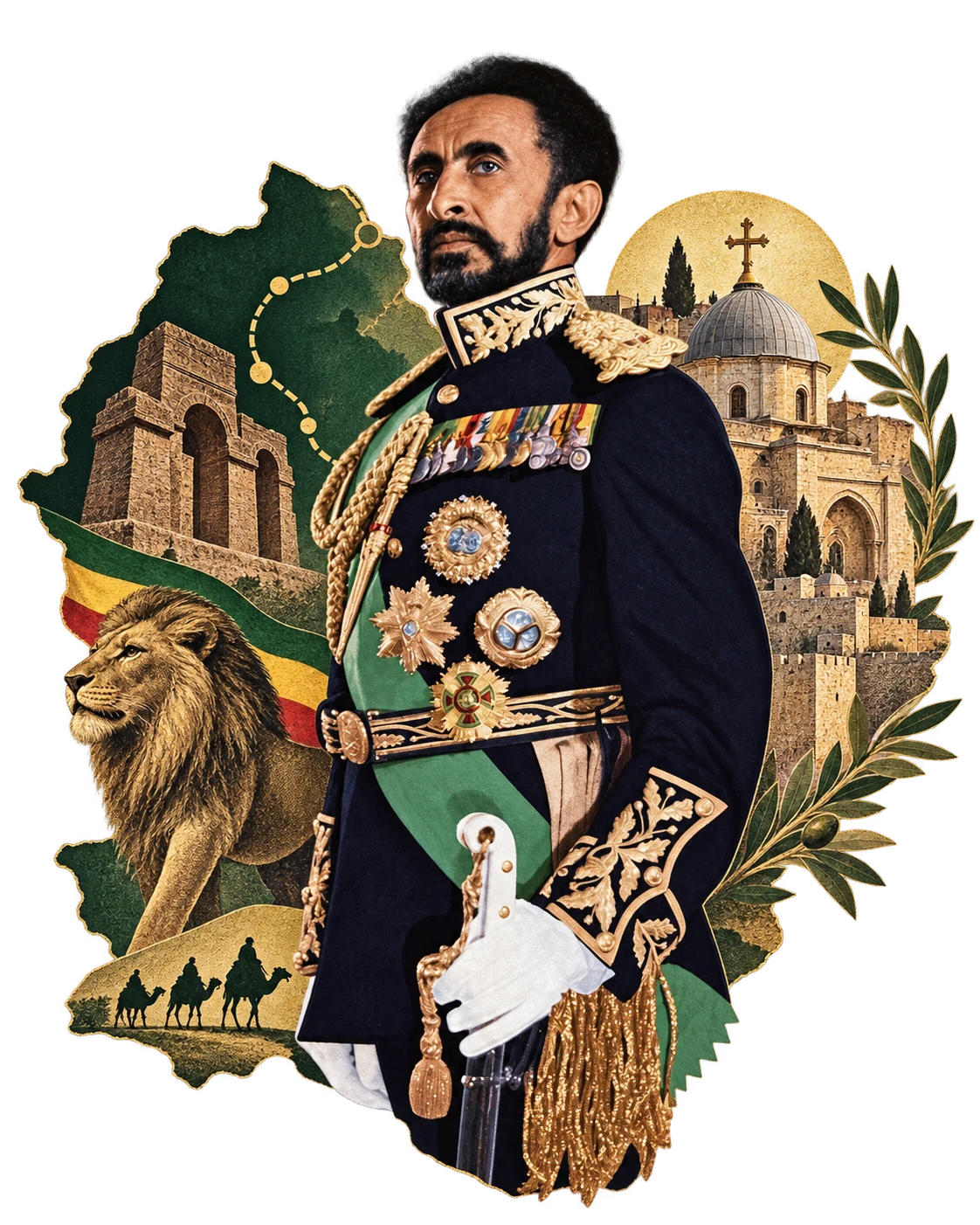
From Ethiopia to Jerusalem - the story of Haile Selassie, the last emperor of Ethiopia.
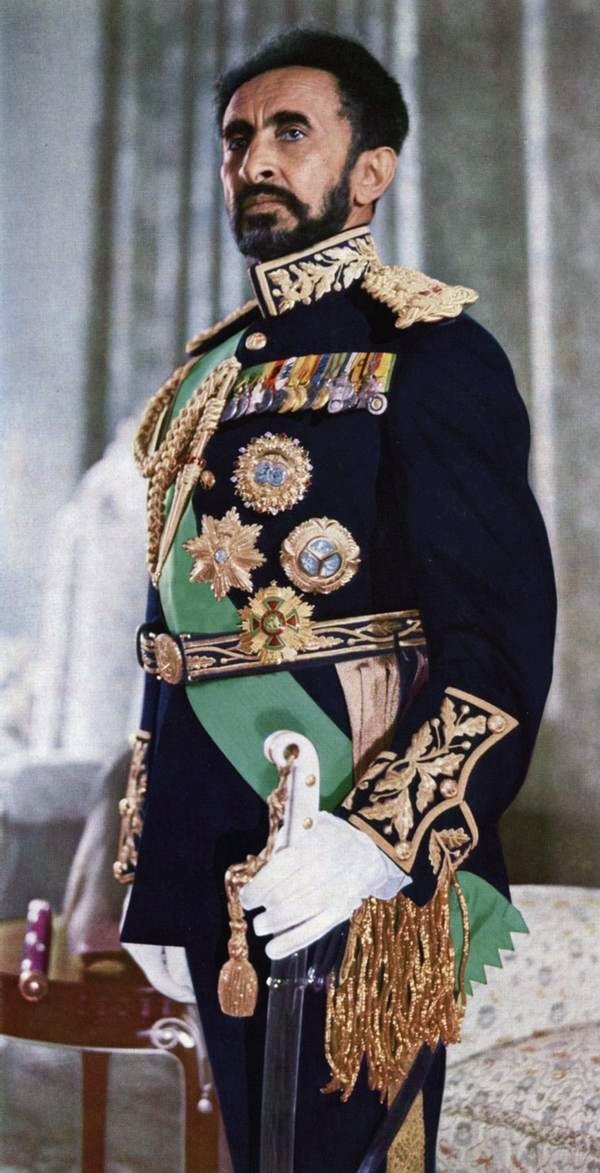
The Queen of Sheba and Solomon's Legacy
The first meeting of the Queen of Sheba and King Solomon is described in the First Book of Kings, chapter 10:
"1 Now when the queen of Sheba heard of the fame of Solomon concerning the name of the Lord, she came to test him with riddles. 2 She came to Jerusalem with a very great retinue, with camels bearing spices, very much gold, and precious stones... 4 And when the queen of Sheba had seen all the wisdom of Solomon... there was no more spirit in her. 6 And she said to the king, 'The report was true that I heard in my own land of your words and of your wisdom. 7 But I did not believe the reports until I came and my own eyes had seen it. And behold, the half was not told me; you have added wisdom and prosperity to the report that I heard. 8 Happy are your men, happy are these your servants, who continually stand before you and hear your wisdom... 10 Then she gave the king 120 talents of gold, and a very great quantity of spices and precious stones. Never again came such an abundance of spices as those the queen of Sheba gave to King Solomon... 13 And King Solomon gave to the queen of Sheba all that she desired, whatever she asked, besides what he gave her as befitted King Solomon. Then she turned and went back to her own land, she and her servants.'"
Did the Queen of Sheba really make this entire long journey, which at the time was even life-threatening, just to hear the king's wisdom...?
The Ethiopian national epic, the Kebra Nagast ('The Glory of the Kings'), includes an addition recounting that Solomon fell in love with 'Makeda,' the Queen of Sheba and ruler of Ethiopia, and that the two spent a romantic night together and were intimate. When the queen returned to her country, she discovered that she was pregnant. When her son was born, she named him Menelik, meaning 'son of the king.' When Menelik turned 22, he set out with his friends to find his father in Jerusalem. King Solomon tried to persuade him to remain in Jerusalem and even to inherit his throne, but Menelik refused and asked to return to Ethiopia. Solomon sent him off with great wealth and assembled a retinue to accompany him on his return. The retinue numbered about 10,000 of the country's finest men, including priests and Levites. Solomon also changed Menelik's name to David, after his grandfather, and gave him a copy of the Ark of the Covenant. On the night before setting out on the journey back to Ethiopia, Menelik, with the help of Azariah, son of the high priest, switched the copy of the Ark of the Covenant for the original, leaving the copy in the land. The original Ark, which arrived in Ethiopia, was kept in Axum, 'the new Zion.' According to Ethiopian tradition, this Ark is still in the Church of Our Lady Mary of Zion.
And so the meeting between the Queen of Sheba and King Solomon became part of Ethiopian history and national ethos. Menelik was the first emperor of the dynasty of emperors known as the 'Solomonids,' after King Solomon, and every emperor who came to power sought to prove that he was related by blood in some way to this royal dynasty.
Tafari Makonnen on the Road to Power
One of the important emperors was Tafari Makonnen. He was born in 1892 to a noble family in southeastern Ethiopia. His father was Ras Makonnen. Ras means ‘head.’ Tafari’s father was a provincial leader and commanded the army of his cousin, Emperor Menelik II, in the First Italo-Ethiopian War. As a member of a noble family, Tafari Makonnen received the best education available in Ethiopia at the time. He learned French and Amharic, studied religious texts, and was educated in the Ge'ez culture.
When he reached the age of 13, as part of his preparation for leadership, his father gave him a small area under his control. A year later, his father died at the age of 50. Tafari Makonnen was apparently expected to inherit his father's position as the area's ruler, but King Menelik thought he was still too young to take on such responsibility and invited him to the imperial court, where he became a companion to his grandson, Iyasu V.
At the imperial court, Tafari knew how to maneuver wisely. He navigated between the factions and their rivalries, which ultimately led to his appointment as ruler of the area his father had governed. As soon as he took office, 18-year-old Tafari lowered taxes. A year later, he married and began governing the area with great wisdom.
In 1910, Iyasu V, Menelik's grandson, became ruler of Ethiopia, but unlike Tafari, Iyasu made quite a few mistakes, including drawing closer to the Muslim minority. His greatest mistake, however, was his decision to remove Tafari Makonnen from his position as provincial ruler, thereby making Tafari his enemy.
In 1916, Tafari took part in a coup that deposed Emperor Iyasu V and placed Menelik's daughter, Zewditu (Judith), on the throne. Tafari himself was crowned regent and heir to the throne. In practice, Tafari ruled Ethiopia and took the title 'Ras Tafari,' though he was only 24. He believed in modernization and aspired to build a strong army. He purchased two tanks and two airplanes, carried out educational reforms, built an administrative apparatus, and advanced Ethiopia toward the modern world.
In 1923, Tafari succeeded in bringing Ethiopia into the League of Nations, and in 1924 he set out on a tour of Europe. The trip made waves and left a tremendous impression on the European aristocracy. For the first time, Europeans saw a proud, wise, multilingual African prince, accompanied by a large retinue. During this journey, Ras Tafari visited Jerusalem and emphasized that he was descended from King Solomon.
Jerusalem, the Coronation and Rastafari
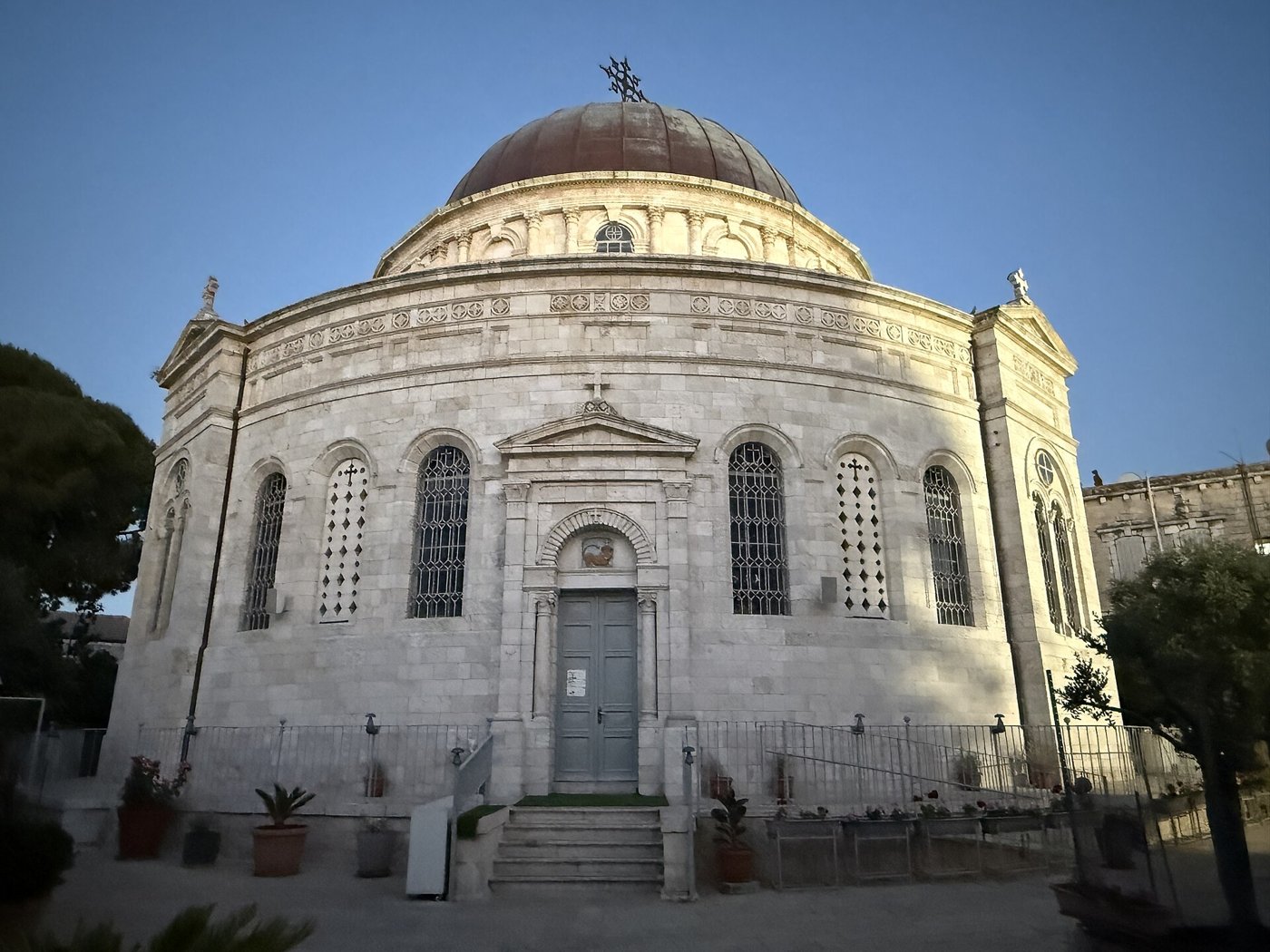
Ethiopian monks had settled in Jerusalem as early as the fifth century. In 1838, they founded a small monastery called Deir al-Sultan on the roof of the Church of the Holy Sepulchre. Their Coptic Egyptian monk neighbors took control of the entrance leading to the monastery and kept its keys as the site's custodians. During Tafari's tour of Cairo in 1924, Ras Tafari demanded that the Egyptian government return the keys to Deir al-Sultan.
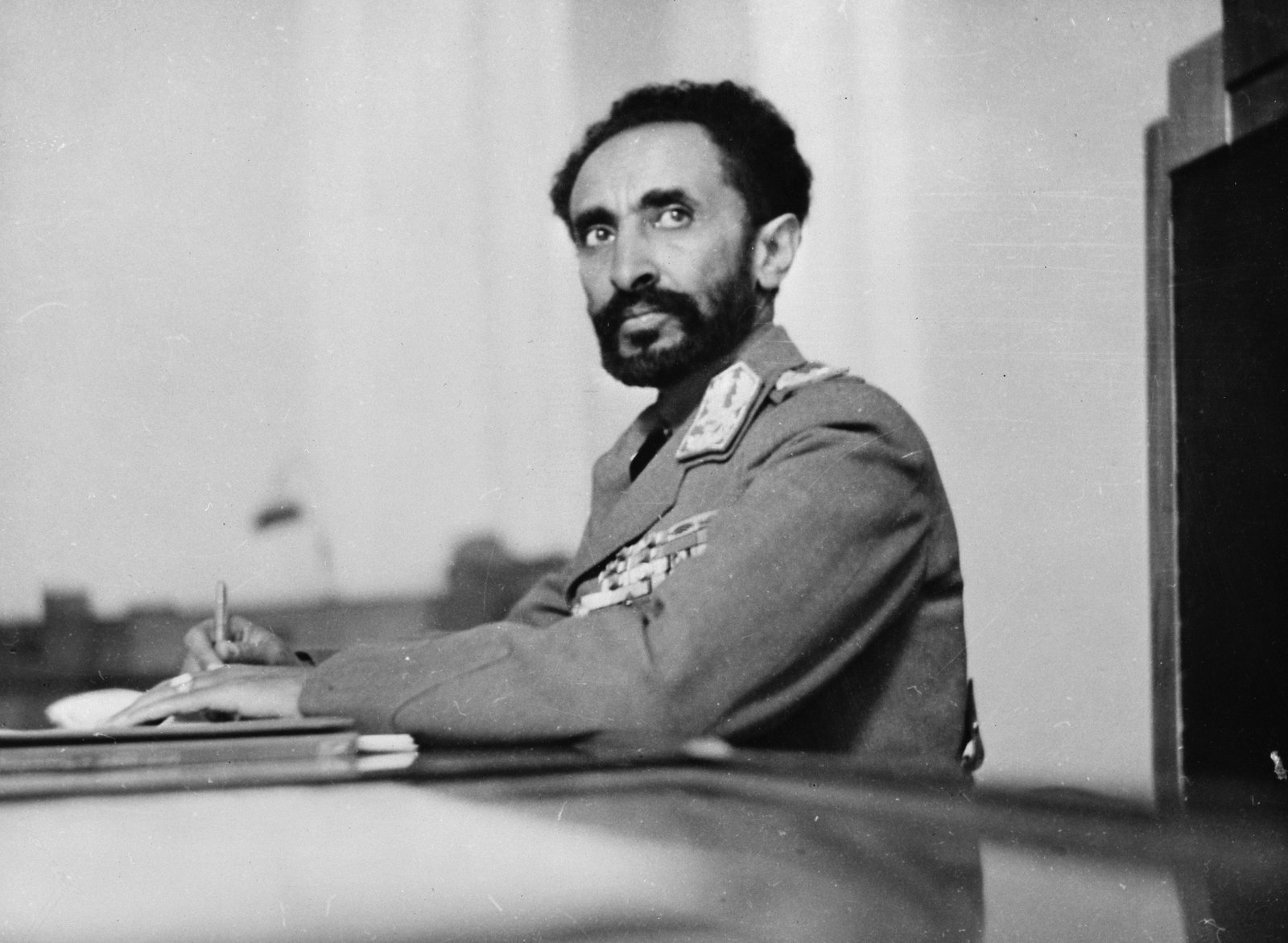
In 1928, in recognition of his service to the country, Empress Zewditu awarded him the title of 'Negus' (king) - an unprecedented move in Ethiopian history. Two years later, the empress died, and Tafari was crowned emperor in an impressive ceremony at St. George's Cathedral in Addis Ababa. The ceremony was attended by senior representatives of most of the independent countries. It was filmed for television and even appeared on the cover of Time magazine. At the end of the ceremony, Tafari changed his name to Haile Selassie, meaning 'Power of the Trinity,' and his title to 'Negusa Nagast,' meaning 'King of Kings.' From that moment, Tafari was 'Haile Selassie I, King of Kings, Lord of Lords, the Conquering Lion of the Tribe of Judah, the Elect of God and the Light of the World.' The lion, the symbol of the Tribe of Judah, represented Selassie's blood connection to the House of David and to Jesus.
His standing as a leader in Africa expressed the idea of black divinity set against the white representation of Jesus in European Christianity. Young Ethiopians admired Haile Selassie, but they were not alone. On the other side of the world, Marcus Garvey founded the Rastafari movement in Jamaica. Garvey was one of the leading campaigners for equal rights for the descendants of enslaved people in Jamaica and for the restoration of the lost dignity of black people. He asked aloud: 'Why should the Queen of England be our queen... (Jamaica was under British rule)... and we not have an African king?' The only African king at the time was the emperor of Ethiopia, Haile Selassie.
Rastafari adherents believe that Haile Selassie was crowned emperor of Ethiopia by divine power over all black people, and that he is the embodiment of the Messiah and the Black Jesus. He is the one who will gather the people of Africa in exile and lead them to freedom. Ethiopia was a source of pride as the only black African kingdom mentioned in the Bible: 'Ethiopia shall soon stretch out her hands unto God' [Psalms 28]. Ethiopia is the only country to have maintained continuous independent rule throughout history, apart from a few years under Italian rule, and unlike every other African country, it was never ruled by a European power. The idea of return appealed to the people of Jamaica's ghettos and poor neighborhoods, inspiring the basic hope that life would be better in the successful, celebrated African country headed by Africa's only black leader.
Rita, Bob Marley's wife, joined the Rastafari religion after seeing Haile Selassie. Rastafarians say that the drought that had long afflicted the Caribbean islands broke the day after Haile Selassie arrived in 1966, proving beyond any doubt that he really was the Messiah.
The person who brought the religion to worldwide attention was none other than the musician Bob Marley. Rastafarians are also known for their distinctive braided hair, called 'rastas' or 'dreadlocks.' They eat vegan food, which they call 'Ital,' and abstain from alcohol. Today, there are about a million people around the world who belong to this religion, including white communities in Europe, particularly Britain, Russia, and Ukraine, as well as in Japan and the United States. Haile Selassie himself had reservations about the Rastafari movement and remained a devout believer in the Ethiopian Orthodox Church throughout his life.
Reforms, Invasion and Exile
Immediately after his coronation as emperor of Ethiopia in 1930, Haile Selassie began the process of bringing the country into a new era. He built a state apparatus modeled on the European one, rather than one controlled by families and clans. His most important initiative was the enactment of a constitution based on the constitution introduced by the Japanese Emperor Mutsuhito. The first written constitution came into force in 1931 and, in theory, replaced the Kebra Nagast as the source of the emperor's legitimacy. Selassie strengthened the army, established modern schools, and opened the country's doors to foreign investment. These were years of prosperity and flourishing such as Ethiopia had never known.
In the 1930s, several European leaders, envious of England and France, sought to establish empires of their own. Among the most prominent were Hitler and Mussolini, who sought revenge for the failure of 1893, when Ethiopia had managed to stop the Italian invasion of its territory. Toward the end of 1935, Mussolini invaded Ethiopia, using mustard gas against the civilian population. About 12 bombs were dropped 'by mistake' on the bases of Red Cross workers who raised the alarm, and by around April 1936 the capital, Addis Ababa, had been captured. Mussolini expected England, France, and the United Nations to resist his conquest fiercely, but they preferred to sacrifice Ethiopia rather than worsen the explosive situation. The message was received loud and clear in Germany as well. It was the signal Hitler had been waiting for, and he dragged Europe into the Second World War. When the capital was captured, Haile Selassie and his family fled to the place he considered his second home - Jerusalem. In Geneva, he delivered his famous speech to the League of Nations: 'Today it is us; tomorrow it will be your turn.' These words echoed in humanity's conscience during the difficult years that followed, as Hitler waged war and carried out a plan to exterminate more than 18 million people, including six million Jews.
After about three months in Jerusalem, Haile Selassie left his wife, Empress Menen, and his children in the city and went to England to organize a guerrilla force to liberate Ethiopia from the Italians. In the summer of 1940, Selassie officially became an ally of the Allied Powers. Charles Orde Wingate ('The Friend'), who was in London after a visit to Mandatory Palestine, was recruited for the mission to liberate Ethiopia. Wingate asked his former aide-de-camp, Avraham Akavia, to volunteer and accompany him on the mission. Akavia, a team of Israeli doctors, and fighters from the 'Special Night Squads' joined 800 Sudanese and 800 Ethiopians, and together they conquered Ethiopia. In May 1941, Haile Selassie entered the capital, Addis Ababa, in a victory parade, accompanied by Wingate, Akavia, and other Israelis who had taken part in the mission. With the liberation of the capital, Selassie and his family returned to Ethiopia after a five-year stay in Jerusalem.
In order to attract educated people and professionals, particularly in education and health, Haile Selassie called on all black people in the West in 1948 to come and live in Ethiopia, and offered a plot of land to everyone who accepted the invitation, in recognition of their support in the struggle against the Italians. Some Rastafarians took advantage of this opportunity and emigrated to Ethiopia. The first Rastafarian settler was Papa Nuel Dyer, who arrived there in September 1965 after hitchhiking from England.
That same year, when the United Nations voted on the establishment of the State of Israel, Lorna Wingate, the wife of Charles Orde Wingate, asked Haile Selassie to support the state - but he abstained...
The Alliance with Israel and the Collapse
At the beginning of 1958, the United Arab Republic was founded. It was the idea of several Syrian officers who sought to unite Syria and Egypt under the leadership of Egyptian President Gamal Abdel Nasser, and eventually to unite all Arab nations into one great nation. A year later, Ben-Gurion sought to establish a counter-alliance of non-Arab countries, including Turkey, Ethiopia, and Iran.
The fact that the sources of the Nile were in Ethiopia had not escaped Ben-Gurion's notice. Israel invested in Ethiopia in the fields of the economy, transportation, security, and the military, and established the Ethiopian police force. This was the most comprehensive foreign aid effort Israel had undertaken in another country. Israel's support for Haile Selassie's regime prevented three attempts to overthrow him. The first took place in 1960, when the Imperial Guard launched a coup with Soviet support, while the emperor was in Brazil. The revolutionaries forced Crown Prince Asfa to read a statement on the radio saying that he supported the coup against his father and accepted the title 'Emperor of Ethiopia.' The coup failed.
In the early 1970s, when Haile Selassie was already around 80, his regime began to weaken because of the oil crisis and years of drought. The Yom Kippur War broke out, and King Faisal of Saudi Arabia promised him $200 million on condition that he sever ties with Israel. And so, at the end of October 1973, Haile Selassie announced the severing of relations with Israel.
The sudden departure of the Israeli experts damaged the Ethiopian army and left the old aristocracy and the upper echelons of the government stunned. They found the rupture of the Zionist-Christian connection, with its profound religious significance, difficult to comprehend. The emperor's grandson said that from the day Haile Selassie betrayed Israel, he was no longer the same person, and from that moment the countdown began to the collapse of his regime within a few short months.
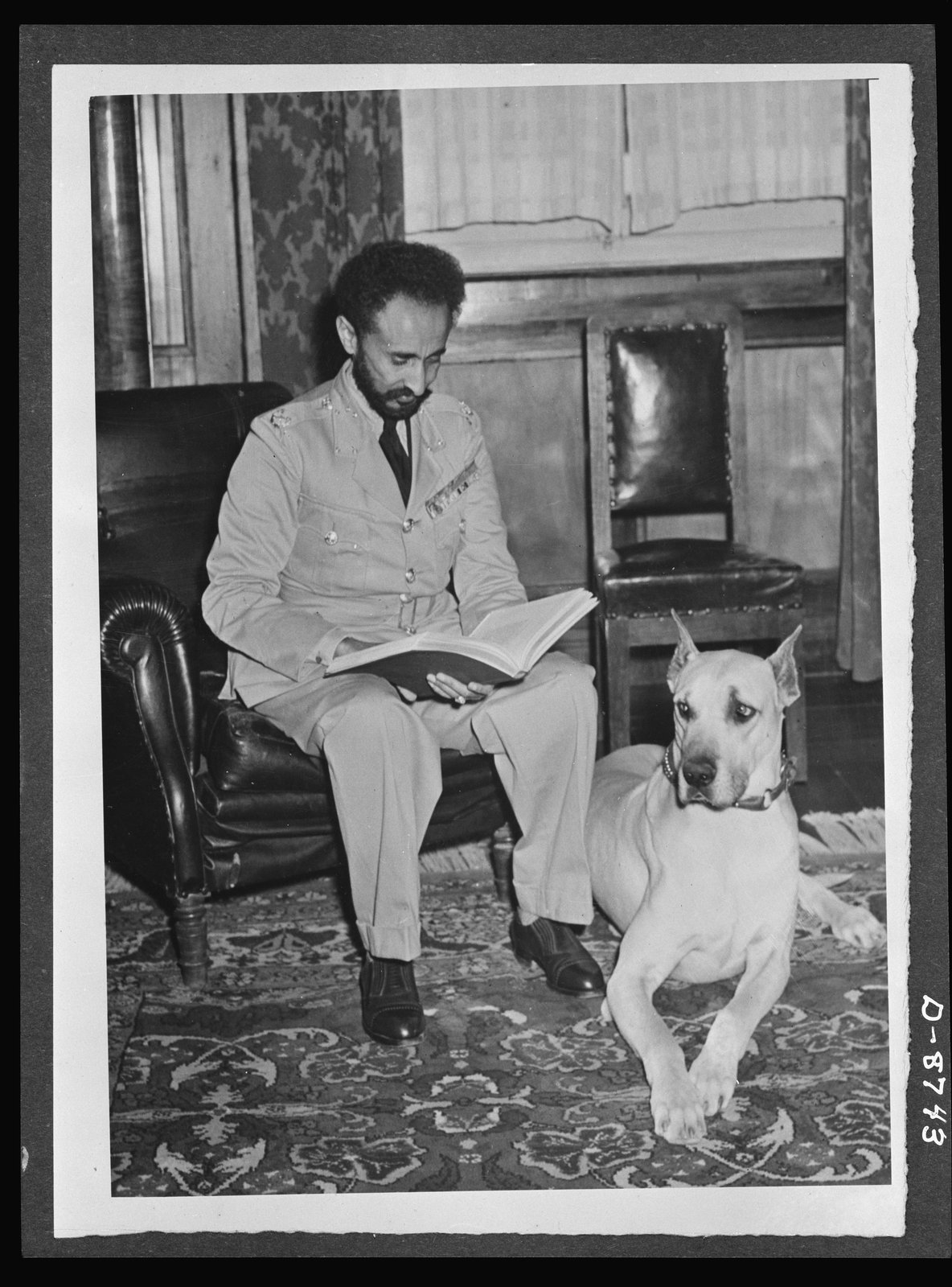
Toward the end of 1974, another coup took place in Ethiopia. A group of officers backed by the Soviet Union seized power. Selassie, accused of stealing tens of millions of dollars from the Ethiopian treasury, was placed under house arrest along with his entire family, and most of his property was confiscated.
A year after his overthrow, in the middle of the night, a group of five leaders of the new military regime entered the isolated room of Haile Selassie in the palace. They were headed by Major Mengistu, Ethiopia's tyrannical and brutal ruler. The five pressed a pillow against the head of the slight, 83-year-old man, strangled him to death, and threw his body beneath the toilets of the revolutionary ruler's palace. Thus ended the reign of the 245th emperor of Ethiopia's Solomonic dynasty.
After Selassie's death, only a few ties remained between Israel and Ethiopia. In 1977, Israel provided military aid in exchange for allowing some Ethiopian Jews to immigrate to Israel, but following pressure from the Soviet Union, Mengistu, the country's leader, severed relations with Israel in 1978.
When the new regime came to power in 1991, after the place where Haile Selassie's body had been buried had been kept secret for 17 years, one of the palace gardeners pointed out the grave, and the emperor's remains were exhumed and reburied in another temporary location.
A few days before the body was discovered and the new regime came to power, Operation Solomon began, during which thousands of Jews were airlifted to Israel in an operation that lasted 34 hours. That same year, Haile Selassie's family members were also released from Ethiopian prison. Most chose to go into exile and are now scattered around the world, but they still make a point of visiting Jerusalem on pilgrimage. In 2000, Haile Selassie was laid to rest for the third time, in a state funeral at Holy Trinity Church in Addis Ababa. Most Rastafari adherents refused to take part in the event, since as far as they were concerned, he had not died.
תגובות
עדיין אין תגובות.