
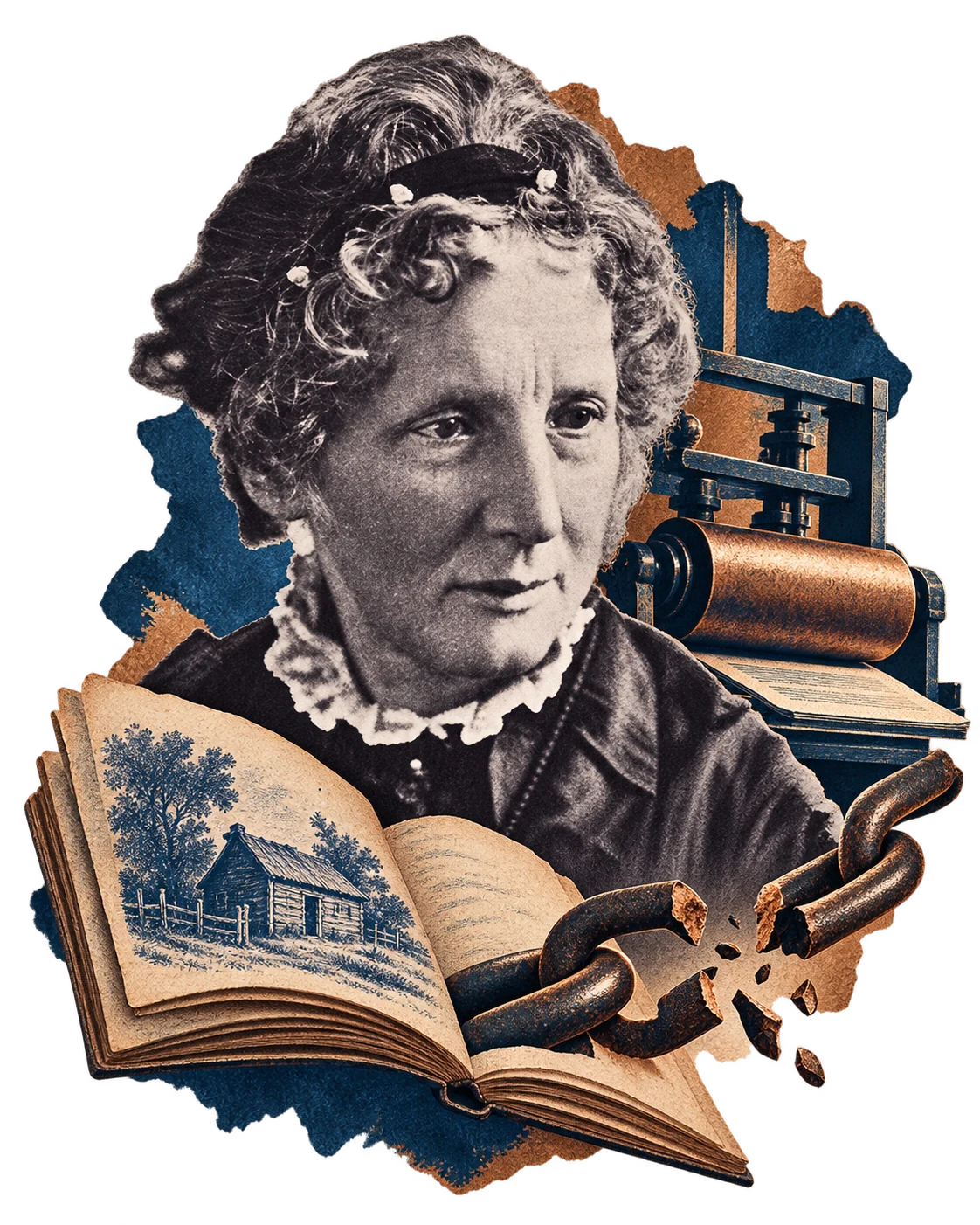
This is a story that moves me all over again every time I hear it. It was one of the most righteous wars, a war I would have been willing to risk my life and fight in, and perhaps many of you would too.
Encountering Slavery
This is the astonishing story of Harriet Beecher Stowe, the little woman who caused a great war.
"He was a cruel man. Long years as a slaveholder had hardened him. Sometimes he seemed to take the greatest pleasure in whipping slaves with his own hands. Many times, at dawn, I was awakened by the heart-rending cries of my aunt, whom he would tie to a wooden beam and lash across her bare back until she was covered in blood. Words, tears, and prayers from his bleeding victim could not deter his heart of stone from achieving its murderous purpose. The louder she screamed, the harder he whipped her, and wherever the blood flowed faster, there he whipped her longer. He whipped her to make her scream, and whipped her to make her be quiet, and only when exhaustion overcame him did he stop raising the blood-soaked whip. I remember the first time I witnessed this terrible scene. I was a little boy, but I remember it well, and I will never forget it - and it will probably be the last thing I remember. It was the first in a series of horrors I was destined to witness and take part in. It struck me with tremendous force. It was the blood-soaked gateway, the entrance to the hell of slavery through which I was about to pass. It was a terrible and dreadful sight. If only I could put on paper what I felt as I stood there before him."
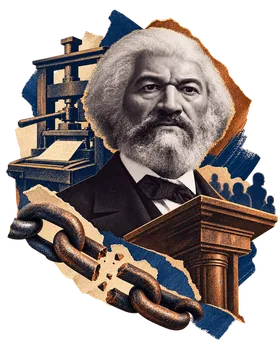
This is a first-hand account by the escaped slave Frederick Douglass. This was the reality Harriet Beecher Stowe witnessed in her everyday life, the reality that outraged her.
This is how she wrote about plantation owners in the Southern states, who had complete control over every aspect of their slaves' lives: "The legal and judicial power placed in the hands of the plantation owner amounted to absolute tyranny over the bodies and souls of the slaves under his control" and "there was no protection whatsoever for the life of a slave."
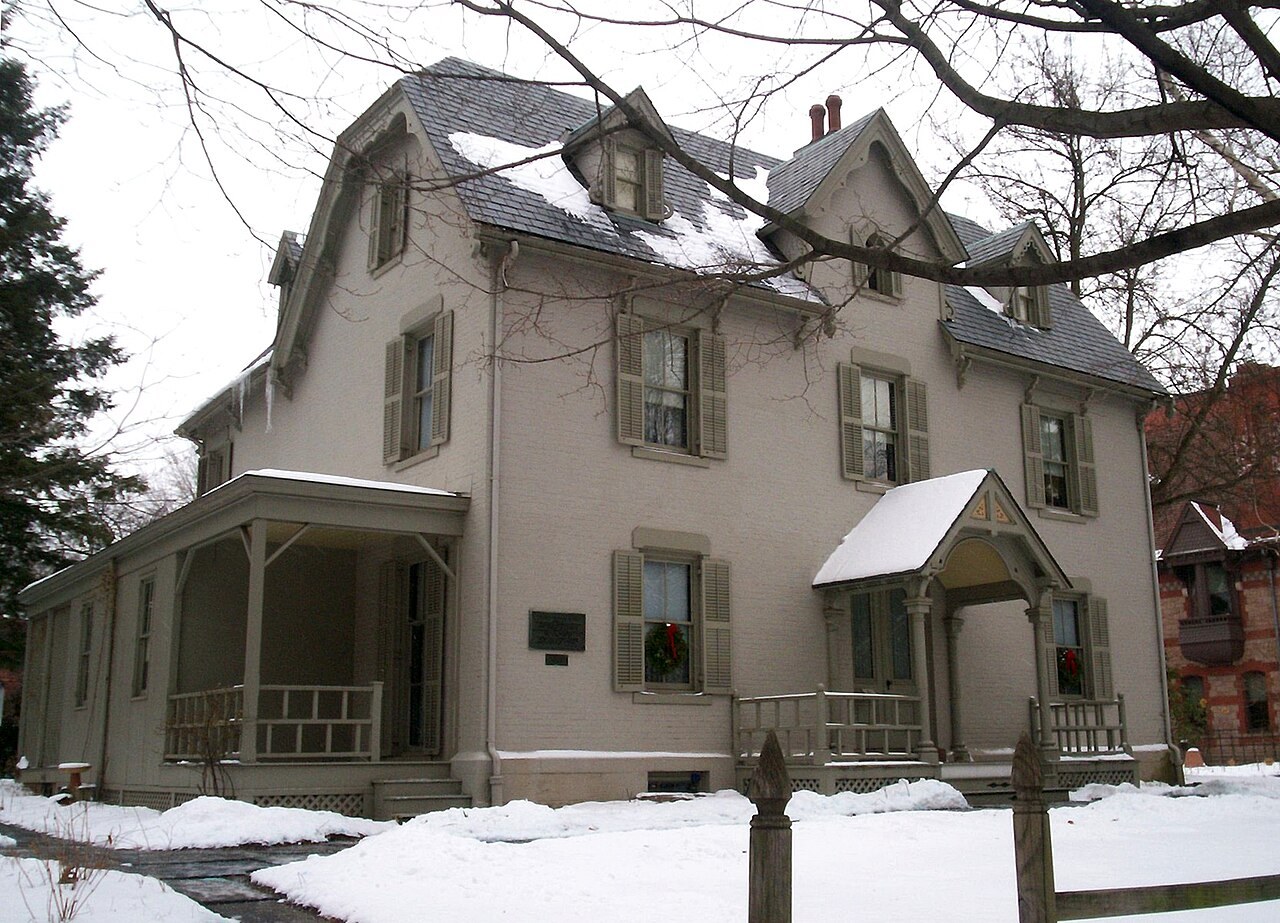
Harriet was born in 1811 in Connecticut, a Northern state. Her father was a Calvinist minister and the father of twelve children. She married a theologian, whom she described as "rich in Greek, Hebrew, Latin, and Arabic, but, alas, poor in every other respect." The couple had seven children, and the death of one of them, at the age of eighteen months, taught her what pain was and stirred in her empathy for the suffering of Black enslaved women, who were forced to part with their children when they were taken from them and sold.
Harriet came from an American family that produced politicians, intellectuals, and government officials. She received an excellent education and was driven by a strong sense of purpose. She knew the escape routes used by fugitive slaves well, because she, her son and husband, and her brother Henry Ward Beecher were active members of an organized network that helped slaves escape to Canada, where slavery was prohibited by law.
Writing 'Uncle Tom's Cabin'
Harriet had a remarkable talent for writing, a keen power of observation, and the ability to make readers empathize with her characters' suffering. She wrote many books, but her best-known book was the one that led to war and change. It began as a serial in the newspaper the National Era, appearing weekly from June 1851. It was originally intended to be a short story, but eventually ran to forty chapters. The entire story was published as a book on March 20, 1852, and became known as "Uncle Tom's Cabin."
Despite its Hebrew title, it is not a tent but a cabin. The original title is Uncle Tom's Cabin; or, Life Among the Lowly.
"The Man That Was a Thing" was the unfamiliar subtitle intended to accompany the title of a very famous book. It was replaced by another, "Life among the Lowly," which, like its predecessor, has completely faded from memory.
The book "Uncle Tom's Cabin" had a profound effect on its readers and presumably moved them to action as well. Just as Dickens brought about change in nineteenth-century England by describing the plight of poor children from the lower classes, who were exploited and abused, and changed his readers' worldview, leading in turn to reforms and changes in legislation, so Harriet affected her readers. The suffering of Uncle Tom and Eliza, the enslaved woman who escaped with her husband and young son, touched their hearts.
In mid-nineteenth-century America, at the height of slavery, a book like this was controversial. It sold 10,000 copies in its first week and 300,000 copies in its first year, and became the first book in American history to sell more than a million copies. It was the best-selling novel of the nineteenth century, and the best-selling book in the United States after the Bible.
It could be said that "Uncle Tom's Cabin" caused the first public scandal in the United States.
The book is a moving account of the suffering of a Black slave who faithfully serves his owner, a kind and gentle man who values his loyalty. When circumstances change, the slave is passed from one owner to another and eventually falls into the hands of a cruel and wicked master. Even in his new situation, he accepts his fate and does not protest, despite the humiliation and beatings he endures.
The Storm Around 'Uncle Tom's Cabin'
Eight years passed between the book's publication and the election of Abraham Lincoln as president for the Republican Party in 1860. Lincoln defeated his Southern opponents, who supported expanding the areas and states where slavery was legal, and the conflict between supporters and opponents of slavery led to the outbreak of the Civil War. In the Southern states, the book was met with anger, resentment, and personal attacks on the author. One critic described her as "a tall, coarse, vulgar-looking, stoop-shouldered woman, with a long, yellow neck and a long, pointed nose through which she speaks." Critics furiously objected to the implication in her book that "Black people are like white people" - that is, that they have human feelings, kindness, and generosity, that they feel love and hatred, and that they suffer when treated cruelly... One response to the publication of "Uncle Tom's Cabin" was the publication of books presenting opposing "truths," for example, "Aunt Phillis's Cabin," which portrayed the opposite situation: compassionate masters who never whipped their slaves, because such harm was neither proper nor sensible. The book "Gone with the Wind" was also written as an attempt to argue against the depictions presented in "Uncle Tom's Cabin." In response to the accusations, Harriet published "A Key to Uncle Tom's Cabin" in 1853, which included hundreds of documents and facts that served as background for her book. Harriet said of the process of writing it, "I did not write the book. God dictated it to me." She explained that her motive for writing it was her love of her country, and that she feared the Day of Judgment that would come upon her land because of the ongoing injustice taking place within it.
It is said that when Abraham Lincoln met Harriet in 1862, in the midst of the Civil War, he told her: "So you are the little woman whose story started this great war." The book had such a powerful effect on British readers that, because of it, Britain refrained from joining the Confederate states in the Civil War.
Today, in the African American community, the term "Uncle Tom" is used as an insult for a Black person who grovels before white people and tries to imitate their customs, while denying their own identity.
תגובות
עדיין אין תגובות.