
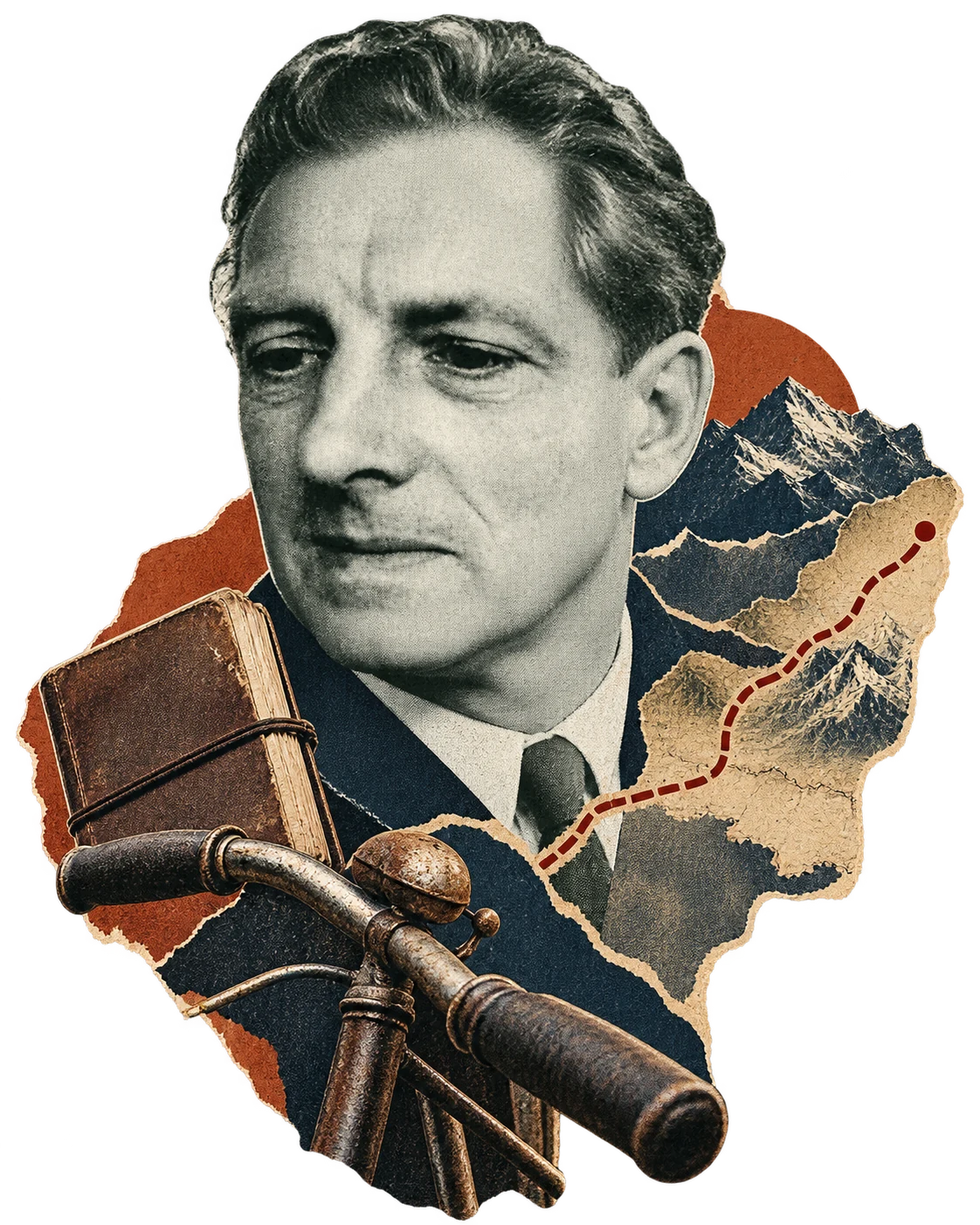
It is difficult to overstate the greatness of this Righteous Among the Nations, who saved thousands of young people while putting his family and children at risk. A lover of humanity, a man of peace and a freedom fighter, he paid for all of this with his life.
Johan Gerard (Joop) Westerweel
"In this volume, we have sought to bring to life the figure of Joop Westerweel, a Righteous Among the Nations and a son of the Dutch people, who bound his soul to those of Jewish pioneers and young people and gave his life to save them" - thus begins the book by Bracha Habas, *The Hidden Light - Joop Westerweel in Life and Death*.
Joop was shot on the morning of August 11, 1944, near the Vught camp in the Netherlands. He left behind his wife, Wil Westerweel, who was also a well-known educator in the Netherlands, to raise their four young children alone. Joop was a pillar of the Dutch resistance, a daring underground movement whose heroic stories became known beyond the borders of the Netherlands. They were told in Belgium, France, Spain, and elsewhere, encouraging local people to take action against Nazi cruelty during World War II.
It was clear to Henri Winkelman, commander of the Dutch army, that he could not defeat the Nazi army, which was larger and better equipped. The Dutch army had no tanks and lacked field artillery and anti-tank weapons. With no other choice, Winkelman decided that the army would defend only a number of vital provinces, known as "Fortress Holland," in the hope of prolonging the campaign until the Allies intervened and rescued them.
The German attack began on the morning of May 10, 1940. The Luftwaffe began bombing Dutch airfields. Four days later, the Germans bombed Rotterdam. The center of Rotterdam was almost completely destroyed, 900 residents were killed, and 80,000 people were left homeless. The devastating bombing, the Germans' threat to bomb other Dutch cities as well, and the Allies' failure to arrive led the Netherlands to surrender after four days of fighting. Queen Wilhelmina of the Netherlands and her family had already left the country on May 12 aboard a British destroyer bound for Britain, where the queen established a government in exile.
The Fall of the Netherlands
The Netherlands was one of the first countries to grant Jews equal rights. They enjoyed comfortable lives, took part in cultural life, were economically secure, and had thriving community lives and complete religious freedom.
When the Nazi Party came to power, some Jews emigrated from Germany to the Netherlands. The best-known among them were Anne Frank and her family. When the Nazis occupied the Netherlands, some Jews fled to England, and some even chose to take their own lives. The Germans knew how the Dutch felt about Jews, so they proceeded cautiously during the first six months, using that time to infiltrate the mechanisms of control in the Netherlands. The relative calm that prevailed gave residents hope that the Nazis would not dare treat Jews in the Netherlands as they had in other countries. But some Jews understood that this hope was unfounded, since it was enough to look at what had happened in Denmark, where, despite the Danish people's opposition, the Nazis pursued their path toward the "Final Solution."
On the eve of the German invasion, there were about 140,000 Jews in the Netherlands, 22,000 of them refugees from Germany who had already witnessed the destruction of the Jewish community there and mistakenly thought they had reached a safe haven. The invasion plunged the Jewish community into terror. Several months later, the Nazis began rounding up Jews and sending them to the Mauthausen concentration camp.
The Dutch religious leadership watched developments with alarm. Immediately after the first racial laws were decreed, statements of protest against them were issued by the "Churches Association," founded at the time, and protests were voiced in Sunday sermons. Protests were also heard at universities, from both professors and students.
In February 1941, Nazi militias entered the neighborhoods where Jews lived in Amsterdam and began harassing them. That same month, a general strike against these acts began spontaneously across Amsterdam, a strike unlike anything seen throughout occupied Europe. The Nazis crushed the strike brutally, and it became clear that there was no way to thwart the Nazis' plans to destroy the Jewish population of the Netherlands.
Organizing for Rescue
When it became clear that open resistance was ineffective against the Nazis, some Dutch circles decided to organize an underground movement to help Jews.
The year 1941 brought harsh decrees against the Jews, stripping them of their basic legal and material rights. They were forbidden to travel by train or bus. They were forbidden to own bicycles, shop in general stores, move house, employ non-Jewish workers, and more. Finally, the Jews were concentrated in two sections of the Jewish quarter and ordered to transfer their businesses to Aryan trustees. Their bank accounts were frozen and their property confiscated.
Against this backdrop, a pioneering movement of 821 members formed within Youth Aliyah. Some of its members were scattered across agricultural training farms, with a few dozen young people at each farm, or just a few individuals being trained by private farmers. At the time, the farm in Loosdrecht housed fifty young people aged 15-17 from Germany and Austria. After the 1938 pogroms known as Kristallnacht, they had come to the Netherlands through Youth Aliyah, on their way to the Land of Israel. They were led by a young Jewish man named Shushu (Joachim Simon), a little older than the others and well versed in the Land of Israel, Hebrew literature, the Bible, and more. Shushu inspired the young people, who saw him as a devoted father. The publication of the White Paper in the Land of Israel prevented them from leaving the Netherlands, and they fell into deep despair as the dangerous enemy they had fled stood at their doorstep. In July 1942, the Nazis began rounding up Jews at Westerbork camp and sending them to extermination camps in Poland. It was clear that, to save the young people, non-Jews willing to risk their lives had to be found to hide them and forge "Aryan" papers for them.
Joop Westerweel was a teacher and educator, a well-known figure in Dutch educational circles, and an experienced organizer. His first meeting with them took place in early August 1942. He had come from Rotterdam, where he ran a Montessori school. Joop had three children, and his wife Wil was pregnant with their fourth when the Jews approached him. Menachem, one of the survivors, recalled that Joop responded: "Friends! This is the action I have been waiting for all these days. In my work with the schoolchildren, I felt I had reached a dead end. As I stand by without responding to all the humiliation taking place outside, I cannot teach the young people even the simplest things." Menachem also said of Joop: "At our first meeting, we had not yet come to know his extraordinary energy or his immense influence on people, and yet we knew with certainty that, despite everything, we would carry out the task. The whole plan took on a more serious and resolute character."
Smuggling Out the Boys
Joop's plan was to give the Germans nothing, so they would find an empty house. Together with his friends Jan Smit and Bauke Koning, he hid the young people in their home in the forest. Among the last to leave their home on August 16, 1942, and move to Rotterdam were four boys, who settled in an empty apartment Joop had arranged for them. The four boys became part of his household. He provided them with study and reading materials, and a deep friendship developed between them. Wil, Joop's wife, also joined the effort, putting herself and her children at enormous risk.
As time passed, it became clear that the young people could not endure hiding for long and had to be taken out of the Netherlands. Joop and his friends began secretly moving the survivors from one border to another, risking their lives. During breaks between smuggling operations, Shushu and Joop would talk at length. In one of their conversations, Joop expressed his wish to settle in the Land of Israel. Shushu warned Joop not to be disappointed by what awaited him in kibbutz life.
When the decision was made to smuggle the children out, Joop opened the New Testament and read the verse, "He who loves his father or mother more than me is not worthy of me; and he who loves his son or daughter more than me is not worthy of me" (Matthew 10:3). In this way, he grounded all his actions in Christian morality. At first, Joop was reluctant about the Zionist goal the young people saw as their ultimate destination. He emphasized that he was helping them not because they were Jews, but because they were persecuted human beings. Over time, he caught the fervor of the Zionist vision of building a new society in a new land.
On January 25, 1943, Shushu was captured while crossing back from Belgium. At the time of his arrest, he had money, documents, and blank forms for travel permits and licenses on him. He managed to smuggle a note out of prison, telling his friends that he might be transferred to Westerbork camp and asking them to plan his escape from there. Despite his plan, Shushu took his own life two days later by cutting the veins in his wrists with a razor blade.
The Path of Joop Westerweel
Joop was born in the city of Zutphen in the eastern Netherlands in early 1899, and was named Johan Gerard Westerweel. Joop absorbed his moral values from his father, who owned a small print shop and belonged to a small Christian sect called the Darbyist sect. It drew its inspiration from the Bible and the New Testament, and its central tenet was to postpone baptism until adolescence, when a young person could decide whether to join the sect (Anabaptism). The family lived in poverty after his father neglected the print shop and devoted his life to the sect, leading to no small amount of friction between Joop and his father. Despite the sect's many demands, the Westerweel children received a broad general education. Joop was rebellious by nature, and the seeds of his struggle for equal rights for all were planted at a young age. He was sent to study at a religious teacher-training seminary, but left before completing his studies and qualified to teach by taking external examinations. He married at the age of twenty, but the marriage did not last. Restless by nature, Joop searched for an ideological home and sailed to Indonesia, but did not stay there long either. As a pacifist, he objected to being conscripted into the army and became the first Dutch citizen in the colonies to refuse military service. It was a clear act of rebellion, entirely unprecedented, that opened the floodgates for others. After his imprisonment, he was expelled from Indonesia. But even after returning to the Netherlands, he continued to refuse to obey laws that went against his principles. He regarded certain taxes and the requirement to carry an identity card as infringements on personal freedom.
When he returned to Amsterdam, he devoted himself to education, and his charisma had an enormous effect on the children. He won their hearts with his sincerity, his passionate nature, his dedication, and his boundless concern. He knew how to motivate them, set them challenges, and help them act and achieve their goals. One of his important initiatives was a sports club and a soccer team he managed to bring together, accompanying them all the way to winning the championship. (Joop Westerweel's name can still be seen on the cornerstone of the sports club.) The school inspector who described him best wrote: "One of my worst employees, but at the same time the finest teacher and educator I have ever known."
In 1932, Joop left Amsterdam and moved with his family to the Quaker school Werkplaats in the town of Bilthoven, where he taught literature, mathematics, and biology. The school gained a reputation as the best progressive educational institution in the Netherlands. Enlightened parents sent their children from far away, and the school accepted students from various backgrounds, including members of the royal family. Because he refused to pay taxes, some of which funded the army, Joop also refused to accept a salary. He lived with his family in a room with only three beds and ate at the headmaster's table. It was at the school that he first encountered Jewish refugees, when transit camps for refugees who had been stripped of all their possessions were set up not far from his home in 1938. His first action was to take a group of young refugees into the school. After eight years working there, the Westerweel family moved to Rotterdam, to the Maria Montessori School. The method encouraged independent learning, bringing out each child's nature. It required educators to make an effort to know every child personally and in depth. Thus, those who followed this method were accustomed to being more attentive and sensitive than most.
Joop saved more than 300 young people and, in addition to saving them, instilled in them a vision and a sense of mission. He insisted that the first group smuggled to Spain never forget those who helped them cross the borders on their way to the Land of Israel, or lose touch with them. He spoke with them about their responsibility for the future, the work they would do when they arrived in the Land, and building a new world, a world of freedom, understanding, fellowship, and justice: "You stand on the threshold of liberation; soon you will reach the land of freedom, and your aspiration to build the Land of Israel as a homeland for all the Jews of the world will be fulfilled. I wish each and every one of you happiness and success, but you must not forget your friends who fell along the way and whose lives were sacrificed to pave your path to freedom. Build your country, erect a memorial to them, and keep their memory alive. Remember Shushu and Kurt Haniman and all the friends who gave their lives to save their companions. Remember the suffering of the world, and build your country so that it will be a source of freedom and the right to live for everyone who resides there, and so that you will never know war again. I wish you all a successful passage to a life of freedom and happiness."
Joop wanted the survivors to take up the struggle as something noble, just, and good: "Great, influential, almost a prophet. Even his simplest words had profound meaning and far-reaching vision. He never put himself at the center, but rather the just, exalted, humane cause," one survivor recalled. A Dutch newspaper described the occasion: "A strong wind blew and howled. Seventy young people stood outside the old hut and said nothing. Their gaze was fixed on a short man with broad shoulders and a mane of hair blown in every direction. Great weariness hung from his eyelashes, the weariness of sleepless nights. Nights spent smuggling people across Europe's borders. His tired eyes looked at each and every one of them, speaking to each one before he addressed them..."
The Arrest and the Commemoration
He had come close to being arrested several times, but his confidence and an array of disguises helped him evade capture. Though he felt danger closing in, he continued his work, even when his wife Wil was arrested.
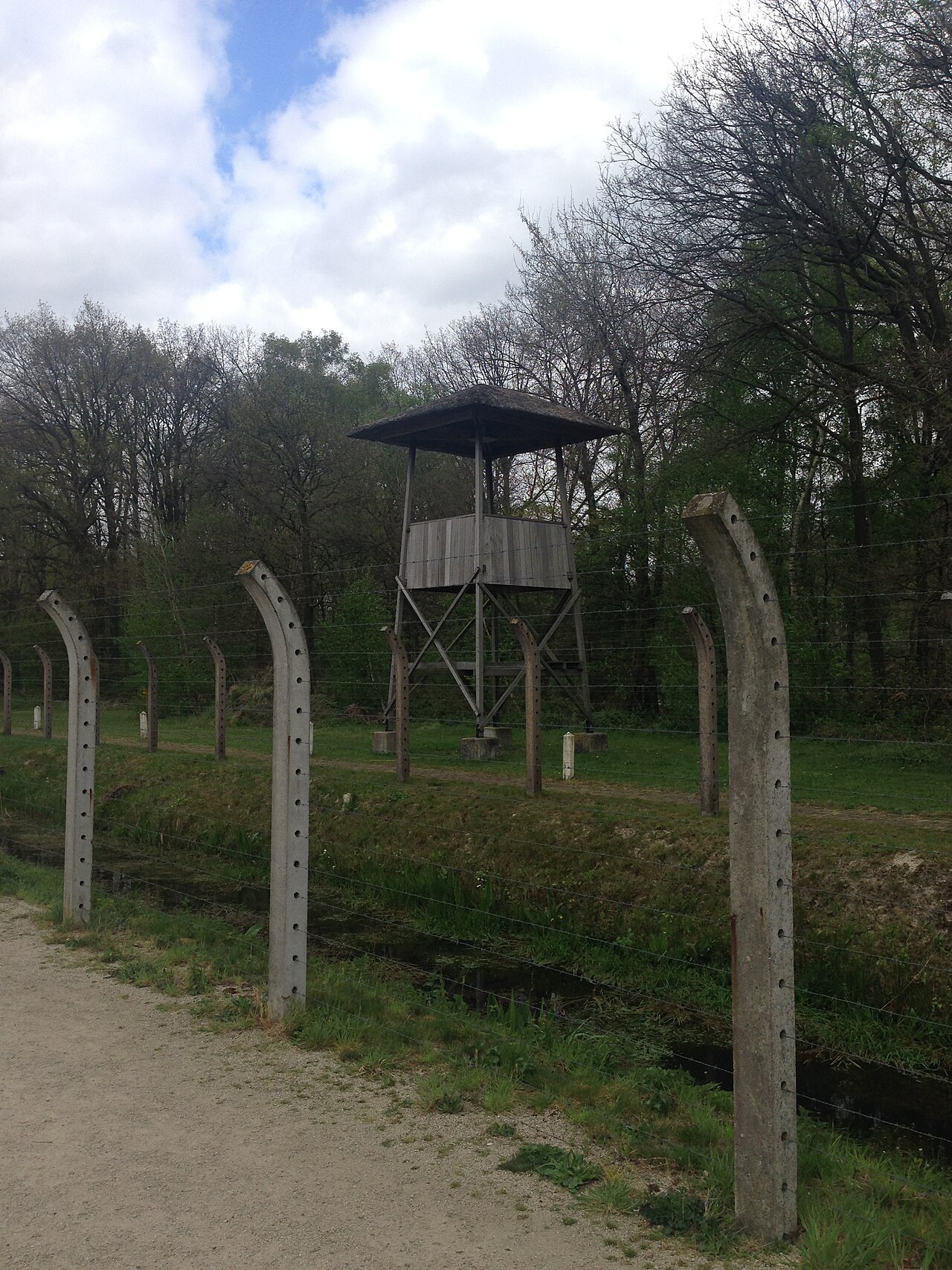
In March 1944, while trying to smuggle two Jewish girls from the Loosdrecht group, Thea Perlmutter and Ruthel Director, into France with Bauke Koning, he was captured at the southern border crossing on the way to the town of Eivtharben. The group knew this place to be extremely dangerous because of its topography. His arrest marked the beginning of five months of torture, interrogation, and solitary confinement. The torture was meant to make him give up the names of other members of the underground, but Joop endured it bravely and betrayed no one: "You know that I would never betray you. I am certain of that under all conditions and circumstances," he wrote to his friends in one of the letters he managed to smuggle to them with the help of a prison doctor. In other notes he managed to get out, he asked about the fate of the young people he had saved. In one letter he wrote: "I am such an ordinary man. Never idealize my character. I must get through these hard days and endure them, and if, in the end, my fate is sealed after all, dear friends, then I will go like a man." In every letter, he encouraged his friends to continue their rescue work: "If only you knew how strong my desire is to remain in constant contact with you, to know every last detail, and to work with you again as an active partner. Dear and faithful friends, I think of you often, and my deepest feelings are with you." In another he wrote: "And if we never meet again, may our shared work be a sacred support to you throughout your lives. May God bless you." Joop had no death wish. He and his friends planned his escape. He was kept under strict guard. When he was captured, he had a thick beard and was carrying the identity papers of another professional smuggler, whom the Germans were searching for. His French nickname was "Le Lièvre" (the hare), and the Gestapo attributed to Joop the many serious charges against that smuggler, including acts of sabotage and even the murder of a police officer.
There were quite a few attempts to rescue him. His friend Jan Smit, with the help of a guard at the prison in Eigtehoven, managed to meet with him alone. They planned to have him escape while being transferred to Rotterdam for interrogation, but the attempt failed because the transfer took place earlier than planned. In another plan, the doctor at Vught camp was involved, pretending that Joop had a stomach hemorrhage. The plan was for him to send Joop to a hospital in Rotterdam, from where his friends would smuggle him out, but this plan also failed because he was taken to the prison hospital rather than the one in Rotterdam. At the same time, several attempts were made to arrange a meeting between Joop and his wife Wil. On one occasion, they even managed to see each other from a distance, with a barbed-wire fence between them.
In April 1944, following a denunciation, many members of the underground were arrested and the organization began to collapse. Its members were eleven Dutch people and fourteen Jews, young people who worked hand in hand, united by a shared vision and purpose. One by one, they were captured and imprisoned in the Netherlands and in Paris.
Joop was executed along with three of his fellow prisoners as punishment for the assassination of the SS commander in the Netherlands, a crime he had not committed at all. His life ended at the age of 45. His wife Wil heard of her beloved's death from one of her friends, who was a friend of a kapo at Vught camp. She told Wil how Joop had walked to the gallows upright and with his head held high, inspiring his fellow prisoners as well. A doctor who was a prisoner at the same camp recounted how, on the last night, after Joop already knew his sentence, his clear voice rang through the walls of the bunker as he recited his favorite freedom poem.
In 1964, Joop Westerweel and his friends were recognized as Righteous Among the Nations. In 1947, a memorial forest was planted in the Ephraim Mountains in Joop Westerweel's name, and a primary school named after him operates in Amsterdam.
Martha, Joop's daughter, came to Israel, married an Israeli, and made her life here.
I am a descendant of a man who was saved thanks to him. Here is a photograph of the children in the training group when they arrived in the Netherlands from Germany. My grandfather, then Max Keshover, is wearing the checked shirt, in the second row from the back, third from the left. Only 23 of them survived the war.
My grandfather, who called himself Moshe Kini after immigrating to Israel, was the secretary of Kibbutz Gilad and established the Westerweel Forest in Joop's memory near the kibbutz. It stands alongside other memorials built by the children of Westerweel, as they called themselves. My grandfather, a landscape architect, designed them.
תגובות
עדיין אין תגובות.