
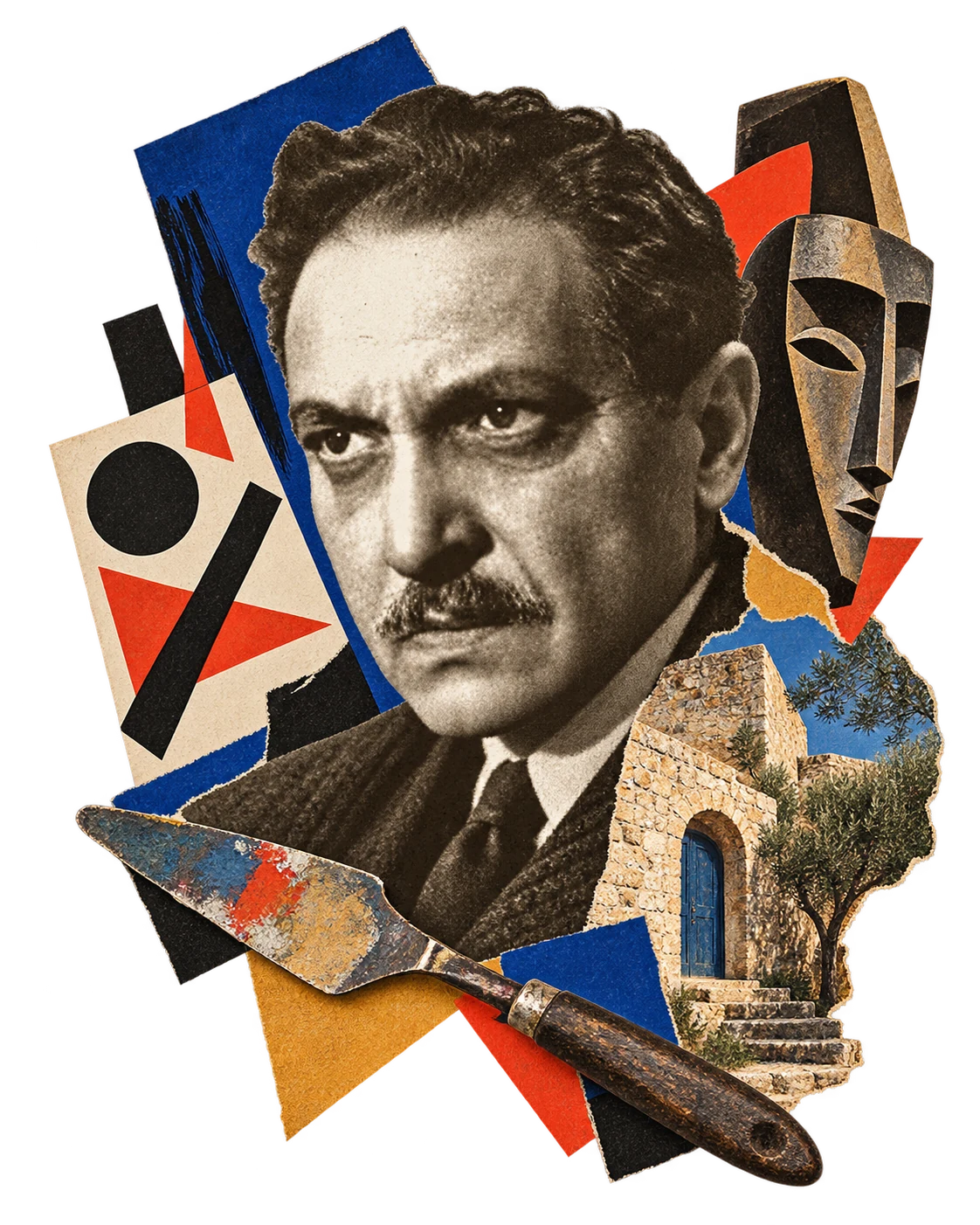
His talent for painting emerged when he was still a child. As an adult, he helped found the movement that became the starting point of modern art, and on its principles he even established a settlement.
The Painting Rediscovered
With a scalpel, centimeter by centimeter, hour after hour, and with endless patience, the painter Eli Shaltiel peeled away the layers of dust and paint that had accumulated over the years on the painting's surface. For more than three decades, the painting had secretly survived the harsh winters, the scorching summer heat, and even the great fire. Gradually, the original painting began to emerge. As the days went by, it became clear that the damage was extensive, and the attempt to understand what the original painting had looked like began. By chance, Shaltiel came across a 12-minute film from 1959 in which the painting could be seen clearly. From that moment, the restoration became easier. Shaltiel now knew what he was likely to find, and when he finished the restoration, he stepped back and saw the painting in full view. It was a painting of three naked women. Who was the painter, when was it painted, and why...?
The show staged at the Cabaret Voltaire was highly unusual. In 1916, not far from the cabaret at Spiegelgasse 1 in Zurich, the largest city in neutral Switzerland, which had become a refuge for artists during the First World War, a man whose name would be etched in the history books was staying: Vladimir Ilyich Lenin. Like them, he too hoped to change history. The group that gathered at the cabaret included Hugo Ball, who had founded the group; Richard Huelsenbeck and Emmy Hennings, all three of them German; the Alsatian Hans Arp; the Romanians Marcel Janco and Tristan Tzara; and the Swiss Sophie Taeuber. What they all shared was a loathing of war and a vision of creating a new artistic genre - "Dada."
"This is a once-in-a-lifetime discovery. A rare find of global significance, unlike anything I have ever worked on," said Eli Shaltiel, who uncovered the painting. "You don't come across original works every day by one of the most important artists who ever lived here, whose works are kept in museums around the world and are worth a fortune," said Raya Zomer-Tal, director and curator of the Janco-Dada Museum in Ein Hod.
From an Abandoned Village to an Artists' Village
In mid-August 1938, Yusuf Abu Durra's gang attacked the detention camp near Atlit, where the British had imprisoned members of Arab gangs. During the attack, the gang abducted the camp's deputy commander, Moshe Lazarovitch; his wife, Bruria; their three children; and Bruria's brother, Eliyahu Kirzner, who worked at the salt works in Atlit. The three children were released, but the three adults were murdered, and their burial place was discovered only 25 years later. The abduction was carried out with the full cooperation of the prominent figures of the hostile village of Ein Hut, the imam Sheikh Ali al-Saadi, and the village mukhtar, Zaidan Abu al-Hija, deputy to Salah al-Din in the battles of 1948. The Jewish settlers began organizing a reprisal, and the villagers feared for their lives. About 600 people gathered in the mosque plaza and decided to flee. After the fighting ended, a minority returned and settled on the outskirts of the village. In an irony of fate, years later the settlement of Nir Etzion was established on the village's land. Its residents were refugees from Gush Etzion, and for many years they were the ones who supplied the refugees from Ein Hut with water and electricity.
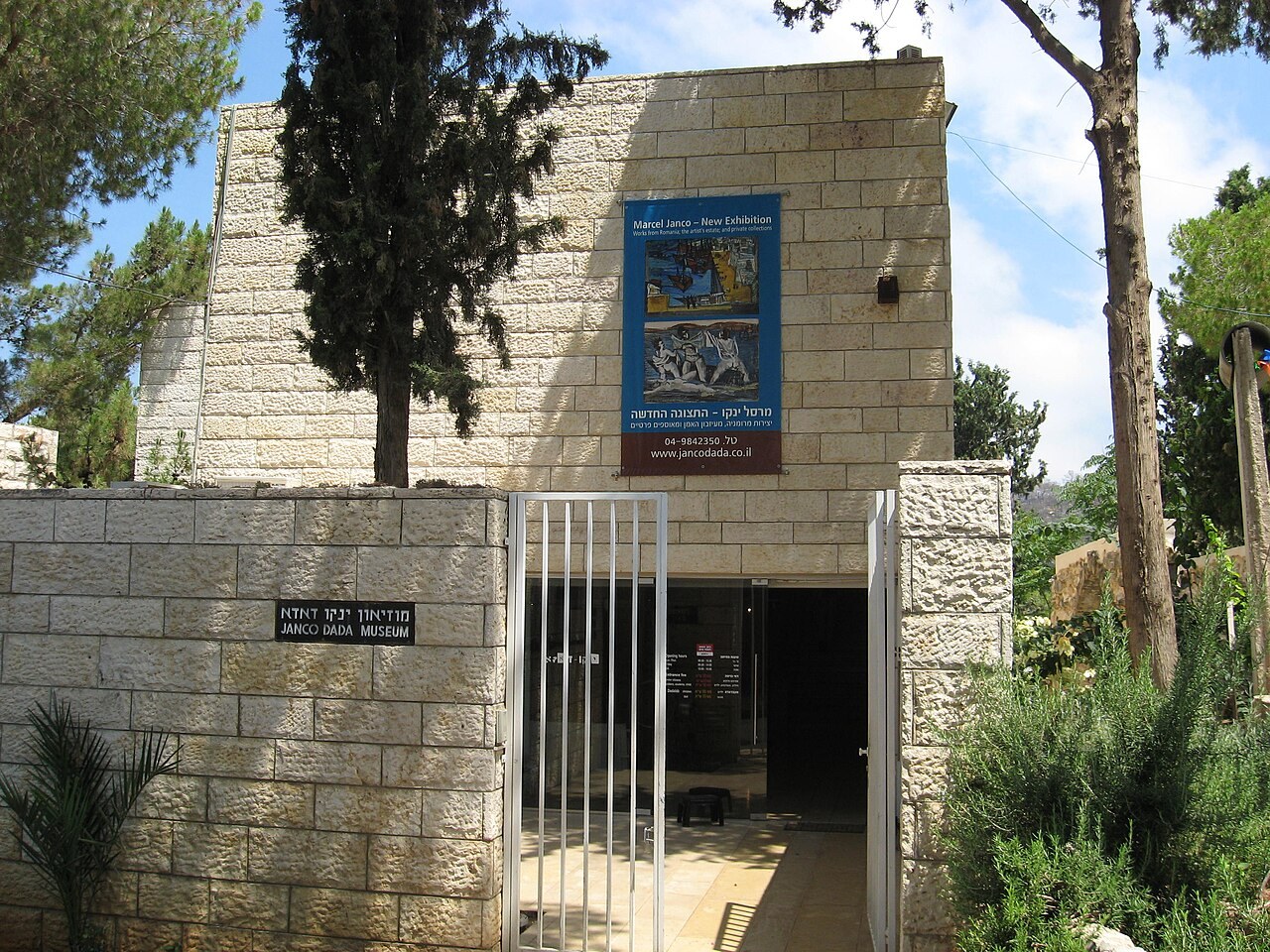
Immigrants from Algeria were housed in the abandoned village homes. They later left and founded the moshav of Tzrufah, and the plan was to demolish the houses. When Marcel Janco learned of this, he was an artist working in the Planning Department of the Ministry of the Interior and responsible for identifying land for national parks. He proposed that the state let him establish an artists' village there. As he put it: "I'm as romantic as all artists; I loved being close to nature... It was a ruined village, teeming with mice, with no electricity, water, or roads. With our own hands, we created this wonderful place."
This was not Marcel Janco's first attempt to establish an artists' settlement. As early as 1950, he tried to establish one in Jaffa and was among the few who fought against the destruction of Jaffa's dilapidated kasbah, left empty of its residents. "Modern Tel Aviv is not beautiful; it is even ugly. And if there is one beautiful corner, please don't destroy it," said the modernist artist, who had only recently arrived in the country, with heartfelt conviction. Thanks to him, Jaffa's artists' quarter exists today. Janco later came to the defense of the old quarters of Acre, Ramla, Beit She'an, Safed, and Tiberias, and helped establish the "Supreme Committee for Holy and Historic Sites and Monuments in Israel."
In 1953, Marcel Janco brought together the first group of settlers for Ein Hod. As stated in the minutes of the Ein Hod Development Committee in 1960: "All planning and construction in the village and its surroundings, as well as all development work, must be carried out with the utmost care to preserve the village's physical character, both within it and in its appearance in the surrounding landscape." Ein Hod, the new name given to the settlement, became over the years an example of an integrated approach to preservation and a gem that draws many visitors on weekends. According to Janco, the village of Ein Hod was in fact the greatest Dadaist act he had ever carried out. In 1982 he said: "Of course, there is a direct connection. My dream of establishing an artists' village came from my experience with Dada in Zurich. I saw there that a group of artists working together could be a great success, and here in the village I thought of creating a similar group of young artists, to create a new movement for Israel."
The founders of the "Dada" movement were a group of artists from different fields. Among them was the entrepreneur Hugo Ball, a writer who recited his poem "Karawane" at the Cabaret Voltaire - a collection of nonsensical sounds delivered to a stunned audience; the German poet and journalist Richard Huelsenbeck, the king of provocation; Tristan Tzara, a Romanian poet; and Marcel Janco, Tzara's close friend. Marcel Janco was described as a handsome, melancholy man, a charismatic character who played the accordion and sang Romanian chansons. He was a painter and sculptor who designed masks for the Dadaists and recited - or, more accurately, screamed - poems with Tzara and Huelsenbeck. This group of artists met chaos with humor, originality, and a breaking of conventions. Thus one of the most important art movements emerged. The word "Dada" was coined by Tristan Tzara a few months after the movement was founded. There are several accounts of how the word came into use: a child's babble, a name for a toy, a doubling of the word "yes" in Slavic languages, and more. "The slaughter of 1914, when the world war broke out, filled us with revulsion, and so we devoted ourselves to the arts," said Hans Arp, one of the members. "We sought a natural and fundamental art that would free people from the madness of those days, and we also sought a new order that would establish a balance between heaven and hell... Our intention was to create a clown's show and a requiem at the same time." In his 1918 Dadaist manifesto, Tzara declared that, as editor, he wanted to make it clear that he felt unable to endorse the opinions published in the manifesto because, in principle, he was against manifestos - but he was also against principles. Anyone who thinks the Dadaists were silly and foolish has a point. Fooling around freed them from the shackles of reason. Fooling around can be funny, provoke laughter, and make us understand that laughter is liberating. Dada was, in essence, the starting point of modern art, as it broke free from the shackles of the past.
Three years after the village was founded, its founder, Janco, was at the peak of his career. His works were exhibited in prestigious museums around the world and sold for high prices. Dozens of houses he had designed as an architect adorned his native Romania, and as one of the founders of the "Dada" movement, he was highly respected and admired. In the run-up to Purim, Janco decided to adopt a Romanian tradition and decorate the village houses with murals to give the Purim ball a festive atmosphere. Other artists who lived in the village joined the effort. The Tel Aviv bohemians came north to attend the festive event, which attracted widespread attention. They wrote to the then president, Yitzhak Ben-Zvi, to Prime Minister Ben-Gurion, and to his ministers, telling them about preparations for an "original Israeli masquerade ball." The letter read: "Dozens of village residents, including some of the finest painters, are working to give the ball the character of an original carnival. The walls of 13 houses will be covered with giant murals made by renowned artists. Each house will have its own distinctive style." Marcel Janco decorated his house with his own hands, and then painted the three women. Shortly after the ball, the walls of the village houses were whitewashed again, covering the paintings. Not all the villagers looked kindly on this. "Comrade Yossifon wants to save the paintings from a barbaric act, in connection with the removal of Janco's paintings from the walls," reads the minutes of one of the village meetings. Janco replied: "Regarding the barbarity of removing the frescoes from the walls... he thanks all the friends who are concerned for his reputation and the future of his work. However, he notes that he has greater ambitions elsewhere in the world." Years later, his granddaughter explained: "In this case, Janco saw these paintings as part of a particular event, so he had no problem with erasing them afterward. He always believed in his ability to create anew."
From Bucharest to Israel
Marcel Janco's life can be divided into two nearly equal parts: 46 years in Europe and 43 years in Israel. Janco was born in Bucharest in 1895 as Marcel Hermann Janco, the eldest child of the prosperous merchant Hermann Zvi Janco and Rachel, née Yuster. Two sons, Jules and Georges, and a daughter, Lucia, were born after him. From an early age, he was exposed to creativity and art, and his mother gave him private piano lessons. He began drawing as a child, and in high school, together with his friends Tristan Tzara and Ion Vinea, he produced a subversive newspaper in which he published his drawings. In 1915, at the age of 20, he arrived in Zurich to study architecture at the Polytechnic Institute; his two brothers joined him later. In Zurich, he joined the "Dada" movement, but six years later he parted ways with the movement and moved to Paris.
In 1922, Janco returned to Romania, where he helped found a journal that published his work alongside that of other modern artists. Together with his brother, he opened an architectural design office. More than 40 private homes and public buildings were built in Romania according to their designs. The style of the houses he designed was easy to recognize. Their lines were clean and elegant, with no ornamentation, and they featured an intriguing combination of shapes, such as round or triangular windows. Looking at the buildings could sometimes feel like looking at one of Janco's paintings. In 1939, amid rising antisemitism, the persecution of Jews in Romania, and the Bucharest pogrom, Janco held his final exhibition in Romania. One visitor came up to him and said, "What a tragedy that you are Jewish." Janco responded by slapping him. "I knew then that I was finished with Romania," he said later.
In 1940, he immigrated to the country with his family. "I came to the Land of Israel with the help of a collector at the British Embassy in Bucharest who knew me as an architect and appreciated my work. He obtained a certificate for me, and I sailed by ship to Constantinople. From there, I traveled by train and bus to Palestine," he said. With his characteristic humor, he described the difficulties of settling in the country: "I left a great deal of property behind, but I don't regret it, even though they didn't greet me with flowers here... Well, what was the artistic reality here? I found out at the border crossing. The English police officers asked me whether Van Gogh was Jewish. Why? Because in every room in every kibbutz, a reproduction of his work hangs on the wall."
In Israel, Janco was captivated by the scenery and the light, and moved by the struggle for independence. He carried a notebook in which he recorded the landscapes he saw. When he returned to his studio, he made a point of putting these new sights on canvas in vivid colors. Of the landscapes he took in, he said: "God splashed color over the whole world with a heavy hand, but painted Israel with a fine, delicate brush."
Janco's Legacy
With the establishment of the state, another group of artists came together and called itself "New Horizons," marking a turning point in the history of modern art in the country. Marcel Janco was among its founders, alongside Zaritsky and Streichman.
In June 1983, in the presence of the then president, Chaim Herzog, the Janco-Dada Museum was inaugurated. It had been established by his friend, the painter Itche Mambush. Ten months later, in April 1984, Marcel Janco died in Ein Hod at the age of 88. He left behind a vast estate and an immense artistic legacy. Janco was an Israel Prize laureate for painting, and a street in Tel Aviv is named after him.
In 2009, the Council for Conservation of Heritage Sites in Israel, together with the family, took on the preservation of Marcel Janco's studio, adjacent to the museum building. Eli Shaltiel carried out the gradual uncovering and restoration of the paintings. The painting of the women was largely preserved, and with the help of computer simulations and a special plaster base prepared for the damaged and missing areas, it was fully restored.
תגובות
עדיין אין תגובות.