
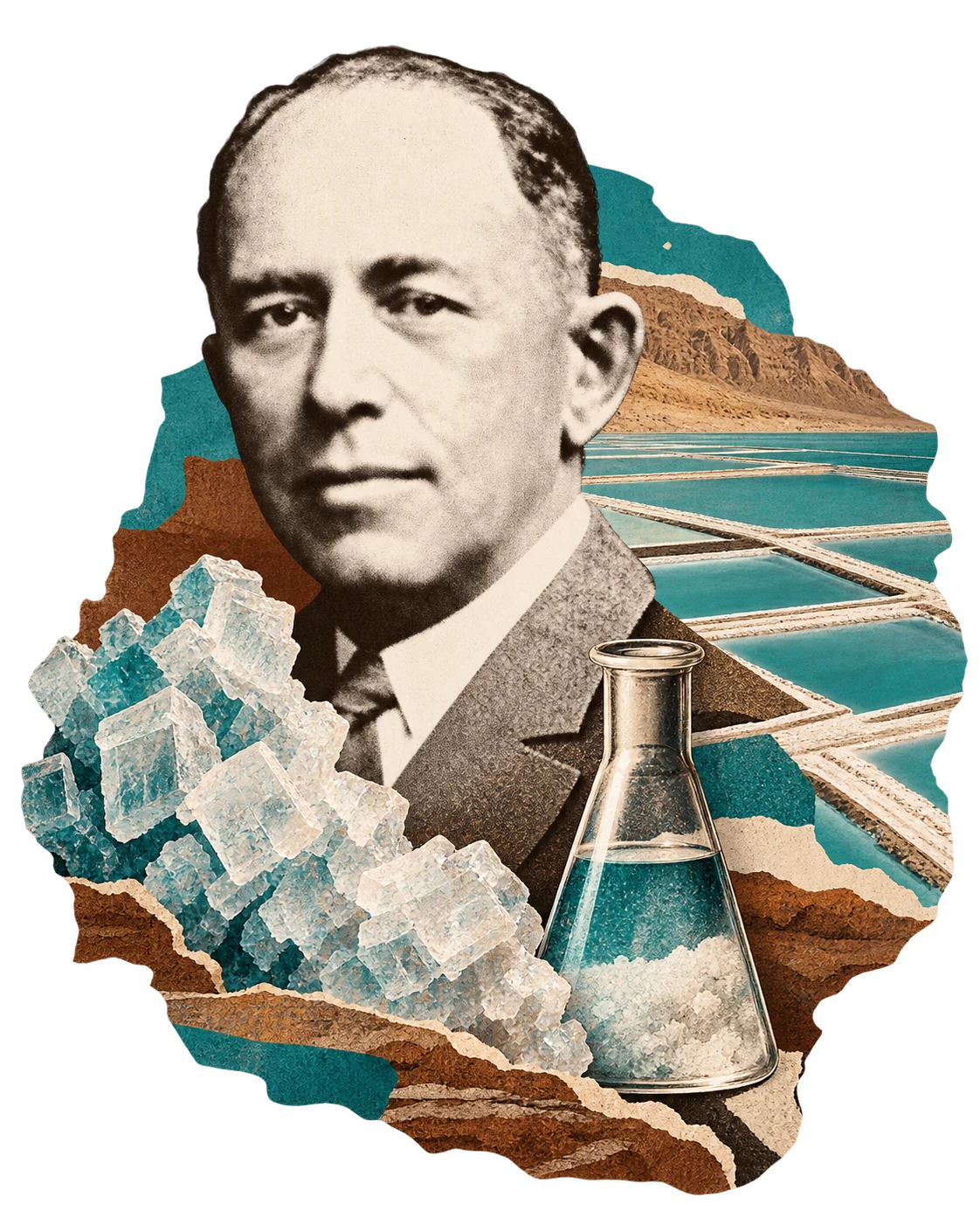
At a time when Zionism and pioneering were associated with working the land, there were also a few visionary Zionists who saw industry as the future of the state that had yet to be established.
Moshe Novomeysky The geological report surveying the Dead Sea, commissioned by Herzl from Professor Max Blanckenhorn, was meant to remain secret. It was accessible only to five people entrusted with the secret: Herzl; Otto Warburg, who at the time headed the Office for the Settlement of Palestine; Leopold Kessler, a mining engineer living in London; Dr. Chaim Weizmann, then a chemistry lecturer at the University of Geneva; and Moshe Novomeysky, who was in fact the only one to understand the report in depth. Novomeysky saw the enormous potential of the minerals in the Dead Sea and was the only one who knew how to extract them. After reading the report, he could already envision a vast industry, and was undeterred by the major obstacles because even then he had solutions for them.
The Journey to the Dead Sea
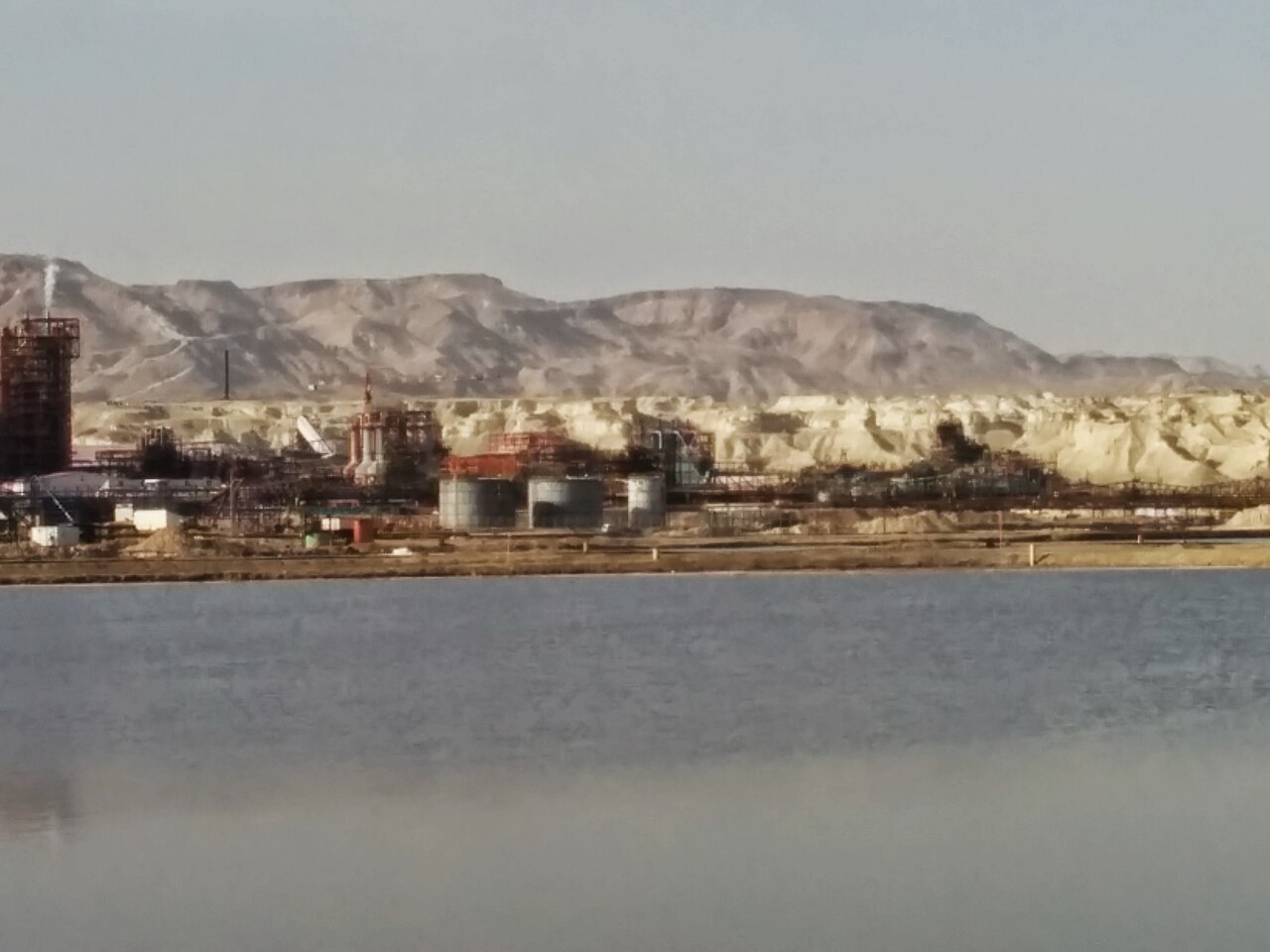
In 1919, about 14 years after seeing the secret report, Moshe Novomeysky decided to immigrate to Palestine, bringing with him the knowledge and capital he had raised to realize his dream of establishing a mineral industry at the Dead Sea. In those years, the Dead Sea was a remote, desolate place, dangerous both in terms of security and climate. Moshe Langotsky, who would later become Novomeysky's right-hand man, wrote: "Novomeysky and I set out in a car belonging to the Kadima drivers' company. We arrived in Jericho, stopped at the police station, and announced that we were going to the sea. The car wandered around for several hours, but we could not find the sea. The driver lost his way, and in the evening darkness we returned to Jericho [...]". The next day, they went back and found the Dead Sea. Moshe Langotsky also recounted that he worked alone for two years testing the soil: "The surroundings where I lived and worked in complete solitude were desolate and wild. Bandits roamed the mountains, and vagabonds..."
Roots in Siberia
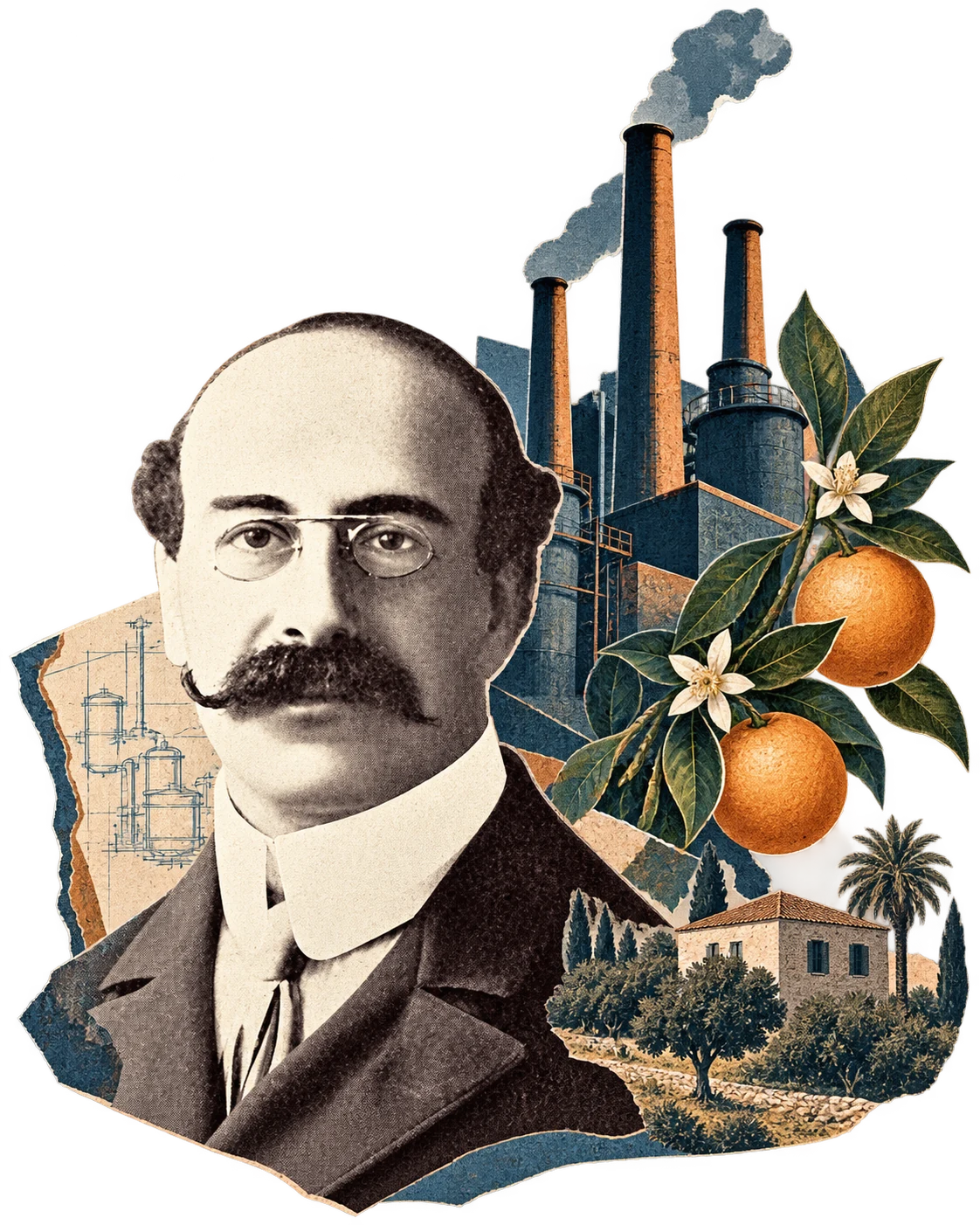
Moshe Novomeysky was born in Barguzin in 1873 to a prosperous family of exiles. His parents, who were also born in Barguzin and married at the age of 16, began their lives as fish merchants and opened a business transporting goods to mines in the region. Over time, the business expanded, and together with Russian partners they acquired mining lands in Siberia. At home, his parents spoke about Zionism and socialism, and from childhood Moshe was exposed to the revolutionaries' ideas. It was already clear to him that he would eventually join the family's mining business. At 11, he began studying at a technical school whose graduates were awarded "personal honorary citizenship." He pursued higher education at the Royal Prussian Academy of Mines, where he became interested not only in gold mining but also in potash extraction. The inquisitive Moshe broadened his knowledge of bacteriology, geology, and philosophy at the universities of Berlin and Heidelberg as well, and after four and a half years received a diploma in metallurgical and chemical engineering. During his studies, he joined Russian revolutionary exiles and met Zionist Jewish students, through whom he came closer to the national idea. After completing his studies and obtaining an exemption from military service, he returned to his hometown. Novomeysky began investigating the minerals in his surroundings and even prepared plans for extracting them. In 1900, near Lake Olga, he established a pioneering plant to produce and refine Epsom salts, and within a short time it was supplying sodium sulfate to all the glassworks in eastern Siberia. This success gave him confidence, and in 1907 he established another plant in western Siberia.
The Road to the Land of Israel
Three events brought the industrious Jewish industrialist from frozen Siberia to the lowest place on earth. The first was the construction in 1897 of the railway from Siberia to Moscow, which connected the isolated Jewish community with cultural centers - and drew Moshe Novomeysky into vigorous Zionist activity. By the age of 25, he was active in Zionist associations, and in early 1903 he took part in the first conference of Siberian Zionists and began corresponding with Ben-Zion Mossinsohn, one of the leading Zionists in Russia and later a founder of Tel Aviv and principal of its Gymnasia.
The second event was the 1905 revolution against Tsar Nicholas II, during which Moshe Novomeysky was imprisoned for seven months. Upon his release, he moved to Berlin, having realized that Siberia would show no kindness to Jews. But when the turmoil subsided, he returned and continued his Zionist activities there.
The third and decisive event that prompted him to travel to the Land of Israel was his participation as a representative of Siberian Jewry in the Zionist Congresses, where he encountered the country's pioneering workers and their leaders, including Yitzhak Ben-Zvi and Yosef Aharonovitch.
Moshe Novomeysky's first visit to the Land of Israel was in the hot month of June 1911, and it left a profound impression on him. He wrote about it nine years later: "The sight of this ancient city (Jaffa), emerging on the horizon, stirred me deeply. As I saw the approaching coast of the Land of Israel, the cradle of the Jewish people, my heart was swept up in a wave of emotions and childhood memories. But it was not national feelings that stirred me, nor was it only the anticipation of coming into contact with the Holy Land. Another source of my excitement was that this was my first contact with the ancient world, which had always greatly interested me... A native of Siberia who travels to the old countries of Europe, such as Britain or France, is deeply impressed by the sight of castles, gardens, churches, and parliament buildings that take him back hundreds of years. And here I was, about to enter a land whose history spans not hundreds of years, but several thousand."
In the country, he met Arthur Ruppin, director of the Palestine Office in Jaffa; Zalman David Levontin, head of the Anglo-Palestine Bank; Yitzhak Ben-Zvi, who would later become president of the state; and others. After being awed by Jerusalem, he traveled down to the Dead Sea accompanied by Aaron Aaronsohn, an agronomist from Zikhron Ya'akov. After collecting samples of Dead Sea water, he continued to the Galilee and, three weeks later, sailed back to Siberia.
Following the pogroms in Ukraine, Poland, and Galicia, and the manifestations of antisemitism in Siberia, he left Siberia and on 08.10.1920 arrived in Tel Aviv after a journey through Shanghai and Egypt. At the age of 47, he began a new chapter in his life and set about establishing the Dead Sea potash works. Moshe Novomeysky arrived with money, knowledge, and a plan for building the plant, but his first undertaking in the country was helping immigrants. He opened an office in Tel Aviv to receive Jewish immigrants, refugees from the Bolshevik Revolution who had fled to China and, unlike him, had arrived penniless.
The Founding of the Potash Plant
He acquired the concession of the Transport and Shipping Company from Ibrahim Hasboun, a resident of Bethlehem. Hasboun had a shipyard on the northern shore of the Dead Sea that was in financial difficulty. He approached the British for a loan, but they preferred that Novomeysky put his own money into it, and so they helped him obtain the transport concession. Novomeysky established a good relationship with Herbert Samuel, the British High Commissioner in the Land of Israel, and in 1922 applied for a concession to mine minerals at the Dead Sea. At the time, he learned that Major Thomas Gregory Tulloch, a Scottish mechanical engineer and explosives researcher who had served the British administration, had submitted an identical application back in 1918. To join forces, the two partnered and received the long-awaited concession in May 1929. Upon receiving it, they established a public company and appointed the Earl of Lytton as chairman, after General Allenby politely declined their request on account of his age. Moshe Novomeysky was appointed the company's managing director. Since obtaining the concession was conditional on raising the necessary funds, the two launched an effort to raise capital from the public. Although most of the money was raised from Jews, the company was identified as British.
In its first year, Novomeysky built evaporation ponds and a flood-control dam. Parts for building the bromine plant arrived from Germany, and by the end of that summer the site of the potash plant had been chosen. Novomeysky was the first to attempt to extract potash from the sea; until then, potash had been obtained only by mining deposits in the ground. In a short time, the plant became a major employer, both in the Land of Israel and in Transjordan, and the first plant in the Land of Israel to be both a pioneering Israeli enterprise and an international one.
Bromine production began in January 1931, and a month later five tons of bromine had already been exported to England. In February 1932, the first potash products were shipped to England, and the plant's success led Novomeysky to acquire land in the southern Dead Sea region to expand the operation.
May 1, 1934, Workers' Day, was a historic day. The Hachugim group, made up of 27 members of the United Kibbutz Movement, set sail from the northern Dead Sea to a chosen site in the south. Before their departure, Moshe Novomeysky addressed them: "We have gathered here today to begin a new period in the history of our enterprise - the conquest of a new tract of wilderness. We have come to wish you well as you sail to the other end of the Dead Sea, to lay the cornerstone of the new settlement. As I send you today to this place, portrayed in such dark colors in the annals of humanity, I wish you a safe and successful voyage and the joy of creation, knowing that you have been chosen to be the first to lay the cornerstone of a new settlement, at the farthest point in the Judean Desert." The plant was built over three years, and in 1937 the southern plant began producing bromine. World War II brought bromine demand to new heights, since it was used to raise the octane rating of fuel, which was essential for British army vehicles and aircraft. Thus, between 1938 and 1947, the Palestine Potash Company became one of the world's seven largest potash producers.
The UN decision in November 1947 to partition the Land of Israel brought the Palestine Potash Company to an end. Partition left the northern plant within the territory of the Arab state. Novomeysky understood the implications and submitted a memorandum to the UN investigative committee explaining the consequences of the decision, but his effort failed. Moshe Novomeysky and Avraham Rotenberg, brother of Pinhas Rotenberg, founder of the Palestine Electric Corporation, tried to mediate between the Yishuv leadership and the Jordanians. Their efforts led to a series of meetings in Amman between Golda Meir and King Abdullah. At the meetings, it was agreed that if war broke out, the Jordanians would not harm the potash plant in the northern Dead Sea region or the power plant at Naharayim - but the Jordanians did not honor the agreement. It was a ruse intended to draw the Haganah forces away from the plants, and in May the Jordanians entered them and took the workers prisoner.
Moshe Novomeysky was seriously injured in a car accident, and while he was in the hospital the northern plant was evacuated and destroyed, along with Kibbutz Beit Ha'arava. It was a traumatic event, and Moshe Novomeysky was blamed for the defeat. The most painful moment was a letter he received from Ben-Gurion, who reprimanded him and said that despite the UN decision, and despite the fact that the territories were under his responsibility, no one had been authorized to give them up. The stunned Novomeysky reminded Ben-Gurion that the orders to leave the northern plant had come directly from Tel Aviv, entirely without his involvement.
The second blow to strike him was the decision of the state commission of inquiry appointed in October 1948, whose purpose was "to investigate the issues relating to the exploitation of the Dead Sea." The commission concluded that the Palestine Potash Company had failed to make use of the Dead Sea's resources and should be nationalized immediately. The government feared that nationalization would deter future investors, so toward the end of 1949 it decided to allow Moshe Novomeysky to try to restore the potash plant, while reserving the right to nationalize it in the future.
With the threat of nationalization hanging over the plant, it was clear that Moshe Novomeysky's efforts to raise money to restore it would fail. In October 1951, the board of directors of the Palestine Potash Company decided to transfer all its assets to the Government of Israel. In 1952, a new government company was established, called Dead Sea Works Ltd., and in 1955 Moshe Novomeysky was appointed honorary president of the company.
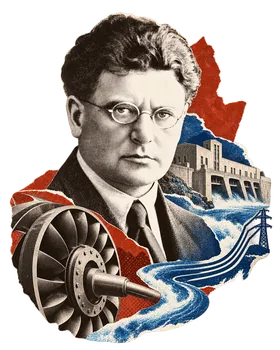
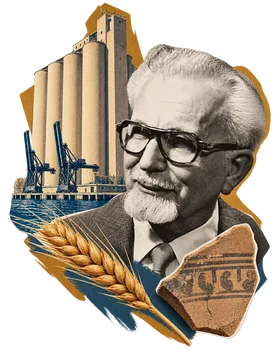
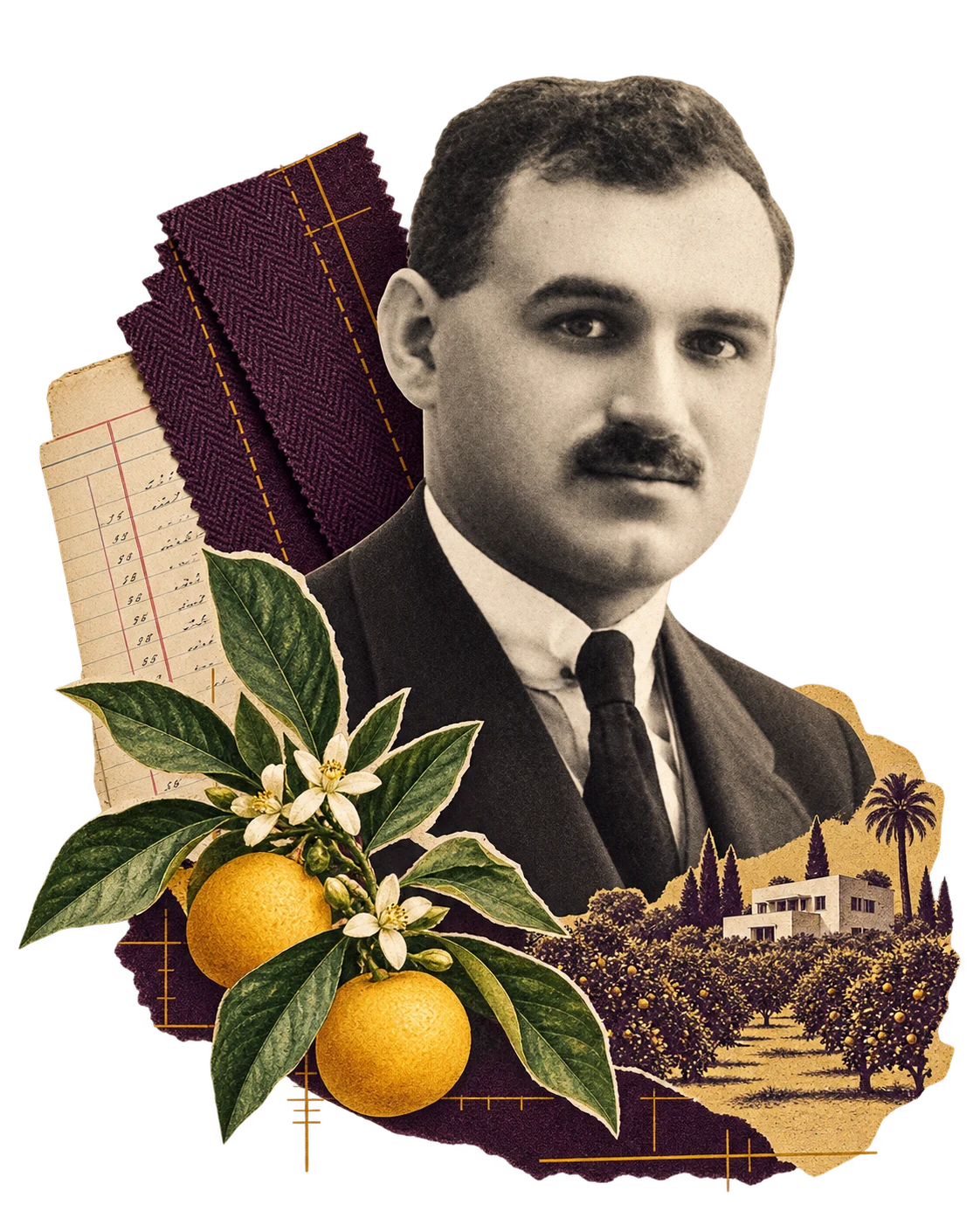
At the time, Zionism found expression in agricultural labor, while Novomeysky, like Hecht of Dagan Granaries and Rotenberg of the power plant, saw industrial development as a way to realize Zionism, for the benefit of the country's Jewish and Arab residents. The remarkable success of the Palestine Potash Company was, in fact, Moshe Novomeysky's success.
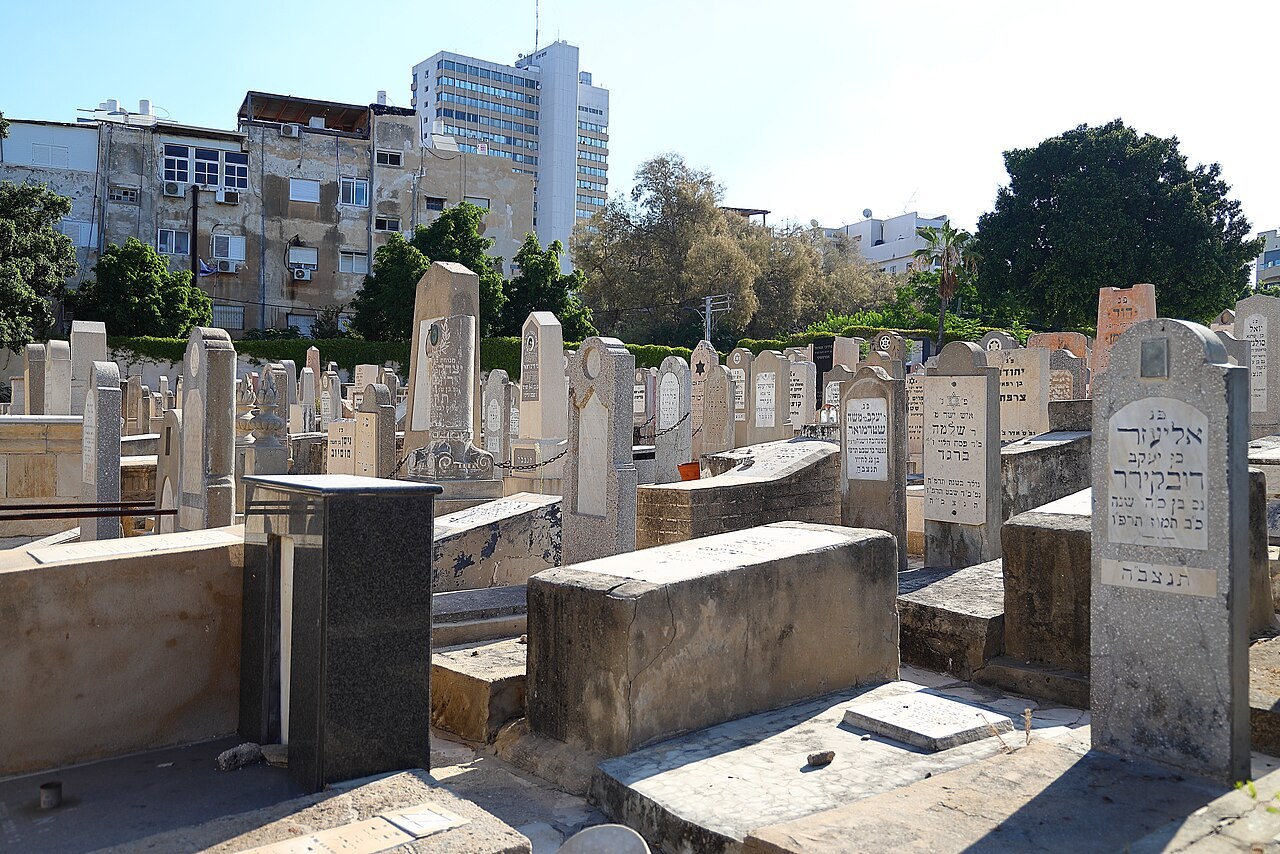
Moshe Novomeysky ended his life heartbroken, in a small apartment in Paris, hurt and pained by the treatment he received in his final years. He died in 1961 and was buried at the Trumpeldor Cemetery in Tel Aviv.
תגובות
עדיין אין תגובות.