
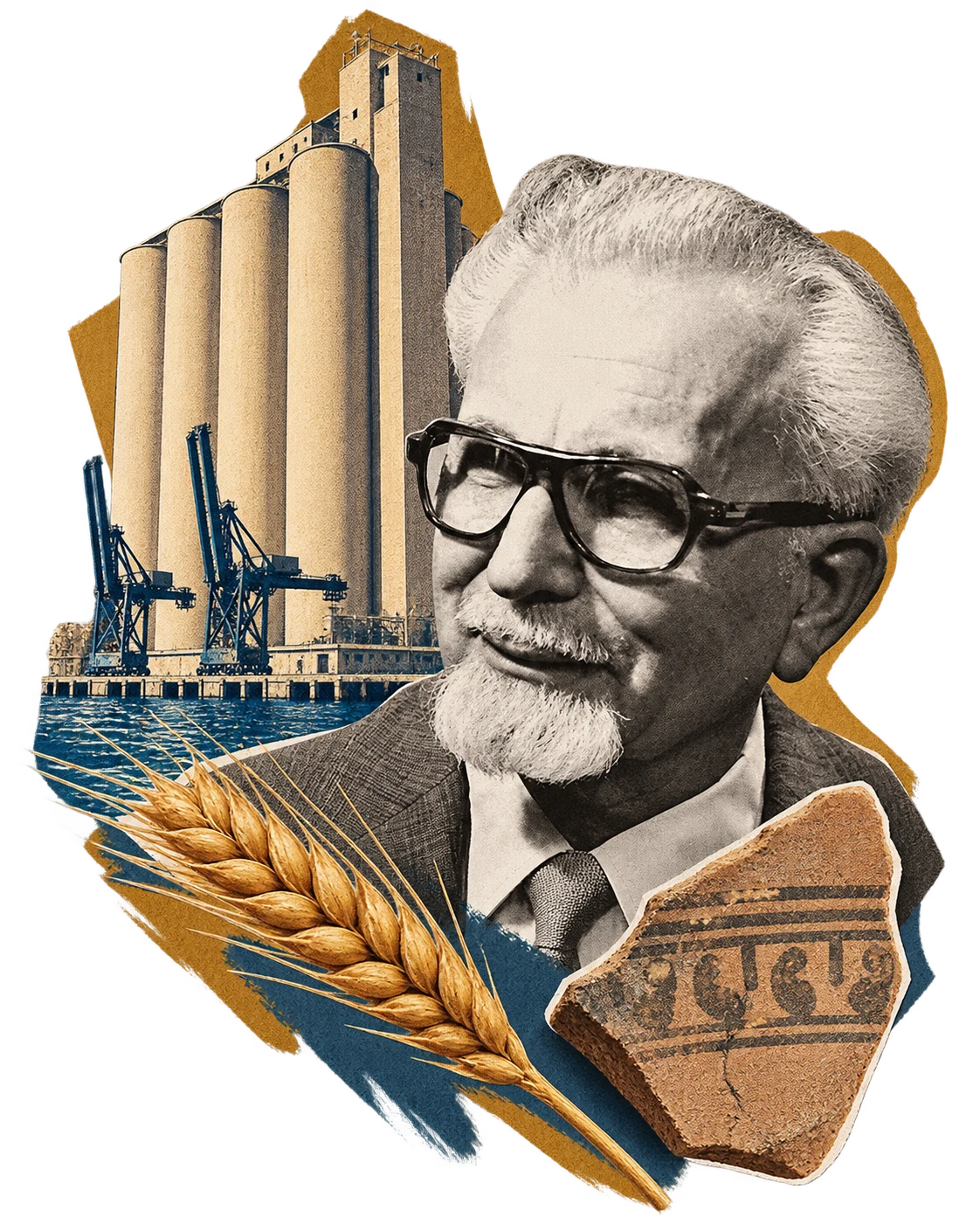
A Zionist activist born into a wealthy, assimilated, anti-Zionist family, he served as personal adviser to Prime Ministers Menachem Begin and Yitzhak Shamir.
Father and Son Reconciled
The phone call Harry Zessler, Dr. Reuven Hecht's personal assistant, received that morning was the result of a strange request from Reuven's father, Jacob Hecht. A week earlier, Jacob had told him that he planned to surprise his son Reuven by coming to Israel, and had asked him to pick him up at the airport and convene the management of Dagon Grain Silos on the very day he arrived.
When Zessler went to pick Jacob Hecht up at the airport, he was excited: the wealthy Hecht owned the Neptun corporation, which controlled shipping and warehouses along the Rhine. The two drove straight to the Port of Haifa and went up to the boardroom. All the members of the management were there, including Jacob's son, Reuven Hecht. When the door opened, silence fell. Jacob entered and said, "My son, I ask your forgiveness. You were right and I was wrong." The elderly man embraced his son, and despite their cold, reserved Swiss demeanor, tears streamed from their eyes.
That was how the bitter dispute between father and son came to an end. They were the leaders of one of the country's most successful enterprises. All the members of the management knew about the tension between them, but had never expected the forceful, tough father to travel all the way from Europe just to ask his son for forgiveness.
Years later, Reuven wrote: "I don't like the expression 'crown prince,' but according to the custom, management would pass by inheritance to the eldest son. I remember that early in our time in Basel, when the Neptun company was being established, my father would travel to large companies to offer them the company's services. He took me, his eldest son, on these trips and introduced me to the companies' managers. It should not be forgotten that even at the age of four, in Antwerp, I had my own office and did all sorts of office work there. I was given a small desk, a suitable chair, an old typewriter, and other office supplies. At that time, my parents were flawless in my eyes; I idolized them. How different the picture was later, when those same wonderful parents sued their eldest son and asked the court to declare him not responsible for his actions."
Roots and an Assimilated Upbringing
Reuven Hecht was born in the summer of 1909 in Antwerp, Belgium, the eldest child of Jacob and Ella Hecht. Jacob and his brother Hermann managed to leave an impoverished Jewish neighborhood and build businesses. Rhenania, a German company, and Neptun, a Swiss company, were giant firms engaged in shipping and warehousing along the Rhine. Jacob built the business empire with his own hands. With money he borrowed, he bought one old ship, then bought more ships and expanded his business along the Rhine countries. He was known as an honest, tough businessman, qualities his son Reuven inherited. The wealthy family belonged to those Jews who saw themselves as Germans of the Mosaic faith and nothing more. They considered national identity more important than Jewish identity.
Reuven was born Rudolf Charles Hecht: "I was given the name Rudolf after the German Crown Prince Rudolf. My second name was Charles, after the son of the King of Belgium," he wrote. "For decades, my family turned its back on Judaism and became assimilated. Everything Germany did was considered right because the Kaiser had ordered it. The way I was brought up as a German patriot meant that I was told I was a German child and had to be loyal like a German... At home, the words 'For God, Kaiser, and Fatherland' were quoted constantly."
When Reuven was nine, the family moved to Basel, Switzerland. Because he was Jewish, Reuven was not allowed to attend Christian religion classes at school. Being excluded awakened in him a need to embrace his Jewish identity. He wanted to learn Hebrew, but his father insisted that he first learn English and improve his French. Eventually Jacob gave in and found Reuven a Hebrew teacher who, between lessons, told him about the Zionist movement and Herzl. Reuven wrote: "I discovered Herzl in my grandfather's bookcase before I had reached bar mitzvah age. It was a book of Herzl's writings, its pages still uncut. I asked my grandfather to give me the book and took it home with me. I remember sitting at my desk and separating the pages with a penknife, one page at a time. I don't remember whether I read the whole book that day, but I remember well that I locked it in my desk drawer as if it were a secret." Reuven was captivated by Zionism and by Herzl, who became his idol. Reuven's new activities troubled his assimilated family, creating a crack that would later become a rift and lead to his being ostracized.
At the age of 13, Rudolf became Reuven for good: "On the day of my bar mitzvah, all my relatives came. When I was called to the Torah by my Hebrew name, Reuven ben Yaakov Halevi, I felt joy and pride. For the first time in my life, I felt a sense of unity with the Jewish community... Of course, after my bar mitzvah there was no place in my life for celebrations like that anymore, and that was surely why, at Christmas, I took the decorated fir tree standing in our home and threw it into the yard."
Studies and Zionism
At the age of 22, Reuven came to Israel for the first time with a group of students. Moved by the country, he visited Haifa and was deeply impressed. Even on that visit, he knew he would be glad to work in the city and make it his permanent home. He looked for a place to build an enormous silo that would save money for the emerging state, just as his idol Herzl had envisioned in his book Altneuland. When the Nazi Party came to power in Germany, Reuven attended a rally in Munich where Hitler was speaking. With a golden Star of David pinned to his lapel, he defiantly sat in the front row. When Hitler began whipping up the crowd, two SA men arrived and drove him out.
During the years 1933-1928, Reuven Hecht studied at Germany's leading universities in Berlin, Munich, and Heidelberg. He studied law, archaeology, art, and ancient history, as well as natural sciences, theater, and journalism. In 1933, he graduated with honors.
Reuven became friends with Alex Rafaeli, who later joined the Irgun and became an industrialist with Kargal-Rotoplas-Phoenix-Migdal, and with Naftali Wydra, who would later become CEO of ZIM and establish the Wydra Institute for Maritime Studies. The three dreamed together of immigrating to Israel and devoting themselves to the Zionist enterprise, so Jacob forbade Reuven from bringing them to his home: "You'll never amount to anything, and if you go on like this, you'll end up in the gutter. When my father said these things to me in all seriousness, I was 23 and had completed my doctoral dissertation with the highest honors. To be honest, it was predictable. I was in a Zionist youth movement, attended Zionist congresses, traveled to Israel for an extended period, and had no desire to begin a normal life. All this was bound to lead to a rupture. I took three shirts and a pair of pajamas and traveled by train to Paris. When I arrived, I went to meet Jabotinsky. He offered me volunteer work. I was very excited and embraced Jabotinsky as a father." By the end of that meeting, Reuven had decided to immigrate to Israel.
During Passover in 1936, Reuven arrived in Israel, this time as an immigrant. At the age of 27, he began planning the idea he had first considered five years earlier: building a silo in the country. While sending a memorandum to the British, he met David Raziel, one of the founders of the Irgun, who sent him back to Europe to establish a center to help Jews immigrate to Israel. Reuven set up immigration offices in Zurich and Paris, and his underground names were Yerushalmi and Rubens. This was the beginning of his extensive rescue work. Among other things, he chartered seven planes to bring Jews from Switzerland to Prague, and later worked with Ludmila Epstein, Ze'ev Jabotinsky's niece, who rescued many Jews in Romania. Reuven is credited with organizing three immigrant ships as part of the Af Al Pi movement, including the Parita and the Sakaria, which carried thousands of Jews. Reuven used some of his family money to finance the ships. For his family, this was the last straw, driving a wedge between Reuven and his father, who feared his son's actions would bring the businesses down. Jacob began legal proceedings against his son Reuven, demanding that he be declared mentally unfit, thereby preventing him from accessing the family businesses and inheritance. Reuven wrote: "Do you seriously believe that one day a Jewish state will be established? Dr. Anau asked me that question. The conversation lasted no more than five minutes and set off the troubles. At that time, my family decided to take action so that their son, as my father wrote in one of his letters, would not bring them down into beggary. They obtained an order declaring me incompetent." He also recounted that, in his father's eyes, losing money at a casino or spending it on an expensive mistress would have been tolerated and forgiven, but wasting money on Zionism was clear evidence of mental illness.
Rescue, Silos and Legacy
In 1941, he married Edith in Belgrade and managed to return to Switzerland, where he continued his work rescuing Jews. In Switzerland, he learned that his parents had fled to the United States after the Germans forced his father to give up the Rhenania company and sell his share in Neptun. Before fleeing, his father had blocked all his accounts, leaving him penniless. These were hard times for Reuven. He lived in shabby boarding houses and supported himself by selling calendars, but it was precisely in those years that he realized he could live on very little and still provide for his family. He joined the American intelligence services and passed on valuable strategic information. In this way, he developed connections with his handlers, who later held senior positions in the American administration.
Even after the war ended, Reuven did not find peace. He returned to Germany, rescued children who had found refuge in monasteries, and brought them to Israel. With the help of his American friends, he managed to recover the assets his father had lost. When he returned to Israel, he set to work helping establish the newly born state. He proposed to the provisional government that it build a network of silos, an idea he had dreamed of since the British Mandate. Two years after the state was established, he was granted the concession to build the silos in Haifa. It was a tremendous victory for him: Reuven, a Revisionist, had built a silo in the red, working-class city. He undertook to employ 200 stevedores who had initially opposed the silo, but once construction was complete, they all had jobs until retirement. As a fair and honest man and manager, he was admired by his employees, and they never went on strike. In 1981, he was able to build the silos in Ashdod.
In 1963, Reuven received the sad news of his father's death. He was appointed president of the Neptun company in Basel and sold the empire he had inherited. He used the proceeds to help establish the University of Haifa and set up a foundation in his name that continues to support institutions and cultural activities to this day. He donated his archaeological collection and established a museum named after him. Some of the funds went toward building Hecht House, Hecht Park, the Haifa Auditorium, the Boat Museum, and the Arts Center. Each year, the Hecht Prize is awarded for research into the history of Israel, and scholarships are also awarded to students. In 1993, Dr. Reuven Hecht died in Haifa at the age of 83.
Once, when Jabotinsky was speaking about honor and splendor, someone asked him where one could find such a person. Did he know anyone who embodied both honor and splendor? Jabotinsky replied, "Yes, Reuven Hecht."
תגובות
עדיין אין תגובות.