
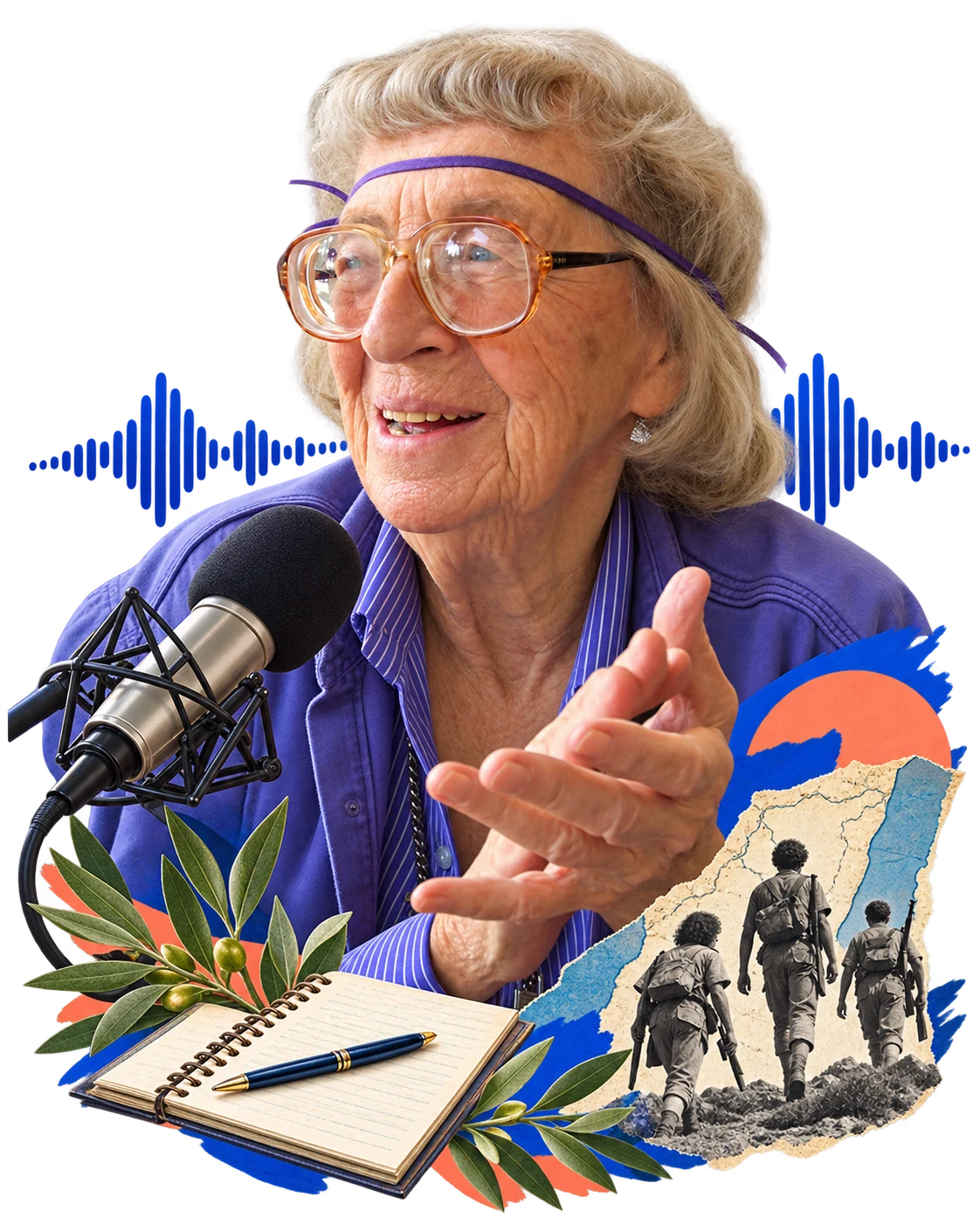
She described herself as not pretty, or more precisely, "ugly," which didn't stop her from living out her loves... and, according to her, there were many... She was given a number of other nicknames, including "the Yellow She-Devil" and "the fighter for spoken Hebrew."
Netiva was born in July 1928, on Tisha B'Av. She was the third daughter of Yaffa and Dr. Baruch Ben-Yehuda. Her grandparents were Aharon and Geula Turknitz, who immigrated to the Land of Israel in 1904 and lived in Rosh Pina. Her grandfather was a teacher and educator, and was also among the founders of the Hapoel Hatzair association. Her father, Dr. Baruch Ben-Yehuda, was the principal of the Herzliya Hebrew Gymnasium and a devoted Zionist. When the state was established, he became director general of the Ministry of Education. She studied at Mikve Israel and at the Herzliya Hebrew Gymnasium, where she stood out as an outstanding athlete in shot put and tethered-ball throwing, and was even considered for the Olympics.
Netiva of the Palmach
After graduating from the Herzliya Hebrew Gymnasium, she enlisted in the Palmach. She became known as a killer and earned the nicknames "the blonde she-devil" or "the Yellow She-Devil." Her very presence on the battlefield struck terror into the Arabs. She was one of only two female demolition officers in the Middle East, and perhaps in the world, and the only operator of the Davidka in Safed. These are just a few of the stories that made her famous.
As part of a reprisal operation against Arab transportation, Netiva was sent with a squad from Ramot Naftali to attack a bus transporting Arab fighters. At one of the bends in the road, an electric mine was laid, and Netiva waited in ambush beside the electric switch. The bus arrived, but the mine did not explode. Netiva did not lose her nerve. She jumped out and opened fire on the driver with a submachine gun at close range. The squad threw grenades at the bus. Most of the Arab fighters on board were killed; only a few managed to escape and spread the story of the Yellow She-Devil who had slaughtered them like a madwoman.
On another occasion, she went with a squad to train in a field near Ramot Naftali. The squad was taken by surprise by several hundred Arabs who had been lying in wait and surrounded it from every direction. The recruits were naturally terrified, to the point of losing their nerve, but Netiva took charge. She moved from recruit to recruit, showing each one how to fire the weapon he was holding. The Arabs advanced toward the squad in an encircling movement. Netiva lay there calmly, rifle in hand, showing her people that any Arab who tried to approach would be hit. The hundreds of Arabs tightened the ring, and the surrounded squad had no way out. The attackers were already very close. Netiva gathered everyone around her and inspired them to resolve to defend themselves to the end. She fired constantly at the approaching Arabs and inflicted many casualties. Fortunately for the surrounded squad, the people of Ramot Naftali heard the exchange of fire and rushed to help her, and Netiva withdrew safely with all her people.
Because the Arabs had sworn to take revenge on her in particular for the humiliation she had caused them, the "Yellow She-Devil" was then transferred out of the Upper Galilee.
In an interview with Uri Milstein, she said that the first time the story of the "Yellow She-Devil" was published, in the Working Youth movement's magazine Bama'aleh, she concluded that the esteemed editors didn't care what caliber of monkeys they employed. The writing was at the same level, too. According to her, what the article said, and what was later recycled in almost the same style in Bamachaneh and other newspapers, even abroad, was a bluff. "Every word was a lie. Fabrications."
Netiva kept asking herself, "Who could have given this story to that journalist?" She couldn't find an answer. One day Palmach commander Yigal Allon visited the base where she then held a non-combat role. He treated her with extraordinary warmth and said to everyone present, "Why, this is the 'Yellow She-Devil.'" Netiva asked, "Who gave the journalists these stories?" She said she refrained from adding, "Who was the bastard who gave them?" The revered Allon replied, "Who? What a question! I did."
After the War
The War of Independence left a scar on Netiva's soul, and she tried to erase the memories by drinking heavily with former soldiers in bars. There she met Pinhas Avivi, who would later become her husband and the father of her only daughter, Amal. In 1950, they flew to England. Netiva continued her sculpture studies, which she had begun earlier, and worked at the Israeli Embassy.
In 1956, Netiva began studying philosophy, logic, and linguistics at the Hebrew University of Jerusalem. After a further two years on an assignment in the United States, Netiva and her husband returned to Israel. Their marriage ended in 1964.
The Hebrew of the Street
Netiva began working for the government. At the same time, she devoted herself to compiling entries for A World Dictionary of Spoken Hebrew, which she wrote with Dan Ben-Amotz. The first volume of the dictionary was published in 1972.
She began to recognize slang as an important linguistic phenomenon during her studies at the Hebrew University. Her mentor was Professor Haim Blanc, who taught Netiva that to understand a language, one must leave behind grammar books and the confines of linguistic rules and start listening, develop an "ear" - a term she repeated again and again.
The publication of the first volume of A World Dictionary of Spoken Hebrew earned her the nickname "the fighter for spoken Hebrew." The dictionary changed her life. Overnight, she became a player in the ongoing debate over Hebrew, offering a fresh perspective and a challenging position. She was given a regular spot on a radio program, wrote for the press, lectured, and enjoyed her new status. Her rugged persona, her supposedly masculine way of speaking, her self-irony, her solitary lifestyle, and "Netiva's Cafe" - the improvised coffeehouse on Palmach Street near her home where everyone talked - made her a fascinating figure.
Telling It in Her Own Voice
In 1980, when she was 52, a tumor was diagnosed in her head, and she was told she had about a year to live. As a result, she resigned from her job so she could devote her time to writing her memoirs of the War of Independence. At the end of that year, she published her autobiography: "1948-(Between the Spheres)-1980." The doctor's findings proved completely wrong. Netiva decided to continue writing and published two follow-up books to her personal story. In the years that followed, she published the second volume of A World Dictionary of Spoken Hebrew. Netiva wrote more than 20 books. Her book Autobiography in Poetry and Song, published in 1990, inspired a radio program on Kol Yisrael, in which the program's producer, Gil Aldema, and a team of singers recreated songs from the early days of Zionism.
Ben-Yehuda was known for her sharp tongue and down-to-earth character. She was one of the most articulate speakers of the 1948 generation, combining broad knowledge with a sense of humor and a direct manner. This character showed, for example, when she walked out of a live television broadcast about Dan Ben-Amotz in 1992, protesting remarks by the host, Gabi Gazit, as well as in her blunt remarks.
She once said, "I slept with half the Palmach, and if I hadn't been so ugly, I would have slept with the other half too." On feminism, she said, "I can't be part of a women's collective like that, united against discrimination. I've lived my feminism all my life. When I feel I'm being discriminated against, I shout. When I didn't get the rank I deserved... I shouted at my boss: 'What is it, you don't like my genitals?'"
In the last year of her life, she fell ill and moved to Tel Aviv, where she lived in solitude. Netiva Ben-Yehuda died in 2011 at the age of 82, at Kibbutz Lohamei Hagetaot, and was buried in the community of Klil, where her daughter lived.
תגובות
עדיין אין תגובות.