
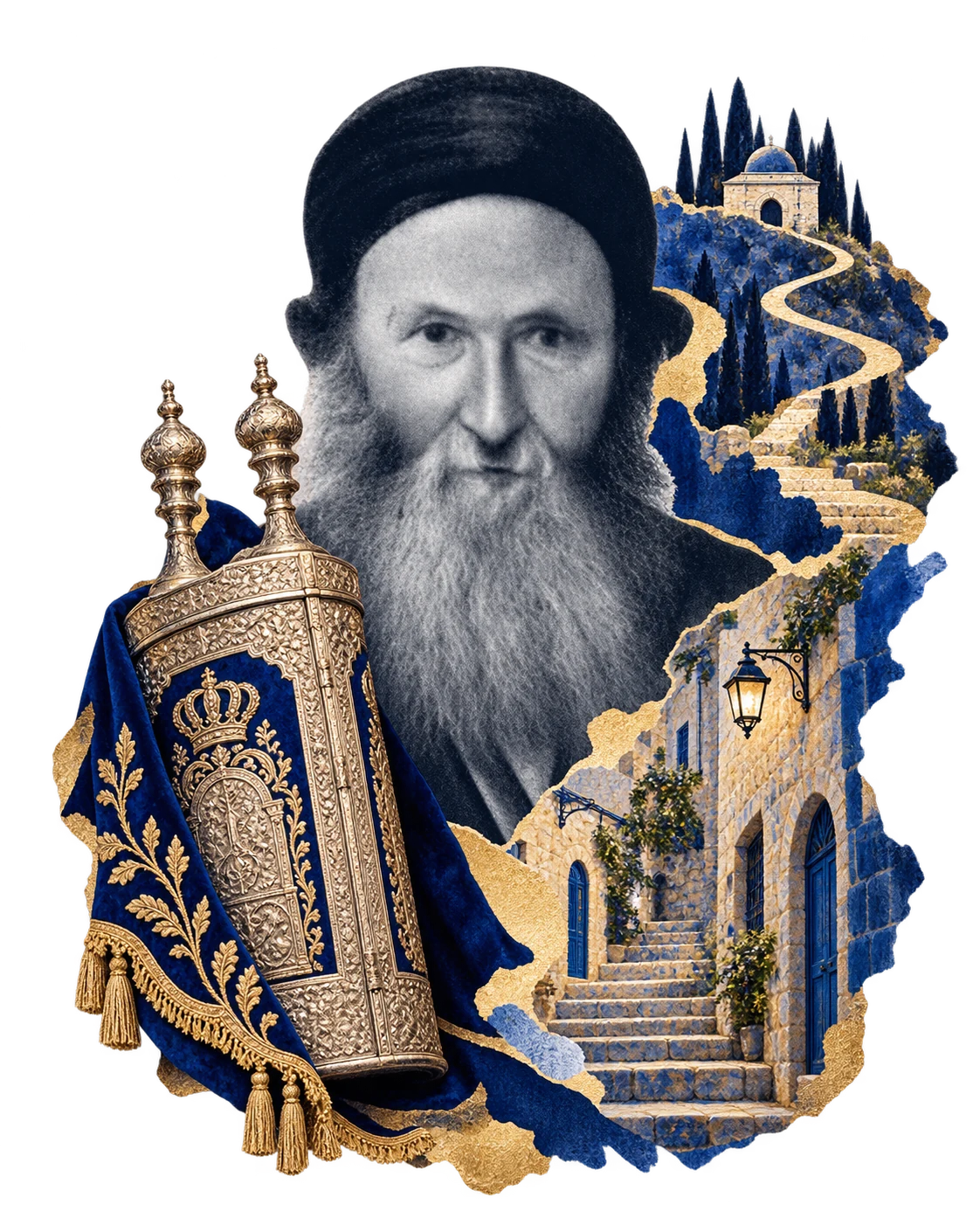
Once a year, every year since 1833, the Torah scroll makes its way from the Abou family home in Safed to the tomb of Rabbi Shimon bar Yochai on Mount Meron.
The Abou House and the Rashbi Hilula
Every year on Lag BaOmer, the celebration of Rabbi Shimon bar Yochai at Mount Meron brings enormous traffic jams. The celebration draws hundreds of thousands of faithful on the day itself and in the days around it, and at its peak a bonfire is lit beside Rabbi Shimon bar Yochai's tomb. Since 1833, a Torah scroll procession has made its way from the square opposite the Abou family home in Safed to the tomb of the Rashbi. Not everyone knows that the entire tomb complex was purchased by the Abou family patriarch, and that the family built the synagogue that stands there today.
The Abou family is also connected to the first settlement on Mount Meron, eight years (!) before the founding of Petah Tikva, known as the "Mother of the Settlements." Rosh Pina was later established on the family's land. The family's history is woven into the story of Jewish settlement from 1817, when Shmuel, the family patriarch, left Algeria and came to the Land of Israel. This family produced a long line of rabbis, leaders, fighters, land redeemers, and defenders of the Jews. The family certainly lived up to its name, "Abou," whose source is in the Book of Psalms: the initial letters of the Hebrew phrase "made in truth and uprightness" in Psalm 111:8.
Shmuel Abou: From Algiers to Safed
Shmuel, the family patriarch, was born in Algiers and grew up in a prosperous merchant family that could afford to provide him with an excellent education. He studied at a yeshiva and was even ordained as a rabbi. The family's story comes with quite a few lesser-known tales. One of them concerns Shmuel's immigration and his connections with the family of Abd al-Qadir al-Jaza'iri.
In 1830, the French conquered Algeria from the Ottomans. Two years later, the local tribal sheikhs chose Abd al-Qadir al-Jaza'iri, then 23, leader of the Berber tribe in Kabylia, to lead a revolt against the French. Al-Jaza'iri launched a guerrilla war against them that continued until 1847. At the end of that year, Abd al-Qadir al-Jaza'iri surrendered and gave himself up to the French, who exiled him from his homeland, first to France and then to Damascus.
Shortly before surrendering, al-Jaza'iri entrusted his property to a respected Jewish family related to Jean Pierre-Bloch, a Jewish French politician. Abd al-Qadir al-Jaza'iri had a deep connection with the Abou family, to the extent that the French saw the family as a threat to their regime and "hinted" that they should leave. This hint neatly aligned with the family's desire to immigrate to the Land of Israel. In 1817, Shmuel Abou took his parents, family, and property and settled in Safed. The Abou family's connection with Abd al-Qadir al-Jaza'iri continued while he was in Damascus. These ties helped the family deal with the Ottomans, who ruled the country at the time and valued al-Jaza'iri's recommendations.
The French, for their part, also wanted ties with this family and appointed its members consuls in the Galilee. Abd al-Qadir al-Jaza'iri's great-grandson, Razak Abd al-Qadir, fell in love with the idea of the kibbutz and helped the Shai (the intelligence service of the time) and the Mossad. Toward the final decade of his life, al-Qadir, who spoke fluent Hebrew, moved to live in a caravan in the settlement of Migdal. When he died, he was buried at Kibbutz Afikim under the name Dov Golan.
In Safed, Shmuel had three sons, Avraham, Yitzhak, and Yaakov, and two daughters, Sarah and Simcha. Several years later, he traveled to India, where he formed a connection with the Sassoon family, a wealthy and well-known Jewish family called the "Rothschilds of the Far East." After the expulsion from Spain, the family moved to Iraq and from there to India, where it established an international textile empire.
Shmuel, who served as rabbi of the local community for several years, asked the Sassoon family for the concession to trade in clothing dyes in the Land of Israel, a concession that was expected to bring him considerable income. In return, David Sassoon asked him to give some of his time and knowledge to the local community. In recognition of his work, David Sassoon built a synagogue in Mumbai named after Shmuel Abou. In Israel, the Abou family leased the indigo crop in the Jordan Valley and exported it to France through the ports of Acre and Sidon. Years later, Shmuel's son Avraham encountered the Bene Israel community, from whom Baghdad's Jews had kept their distance, and turned to Safed's rabbis. They issued a ruling instructing that the members of the Bene Israel community be regarded as fully legitimate Jews. Shmuel, his father, was the first to sign the ruling. When the matter came up again in 1952, the Chief Rabbinate relied on that same ruling and reaffirmed its validity.
After realizing that under Turkish rule the lives and property of Jews were at the mercy of others, Shmuel traveled to Algiers with prominent members of the local Jewish community and persuaded the French authorities to appoint him French consul in the Galilee. He received his letter of appointment in 1874, and on returning to the country, offered the Jews of Safed and Tiberias the opportunity to become French subjects and enjoy his protection. Many accepted his offer, as did some of the Galilee Arabs and some Bedouin.
Rebuilding Safed and the Redemption of Meron
A series of disasters struck Safed. The first occurred in 1834, when Muhammad Ali, ruler of Egypt, conquered the country and sought to impose conscription into the Egyptian army. This requirement sparked a revolt known as the "Peasants' and Bedouin Revolt." For 33 days, rioters attacked Safed's Jews, looting, killing, and wounding many. Three years later, an earthquake destroyed Safed. About half of its Jewish residents were killed, and many of the survivors fled to Tiberias, Jerusalem, and Hebron. After the devastation, Shmuel Abou and the rabbi from Avritch, head of the Ashkenazi community, set about rebuilding the city. Shmuel Abou built the Ari Synagogue and the synagogue of Rabbi Yosef Bena'a, the "White Righteous One," where he would pray. It was there that he brought the famous Torah scroll that sets out every year in the Lag BaOmer procession.
In 1870, Shmuel Abou purchased the burial plot of Rabbi Shimon bar Yochai and built the tombstone and part of the structure around it. He also bought another 7,000 dunams in the village of Meron and encouraged dozens of Jewish families from Kurdistan to settle there. These settlers divided their time between agricultural work by day and studying Torah and the secrets of Kabbalah and the Zohar by night. This settlement preceded the familiar pioneering Zionist settlement in the country by decades. For this deed, he and his descendants were honored with the Torah scroll procession setting out from his home, a tradition that continues to this day.
Throughout history, the Abou family has been connected with the redemption of land. In 1872, the family purchased the lands on which the colony of Mei Merom was established, later Yesud HaMa'ala, as well as Mishmar HaYarden, Mahanaim, and Ein Zeitim.
Six years later, in 1878, still carried along by their dream, Yaakov Hai, Shmuel's son, and thirty families from Safed settled on the outskirts of the Arab village of Ja'uni and established a colony there called "Gei Oni," later known as Rosh Pina. A year later, Shmuel died in Safed.
After Shmuel's death, the rabbinate and the consular post passed to his son Yaakov, the first generation of the family born in the country. Yaakov continued his father's legacy. He expanded the building of the Rabbi Shimon bar Yochai synagogue, and in 1882 he helped Moshe David Shuv purchase the land at Rosh Pina. In his memoirs, David Shuv wrote that when the Turkish authorities ordered the settlement at Rosh Pina to stop, he approached the authorities in Damascus with a letter of recommendation from the Abou brothers to the Hakham Bashi in Damascus, Rabbi Mercado Alkalai. This advocacy proved effective, and the order was revoked. He also wrote: "From the very first day, he stood by us in our hour of need. He was a man of noble qualities, a spiritual leader, beloved and welcome to all his brethren..."
Yaakov Hai Abou and His Wife Esther
A 1976 article in the newspaper Maariv recounts how Yaakov and his wife Esther met: "The wife of Rabbi Yaakov-Hai Abou, born in Liverpool, England, came to visit the country with her parents when she was a fifteen-year-old girl. Their son Meir Abou told how the young Sephardi rabbi from Safed met the English tourist and fell in love with her 'at first sight': One day, in the early 1870s, my grandfather saw a camel caravan passing down the street, with tourists dressed in 'franji' clothes swaying on the camels. As he stood watching the procession pass his courtyard gate with curiosity, one of the camels suddenly bolted, and a delicate, beautiful girl tumbled from its hump to the ground. They carried her in their arms to our home to revive her, and that was how it turned out that the tourists were none other than the family of the chief rabbi of Liverpool, who was a lover of Zion."
The rabbi had arrived by ship with his wife and two daughters at the port of Acre, where they were greeted by the city's British consul, Signor Avraham Pinchi, who hired camels for them. Their first destination was the holy city of Safed. The rabbi's family from Liverpool stayed for several days at Shmuel Abou's home, and the girl so charmed the rabbi-consul that he quickly asked for her hand for his son. Her parents, impressed by the Abou family's gracious hospitality and love for the country, agreed to the match, and so Esther-Malka Cohen-Tzedek of Liverpool married Rabbi Yaakov Hai Abou. Esther was the first Ashkenazi woman in the family, a rarity at the time.
The second Ashkenazi woman to join the family was the wife of his son Meir. Golda, Esther's younger sister, married Signor Avraham Pinchi, the British consul in Acre. After Avraham died, Golda moved to Safed at the age of 80 and welcomed High Commissioner Sir Herbert Samuel when he came to Safed with his family for a vacation in the early 1920s. Golda laid her hand on his head, blessed him with the Priestly Blessing in English, and even gave him a rare gift: a photograph of the Jewish school class in Liverpool, showing her and Samuel's father sitting next to each other. They had been classmates.
In 1883, a wedding was held in Rosh Pina. During the celebration, a pistol carried by one of the guests went off accidentally, killing a builder, a member of a large and respected family among Safed's Arabs. In response to this tragic incident, about two hundred Arabs from the dead man's family, men, women, and youths armed with sticks and stones, came to Rosh Pina and attacked the colony to avenge his death. The farmers of Ja'uni, led by Haj Ali Jilbud, formed a living wall between the people of Rosh Pina and the furious Arabs of Safed. Meanwhile, Moshe David Shuv sent one of the young men on horseback to Safed to inform the French consul, Yaakov Hai Abou, of the incident and ask for his help. Yaakov Hai arrived accompanied by several soldiers, his two brothers, Hakham Avraham and Yitzhak Mordechai, and the consulate's kawas guards. They dispersed the attackers, took the dead man's body to Safed, and arrested the young man accused of firing the shot. Consul Abou gathered the dead man's relatives, calmed them, and secured their agreement to a sulha, a reconciliation agreement. Later, with the help of Baron Benjamin (Edmond) de Rothschild, compensation was paid and the matter was settled.
That summer, Yaakov Abou received an important English guest, Colonel Albert Edward Williamson Goldsmid, a British colonel and head of the Lovers of Zion Society in Great Britain, who brought a letter from Yaakov's brother-in-law in England, the brother of Yaakov's wife, who was also a friend of Goldsmid's. At the Abou home, Goldsmid met Moshe David Shuv and his brother-in-law Mordechai Katz from Rosh Pina. As he was on his way to Damascus, he asked them whether the Hebrew farmers would be willing, if necessary, to take up arms to defend the country. The two answered yes, and he said: "Rosh Pina is a glory to Israel." Colonel Goldsmid was one of the enthusiastic supporters of "Gilead," Lawrence Oliphant's plan for Jewish settlement east of the Jordan, presented in 1879. As an officer, Goldsmid also proposed a plan to defend this settlement east of the Jordan. Later, he became close to Herzl, who wrote in his diary that Goldsmid was as close to him as a brother.
For more than twenty years, Yaakov Hai Abou served as consul and community leader. He was distinguished by his noble qualities and ability to lead the public, and was loved and respected by Jews and other residents alike. Yaakov Hai Abou died in 1899, at the age of 58, after suffering a serious accident from which he never recovered. With Rabbi Yaakov Hai, the Abou family's era of rabbinic leadership came to an end. His children chose other careers.
The Generation After Yaakov Abou
According to family tradition, Yaakov's consular post was supposed to pass to his son Meir Effendi Abou. However, through the intervention of Yehoshua Osovitzki, the Baron's representative to the French consul general in Beirut, the post was given to his brother, Hakham Yitzhak Mordechai Abou. Meir himself, with the help of Colonel Goldsmid, enrolled at the Polytechnic School in England.
When he returned to Safed, Meir Effendi Abou joined the civil administration in his city. Respected and accepted by the authorities and connected to Arab aristocracy, he often used his influence and did much to help the colonies of the Upper Galilee.
In 1915, a group of young Jews tried to cross the northern border to volunteer for the French army. The Turks caught them and put them on trial as traitors, facing the death penalty. They were released thanks to Meir, who used his connections at the highest levels. Like his ancestors, Meir continued the Lag BaOmer tradition for 50 years. He was also active in land redemption and successfully helped fend off the Arabs' legal attempt to annul Jewish ownership of the lands of Mishmar HaYarden.
When the British conquered the country, his home served as a center for illegal immigration. Meir issued immigration certificates attesting to the holders' connection to the country, so that the British could not deport them. He did all this at risk to his life, in defiance of the British authorities. Rabbi Meir Effendi Abou died in November 1947.
The second son, Moshe, studied dentistry in France and became the first dentist in Tiberias and the Galilee. For decades, Jews, Galilee Arabs, and Bedouin from the Beit She'an Valley and across the Jordan came to his clinic. Rabbi Yaakov Hai Abou married off his only daughter, Mas'uda, to a farmer from Yesud HaMa'ala. The pampered, delicate young woman suffered from fever and desolation, like all the pioneers of the Hula Valley. On the verge of despair, she separated from her husband and returned to her parents' home in Safed.
After Rabbi Meir Effendi Abou died, his son Rafael continued the family tradition. He was one of Safed's leading figures and most prominent defenders, among the first policemen to enlist in the Mandate Police, and went on patrols and ambushes armed with a weapon. Later, he joined the Haganah and, with the founding of the state, helped organize the civil administration.
Rafael had two sons and a daughter: Yosef, Zvi, and Atzmona. Yosef Abou (Evron) was a fighter and commander in the Haganah and Palmach, and later fought in the ranks of the Irgun. He was among the fighters at Birya, near Safed, and in the Jewish Resistance Movement. Yosef was a successful and well-known journalist. He married Yehudit, granddaughter of Nisan and Sima Kantorovitch, among the founders of the colony of Rehovot. He was the first in the family to painstakingly collect all the historical materials relating to Beit Abou and produce extensive documentary records in print and online. In 1987, France awarded him the title of Knight of the Legion of Honor for "his dedication to nurturing the tradition and the bonds of friendship between Israel and France."
Zvi was among the defenders of Safed in 1948 and saved the Jewish Quarter of Safed from an Arab attack in the days before the War of Independence. Zvi devoted his life to Jewish education in Israel and the Diaspora. He lost his life in a car accident in 1976.
Yosef died in 2014, and the tradition passed to his nephew, attorney Rafael Abou, named after his grandfather. Rafael Abou was born in the United States, and in 1975 his family immigrated to Israel and settled in Ramat HaSharon. Rafael grew up and was educated in Jerusalem, studied at the Or Etzion Yeshiva under Rabbi Haim Druckman, enlisted in the Air Force, and was even selected as the President's Outstanding Soldier for 1991.
And so, to this day, each year during the Lag BaOmer celebration, the person carrying the Torah scroll from Safed to the tomb of Rabbi Shimon bar Yochai and back is a proud descendant of the renowned Abou family.
תגובות
עדיין אין תגובות.