
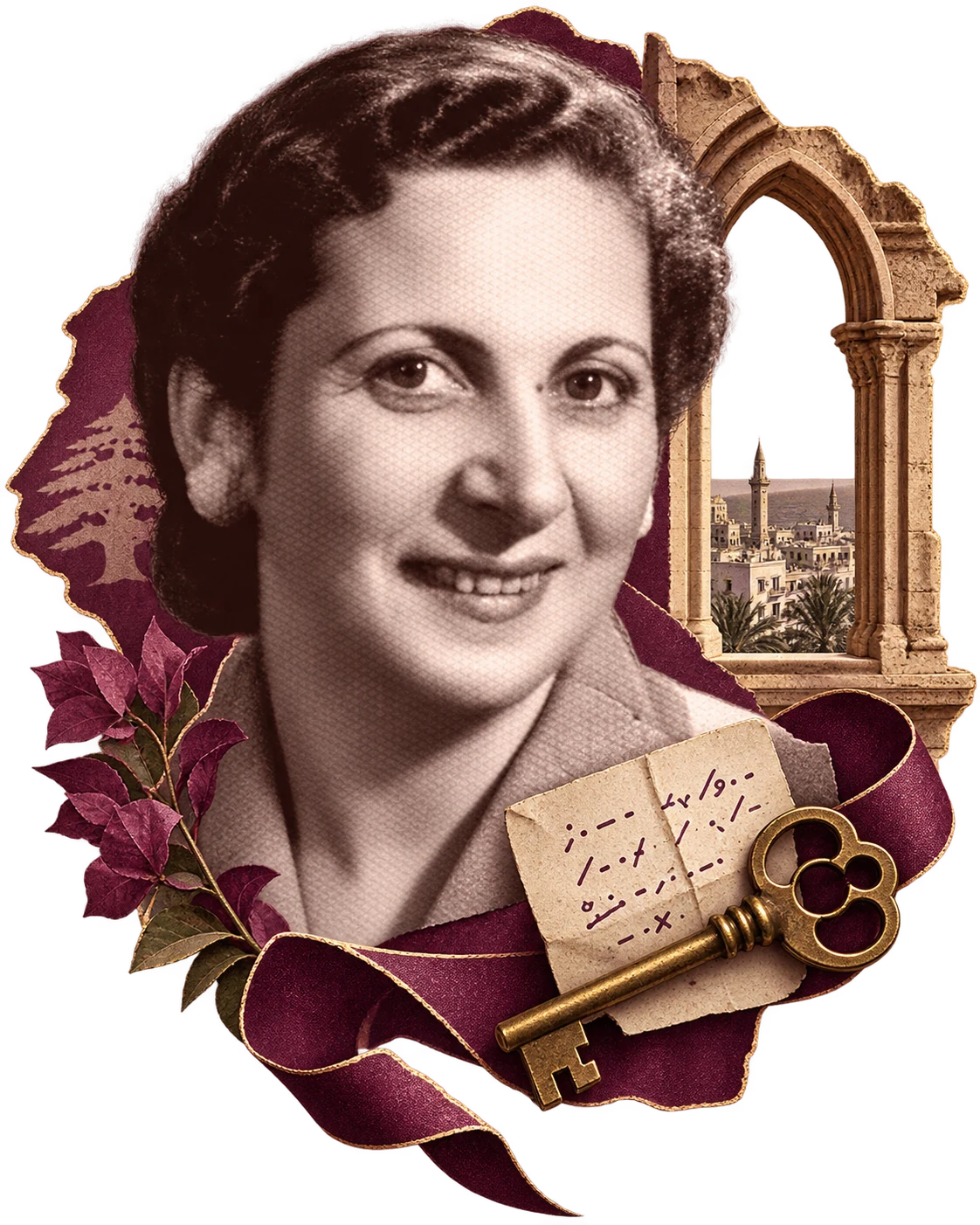
A captivating conversationalist, intelligent, elegant and beautiful, she could make people fall under her spell after just a few minutes of conversation. She had connections with Camille Chamoun, former president of Lebanon; Pierre Gemayel, one of the leaders of the Christian Phalange; and the Lebanese prime minister. In the end, she was sentenced to death.
Arrest and Torture in Beirut
Summer 1961. It was supposed to be another quiet evening in Wadi Abu Jamil, Beirut's Jewish quarter. The rumble of tanks entering the neighborhood, along with dozens of soldiers, made it clear that this evening would be different. The residents of the quarter watched with curiosity and fear as the force surrounded Joseph Cohen's home. After a few minutes, they arrested Shulamit Kishik Cohen, a 40-year-old woman and mother of seven. "When they came to arrest her, a huge number of soldiers arrived with tanks and closed off the entire street, as if my mother had wings to fly away... We didn't even have a chance to smuggle her out through the kitchen window," her daughter recalled. Shulamit was taken immediately to the Lebanese intelligence service's interrogation facility, where she was questioned and tortured for two years. "I screamed for the first time when they pulled out my first fingernail, and it was a terrible scream. To this day, when I say that I screamed, I can hear the sound that came out of me. I screamed so loudly... Then the tears started streaming down my face. And when he ordered them to continue, I started biting my lips like this - hard! The force of my bite made my teeth cut into the flesh around my lips, and the blood began to flow, but I didn't scream again. The Lebanese officer couldn't bear to watch any longer. He got very angry, turned to his colleagues and said, 'You couldn't have endured a quarter of what this woman has gone through. Do you see why Israel is winning now? Because they have people like this.'" Shulamit later recounted this after being convicted of serious espionage and smuggling Jews. "With one hand she rocked the cradle, and with the other she turned the world upside down," the prosecutor claimed. Throughout the trial, Shulamit never admitted guilt. On March 19, 1963, after two years of interrogations and torture, Shulamit Kishik was tried in a military court and sentenced to death by hanging.
Shulamit made no mistake that led to her arrest. The person who betrayed her was Mahmoud Awad, an inspector from the Ministry of Finance who worked for her. Awad was corrupt, a gambler and greedy. Although Shulamit had reservations about employing him, their relationship continued after he was sent to be vetted in Israel and brought back important intelligence. He became friends with Joseph, Shulamit's husband, and was treated like a member of the family. In an attempt to save his own skin, Awad told a Syrian agent everything he knew. His file contained more than 350 pages of testimony against Shulamit, and the court did not need her confession.
Her Path to Espionage
Shulamit Kishik Cohen had all the qualities a spy needed: intelligence, daring, cunning, energy and charisma. But she had no training for the role, and no one had even suggested that she join the intelligence services. In 1947, she "recruited herself." "You can't learn how to be a spy. A lot of it has to be inside you. You need the talent to see, hear and understand in a minute," she explained. Her test mission was to take a Jewish officer named Winkler, who had been expelled from England, from Beirut to Abu Alwan, the contact sent from Palestine, who would smuggle him into Israel. Shulamit approached Abu Jacques, a Jewish merchant whose shop was frequented by smugglers he knew. In return for 800 Lebanese pounds, which she received from her husband, she carried out the mission. A few days later, Shulamit received an invitation to come to Israel. She entered the country via Metula while pregnant for the sixth time. At the end of the meeting, she officially became an intelligence agent, tasked with gathering information and smuggling Jews who had come to Lebanon from various Arab countries. Shulamit was run by Unit 154, which handled agents, and was given the codename "The Pearl." "My heart told me I was a soldier recruited into the secret department of the Jewish people," she said.
Shulamit was born in 1917 in Argentina as Shulamit Kishik, to Meir, a Syrian-born merchant, and Alegra. In 1924, her Zionist family immigrated to the Land of Israel and settled in Jerusalem. Shulamit attended the Evelina de Rothschild School for Girls. She was a bright, diligent student who was even moved up a grade twice. She was a soloist in the school choir and active in the Scouts and Maccabi. Her father continued his business in Argentina and came to the country for several months each year. During the 1929 riots, the family kept illegal weapons for self-defense, and Shulamit grew up with the understanding that Jews had to defend themselves. A financial crisis in her father's business led him to decide to marry Shulamit off before she had even turned 17, to Joseph Cohen, a wealthy Jewish merchant from Lebanon who was twice her age.
"Instead of my father giving the groom a dowry, he received money. He basically sold me," Shulamit described what happened. "I never dreamed of getting married at my age. I had all the whims of a teenage girl... On my wedding night, I locked myself in a room and cried..." After the wedding, Shulamit moved with Joseph to Wadi Abu Jamil, Beirut's Jewish quarter. "It was extraordinary for someone to bring a bride from Palestine," she said. Heavy-hearted, Shulamit left behind Jerusalem, which she loved, and her family. Despite her wealth and loving husband, she felt like a stranger in a gilded cage.
From the Community to the Underground
But a woman like Shulamit was not going to sit idle for long. A Maccabi youth club operated near her home. She volunteered to teach its members Hebrew, singing and Israeli folk dancing, and prepared the young people to immigrate to the Land of Israel. She met the Lebanese prime minister through her volunteer work. At the time, the Jewish community would invite the prime minister to its end-of-year ceremony. When she arrived at his office with an invitation to the event, Prime Minister Riad al-Solh was impressed by her sharp mind, energy and personal charm, and invited her to his home to meet his wife and daughters.
December 24, 1947, the day of a Christmas ball at the Lebanese prime minister's home to which she had been invited, changed the course of her life. It gave her life new meaning and made it exciting and dangerous, to the point of death. These were the first days after the UN decision to partition the Land of Israel. At the ball, she met the chiefs of staff of Syria and Lebanon and a number of senior officers. She heard them talking about Fawzi al-Qawuqji's "Army of Salvation," which had arrived in Bint Jbeil, and their plan to destroy the Jewish state that was about to be established. "My hands and feet were trembling and my head was spinning. The scenes before my eyes grew blurred, and only my ears continued to hear the terrible things clearly. More and more places that would be destroyed, and the lives of Jews that would be wiped out," she described what she experienced in those moments. She realized that the important information she had must quickly reach the security authorities in Palestine. She wrote a message in the code she had learned in the Scouts and sent it through a merchant from southern Lebanon to a Jewish friend from Kibbutz Misgav Am, near the border. In the letter, she described what she had heard and even offered herself as an agent. A few days later, an Arab man arrived at her home, introduced himself as Abu Alwan, and gave her the test mission: to deliver a Jewish officer named Winkler to him.
At that time, conditions for Jews in Arab countries were worsening. Their rights were taken away, their money was frozen, synagogues were set on fire and homes were destroyed. Jewish refugees from Syria arrived in Lebanon, where conditions were better, and Shulamit was tasked with getting them to Israel. Most of the refugees had fled without their parents' knowledge. They were young Zionists, aged 13-20, some religious, but all eager and determined to reach Israel. Thus Operation Flame took shape (1961 - 1959), an operation to bring all those refugees to the Land of Israel. In 25 waves, all the refugees were brought to Israel. Shulamit was the brains behind the operation. Thanks to her ability to adapt to any situation, she succeeded in bribing Lebanese officers and enlisting criminal smugglers. She thus earned the title "Monsieur Shulamit," an honorific given to a man, not a woman. In some cases, she personally led the column of refugees through southern Lebanon into Israel, and even smuggled out her two eldest sons, who were five and seven. When the land route was closed, Shulamit managed to smuggle about 1,000 Jews by sea. She got the money to fund these operations from her husband Joseph, after the smugglers demanded payment in advance.
Because of his wife's activities, Joseph had to deal with problems of reputation. "I met with the head of the Criminal Investigation Department, the head of the security service, the prime minister, the president - at the time it was Camille Chamoun - and Pierre Gemayel, who was the head of the Phalange... I was the subject of gossip. A married woman meeting with government leaders at unusual hours, going out with someone different every day, and not even a Jew..."
Trial, Prison and Release
In 1961, Shulamit Kishik was caught and, after two years of torture, sentenced to death by hanging. Her husband, who knew about all her activities, was sent to prison. Following political pressure, her sentence was commuted to 20 years in prison. In the women's prison where she served her sentence, she taught the prisoners to read and write, as well as singing, embroidery and sewing. There she earned the respectful title "Sitt Shulamit" - Lady Shulamit.
After the Six-Day War, Shulamit was released in a prisoner exchange. Minutes before she was transferred to Israel, one of the officers who had arrested her tried once more to get her to confess. He said to her, "One of your feet is already in Israel... You can finally tell the truth." But she refused. "I saw it was ten to four and said to myself, I know, Shulamit, you've kept quiet for seven years; another seven or eight minutes won't hurt. Until both feet are on the other side, I'm not opening my mouth," she recalled. Shulamit was released and arrived in Israel, but her husband and the rest of the family who had remained there were smuggled to Israel via Cyprus. This is how she summed up her 14 years of activity: "When you carry out an operation and it succeeds, it pushes you to do another one, but each time it's more dangerous, each time it's more unusual... Still, I can be proud of something. I have a part in the state, even if it's as small as a matchstick."
In Israel, Shulamit received the recognition and respect she deserved. In 1992, she received the "Guardian of the Secret" award from the Intelligence Heritage Center, which also produced the film "Monsieur Shulamit." In 2007, on Israel's 59th Independence Day, she lit a torch, saying in her speech: "God saved me from death. I never worked to win an award or to chase fame. I did it because I wanted to and loved the country and wanted to help establish it. It wasn't a business. I did it without asking for a single penny." Three years later, she was named a Worthy Citizen of Jerusalem, and in 2011 she received the Exemplary Service Award and the "Dona Gracia" medal. The Herzliya municipality named a street after her.
Her story is told in the book "Shirat HaShulamit - The Story of a Zionist Spy," written by Ezra Elnekam, and in the book "Codename: The Pearl" by Aviezer Golan and Danny Pincas.
Shulamit had seven children. Her son Yitzhak Levanon is an Israeli diplomat who served as Israel's ambassador to Egypt. Another son is David Kishik-Cohen, formerly a senior official in the Civil Administration. Shulamit lived a long life and died in 2017 at the age of 100.
תגובות
עדיין אין תגובות.