
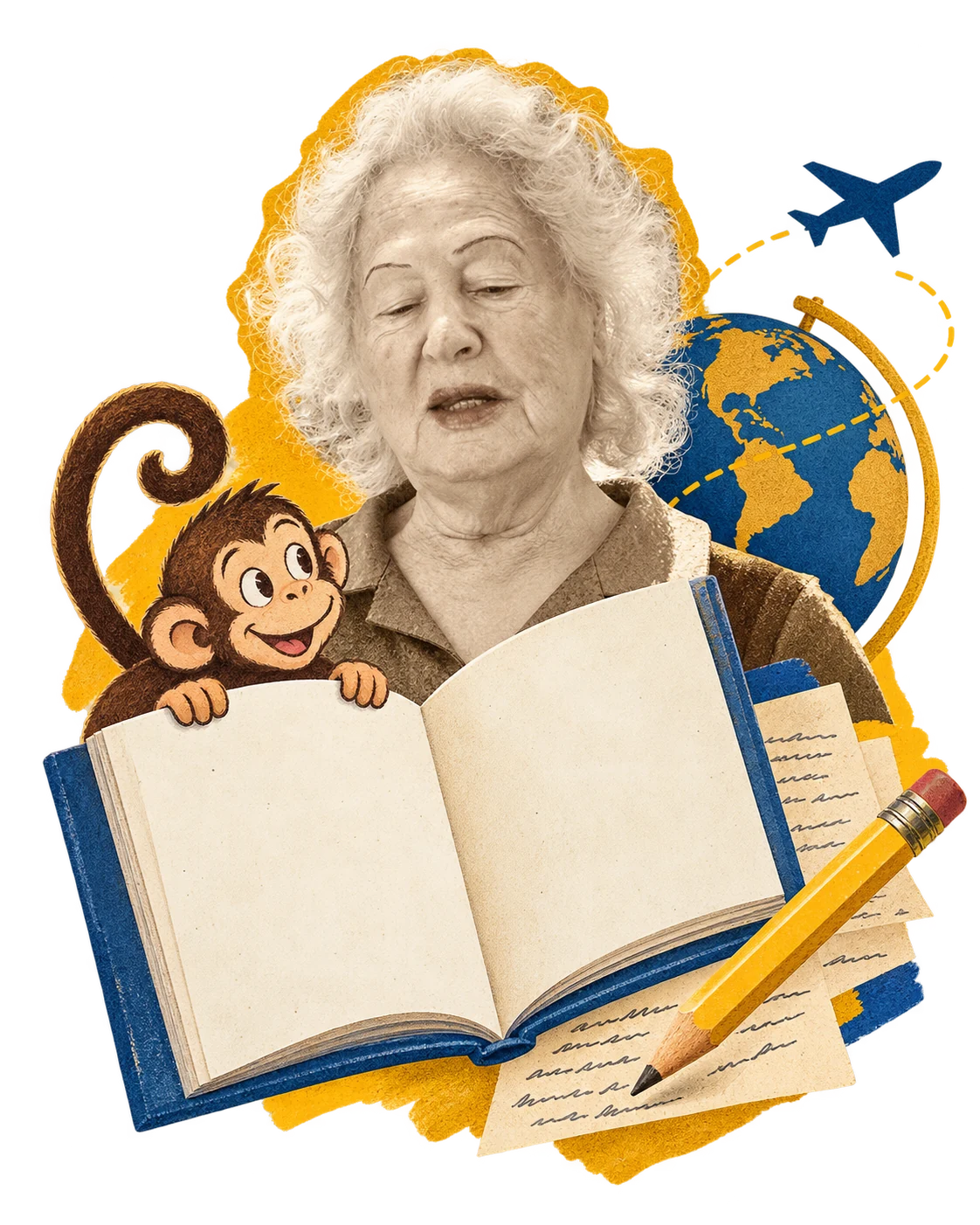
A teacher born and raised in the first workers' moshav. One of Israel's most prolific children's authors, and the creator of Kofiko and Chipopo.
At a time when there was no central educational curriculum, Tamar Bornstein-Lazar took it upon herself to educate Israel's children according to her own vision: an education infused with humor and grounded in the time and place in which she lived. She also believed in passing on Jewish tradition in secular schools. She compiled booklets of stories, poems, facts, arts and crafts, jokes, recipes, and more, with each booklet focused on a single subject. The booklets became books, sold door to door in sets, and some even came with workbooks. Tamar not only wrote the books but illustrated them, too, and paid close attention to every detail.
Her home in Ein Ganim, known as 'Kofiko's house,' is the last surviving house from the moshav era. The two-story house boasts a large swimming pool and a small orchard decorated with life-size sculptures made by the author. In the garden is a corner devoted to members of the Second Aliyah, whom she admired.
Tamar Bornstein-Lazar was born in 1927 and grew up in Ein Ganim, a cooperative moshav founded in 1908 by workers of the Second Aliyah. It survived on its own for 30 years before merging with Petah Tikva. Its founders, young secular socialists, worked for Petah Tikva's religious farmers. These poor workers, who were committed to using the Hebrew language, were filled with fervor, and in Ein Ganim they saw their dream come true for the first time. A health fund and the Histadrut labor federation were established in the moshav, which became a model for later communities such as Nahalal. Among its residents were David Ben-Gurion, Shmuel Dayan, Haim Brenner, who wrote his book 'From Here and There' there, and Yigal Mossinson, author of 'Hasamba.'
In his book 'Only Yesterday,' S.Y. Agnon wrote about the moshav, describing the poverty and struggle to make a living, as well as the workers' determination: deprivation on the one hand, and literary and cultural richness on the other.
Roots in Ein Ganim
One of the first plays Tamar Bornstein-Lazar wrote was about the moshav as she remembered it from her childhood. It was called 'Who Saved the Colony?' The book describes the relationship between one of the moshav's defenders and an orphaned Bedouin boy suspected of wanting to attack the community. The boy helped the residents by crossing enemy lines and summoning the British soldiers to their aid.
Tamar's first story was published in 1951 in the newspaper 'Davar LaYeladim' and tells of a small, sickly, poor girl who needs milk to get well. The first story about 'Kofiko' was published in 1954, also in that newspaper. It tells of a girl named Efrat and the monkey her uncle brought her from Africa. The amusing monkey dressed up as a woman for Purim and won first prize.
The first violation of the rights to the 'Kofiko' stories occurred when Zelikovitz Publishing House published one of them in a collection of children's stories without permission. With great shrewdness, Tamar suggested that instead of taking the publisher to court, the publisher should publish the book instead. And so, in 1957, the first book in the series came out: 'Kofiko Hosts.'
A few details changed between the first 'Kofiko' story, published in 'Davar LaYeladim,' and the book. The girl's name changed from Efrat to Noga, Tamar's daughter, who, like Efrat, is given a monkey by her sailor uncle. Kofiko also had a cleverer rival: Chipopo, his cousin. The mischievous Kofiko got up to antics in the neighborhood, in Ein Ganim in Petah Tikva, while Chipopo was a detective monkey who worked in a different country each time and brought us information about that country. As an educator with, as noted, distinctive teaching methods, Tamar argued that children would learn geography by reading the Chipopo books.
Tamar's granddaughter, Amit Gavish, recalled: "All the Kofiko stories are based on real events that happened in the family. All the characters are real: Noga is my mother, Yoram is my uncle and Orna is my aunt, Tamar and Shlomke are my grandparents, and every character in the books is a real person. From the moment I was born, I was in the books. In fact, Kofiko reflects the atmosphere in our home. Everything was done with a lot of humor; everything was very funny. She was an unconventional grandmother, very much a child at heart. We never had any grown-up conversations with her."
For years, her home was open to young people who came to hear stories, and she welcomed them with all her heart and soul.
The editor of 'Davar LaYeladim,' Uriel Ofek, loved the first Kofiko story and encouraged Tamar to send him more. Tamar began writing and never stopped. She created a brand that outlived her and is still going strong today.
The Beginnings of Kofiko
About 25 years ago, Tamar's daughter Noga Barak began managing her mother's copyrights. She was the one who, in effect, took Kofiko off the pages of the books and turned him into a brand that includes television productions, stage shows, YouTube channels, and merchandise. "We're extending the brand into different content areas, and we have to reinvent ourselves all the time," Noga says. "Kofiko has moved with the times, both in terms of content and visually. Kofiko has to keep changing, or he'll cease to exist. Our competition is with international brands... Mom started writing about Kofiko before I was born," Barak says. "She chose a monkey because he can get away with doing things a child can't. He became part of our lives. A virtual character who lived with us and felt very real. Adults often tell me, 'When I was a child, Kofiko was like a friend to me.' So if he was a friend to them, he was a brother to me."
About 150 books about Kofiko have been written to date. Tamar Bornstein-Lazar published about 450 books, including the 'Chipopo' series. Noga explains his cross-generational popularity: "Kofiko grows up in a typical, average family, what you'd call a middle-class family. Mom managed to make everyone feel as if the story had been written about them. Kofiko is the neighbor across the hall."
"Grandma would get up in the morning and sit on the balcony overlooking the yard, with all the grandchildren around her, since we lived above her and the yard was shared. Then she would write until we got back from school. She never knew how to cook, so she would heat up corn schnitzels for us, and we'd sit and read, mostly her books, because she wrote at a dizzying pace. She would also use us to test whether the jokes were funny and listen to our comments. It was very important to her to hear what we, her grandchildren, thought. Our opinions mattered most to her," says her granddaughter, Amit Gavish. Amit also recalls her grandmother's sense of humor: "Even when she was already 80, she still had her sense of humor. One day someone called and offered her an account at some bank. She was tired of saying she wasn't interested, so she decided to play along with the telemarketer. She said all her money was under the floor tiles, that she had a whole pit full of money, and tried to persuade the telemarketer to call the customers and get them to switch to the under-the-tiles method, too." Naturally, that little incident also made it into one of the Kofiko stories.
Kofiko as a Brand
Commercial companies repeatedly tried to use the brand without permission. That was the case with the food chain 'Machsaney Kimat Hinam,' which marketed breakfast cereal called 'Kofipo' with a picture of a monkey. After a three-year legal battle, the court ruled in Tamar Bornstein-Lazar's favor.
We may soon see a Kofiko feature film and a range of new products, but there is one thing we can be sure of: we'll never see Kofiko sausages. "My mother and I are vegetarians, and I won't support meat or sausage products. We have already been approached about it. It's not going to happen," Noga says.
On June 16, 2020, Tamar Bornstein-Lazar died at the age of 93 and was buried in Segula Cemetery in Petah Tikva.
תגובות
עדיין אין תגובות.