
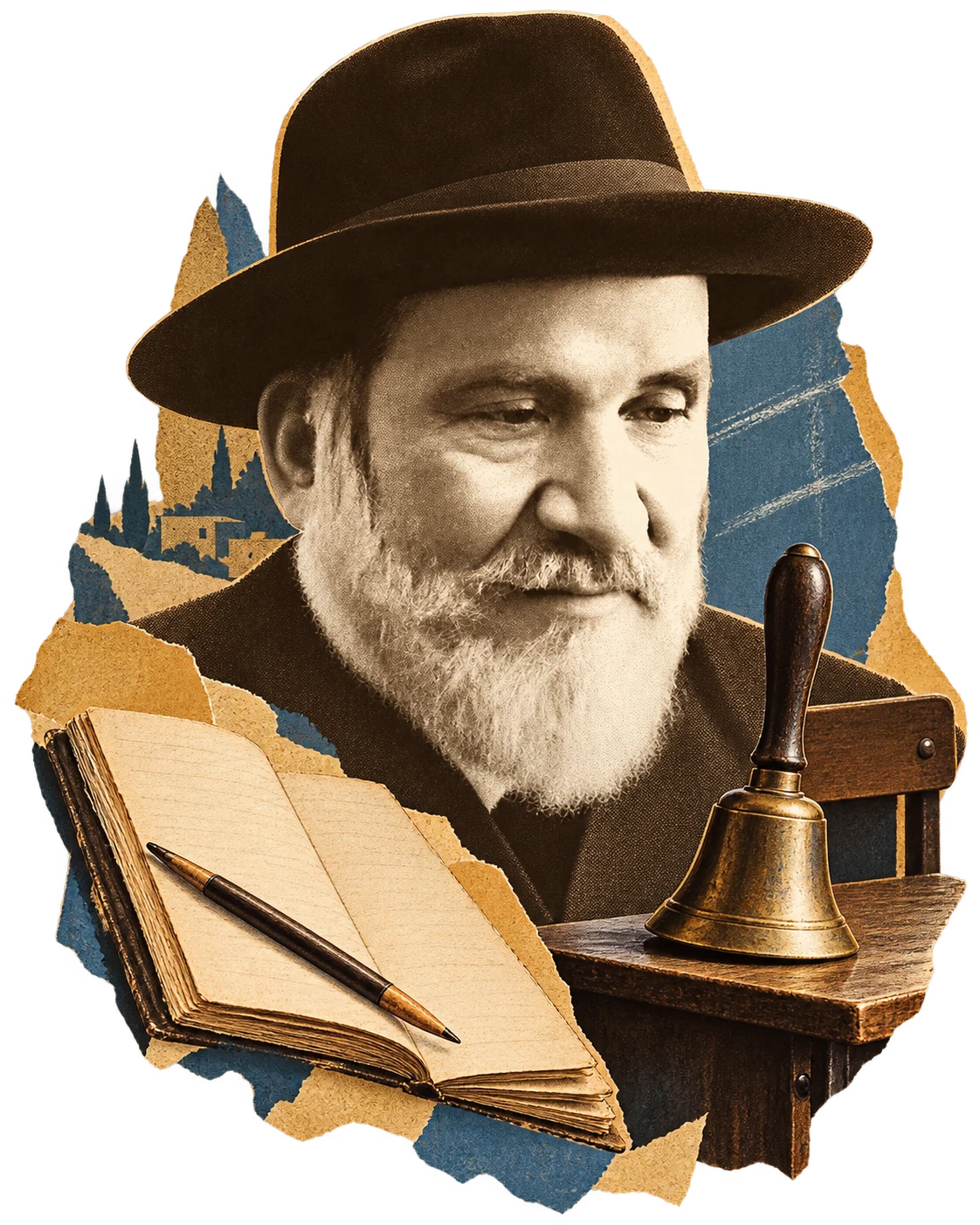
He was one branch of a magnificent family tree, distinguished by a respected dynasty of rabbis. One of the earliest teachers and the finest of administrators.
Yehuda Chaim Antebi Today, a teacher enters the classroom equipped with a defined curriculum and well-organized lesson plans, while the student is equipped with books, notebooks, and sometimes even a computer. Both the teacher and the student speak Hebrew. In earlier times, schooling faced considerable difficulties. There was no curriculum, nor were there textbooks. A fine account of that period can be found in the book by the artist Nahum Gutman (1980-1898), who tells how his father, a teacher at the gymnasium in Tel Aviv, would labor late into the night writing the books he used to teach his students. Gutman also skillfully described the challenges surrounding the Hebrew language, writing: "On the sand dunes, where Allenby Street now stretches, the students would gather at night in groups, in circles, talking, telling stories and arguing. Singing songs. There, for the first time, amid debates about questions of Zionism, some of us became theorists who said that every language has words and expressions considered vulgar. So they demanded that Hebrew words be coined in this area, too; for example, the word 'nad' meaning a fart, following the expression 'a swollen wineskin,' or the word 'zereg,' and I think even 'zayin' was our invention, as was 'mashvitz.'"
The Old and the New Education
Until the First Aliyah (1881), education in the Land of Israel was exclusively religious and took place in a heder or in yeshivas, depending on a student's age. With the arrival of new immigrants, upgraded heders and even schools were opened, where religious studies were taught alongside secular studies, then considered a supplement to general education and vocational training. The aim was for the next generation to be able to support itself without depending on the halukkah funds sent from abroad to support yeshiva students.
The transition from religious education to modern education was accompanied by quite a few struggles, but some of the people pushing for modern education were members of the Old Yishuv themselves. The most famous among them was Yehuda Antebi.
The Start of His Career as a Teacher
Yehuda Chaim Antebi was born in Safed in 1878 into a distinguished, far-reaching family with roots in Syria (the family name comes from the city of Antep in southern Turkey), many of whose descendants were involved in public life in the Land of Israel. Many books and articles have been written about the family, a dynasty of rabbis who served for generations in the Old City of Aleppo, Syria. Some members of the family claim they came to Syria following the expulsion from Spain (1492), but it is more likely that they were Musta'arabim (a term for Jews who lived in the region) as far back as the First Temple period. At various times, some family members who spread to Damascus, Safed, Jerusalem, Tiberias, Cairo, Beirut, and Paris served as rabbis of their communities, and some of their descendants are social activists to this day.
Yehuda Antebi grew up in poverty, but also in the spiritual richness of stories and religious studies. In the year he was born, members of the Old Yishuv ventured beyond its boundaries and founded the colony of Petah Tikva. The spirit of innovation and education that had begun to blow also reached Antebi, who aspired to work in teaching, a profession he regarded as a mission. At the beginning of his career, he taught Hebrew at the JCA school in Rosh Pina. Yehuda Antebi was very different from the local farmers. He was a member of the Old Yishuv, religious, and of Middle Eastern Jewish descent, while the local farmers were Ashkenazi, some of them secular, and saw themselves as modern pioneers. Those Ashkenazi farmers found it difficult to accept Yehuda Antebi, making it all the harder for him to settle in, as he wrote in his memoirs: "On Friday night, after the meal, old farmers, among the colony's most respected, would sit together, cheerful and good-hearted, for this was Baron Rothschild's golden age. Every person received a monthly stipend, and workers received a special wage... And so they duly ate and drank. And there was no drink but wine. Naturally, there was great danger of falling among these merry, joking companions... And then, as the conversation rolled on, 'the Sephardi' came up. I, sitting at the far end, recoiled and sat trembling at the arrows of mockery from these complacent people, for I knew what they thought of a Sephardi. After all, they had not wanted to rent a house in their neighborhood to me, the teacher of their sons, had it not been for the director's recommendation... In the middle of the conversation, the laughter and the joking, one of them suddenly said: They say the colony's clerk will be a Sephardi this time, and laughter rang out in response... What if one day the director of all the colonies is a Sephardi?!... Who knows, perhaps they'll appoint a Sephardi school principal?!... And a drowsy fellow who had been sitting there, joining in the laughter and mockery out of a sense of self-importance, added: Antebi... A few weeks later, the whole gang was standing on the grounds beside the administrative building, hats in hand, anxiously awaiting an important guest: the new colony clerk, Mr. S., a Sephardi clerk! A few months passed, and a cheer rang out along the main street, crowded with people. Among them were dignitaries from the nearby town and representatives of all the neighboring colonies. They had all come to welcome the distinguished guest from Paris, Mr. P., appointed chief director of all the colonies - and a Sephardi. A few years later, passersby saw our friend Antebi leading the rows of students, bell in hand (a special privilege of the principal), and, as everyone knew, a pure-blooded Sephardi."
As time passed, the farmers recognized the pure diamond that had fallen into their lot, and their relationship with him changed to the point of admiration. Their envy of his pure Hebrew can be seen in a letter from Moshe Halevi to Shlomi, Yehuda Antebi's son: "In the days when Yitzhak Epstein, the creator of Galilean Hebrew, was a teacher and principal of the school in Rosh Pina, the teachers would meet at his home on winter evenings to spend the evening over a cup of tea they poured for themselves from the gleaming Russian samovar. They took a lump of sugar wrapped in dark blue paper to sweeten their tea, and began practicing the guttural letters aleph, heh, chet, ayin. Antebi (with an ayin, not an aleph) - ‘hot tea’ with a chet, not a kaf; ‘thunder and lightning’ with an ayin, not an aleph, and so on. Winter coat and shoes - not 'mail' and 'naili' for winter - gave their throats quite a workout [...]" Moshe Halevi goes on to say that Principal Epstein suggested "that the Sephardi teachers tell a sentence or a short educational, religious story in Ashkenazi-Yiddish, and the Ashkenazi teachers repeat the same story in Arabic."
The best teachers taught at the school in Rosh Pina, with Yehuda Antebi at their head. The teaching methods they developed at the school brought teachers from across the country to learn how to teach, earning the place the title "the University of the Galilee."
Yehuda Antebi became a famous and revered teacher. He taught and ran the JCA schools in Rosh Pina and later in Yavne'el. When he decided to leave Yavne'el, the residents did everything they could to change his mind. On the morning he left the colony, many residents and students accompanied him, tears in their eyes.
His Years in Kfar Tavor
He spent most of his years as a teacher in Kfar Tavor, where he worked for 15 years starting in 1910. As soon as he arrived, he made his mark by saving the colony from a blood feud. Some time before his arrival, a thief from the Dalayka tribe (Bedouin who lived near the colony) had broken into Kfar Tavor. Although this was a common occurrence, that evening the thief encountered a tough farmer who shot and killed him. In the Bedouin way of thinking, theft was no reason to kill, so they sought to avenge his death by killing one person from the shooter's family or someone else from the colony. Yehuda Antebi, who spoke Arabic and knew their customs, decided to take a risk. He went to the sheikh and explained that no one in the colony had intended to kill the thief, only to drive him away. As the Bedouin saying goes, "the accident is blind," and since they were like children of the same father and were neighbors, it was right to make peace and reach a sulha - and so they did. When asked where he had found the courage to go alone to the sheikh, he replied with a smile, "I trusted in the Bedouin custom of hospitality, and that those who carry out a mitzvah come to no harm."
Yehuda Antebi changed the curriculum in Kfar Tavor. He introduced prayers at the school and established a kindergarten. While teaching there, he also tutored the Peikowitz (Alon) family. Among his students were Moshe Alon and his younger brother Yigal Alon (one of the Palmach commanders, an IDF major general, and a minister in the governments of Israel).
Yehuda Antebi understood his role as principal in the broadest sense and aspired to standards that may seem commonplace today but were far-reaching at the time. He insisted that the school be clean and orderly and appointed an employee to be responsible for this. He established a library because, as he put it, "reading leads to education, through which the young farmer will acquire development and understanding, and learn the best ways to advance his work." In Yesud HaMa'ala, he sought to teach a foreign language because "the lack of foreign-language instruction leads some farmers to spend considerable sums sending their sons to schools in Safed to learn from others, so that they can learn French there, while some send their sons to the Arab schools in the village near Yesud HaMa'ala, so that they can learn Arabic there alongside the Arab children."
When members of the Second and Third Aliyah brought with them a secular spirit, he emphasized the need for religious studies and prayer at school, because "religion is natural to the people of Israel and has been bound to them from the day they became a people through its teachings." He also put forward a practical, economic argument that he thought would be more persuasive: "If the school does not teach religion, the fathers will put up strong opposition, which will harm the school's development and help establish heders of the old type."
Yehuda Antebi opposed corporal punishment and any punishment that would harm unruly students: "I believe that every teacher, when setting out to educate, should, like a careful craftsman, attend to the development of the student's body and soul, and should not weaken or suppress one at the expense of the other... Let us not use the empty phrase 'uncivilized and uneducated' as an excuse to shirk our duty to educate them... We can speak to each student individually, without shaming him in front of his classmates."
Yehuda Antebi knew how exhausting the teaching profession could be, and lamented: "It is a pity that the tired teacher, working under such difficult conditions, cannot devote more attention to the individuality of his students." He was aware of the damage caused by the profession and made clear that teachers needed support: "The material circumstances of teachers... require outside attention and interest... Teachers do work that not only will not lengthen their lives, but will also rob them, in their final years, of the gift of wholeness bestowed on them by nature, leaving them with throat ailments, weak hearts, nervous disorders, and pulmonary tuberculosis... In view of the great sacrifice they make on the altar of education, I consider it a moral duty of the administration to look after them... and to try to increase their salaries so they can live well and comfortably."
Yehuda Antebi was on good terms with the family of his neighbor, Dov Hershkowitz. Antebi and Hershkowitz were good friends. By chance, they had the same number of children, all the same ages. Whenever Antebi stepped out of his home and saw Hershkowitz leaning against the door, he would greet him first and teasingly say, "Hello, Mr. Hershkowitz! Shall we have another child?"
Safed and His Final Years
When he finished his work in Kfar Tavor and returned to his hometown of Safed, members of the colony and generations of students who loved and admired him accompanied him sadly, just as they had when he left Yavne'el. In Safed, he ran the Mizrahi girls' school, and by then he had a little money, enough to rent a pleasant house in the higher streets of the Old City.
Alongside his teaching, Antebi devoted himself to public service. He served as president of the committee of the Sephardi community in Safed and was a member of the city council. His knowledge of the Arabic language and culture earned the trust of Arabs, who would come to him to judge their disputes as an impartial and fair local "qadi."
When Yehuda Antebi passed the age of seventy, he suffered a stroke and moved to a small apartment in Tel Aviv, near his daughters, who cared for him. He died in June 1949 at the age of 72. He left behind many fine students, the most prominent of whom was Yigal Alon. At the Yigal Alon Museum in Kfar Tavor, excerpts from Alon's diary about the teacher who had such a profound influence on him are on display.
תגובות
עדיין אין תגובות.