
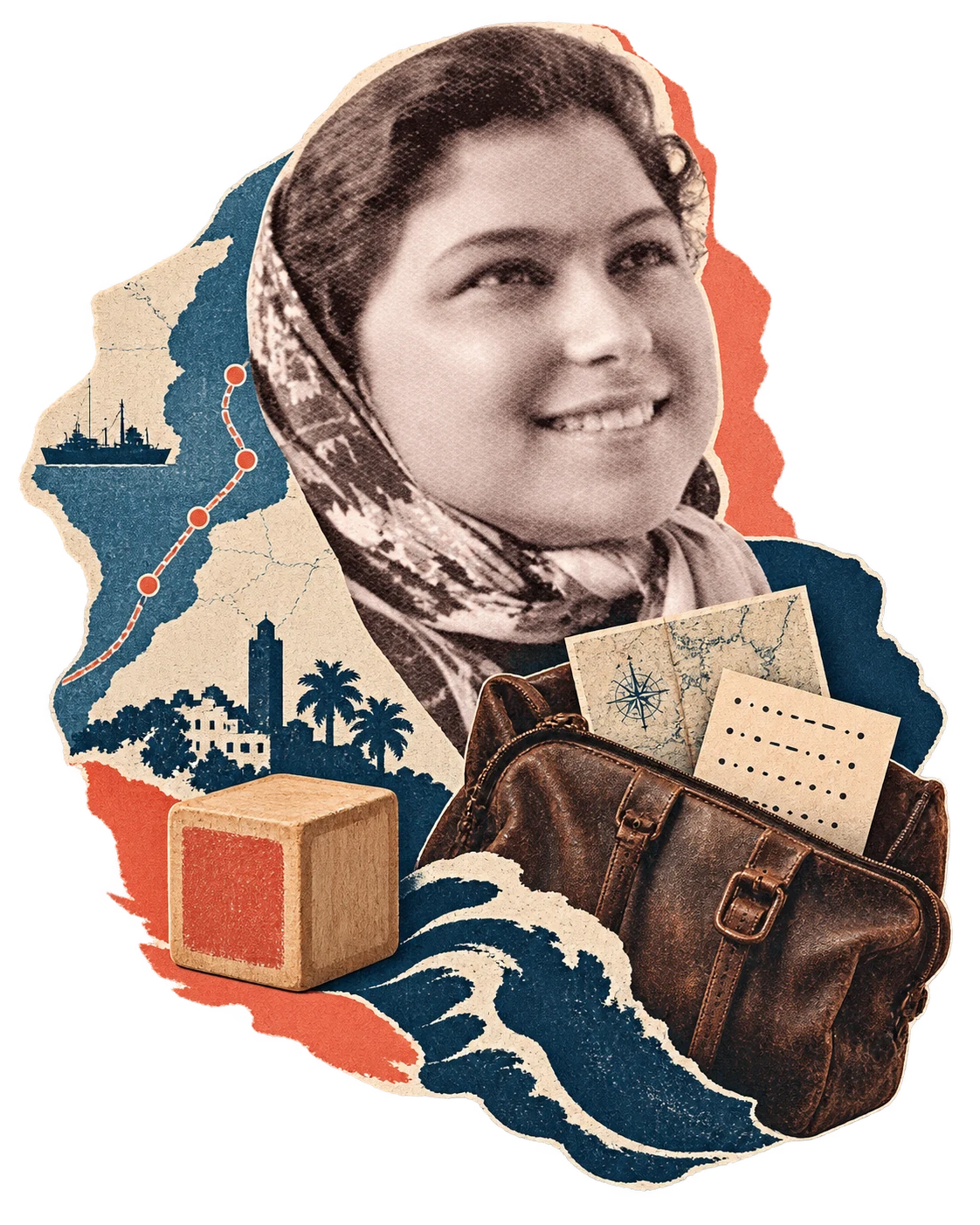
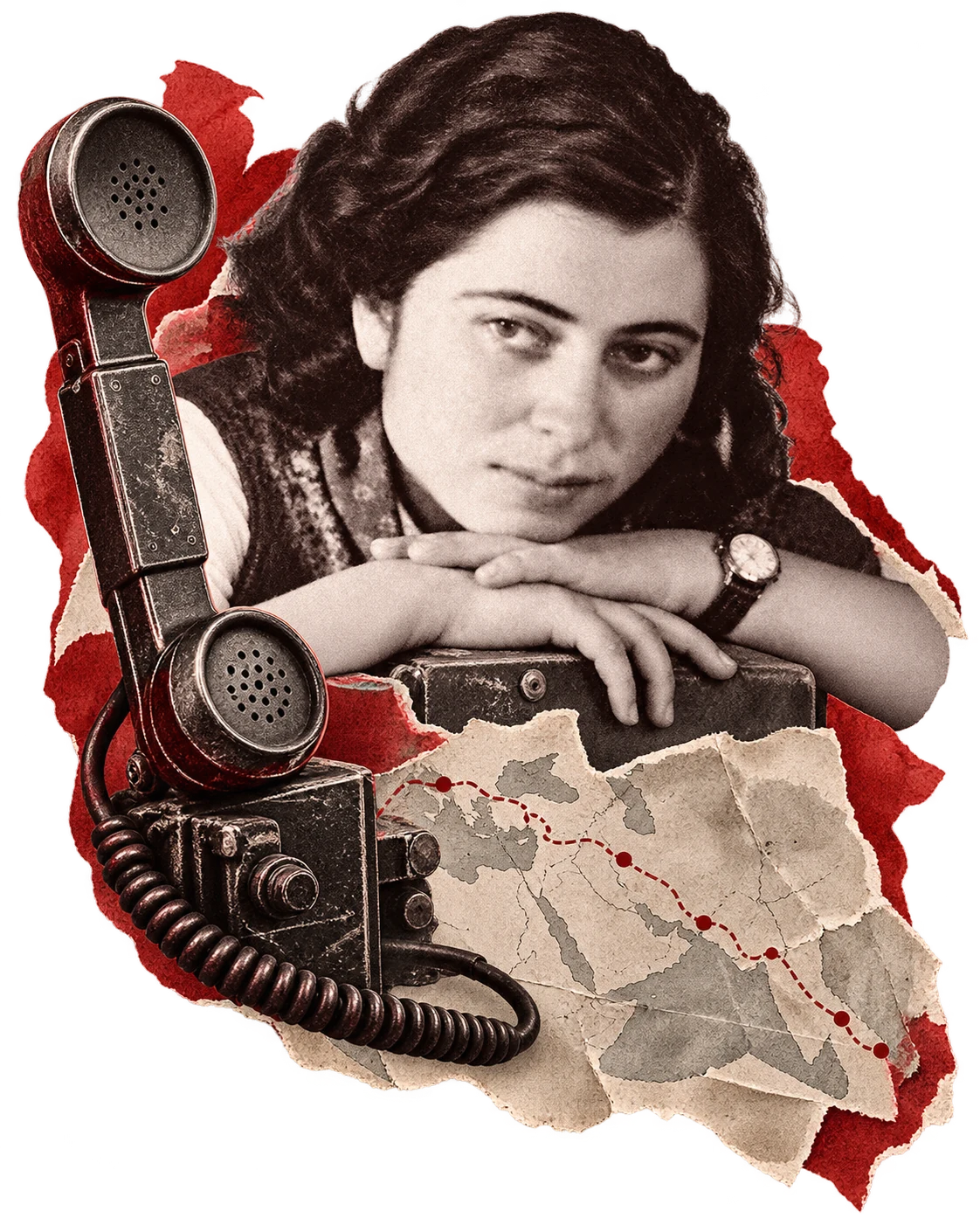
The kind kindergarten teacher who taught children songs in Hebrew was actually a Mossad agent involved in arms smuggling and illegal immigration.
Meeting Yehudit was no ordinary, chance conversation. Her brother, whom I have known for some time, was the one who opened the door for me - the door to a world of secrets, missions, and encounters that appear in no book. I knew I was about to sit across from a woman who had become a legend in her own lifetime, and my excitement almost eclipsed my curiosity. She began without any introduction: when she was a child, her teacher was Alexander Zaid. She grew up in Nesher,
where Izz ad-Din al-Qassam is buried, the fighter whose name became a symbol and the name of the Izz ad-Din Brigades. "The British killed him," she said matter-of-factly, as if it were an everyday fact. Every so often her younger brother, now 93, joined in and added a comment. She smiled and corrected him: she was two years his senior, and in the Palmach she had been his platoon commander. And so, amid memories that sounded almost imaginary and hints of another world, the conversation began to flow.
Morocco on the Brink of Independence
But before we delve into it, we need to understand the period. This was the time when Yehudit, a Mossad agent in Morocco, found herself at the heart of a dangerous game - one in which any mistake could cost someone their life. From 1912, most of Morocco was under French protection, while a smaller part was under Spanish protection. King Mohammed V bin Youssef was exiled to Madagascar, and the French appointed Mohammed Ibn Arafa as a puppet ruler in his place. The Alliance Israélite Universelle (Kol Yisrael Haverim), which operated in Morocco, believed that Jewish life would be safer under French rule and cultivated good relations with the French. In 1954, the Moroccans launched a violent revolt and demanded independence. More than a thousand civilians were killed during the revolt, including seven Jewish merchants. In October 1955, Mohammed Ibn Arafa resigned, and the French restored King Mohammed V. The movement that led the demand for independence was al-Istiqlal (Independence), founded in 1949. Its members hated Jews, among other reasons because of their ties to the French, whom they despised. It was clear that as soon as Morocco gained independence, Jewish lives would be in danger, and so in 1954 the Jewish Agency began bringing them to Israel.
Kindergarten teacher Yehudit Galili joined a Jewish Agency delegation that left Israel, with the aim of establishing a kindergarten for the children of the emissaries and the Jewish upper class in Casablanca. The kindergarten was set up in a magnificent villa on Rue Goulis Paris, in one of the city's upscale neighborhoods, and operated in Hebrew according to the Israeli curriculum. Decades after it was founded, a moving reunion took place in Haifa between the children, who were by then around 70, their parents, who were in their 90s, and their teacher, Yehudit. Among those "children" was Shlomo Kabilio, commander of Operation Misgeret for the Mossad in North Africa. At the reunion, he said that when the King of Morocco returned, Jews were in danger and there was genuine concern for their lives. Those who wanted to leave the country were refused permission and given no exit permits, but he himself was required to leave Morocco immediately because the King had not renewed their residence visas. When Israel decided to help Moroccan Jews defend themselves, he was sent, along with 22 other commanders, to Morocco, Algeria, and Tunisia, where together they established Misgeret.
In October, Lieutenant Colonel Shlomo Yehezkeli, who was in charge of Morocco, and a team of agents began recruiting local young people for a unit codenamed Gonen. The agents trained with the Mossad for five months, practicing covert operations, preparing weapons caches, transmitting encrypted messages, and more. Toward the end of 1955, they began operating in the field. They established branches in Marrakesh, Casablanca, and Tangier, and trained local teenagers. Some paid with their lives to defend the community, among them the martyr Rafi Vaknin, father of Michal and Yael, two of the kindergarten pupils, who was captured, tortured, and executed. Abraham Hassan and Rafi Ben-Gera also began their activities in Morocco and later moved to Algeria, where they disappeared. Some of the operatives were themselves kindergarten children, like little Orly, whose parents, Carmela and Yona Zabin, were part of the Misgeret team that came from Israel. Carmela was a radio operator and Yona a weapons instructor. On their way to the airport, they hid the transmitter inside Orly's doll and explained that when she boarded or got off the plane, she absolutely must not hand over the doll, and that if anyone tried to take it, she should burst into heart-rending tears. And so she became the youngest Mossad agent...
"I arrived in Morocco when I was 23 and was astonished by Casablanca's beauty," Yehudit recalled. "In those years, there was nothing in Israel. Suddenly you saw tall buildings, streets. I came with the desire to establish an educational project, but the opening kept getting delayed, and I told the Jewish Agency people, 'If you don't open a kindergarten, I'm going back to Israel.' At first I helped them identify immigrants, and, to my great regret, with the selection process that was carried out. We traveled to remote areas, such as the Atlas Mountains, to find Jews. I helped with registration, and my heart aches when I remember the separation process. After several months, we found a building in Casablanca, and it became the first kindergarten run on the Israeli model... The situation in Morocco kept getting worse as the struggle began between the French and the Moroccans, who wanted independence." Yehudit, too, was recruited to Misgeret, as she recounted: "One day I had time off and arrived at the kindergarten early. I heard voices and was surprised to find people there. I saw three guys, and they were shocked. One of them was Shlomo Yehezkeli. He told me what he told me, and they recruited me to Misgeret. I'm a kindergarten teacher, which is a wonderful cover. I became a liaison between different cells and moved items between various secret caches. I had a teddy bear in which we hid notes, letters, and spare parts for a transmitter. It was an innocent-looking teddy bear that sat off to the side, and nobody played with it. Once, when a Moroccan policeman wanted to search me and the teddy bear, the person accompanying me signaled to the policeman that I wasn't quite right in the head, since I went around with a teddy bear. I knew how to forge documents, pass notes inside a pack of cigarettes, and gather intelligence from the offices of senior Moroccan officials through my connections. I helped Misgeret."
Love blossomed between Yehudit and Shlomo Yehezkeli in Morocco, and in time they became a couple and married. It later turned out that their paths had crossed even earlier, when they both took part in the operation to free the detainees at Atlit and in the fighting along the road to Jerusalem...
Youth, the Haganah and the Palmach
Yehudit Galili was born in Tiberias in 1930. Her father, Shimon ben Moshe Mizrahi, was already the sixth generation of his family in the country, and her mother, Naomi Mard, was descended from the Luria family, one of the prominent Ashkenazi families. Among its members were the biblical commentator Rashi and Rabbi Isaac ben Solomon Luria, the Ari, one of the greatest Kabbalists in Safed in the 16th century. As a child, Yehudit moved with her family to Nesher and was among the first children to grow up there. She was a counselor at the local branch of the Working and Learning Youth movement, and at 14 she joined the Haganah. In 1941, along with other young people, she worked on fortifications on Mount Carmel, in what would later be called "Masada on Mount Carmel." A year later, she was already involved in dangerous operational activities. She was among those who freed immigrants detained at the Atlit detention camp and smuggled them to Kibbutz Beit Oren. What followed was only natural: at 17, she joined the Palmach, completed a squad commanders' course, and became one of the armed escorts on buses between Nesher and Haifa. Yehudit was wounded in the battle to liberate Haifa, and a month later she went to serve in the Sixth Battalion of the Harel Brigade, where she trained people and escorted convoys on the road to Jerusalem.
When the State of Israel was established, Yehudit began studying to become a teacher at the Haifa Teachers' Seminary. But someone like Yehudit was never going to be without pioneering work or volunteer service to the community. In 1952, she helped establish the state school at the Beit Shemesh transit camp in Har Tov, where she first developed a teaching method using songs and dolls she made herself. The method was later set down in a booklet called I Sing and Read, and many pupils across the country learned this way at the time.
Shlomo Yehezkeli was eight years older than Yehudit. He was born in Vienna as Otto Shlomo Schornstein, to Esther and Yehezkel. Following Kristallnacht in 1938, he immigrated to the Land of Israel alone. An ardent Zionist, he founded Kibbutz Yavne with his friends. In the diary he left for his children and grandchildren, he documented his life from the day he arrived in the country. "I was fortunate that, in every role, I was at the forefront of the most important work of the time," he wrote in his diary. He later joined the Haganah and the Palmach and worked in illegal immigration. In 1947, he took part in bringing immigrants ashore from the ship Shabtai Luzinsky at Nitzanim Beach, an event commemorated in the song "Shoshana." After the state was established, he took part in several operations to capture territory, including Hametz, Barak, Nachshon, and Ben-Nun. Shlomo took part in the first battalion commanders' course, and in 1955 he joined the Mossad. One of his first assignments was Operation Misgeret.
At the end of World War II, thousands of Jewish refugees who had survived the Holocaust sought to reach the Land of Israel. They arrived after an arduous journey on foot and aboard rickety, extremely dangerous ships. The British authorities in the country continued to enforce the White Paper policy, which restricted immigration. Ships that were intercepted were sent back out to sea, and many immigrants were caught and sent to camps in Cyprus, while others were transferred to the Atlit camp.
As October 1945 approached, the Jewish Resistance Movement decided to break into the Atlit camp and free the immigrants. Yehudit, then a member of the Haganah, was brought into the confidence of the operation by her brother Yossi, one of the organization's commanders. After the break-in, the immigrants were smuggled on foot to nearby kibbutzim such as Beit Oren and Yagur. Years later, she recalled: "I will never forget meeting the frightened immigrants. They were exhausted and terrified. Everything was communicated with hand gestures. They made their way along dirt paths and between rocks in the dark... When we reached Beit Oren, the scene was incredible. The kibbutz members welcomed them with a warmth and love that are hard to describe." The kibbutz members prepared changes of clothes for the refugees so they could blend in among them and the British would not be able to find them. "Khaki clothes, like the ones we wore at the time, so they looked like kibbutz members. That was the whole point," Yehudit said. At dawn, the British began surrounding Kibbutz Beit Oren and blocking the roads. Fearing that the British would return the refugees to the Atlit camp, the Haganah summoned thousands of local civilians to mingle with the immigrants and make the British task more difficult. After negotiating with Haganah leaders, the British decided to withdraw, while also concentrating their efforts on finding those who had broken into the camp and the immigrants. As soon as the British identified the people who had broken them out, the Haganah arranged new identity papers for Shlomo under his new name. And so Otto Shlomo Schornstein became Shlomo Yehezkeli, taking the name of his father, Yehezkel, who perished in the Holocaust.
The Misgeret Operations in Morocco
Misgeret consisted of three main independent branches: Gonen, the self-defense arm, which organized the defense of Jewish communities; HaMekhela (The Choir), which secretly brought Jews to Israel. Its members led Jews to various destinations, and sometimes these journeys ended in tragedy, as in the case of the ship Egoz, which sank with 44 immigrants aboard; and the third branch, Intelligence, whose purpose was to provide operational and political information and which was based in Rabat.
At the reunion, the children talked about their last day at the kindergarten: "And then, suddenly, the kindergarten closed. It was a profound shock." From one day to the next, there was no kindergarten and no Yehudit. Some remembered that the last song they learned in Hebrew was "We Have Come to Drive Away the Darkness," for Hanukkah.
Not far from Casablanca was a transit camp where Jews were gathered before immigrating, called Mazagan. Yehudit escorted immigrants to Gibraltar, forged passports for them, and prepared hidden caches. Misgeret operated for nine years and was responsible for secretly bringing around 30,000 Jews to Israel, smuggling them by sea and overland.
After their work in Morocco, Yehudit and Shlomo Yehezkeli moved to Marseille and later to Paris, where Shlomo coordinated the Mossad's activities. Some of the couple's operations remain classified, but it can now be told that they took part in the affair of the boy Yossele Schumacher, who was kidnapped by his grandfather and smuggled out of the country; they were involved in capturing Eichmann, in the affair of the spies in Egypt, and in other espionage operations in Italy.
The Way Forward and Recognition
In 1965, the family went on an assignment in Central Africa, where Yehudit established a classroom for the children of Israeli emissaries. When they returned to Israel, Yehudit took a journalism course and promoted education in the country by publishing articles and reports on various subjects. She also wrote children's books and lectured at teacher-training colleges. In 1988, she retired and turned to painting and sculpture, making films, and writing books. She also completed a documentary about Nesher, the town where she grew up, and the neighborhood of her childhood.
In 1993, Shlomo died at the age of 71. The words "A man of understanding walks uprightly" (Proverbs 15:21) were engraved on his tombstone.
Yehudit Yehezkeli won many awards, among them a Rotary award and education awards, and was named a beloved citizen of Haifa. As president of B'nai B'rith, she received a national award of recognition for her community work and volunteer service. At the reunion with the kindergarten children, Yehudit showed them the little bear she had kept, and, after a very long wait, each of the children received a kindergarten graduation certificate.
When Bialik wrote, "May my lot be with you, afflicted ones of the world, silent of soul, secretly weaving life, modest in thought and deed, sparing of words and rich in glory" - there is no doubt he meant people like Yehudit and her husband Shlomo.
תגובות
עדיין אין תגובות.