
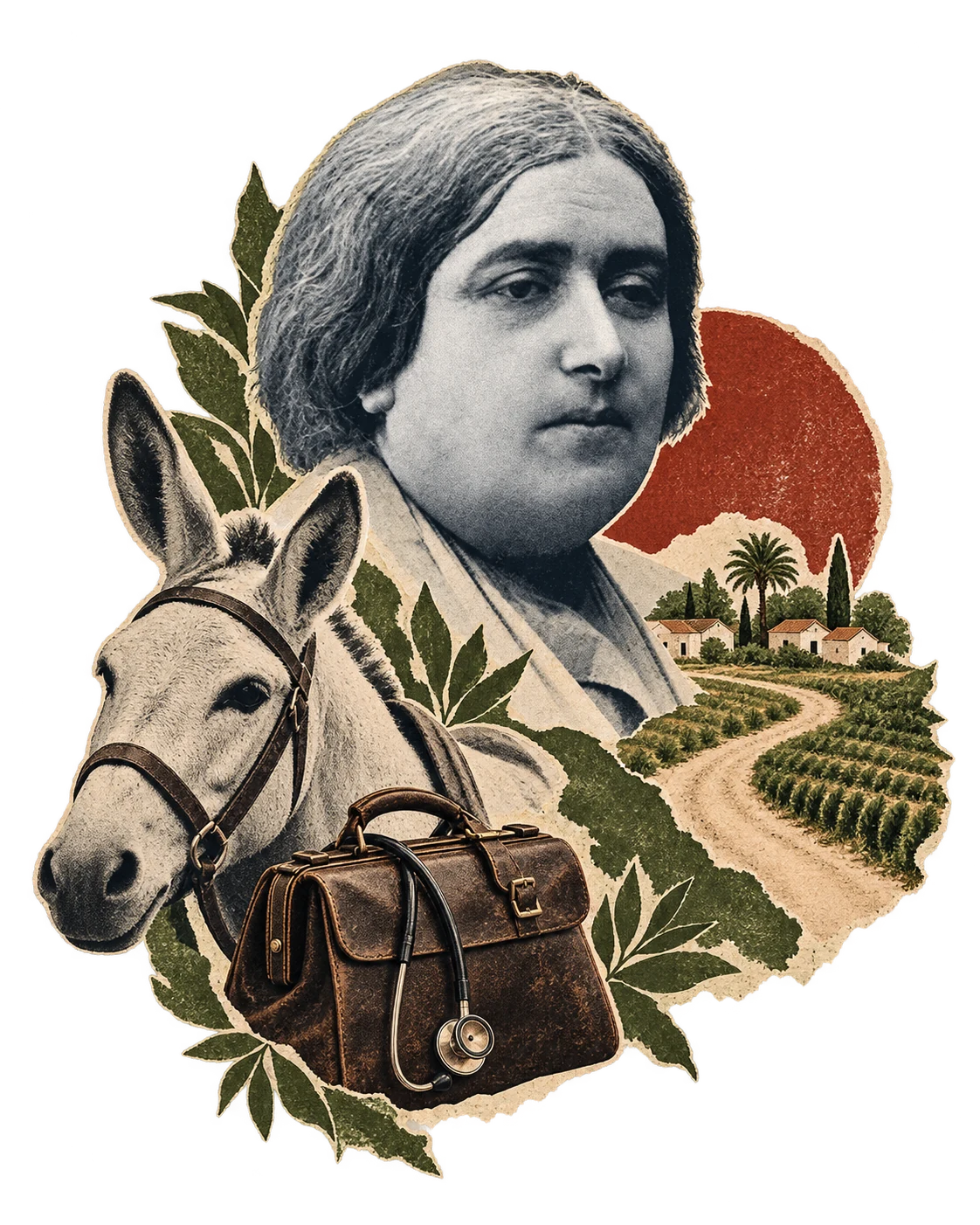
He was neither a charismatic leader nor a warrior, but a beloved pioneer whose words were engraved on the emblem of Rishon LeZion, and whose movement is represented on the emblem of the colony of Gedera.
Dr. Chaim Isser Hissin made his name not as a determined, leading figure or a warrior who conquered objectives, but as the doctor of Tel Aviv, the first Hebrew city. At the beginning of his career, Hissin was a worker with the Bilu movement ("House of Jacob, come, and let us go") at Mikveh Israel, a well-digger in Rishon LeZion, and a wagon driver in Gedera. When life in the Land of Israel overwhelmed him, he returned to Russia, studied pharmacy, and then went to Switzerland to study medicine before returning to the country as a doctor.
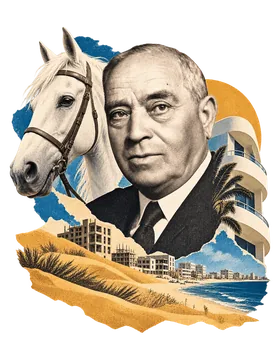
In quite a few photographs from that period, Dr. Hissin can be seen visiting his patients on his donkey, an unusual sight in the young neighborhood. Nachum Gutman, who grew up in the neighborhood, painted him and wrote: "We all always welcomed Dr. Hissin with great affection and warm smiles. He was a likable, slender, kind-hearted man who loved a joke and always brought good cheer with him. He wore a broad-brimmed cork hat and a white riding coat that hung down over the donkey's legs. When he rode his donkey along the shore of Jaffa, his umbrella, white on the outside, gleamed like a sail on the blue sea, or looked like a hot-air balloon. The pipe that never left his mouth was always smoking. Above the donkey's white head, beneath the green shade of the umbrella, the doctor's intelligent eyes blinked behind glasses as thick as chunks of ice, while behind him the donkey swung its tail in rhythm to drive away the flies. And so this charming figure, a combination of East and West, of man, ship, hot-air balloon, train, and beast, came to a halt beside the canal they were quarreling over."
From Minsk to Rishon LeZion
Chaim Isser Hissin was born in Minsk (today in Belarus) in 1865 to a religious family. Until the age of bar mitzvah, he studied in a cheder, and afterward moved to Moscow to attend a gymnasium. There, like many of his generation, he believed in a revolution that would bring redemption to the Jews.
After seven failed attempts, members of the Narodnaya Volya organization (People's Will) succeeded in assassinating Tsar Alexander II in 1881. When it was hinted that Jews had been involved in the assassination, antisemitic reactions arose, leading to pogroms that broke out in Ukraine that April. These pogroms were called the "Storms in the Negev." Jews realized that great danger awaited them in Russia, and emigrated to the United States, while a smaller number went to the Land of Israel. The pogroms also led to the establishment of several Jewish organizations that supported immigration to the Land of Israel. In 1882, the Bilu organization was founded in Kharkiv, Ukraine. Its name was an acronym of the verse "House of Jacob, come, and let us go" (Isaiah 2:5). Its founders set out to settle in the Land of Israel, revive the Hebrew language, and live communally, sharing their lives and possessions. Bilu was considered the first Zionist-socialist group.
At the age of 17, Chaim Hissin joined the Bilu group, and that same year he was among the first six to arrive in the Land of Israel. They arrived at the port of Jaffa and moved into a house above the well in the orchard of the wealthy Jaffa resident Anton Ayoub, who was renowned as the developer of the Shamouti orange variety. Not far from the orchard, Karl Netter had established the first agricultural school, Mikveh Israel. Chaim Hissin and his friends began working at the school, but the hard labor imposed on them by its director, Shmuel Hirsch, broke some of the group, and they returned to Russia.
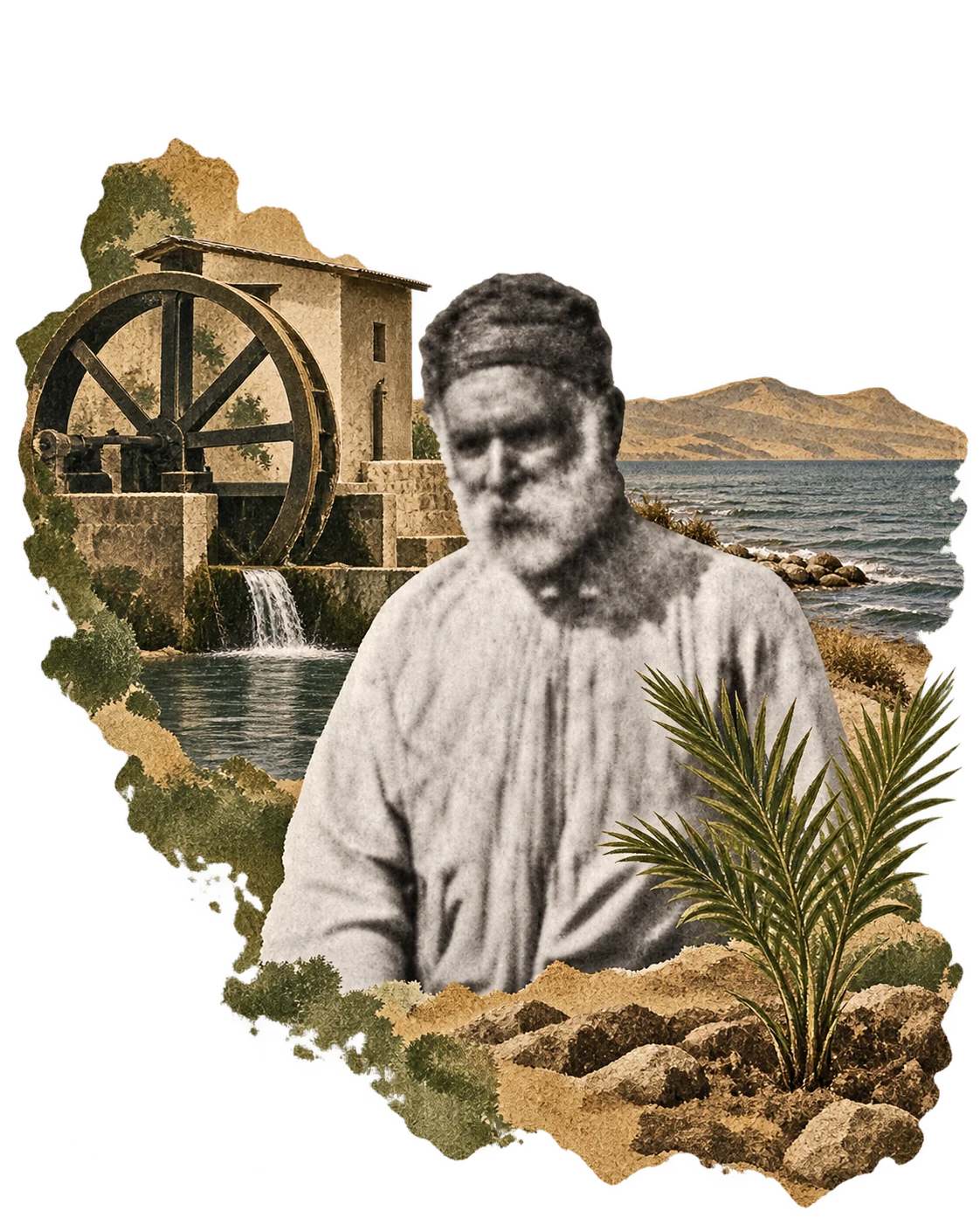
As some of the group returned to Russia, other Bilu members arrived in the country, among them Hissin's partner and fiancée, Fanya Frizer. Fanya quickly understood that her dream of becoming an opera singer would not come true here. Hissin and his fiancée moved to Rishon LeZion and worked as laborers, hoping to receive a plot of land. One of the well-diggers, Hissin was the one who declared, "We have found water" - words that are still inscribed on the city's emblem. In 1883, Hissin and Fanya married in Rishon LeZion beneath a sycamore tree. When their daughter Sarah died at just two months old, they buried her beneath that same tree. She was the first person to be interred in Rishon LeZion's cemetery, which still exists today.
From Gedera to Odessa and Switzerland
In 1885, Hissin and Fanya joined their Bilu friends, who had founded the colony of Gedera. There Hissin worked as a wagon driver, carrying passengers and cargo from Jaffa to Jerusalem and back. After their daughter died and they had lived in poverty, he wrote in his diary: "I do not want to hold out my hand to philanthropists year after year. I am going away, and will return when I can manage on my own"... The Hissins returned to Odessa.
In Odessa, Hissin began publishing articles about the Land of Israel in the newspaper Voskhod, under the title "Letters from the Land of Israel." They had a great influence on young people and on Russian-speaking readers who supported the Lovers of Zion movement. Some of them even immigrated to the country as a result of these articles. In 1887, Hissin also published an account of his life in the newspaper, titled "From the Diary of One of the Bilu Members."
Dr. Chaim Hissin's donkey has a story of its own, too. The first settlers saw themselves as restoring an ancient glory - returning to the observance of commandments that could be fulfilled only in the Land of Israel, or that had not been observed during the years of exile. One such commandment is the redemption of a firstborn donkey. The source of the commandment is the instruction in the Book of Exodus: "Every firstborn donkey you shall redeem with a lamb; if you do not redeem it, you shall break its neck" (Exodus 13:13). According to Torah law, the firstborn of an unclean animal is sacred, but because it is considered unclean, it cannot be offered on the altar. Its sanctity must therefore be removed by redeeming it with a lamb, or, in modern times, with money.
Shlomo Barsky was a wealthy man who bought an estate in Gedera and brought with him a white female donkey to use as transportation. In 1908, Barsky held the ceremony for redeeming a firstborn donkey, and the donkey was redeemed with money that was donated to the community. Immediately after the redemption, the donkey was led to Tel Aviv in a procession headed by Shlomo Barsky, who handed it over to Dr. Chaim Hissin. Everyone shouted, "This is what shall be done to the Bilu member whom the people of Gedera wish to honor."
In 1898, while Hissin was studying medicine in Switzerland, Fanya was waiting for him in Russia. He met Chaim Weizmann in Bern while serving as president of the Academic Zionist Association. The two were members of the Democratic Faction, a movement that offered an alternative to Herzl's approach and advocated expanding the Zionist movement and turning it into a popular, democratic movement based on the idea of auto-emancipation.
The Return to the Land, and Tel Aviv
In 1905, Dr. Hissin and Fanya returned to the Land of Israel, this time to settle permanently. They first made their home in Jaffa. Hissin, who represented the Odessa Committee (the Society for the Support of Jewish Farmers and Artisans in Syria and the Land of Israel), helped establish the settlements of Be'er Ya'akov, Ein Ganim, Nahalat Yehuda, and Kfar Malal.
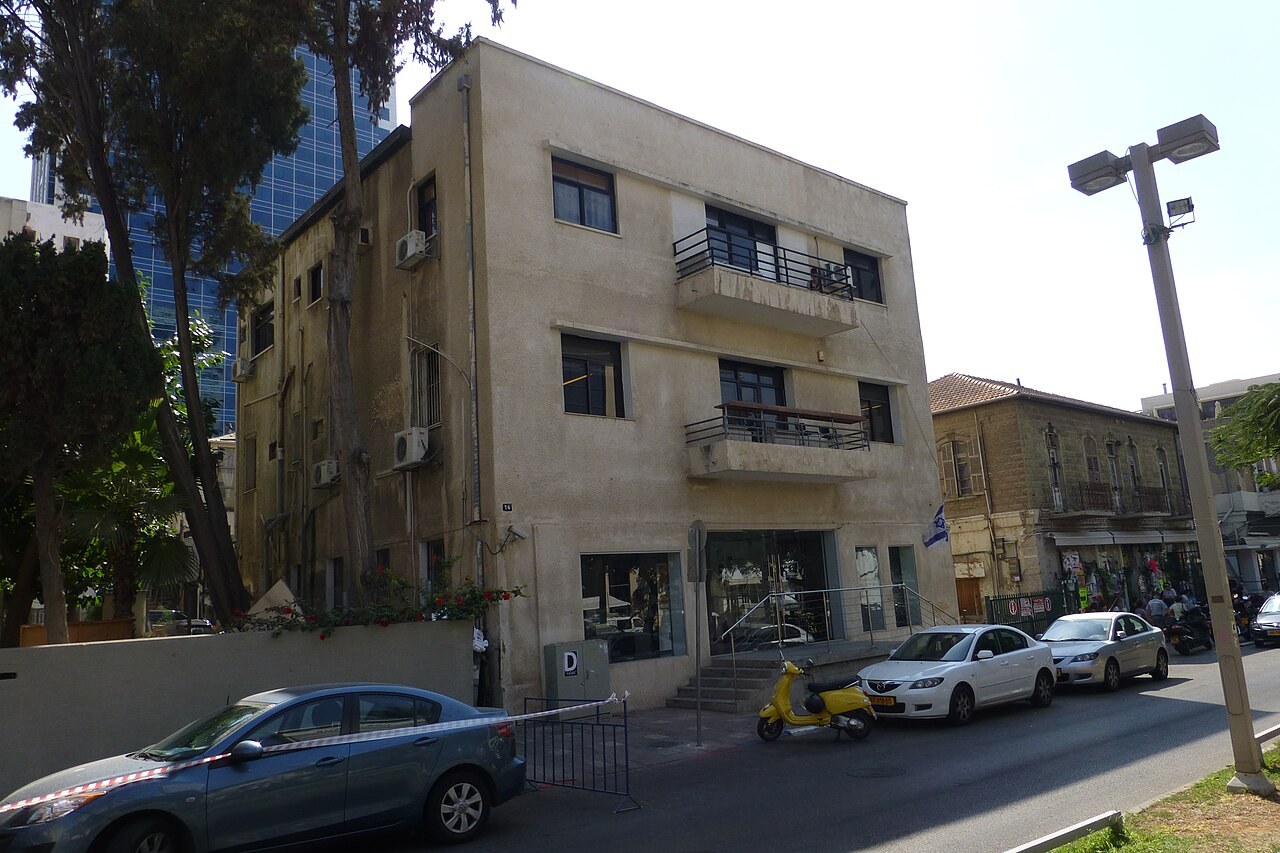
A year after his return, Hissin joined the group of founders of the Ahuzat Bayit company, which built the neighborhood named after it, later to become the city of Tel Aviv. He built his house near that of his friend Meir Dizengoff, chairman of the neighborhood committee and later the city's first mayor. At times, they would ride side by side, Hissin on his donkey and Dizengoff on his mare.
Hissin, who had political insight, would occasionally advise Dizengoff. He wrote: "The settlers themselves are to blame for the Arabs' hostility toward them, and they fully deserve it. Ten years have not been enough to open the settlers' eyes, and they still have not learned how to treat their neighbors. The Jews think too highly of themselves and look down too much on the Arabs. Instead of earning respect through a pure way of life, composure, and a strict pursuit of justice, they have adopted an attitude of arrogance, contempt, and extreme arbitrariness toward the local population. Some settlers take chickens, eggs, and barley on credit; they hire a laborer and then do not want to, or cannot, pay him. After the Arab comes back again and again to ask for his money for six months, and sometimes even a year, he is first told to "come back later," then cursed coarsely, and often even beaten... If an Arab enters a room, he is usually pushed out. Sometimes he is allowed to stand by the door, and only rarely is he invited to sit down."
Hissin initiated a charity committee that gave poor people money to live on, so they would not have to go from door to door begging for alms. He was also responsible for sanitation and cleanliness in the new Hebrew city. In 1912, the doctor founded the "Hebrew Medical Association, Jaffa, Land of Israel," which became the basis for the Israel Medical Association.
Hissin and Menachem Sheinkin, also one of Tel Aviv's founders, disagreed about the character of the city. Hissin envisioned a bustling city full of businesses and shops, while Sheinkin imagined the opposite: "When we founded our association, it was understood that we were not building a new Neve Shalom, but a Neve Sha'anan, a kind of summer retreat where people could rest after a day's work." He wanted a quiet city, a garden suburb. Ironically, Sheinkin Street looks like the kind of street Hissin wanted, while Hissin Street looks like the kind Sheinkin wanted.
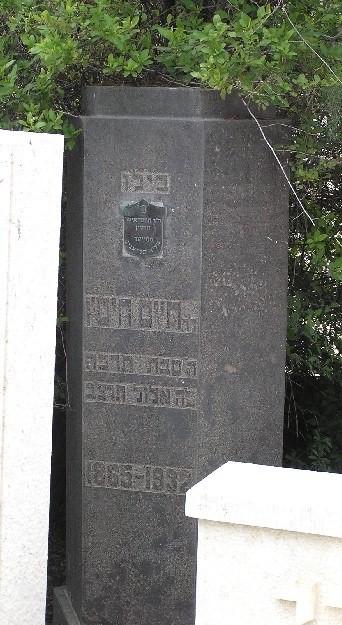
When World War I broke out, Fanya was visiting her family in Russia and could not return to the country. Hissin, left in the country with his children, was expelled from Tel Aviv by Ottoman order in 1917 along with the other residents. He settled in the colony of Yavne'el in the Galilee, where he treated other exiles who had arrived in the area. In 1918, he worked as a doctor in Safed and helped combat the outbreak of typhus. At the end of the war, Dr. Chaim Hissin and his family returned to Tel Aviv, and in 1919 Fanya joined them. She died a year later. Her epitaph preserves the essence of her life: "As great as her suffering, so steadfast her faith... As pure as her heart, so silent her kindness." Dr. Hissin fell ill and died in 1932. He was buried in the Trumpeldor Cemetery in Tel Aviv.
The Hissins had five daughters and one son: Sarah, Yehudit, Esther, Ada, Devorah, and Alexander. Their granddaughter is director and music editor Naomi Polani, the daughter of Ada and Yehiel, and their great-grandson is Gidi Gov.
תגובות
עדיין אין תגובות.