
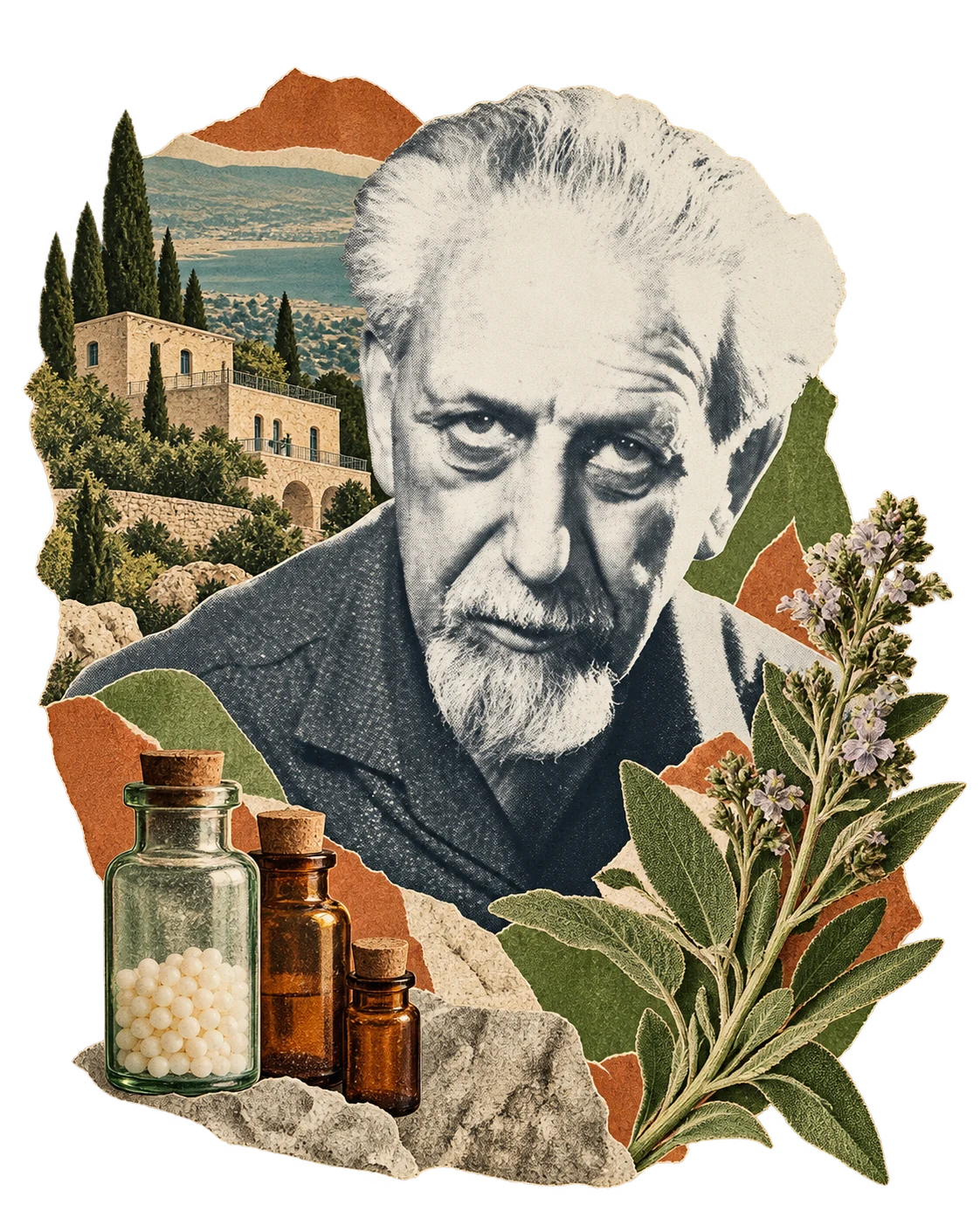
He was an extraordinary man: an idealistic doctor and the first homeopath in the Land of Israel. A visionary who built a unique place with his own hands, unlike anything his contemporaries had ever known.
As a child, the first time he saw his neighbor behead a chicken, he was horrified. Once he understood what went into preparing the chicken soup he had eaten until then - soup that Jews regarded as a cure for every illness - he decided to become a vegetarian and a doctor who would heal without chicken soup.
Erich Jacob Yaroslavsky was born in 1892 in Prussia, Germany. At home, he received a Jewish and Zionist education. After completing his medical studies, he served as a doctor in the German army. At the end of World War I, he married Lotte, and at the end of 1920 they immigrated to the Land of Israel with their son. They also brought a pregnant German shepherd, several unusual chickens, and a pot full of butter, a gift from his mother. He hid his pistol in the pot from the English customs officers and succeeded in getting it through. The family arrived at the colony of Har Tuv, north of Beit Shemesh, and Erich began working there as a doctor.
In 1923, Lotte's parents arrived in the Land of Israel, and Dr. Yaroslavsky, who had changed his name to Yaros, took them on a tour of the country. On one of their trips, as they descended from Safed toward Rosh Pina, they came upon a plot of land overlooking the entire Hula Valley, and Yaros was enchanted by it. When the bus reached the eastern slopes of Mount Canaan, he asked the driver to stop. The small group climbed up and gazed at the far-reaching view, all the way to the Sea of Galilee and the Golan Heights. Dr. Yaros expressed a wish: "In this beautiful place, with this air, I would like to establish a hospice..."
The Dream of Mount Canaan
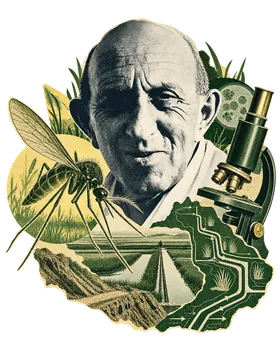
In 1926, a malaria epidemic struck Rosh Pina and the entire Upper Galilee. The epidemic, which claimed lives mercilessly, threatened to thwart the efforts of the young Jewish settlements and became an urgent challenge that required an immediate response. The following year, a dedicated malaria research station was established in Rosh Pina by the Hebrew University, specifically to combat the disease. Leading doctors were at the heart of the effort, including Dr. Gideon Mer, who was appointed chief supervisor of the Institute for Malaria Research. That same year, Dr. Yaros also joined the institute. In the years that followed, Dr. Yaros fought on two fronts at once: on one hand, he battled the malaria and trachoma afflicting the region, and on the other, he began patiently tending the plot he had dreamed of, with endless perseverance.
When he moved to Rosh Pina, Yaros finally realized his vision: with money he received from his father-in-law, he bought the piece of land he had wanted so much. From then on, whenever they had a free moment, he and his wife would go to the plot. With sweat and hard work, they cleared stones, built terraces, and eventually began planting trees. But reality was harsh: there was no water on the site, and the life-hungry saplings were watered with just two cans carried on a donkey's back.
When it was time to expand the plantings, Dr. Yaros approached the colony council with a seemingly simple request: to let him run a narrow water pipe from the colony's upper spring to the land where he planned to build a sanatorium. But this simple request ignited a conflict that lasted a full two years, splitting the colony into two camps: one strongly opposed Yaroslavsky's pipe, while the other supported it. The colony council's 1926 minutes record the explicit decision: "Do not give Dr. Yaroslavsky a water pipe to Mount Canaan." Throughout this period, Yaros, his wife, and their children continued bringing water in cans on donkeys. To overcome the shortage, Yaroslavsky built an enormous cistern with a capacity of 1,100 cubic meters of rainwater - a solution that saved his plantings from certain death by drying out.
In 1927, Dr. Yaros's mother fell ill, and he returned to Germany to be by her side and care for her. In Berlin, he took the opportunity to pursue further training in homeopathy and naturopathy. When he returned to the Land of Israel, he settled in Tel Aviv and became the city's first and only homeopathic doctor. His clinic became successful and earned a strong reputation, but his heart remained bound to the mountainous plot near Rosh Pina. Every weekend, he would go there and continue devotedly tending the trees he had planted.
In 1936, he built another rainwater reservoir and succeeded in making the place flourish. But the road was not one of unbroken success. During the 1939 riots, rioters uprooted about a hundred cypress trees he had planted with his own hands, while forest fires that broke out from time to time destroyed the fruits of his labor. Despite every obstacle, Dr. Yaros never gave up, and continued dreaming of a sanatorium on his land.
In 1939, architect Ze'ev Rechter, designer of the famous Mann Auditorium, prepared detailed plans for a two-story building above the pool. But history intervened again: representatives of the British army, then immersed in feverish preparations for an expected invasion by the German army, vetoed the construction, claiming that it would disrupt their defense plans.
The Road to the Sanatorium
World War II ended, the young State of Israel was established, and the years passed, but Dr. Yaros still had not managed to fulfill his life's dream. Only in 1966, forty years after he had bought the plot, did construction finally begin there. Architect Yehezkel Rosenberg drew up a plan for a modest building with 12 guest rooms, a dining room, a kitchen, storage rooms, and other facilities. Foundations were also laid for a future second floor, and a house was built for the Yaros family to live in.
Dr. Yaros believed that everyone who came to the place would be affected by the tranquility of the surroundings, the divine beauty, the magnificent scenery, the fresh air, and the special atmosphere that pervaded the place, and that all of these would be an integral part of the healing process as a whole. In 1968, the health resort was completed. Dr. Yaros named it Mitzpe Hayamim, meaning "Lookout of the Seas," after the Sea of Galilee and Lake Hula. (Today, Hula is only a small lake.)
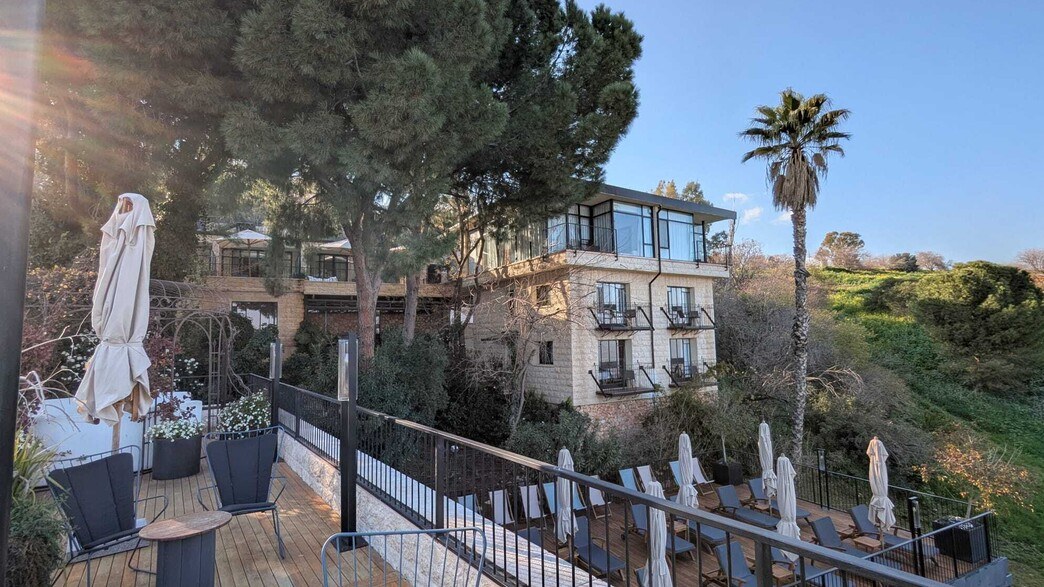
Dr. Yaros, a man of vision and daring, established a modern, meticulously run health retreat. On the ground floor were a lobby for relaxing and resting, a reading room, a pool, and treatment rooms, while the upper floors held the guest rooms. He set aside the large grounds for grain fields, fruit trees, and vegetable gardens. He established a cowshed, a chicken coop, a dairy, and a bakery, a small organic soap factory, a workshop for repairing tools, and even an art gallery. It was a self-sufficient estate that provided for its own needs.
Little by little, the health resort began to build a reputation. It was connected to a water pipe and the electrical grid, paths and paved roads were laid, and guests came from abroad as well. Dr. Yaros personally treated every guest and supervised them closely: smoking was forbidden, no swimming pool was built for fear of drowning, and no televisions were installed because, he said, they were "unhealthy for the spinal cord, the eyes, and the stomach."
The grounds were home to old trees, eucalyptus varieties, many pines, and even rare cedars of Lebanon. Alongside the thriving ornamental trees were traditional fruit trees such as olives and pomegranates, figs and carobs, loquats and apricots, as well as exotic macadamia trees. In a quiet corner lay a small vineyard whose grapes were made into high-quality local wine.
Ancient farming methods are still practiced here: crops are spread over extensive areas, with each plot containing a varied mix of plants - a natural strategy that prevents pests and diseases from spreading. Before every planting or sowing, the soil is enriched with organic fertilizer - poultry and sheep manure from the farm, and homemade compost. At the end of each growing season, the soil is given a long rest so it can renew itself before the next cycle.
The operation of Mitzpe Hayamim is uncompromising: no motorized gardening machinery is heard here. Only hand tools. And the hotel owner himself is the soul of the garden - he is the one who rises at dawn, works the soil with his hands, and plants and sows with love.
In a special corner is the herb garden, with about 40 different types of herbs, some of them woven into the landscape gardening as well. But their role is not limited to the kitchen: natural extracts are also made from these plants for the health treatments offered to hotel guests.
The construction here is a lesson in environmental architecture. The buildings are made of local stone that fits the natural setting, and are low enough that their roofs do not rise above the treetops. When they decided to add a floor to one of the buildings, the plans were drawn up with great care to preserve the surrounding eucalyptus trees. The designer made clever use of the situation: large windows cut into the exterior walls give guests a rare experience - the feeling of living among the clouds, between the branches.
The same approach was taken when the shop was built. When a pine tree stood on the site designated for construction, it was not cut down but incorporated into the building - the successful union made the tree an integral part of the site's unique character.
The pest-control system here is a story in itself. No chemicals at all - only natural biological solutions. During the ripening season, protective nets cover the fruit trees. To combat the Mediterranean fruit fly, wasps, its natural enemy, are released. To deal with other pests, birds are encouraged to nest here - numerous nesting boxes hang throughout the grounds. The kestrel is happy to prey on Spodoptera caterpillars, while barn owls take care of the mice and, indirectly, keep snakes away as well.
Weeding is done by hand only. But there are some surprising helpers in the vegetable gardens: chickens, geese, and ducks roam the grounds and clear them of weeds, while providing fresh organic eggs in return, without the need for processed feed.
Roses are planted in various corners of the garden - not just for decoration. Because roses are particularly susceptible to diseases and pests, they serve as an early warning system, alerting the gardeners to any emerging problem.
Water conservation takes a creative form here. Treated water is pumped to the highest point of the grounds, then begins a magical journey: it flows through constructed channels that cross the entire site, following the natural slope, pauses for a moment in small pools, and continues on its way. Water plants such as watercress grow in the channels and pools, enriching the water with oxygen and purifying it. At the bottom of the system, the water is collected again and reaches its final destination - watering the plants through an advanced drip-irrigation system. Irrigation runs in short bursts several times a day, under computer control, for maximum efficiency and minimum waste.
Family and Legacy
Dr. Yaros worked at the hotel with his wife Lotte and their sons. His target guests were people seeking a natural way of life, eating organic produce, emphasizing the balance between body and soul, and spending time in an environment with few distractions. At the time, this was an innovative and groundbreaking approach, which some people considered downright eccentric.
The meticulous doctor's name became widely known. Guests began making their way up to Mitzpe Hayamim, knowing that the devoted doctor would treat each of them personally, and that is exactly what he did. Dr. Yaros cared for the guests and the farm into old age, believing that his family would continue his life's work. His eldest son, Joseph, studied agronomy and was meant to take over the farm's upkeep. While conducting research in one of the fields on the drained bed of Lake Hula, an agricultural spraying plane showered him with a cloud of pesticide, and years later Joseph died of a serious illness.
The second son, Benjamin, was a nurse. Benjamin's son, Mordechai (Mony), was wounded on the second day of the Yom Kippur War near the "Budapest Outpost" and died two days later.
The youngest son, Aryeh, began studying medicine in Lebanon. When a medical school opened in Jerusalem, he transferred there and became a member of the Hebrew University’s first medical-school graduating class. Aryeh specialized in psychiatry and served as the Jerusalem district psychiatrist. In that role, he submitted an expert opinion to a court in 1969 on Denis Rohan, the arsonist who set fire to the Al-Aqsa Mosque and suffered from Jerusalem syndrome.
Dr. Jacob Yaros also had a relationship with a woman named Ruth, and they had a son. Over the years, a relationship developed between Ruth and Lotte, Dr. Yaros's lawful wife. The two learned to live alongside one another, and a friendship even grew between them. Ruth's son was killed, along with his new wife, in a serious car accident in Italy during their honeymoon.
In 1982, Lotte died. That same year, Dr. Yaros sold the hotel to Sami Hazan, a man of books and ideas. Hazan, a graduate of the Mikveh Israel agricultural school, now had at his disposal a modest building on 150 dunams of land planted with organic crops, probably the most diverse in the world, with the vision that the produce would meet most of the needs of the guests. Although he was already 60, Hazan himself was the farm's principal planter, and about a quarter of a million seedlings passed through his hands each season. Beyond Mitzpe Hayamim's expansion to 100 rooms (52 suites) and its becoming renowned in Israel for its exceptional hospitality and comfort, the ethos of its founder, a pioneer of green tourism and sustainable systems, was carefully preserved. The gardens and orchards evoke descriptions of a utopian Land of Israel.
Two years after selling the hotel, Dr. Jacob Yaros died, exactly 92 years old. Jacob was laid to rest facing the landscape he loved, on the plot he had tended all his life. Few people in Israel have been privileged to be buried as he was, in a place not designated as a cemetery.
Seven grandchildren, one of whom, Mordechai (Mony), was killed in the Yom Kippur War, and of course great-grandchildren and great-great-grandchildren. The name of the other woman in his life was Ruth (Arieli). Miriam Yaron married his son Aryeh and was indeed crowned in 1950 as the first Miss Israel. Miriam Yaron was Dr. Aryeh Yaros's wife.
I knew Dr. Yaros (that is how he introduced himself) very well. We met many times, both near Rosh Pina (at what is now Mitzpe Hayamim) and at his apartment on Keren Kayemet Street (now Ben-Gurion Boulevard). Publisher of the old Tel Aviv Zoo.

תגובות
עדיין אין תגובות.