
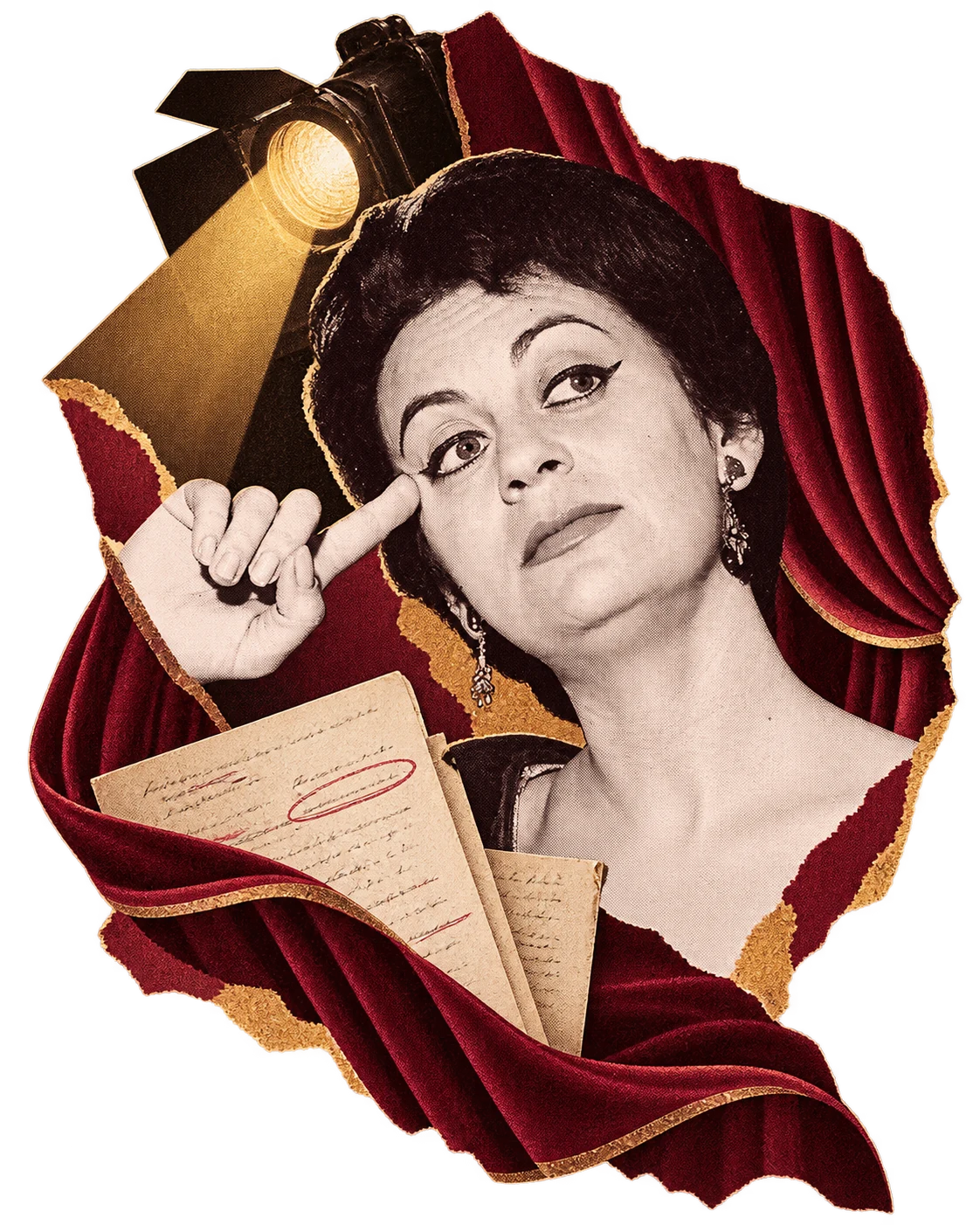
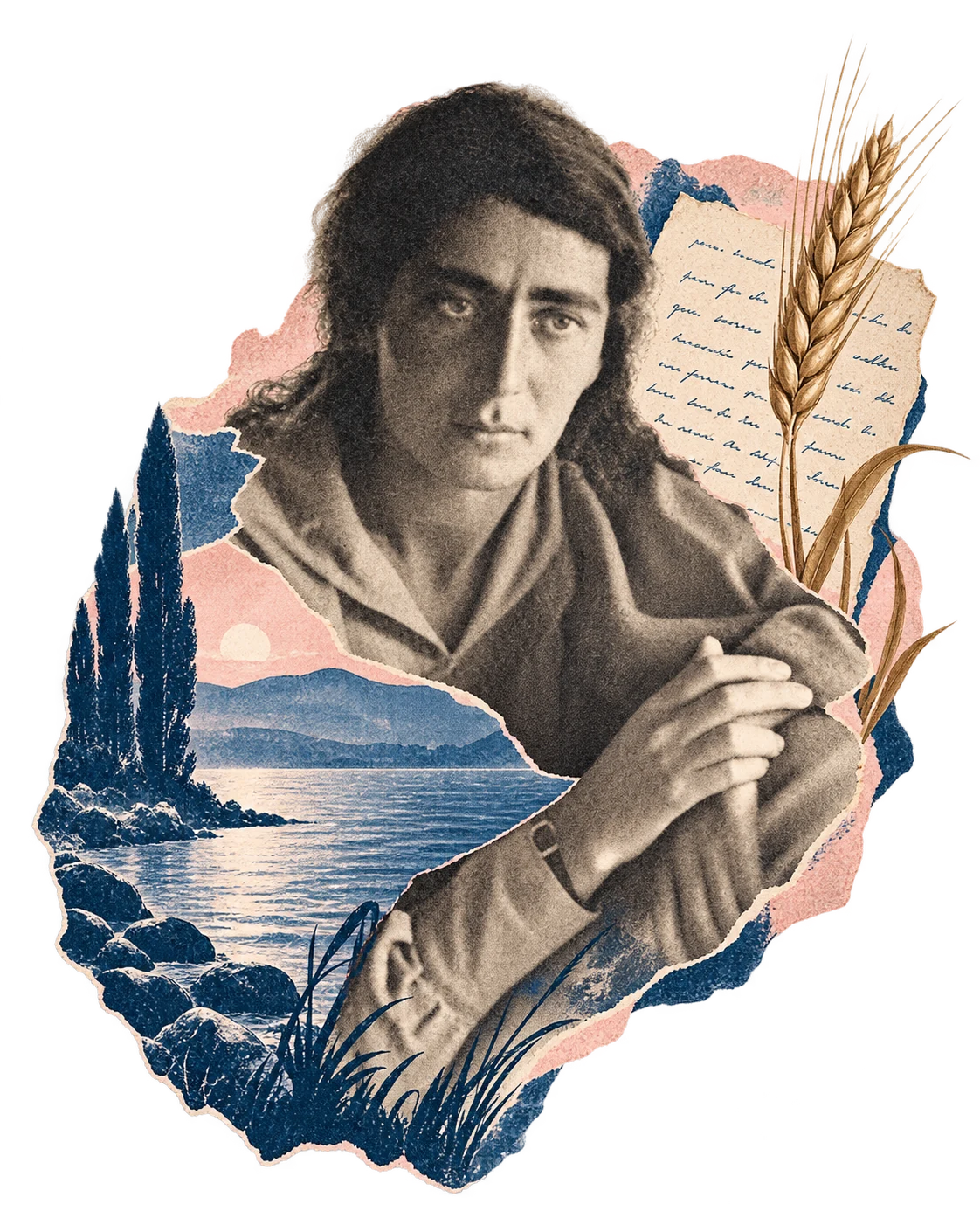
Queen of Hebrew theater, she played more than 100 characters over 83 years, earning a Guinness World Record for the longest theater career.
Looking back over Hanna Maron's life, it seems that powerful forces intervened and shaped its course. Even when fate seemed cruel to her, a door always opened to something better.
Hanna was born in Berlin in late 1923. Her father, Yitzhak Meirchak, was an electrical engineer who had emigrated from Poland, and her mother, Rosa, was an opera singer who had emigrated from Hungary. Hanna was introduced to the world of the stage from infancy. She attended an elite Montessori school. It is no wonder that by the age of four she was considered a child prodigy and had begun acting in children's theaters. In 2011, she was recognized by Guinness World Records for the longest theater acting career - 83 years - and two years later she even appeared in a commercial for a cable company.
At the age of five, she began gaining experience in film as well, first in the movie 'False Oath' and, three years later, in 'M'. By then, she had acted in theaters, recorded several songs, and even taken part in radio plays.
By the age of ten, Hanna understood that her life as a Jew in Germany was in danger. Years later, she recalled how the German inspectors "would slap Dad on the shoulder and say to him, 'Jews like you, Mr. Meirchak, are dear to us.'" The final decision to leave Germany came when Hanna was invited to recite a poem for Hitler's birthday. Her mother had to reveal that they were Jewish, and within two days the family had emigrated to France, where they lived as refugees for a year. At the age of eleven, Hanna arrived in Palestine after her father received an immigration visa. The family settled in Tel Aviv, and Hanna returned to performing in the theater. By the 1960s, she was already a star of the Cameri Theater, alongside Orna Porat and actress Hanna Rovina, who was then considered the grande dame of the theater.
The Road to Medea
The path to becoming the grande dame of the theater ran through a classic leading role. Orna Porat was given the role of Electra, and Hanna Maron asked to play Medea.
The play 'Medea' was first staged in Athens at the Dionysia festival in 431 BCE, and its playwright, the Athenian Euripides, came in third. The play tells the story of Medea, who murdered her young children to take revenge on her unfaithful husband, Jason. Audiences in ancient Athens were looking for horrors, and the children's murder certainly satisfied their appetite for the macabre. The play begins with Jason sailing to the distant kingdom of Colchis, in the eastern Black Sea region, to fetch the Golden Fleece. He could not have obtained it without Medea's help. She betrayed her people and returned to Greece with Jason. After they settled in Corinth, Jason grew bored with the exotic Medea and abandoned her to marry the daughter of the king of Corinth. The wounded Medea decided to commit a series of terrible murders that would cause her treacherous husband pain. Before slaughtering her sons, she sent them to the royal palace with a bewitched dress and crown for the intended bride and her father. When the bride put on the dress, she burst into flames and died in agony, and her father died when he put on the crown. After murdering her sons, Medea took their bodies and prevented Jason from burying them. The play succeeded, among other reasons, because of Euripides' talent for writing from a woman's point of view. "Of all creatures that have life and reason, we women are the most wretched," Medea says in the play.
Medea gave star actresses the chance to showcase their acting abilities and win awards, at least since Sarah Bernhardt performed the role in 1898. The role won Judith Anderson a Tony Award in 1948, Zoe Caldwell one in 1982, and Diana Rigg one in 1994.
Hanna Maron was one of the founders of the Cameri Theater and was considered a theater star. She took on major and leading roles in many productions, including 'Pygmalion,' 'All My Sons,' 'The Glass Menagerie,' 'The Inn of Spirits,' 'A Surrogate Womb,' 'Hedda Gabler,' 'A Doll's House,' 'As You Like It,' 'Twelfth Night,' 'Much Ado About Nothing,' and the musical 'Hello, Dolly!'
Hanna had an exceptional gift for comedy. She spoke directly to the audience and sometimes even brought audience members up onto the stage. She said of herself, "The anatomy of laughter interests me greatly. I experiment a lot during performances." She also used this ability in serious roles, as a way to release tension during a performance. The writer and playwright Moshe Shamir described this when he saw her as Mika in the play 'He Walked in the Fields': "Suddenly I caught myself barely holding back an uncontrollable giggle. Laughter rose from the few people scattered around the auditorium. Had I written a comedy? That was what Hanale taught me - what she had infused into the character, or perhaps what she had drawn out of her. Mika's natural joie de vivre, her indomitable life force."
Hanna Maron took her work seriously. She was diligent and meticulous. She studied and researched every character in depth. This is how she described the process that preceded her portrayal of Hedda Gabler: "I began working on Hedda Gabler long before rehearsals began... I read the play and a great deal of background material... More than any other character, Hedda Gabler had a different face for every interpreter (a champion of emancipation, a lesbian, and all the other variations). At a certain point, this multiplicity of interpretations seemed absurd to me. So I put the material aside... When I began reading the play itself... I discovered that the interpreters were right... A different Hedda emerges in every line of the play, and in fact there is something in Hedda of everything I had read about her." But the most important role of her life was Medea.
The Munich Attack and the Return to the Stage
Toward the end of the 1960s, the Cameri Theater was looking for a director for the famous play. It was clear that a production of this scale required an international director, but Hanna insisted on working with a 30-year-old Israeli director named Yossi Yizraeli, who had trained in London and was beginning to establish a reputation in Israel as well. Yizraeli later recalled that Hanna called him and invited him to a meal at a Bulgarian restaurant, where she offered him the job of directing it. He admired her and was delighted to direct the famous play, but in the version by the Roman Seneca rather than the original by Euripides, which was dramatic but easier to stage. "Only four directors in the 20th century dared to stage Seneca's Medea and succeeded," Yizraeli said. Yigal Tumarkin designed the set, placing a huge aluminum cone at the center of the stage, built at Israel Aircraft Industries. After many rehearsals, a date was set for the premiere, but Yizraeli asked to postpone it because he felt the production was not yet ready. The theater management refused because the expenses were enormous and they wanted to start selling tickets to recoup their investment.
Two weeks before the premiere, Hanna Maron asked the Cameri for leave to fly to London for an audition that Chaim Topol had arranged for her for the production of 'Fiddler on the Roof.' But the Cameri's director did not approve Hanna's trip. Hanna's husband, Yaakov Rechter, secretly approached Yossi Yizraeli and suggested that Hanna fly without the theater's knowledge for 24 hours, then return to rehearsals on Monday and Saturday so that the premiere would not be affected.
Hanna's children later said that on the morning of the flight, February 10, 1970, at two o'clock, their mother received a startling call from a woman who claimed to have held a seance and told her she must not fly abroad, or something bad would happen to her. Despite the warning, Hanna flew to London with Assi Dayan. During a stopover in Munich, three terrorists stormed onto the bus taking passengers to the plane. One of the terrorists threw a grenade at the Israeli passengers. Arie Katzenstein, one of the Israeli passengers, threw himself on the grenade to save his father and the other passengers, and was killed. Hanna Maron was seriously injured, and doctors feared for her life. A few days later, she was out of danger, but doctors had to amputate her leg below the knee, leaving her disabled.
The news took the Cameri's board members by surprise. They could not understand what Hanna Maron was doing in Munich. The production was canceled, and the theater fell into a severe financial crisis. The theater director requested financial assistance from the state but was turned down.
There was severe criticism of Yossi Yizraeli and the secret agreement he had made with Hanna Maron's husband, and he flew to the United States, where he continued his doctoral studies. After several months of recovery in Munich, Hanna returned to Israel and underwent a series of operations. As soon as she was able, she returned to the stage, taking part in a fundraising evening and receiving thunderous applause.
About a year and a half later, it was decided to try staging 'Medea' again, and director Yossi Yizraeli was called back to direct it. The set, originally built for the production, now posed a serious challenge for Hanna, who had lost her leg, but she insisted on carrying on. During rehearsals she stumbled twice, and there were fears she might stumble during performances as well. The costume designer recalled that during one fitting Hanna showed her her prosthetic leg without embarrassment or any need to hide it: "She was a strong woman. She didn't cut herself any slack." Yossi Alfi, the legendary host of the Storytellers Festival, was one of the actors in the production. He recalled: "When Hanna came back, there was something different about her. She had become a true Medea. She was not only physical; she was somewhere else, in the realm of the spirit."
In June 1971, the premiere was held before a packed house. When Hanna came onstage, the entire audience rose to its feet and applauded her enthusiastically. The performance went off without a hitch and became one of the most important productions in Israeli theater. Hanna later said it was the role of her life: "I don't remember ever feeling so good and so enthusiastic in the theater." Hanna herself said that only after the attack, when she had seen with her own eyes what murderous intent and a thirst for blood vengeance looked like, and only after she had shed blood herself, could she portray the role faithfully.
Even before the attack, Hanna had worked extensively to promote dialogue and partnership between Jews and Arabs in Israel, and she continued to do so afterward. Three months after the attack, the terrorists were released in a prisoner exchange in return for the release of an American plane that had been hijacked.
Screen and Remembrance
Hanna also had important roles in films, including 'Aunt Clara,' 'The Eagle,' 'Dead-End Street,' and 'Real Time,' but she entered the Israeli public consciousness through the hit comedy television series 'Close Relatives.' Her call at the start of every episode, 'O-pen!' is still familiar and well known today...
In May 2014, after a career of 86 years and having played more than 100 characters, Hanna Maron died at the age of 90. She was buried in the civil cemetery at Kibbutz Shefayim, alongside her husband, Yaakov Rechter.
In 2018, the Tel Aviv municipality installed a memorial plaque at the entrance to her home at 3 Tarsat Boulevard, opposite Habima Square. Four years later, the Tel Aviv-Yafo municipality decided to name a street after her. Hanna is also mentioned in Naomi Shemer's song 'Heat Waves at the Outpost.' Its final verse includes the line: "With collars white, we race to the theater, and with tender hearts bring flowers to Hanale Maron." In December 2015, Israel Post issued a stamp in her memory.
The series 'The Unimportant Ones,' produced by Eliran Peled and Ido Hartman, revisits forgotten events in Israeli history. Its episode about Hanna is well worth watching.
תגובות
עדיין אין תגובות.