
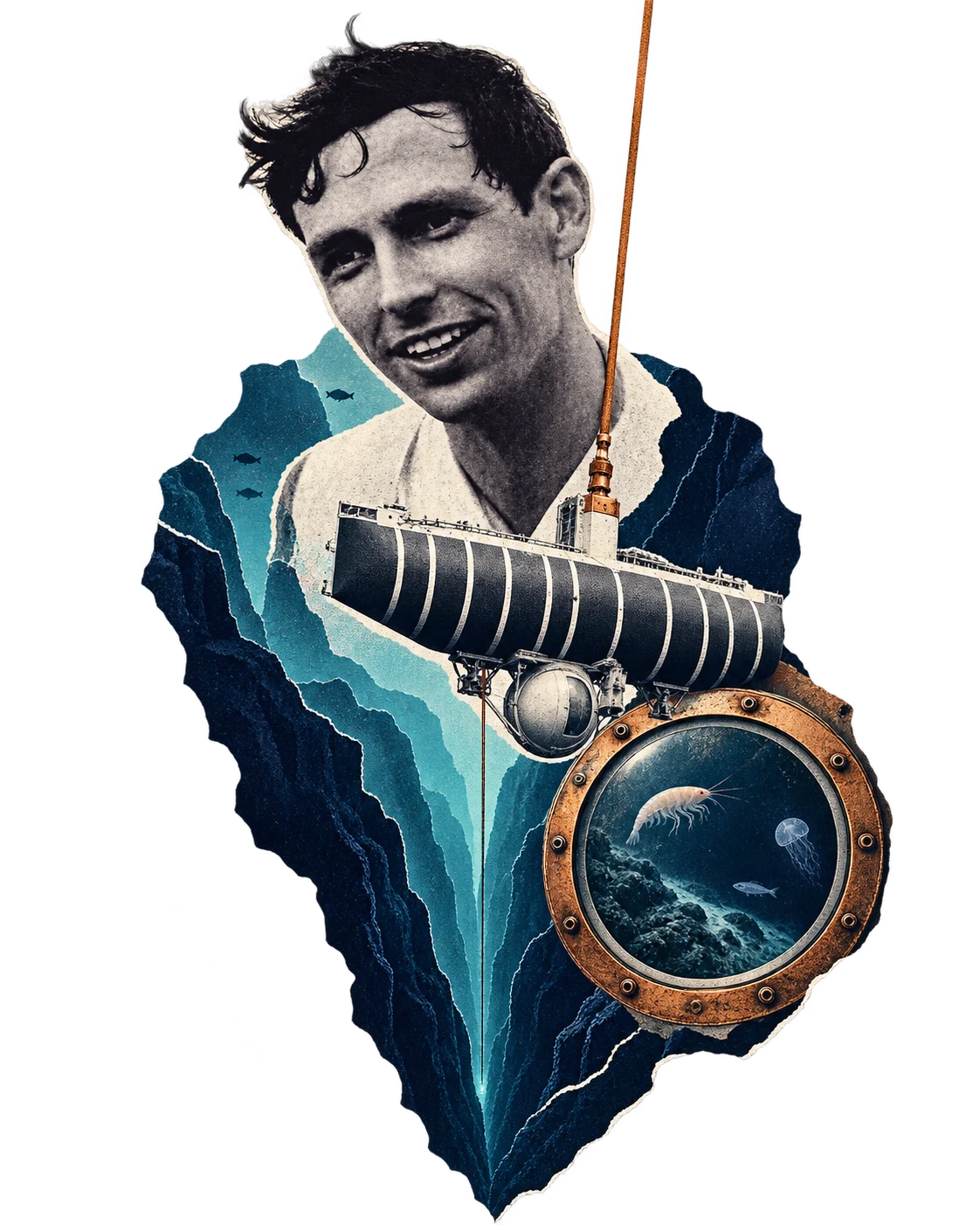
Last week I told the story of the twins Auguste and Jean Piccard. Auguste was one of the world's first two astronauts, having reached a record altitude inside a pressurized cabin he had designed, which enabled him to survive. This time, we'll continue Auguste's story and tell the story of the next generation:
Jacques Piccard.
Drowning is considered a terrible death, involving great suffering. The depths of the sea were seen as the most hostile environment on the planet for human beings, a liquid realm belonging to monstrous, semi-mythical creatures, such as the great fish that swallowed Jonah, or the whale whose "teeth are terrible round about... Out of his mouth go flaming torches... His heart is as hard as stone... he is made without fear" (Job 40-41). Indeed, the first "submarine" known to us was probably that same fish that swallowed the prophet Jonah. According to the text, the journey into the depths of the sea lasted three days and three nights.
The next account we have of an attempt to descend into the depths dates to 332 BCE. Aristotle tells us that Alexander the Great built a diving bell and descended in it at the port of Tyre to gather information.
The Beginnings of Submarines
Even then, it was clear that descending to great depths required a system to protect people. The depths of the sea were dangerous and fascinating at the same time. Gaining control over what went on beneath the water's surface was a constant ambition of rulers and generals, and several scholars in the Middle Ages attempted to design underwater vessels. The first to succeed was the Dutch inventor Cornelis Drebbel, who in 1621 presented his submarine to King James I on the banks of the River Thames. The submarine, built of wood covered in oiled, waterproof leather, was manned by 16 sailors who propelled it with oars. It traveled between Westminster and Greenwich and managed to remain underwater for about three hours. One observer on the riverbank wrote excitedly that "it is not difficult to imagine how useful such a bold invention might be in wartime, if in this way one could attack enemy ships from hiding and sink them with a battering ram." Drebbel's submarine remained a royal curiosity. Drebbel ran into financial difficulties and used the submarine as a publicity stunt, spreading rumors about a monster lurking beneath the waves to attract curious visitors to the pub he had opened at the foot of London Bridge. It was not until 1775 that a serious attempt was made to build a submarine for attack. The American David Bushnell built the "Turtle," a small submarine intended for one person and, in fact, the first military submarine of the modern era. The submarine was tested by the inventor's brother, Ezra Bushnell, and after a brief period of training, the "Turtle" had its first baptism of fire on September 7, 1776. Its target was the ship Eagle (HMS Eagle), but the attempt to sink it was thwarted when the drill struck an iron reinforcement.
In any case, these submarines did not descend to impressive depths. The depths of the sea and their mysteries remained beyond human reach. It was only in World War I that submarines began to demonstrate their full destructive potential. This happened when the British passenger and mail ship Lusitania was sunk by a German submarine in 1915, taking all 1,198 passengers aboard with it, including nearly a hundred children and about 130 Americans. The sinking of the ship was one of the main reasons that prompted President Woodrow Wilson to join the war two years later.
Jacques Piccard and the Trieste
Massive submarine construction began in 1931 in Germany, under Adolf Hitler, with the help of established steel companies such as Thyssen and Krupp. Germany began rebuilding its submarine fleet, the same fleet that played a decisive role in World War II and which Winston Churchill called "the only thing that really frightened me". Jacques was the son of Auguste Piccard. Jacques was born in July 1922 in Brussels, Belgium. He was an economist who kept his distance from his father's scientific adventures, but fate and genes proved stronger than he was. In 1953, while in Italy on business, academics approached him to ask for financial assistance in building a new diving vessel. Jacques summoned his father to Italy, and Auguste put to use the knowledge he had acquired in the field of pressurized cabins, which had earned him the title "the first astronaut." But now their development efforts were headed in the opposite direction - from the heights to the depths. Auguste built the Trieste according to exactly the same principles. It was 15 meters long.
At that time, two diving vessels in the Mediterranean were competing to achieve impressive depths: in Toulon, the French team conducted its trials, while in Naples, Auguste Piccard's team launched the Trieste. The Trieste crew descended to a depth of 3,150 meters, and in 1954 they used it to dive more than four kilometers deep!!!
At that time, Jacques announced his decision to leave economics in favor of pursuing further diving adventures, and Auguste, aged 69, announced his retirement.
To the Mariana Trench
In 1958, the US Navy bought the Trieste for $250,000. Jacques followed it to the United States, where he and Lieutenant Don Walsh began a series of dives, descending to greater depths each time. Over the course of about two years, they made 26 dives, but the most impressive was the dive to a depth of 10,911 meters. (Three times the depth of Auguste Piccard's dive.) To appreciate how deep that is, it is worth remembering that the highest mountain on Earth is Everest, which rises 8,848 meters - meaning the depth is almost 2 kilometers greater than Everest's height. On January 23, 1960, Lieutenant Don Walsh and Jacques Piccard were sealed inside the Trieste. Jacques's heart was pounding. He trusted the submarine his father had built, but knew the danger of descending to such a depth. The water pressure on the submarine was about 9.5 tons per square meter, so if a hole had opened in its hull, they would have been crushed within seconds. The descent was slow. After five hours, they reached the seabed, at the deepest known and accessible point in Earth's crust. The trench, located in the northwestern Pacific Ocean, is Challenger Deep, also known as the Mariana Trench, east of the island of Guam.
No one expected the Trieste to return with discoveries about animals on the seabed. The assumption was that there were no currents at the bottom of the trench to bring fresh oxygen down from shallower depths, and therefore no living creatures either. The Americans hoped they might be able to dump radioactive waste into the trench, where the lack of currents would leave the dangerous materials forever in their cold, compressed grave. To their surprise, the two divers spotted a shrimp-like creature through the window, a small fish swimming slowly, and a jellyfish floating peacefully. This meant that oxygen was present in Challenger Deep, and therefore that currents carried it there. It was the end of the idea of a radioactive grave. After twenty minutes on the seabed, they heard an alarming noise and felt a powerful jolt, and it was clear that something was wrong. Walsh and Piccard hurried to release the ballast, and after three hours and fifteen minutes, they returned to the surface. There they discovered that one of the windows had cracked, but fortunately it had not shattered. Walsh and Piccard made the deepest dive in history about a decade before the first human reached the moon. Since then, 12 people have walked on the moon and spent a total of 300 hours on its surface, while humans have spent only three hours in total in the depths of the ocean, and only three people have ever reached the incredible depth of 12 kilometers. Film director James Cameron (Titanic) was the third person to dive there. This was in March 2012, when he was 57; after three hours, he reached the same depth in a green submersible called Challenger, built especially for the complex mission. Jacques Piccard continued to push the boundaries of underwater exploration in the years after the Trieste. He built a large submarine capable of carrying up to forty people, and in 1969 he joined the American space agency. NASA wanted to test the idea of a space station, so they sent Piccard, along with five other crew members, to spend an entire month underwater, carried by the waters of the Gulf Stream in the Atlantic Ocean.
In November 2008, at the age of 68, Jacques Piccard passed away, and this was the signal for his son Bertrand to begin making his voice heard.




תגובות
עדיין אין תגובות.