
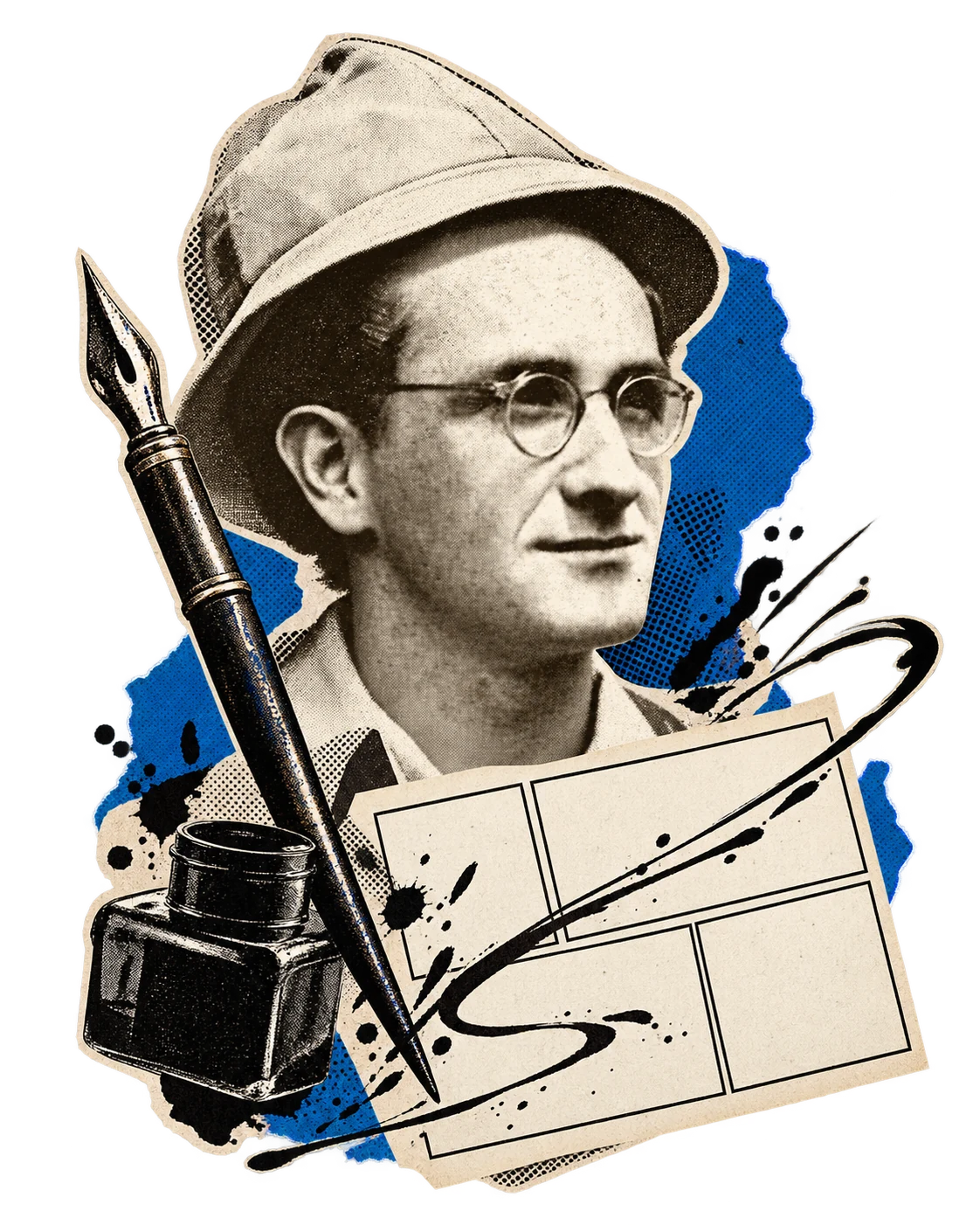
We were all once 'Srulik' - an imaginary, pioneering, innocent boy whose creator spent years giving us a sharp dressing-down through his cartoons.
Even today, many years after the founding of the state, the drawn figure of 'Srulik' - the Israeli sabra, wearing a tembel hat, shorts, and biblical sandals - evokes the Israeli of that era. Innocent, determined, and daring, he scorns hedonism and ostentation, makes do with little, and cherishes the values of the beautiful, good Land of Israel that had just been born. In those years, everyone knew Srulik and followed his 'pronouncements' whenever he appeared in the press - but few knew his creator. The creator of the character was no sabra at all, but a Hungarian immigrant who belonged to what the press then called the 'Hungarian mafia,' which included Yosef Tommy Lapid, Ephraim Kishon, Yaakov Farkash ('Ze'ev'), and Karol Kariel Gardosh ('Dosh'), Srulik's creator. They were all immigrants from Hungary, journalists whose writing was steeped in humor and who drew inspiration from the Hungarian satirist Frigyes Karinthy, a convert. They influenced an entire generation of humorists, writers, and illustrators whose work we still enjoy today.
Hungary Under Horthy
After World War I, Hungary's National Assembly debated the question of the monarchy and decided to have it both ways. It chose not to restore Charles I, the Habsburg Emperor of Austria, to power after his exile in Austria, and instead declared Admiral Miklós Horthy regent for an indefinite period. Thus, in a country without a sea, the admiral became an admiral without a fleet - a regent without a king. Horthy was an antisemite who viewed Hitler as an ally, and restrictions on Jews were imposed at the very beginning of his rule. Hungary joined the Axis alliance, which included Germany, Italy, and Japan, against the Allies, a coalition of 59 countries, including the United States, some South American countries, and most European countries.
In April 1941, Hungary, as a member of the Axis alliance, took an active part in World War II. Its involvement peaked when it joined Bulgaria in the German invasion of Yugoslavia. When Germany invaded the Soviet Union, Hungary too declared war on the Soviet Union, alongside Germany and Romania. A year later, Horthy began enacting anti-Jewish legislation, while also rejecting the Germans' demands to concentrate all the Jews in camps and send them to be exterminated in occupied Poland. The situation of the Jews deteriorated during these years, and some were sent to forced labor, where harsh conditions claimed many lives. As the Red Army approached Hungary's borders, Hitler feared that Horthy would switch sides and join the Soviets, so in March 1944 the Germans invaded Hungary. Over the next ten months, most of Hungary's Jews were murdered at Auschwitz.
In 1942, under Admiral Horthy's decrees, Karol Gardosh was sent to forced labor. After the German invasion, Gardosh was transferred to work in a copper mine, while his family was sent to a concentration camp and murdered. In October 1944, the Nazis closed the mine and led all its workers on a 'death march' toward Hungary. Karol's labor group was assembled in the village of Crvenka, near the Hungarian border, where everyone was killed, except for a dozen survivors who managed to escape the killing ravine, including Karol. Karol joined the Yugoslav partisans and fought alongside them until the end of World War II.
After Hungary was liberated, Karol returned to his city, Szeged, began studying French and comparative literature at the local university, and worked as a journalist.
The Childhood of Karol Gardosh
Karol Gardosh was born in Budapest in 1921. His mother, Marguerite, died giving birth to him, and his father, Sandor Alexander, who struggled to care for him, entrusted him to his married sister. Karol grew up in an area with few Jews, in a secular, assimilated home, but was aware of his Jewish identity. An outstanding student, he stood out for his diverse talents already in high school, where he began drawing and writing with his schoolmate Tibor Klein, who later changed his name to Kajan and became a well-known Hungarian cartoonist in his own right. This happy period ended with the outbreak of World War II.
While studying in Szeged, Karol fell in love with Shoshana (Susan), and they married. In 1946, they moved to Paris, where Karol enrolled in literature and philosophy at the Sorbonne. They joined Lehi, and the underground movement made use of Karol's talent: he began drawing cartoons that were sent to Israel and printed in the underground newspaper. Two years later, Karol and Susan sailed to Israel, arriving on the eve of the state's first Independence Day. At first they lived with Irgun activist Yaakov Meridor (later a Knesset member and Minister of Economy), and later Lehi found them a two-room apartment, which they shared with another family.
In September 1948, Lehi members assassinated Count Bernadotte. Many members of the underground movement were arrested, including Karol. While in detention, he drew Lehi's emblem on the walls of the Jaffa detention center, near the Clock Tower.
Paris, Lehi and Aliyah
Karol's first breakthrough came about two years after he immigrated to Israel. He began working for the newspaper HaOlam HaZeh, edited by Uri Avnery. The paper took aim at the institutions of government, from both the left and the right. One day, an opponent of the paper planted an explosive device on the windowsill of its offices, and Karol was injured. It was a complicated reality for a right-winger working at a left-wing newspaper to be injured by a bomb, probably planted by a right-winger. Uri Avnery suggested that Karol Hebraize his name, and he adopted the name Kariel and the nickname 'Dosh'.
About a year after he began working for HaOlam HaZeh, 'Srulik the sabra' was born. Whenever he was asked how Srulik came into being, he replied: "A political cartoon is usually, though not always, about relationships between nations and peoples, and for that you need symbols, figures that represent those countries and peoples. So there was a need to create a figure to represent the people and the state, and I decided that it should be a boy. An Israeli boy, of course, dressed like an Israeli." Srulik became a symbol of the young state, like other national figures such as America's Uncle Sam, the Russian bear, and Marianne, the heroine of the French Revolution.
Srulik grew up with the country. Over the years he grew taller, his face lengthened, and during the Six-Day War he put on a uniform. His sandals were replaced by high army boots, and his shorts by fatigues. But Srulik always remained a boy, as Dosh wrote: "In the early days of our existence, Srulik was an innocent little boy with questioning eyes. In time, he became a teenager in his physical appearance and behavior... He began wearing long trousers, and the smile on his face became skeptical. At that point I stopped his growing up. I became convinced that the traits of adolescence reflect the character of the country well, even if it is twenty, thirty, or forty years old. Lack of self-confidence, moods that swing wildly from despair to enthusiasm, a sense of strength and weakness at the same time, crises of identity - all these traits continue to be our hallmarks... So Srulik remains fourteen or fifteen in my drawings, with everything that entails."
Dosh refused to be labeled a cartoonist. He told the newspaper Davar after one of his exhibitions: "Our language does not distinguish between a caricature, in the grotesque or humorous sense of the word, and a cartoon. Caricaturists emphasize the ridiculous in a particular face - a long nose and a small body. I try to avoid all that. For me, the idea is the main thing, and the drawing is a means. I try to create what is called in Anglo-Saxon countries an 'editorial cartoon,' that is, a drawn leading article. In this respect I learned a lot from the prophets: they drew allegories. It's a pity Isaiah got there first with his description of Egypt as a broken reed." On his working process, he said: "It's not a matter of a sudden flash of insight, but of systematic work. In the morning I read newspapers, go out into the street, travel into town, look around, concentrate... and then I've found today's subject, or rather tomorrow's subject. I go home, and now I have to decide: do I approach my subject positively, negatively, or mockingly? It's like solving an equation with one or two unknowns. The givens are the subject and my attitude toward it. I also have something 'on the right-hand side,' because the result is known in advance: a visual formulation of the subject. Here too I don't rely on inspiration, but use proven formulas, as in mathematics. Sometimes I try to combine two events, one important, one banal... Another tried-and-tested formula is to follow an absurdity. During the infiltration period, for example, I drew a cinema with three ticket windows: one for civilians, one for soldiers, and one for infiltrators..." About his approach to work, he said: "I am a stickler for discipline at work. Discipline is what distinguishes a professional from an amateur. It was precisely my most successful works that were born of great effort and sweat."
Tommy Lapid called him "the most important cartoonist in the history of the state," in no small part thanks to Srulik. Lapid said: "He created the figure that has accompanied the country all these years. Just as the Uncle Sam cartoon represents America, John Bull represents England, and Marianne represents France, Srulik represents Israel. That alone places him in a kind of pantheon of our history." He added that "for decades, he also had a very great influence on Israeli politics."
At the time, the most widely read newspaper was Maariv, and Dosh gained wide exposure. His cartoons became classics. Tommy Lapid recalled: "As a person, Dosh was a thoroughly pleasant man, in the European sense of the word. He came to Israel as an adult. He was also a writer. But he became a cartoonist because he wanted to earn a living right away, and he didn't know Hebrew, while drawing is an international language."
Lapid added an interesting detail about the creative process: "When Dosh realized that Srulik was too nice for a period that called for criticism, he invented the two little crows in the corner of the cartoon. They would say the unpleasant things, leaving Srulik as a nice fellow." The young, charming, cheerful Srulik, whom people loved so much, was the antithesis of the wandering old Jew.
Srulik and the Breakthrough at Maariv
The journalist and writer Azriel Carlebach, founder of Maariv, recognized Dosh's immense talent. He offered Dosh a column in which a topical cartoon would appear every day. For 47 years, Dosh published his daily cartoon, and quite a few readers bought the newspaper just to see his inspired work, with Srulik as the star of the cartoons.
No cartoonist before him had made such an impact. His work was not limited to Maariv. It was also regularly published in newspapers such as the English-language Jerusalem Post and the Hungarian-language Uj Kelet, and often in leading international newspapers as well.
Dosh did more than draw cartoons: he also wrote opinion columns and sketches, and published 13 books of cartoons, prose, and reflective writing. He received the Herzl Prize, the Nordau Prize, and the Jabotinsky Prize. In 1976-1977 he served in the Israel Police with the rank of deputy superintendent, helped establish the Civil Guard's public information unit, and was its first head. From 1981 to 1983 he served as cultural attaché at the Israeli Embassy in England. On his return from London, he was a member of the executive committee and plenary of the Israel Broadcasting Authority.
'Srulik' became a celebrity and, as such, appeared on a range of products. He was featured on cigarette boxes, hats, shirts, and various souvenirs. His image was also immortalized in figurines, posters, dolls, ashtrays, cups, key chains, postcards, and more. His image is still used in response to current events.
Dosh was active in the Lehi memorial association and helped design the movement's museum at Beit Yair. Dosh and Shoshana had a son and a daughter. Their daughter, Daniela Gardosh-Santo, formerly served as head of the Children's and Youth Department of the First Channel and conceived the book 100 First Songs, which her father volunteered to illustrate in color; until then, Dosh's publications had been in black and white. Dosh and Shoshana divorced, and in 1964 Dosh married actress Tova Perdo, who was his life partner until his death.
Dosh died on February 28, 2000, at the age of 79, and was buried in Yarkon Cemetery. Some cities have named streets after him, and his children established a website in his memory. The Tel Aviv-Yafo Municipality also awards the Dosh Cartoon Prize every year.
Srulik, too, received great recognition. In the year marking the fiftieth anniversary of Israel's independence, the beloved figure was chosen to adorn the state's official stamp. Cartoonists including Shay Cherka and Uri Fink continue to draw Srulik. In Tel Aviv's Florentin neighborhood, one of the most beautiful graffiti murals was painted, depicting the boy Srulik.
These memories sketch our history in a single line, from where we were to where we are today.
תגובות
עדיין אין תגובות.