
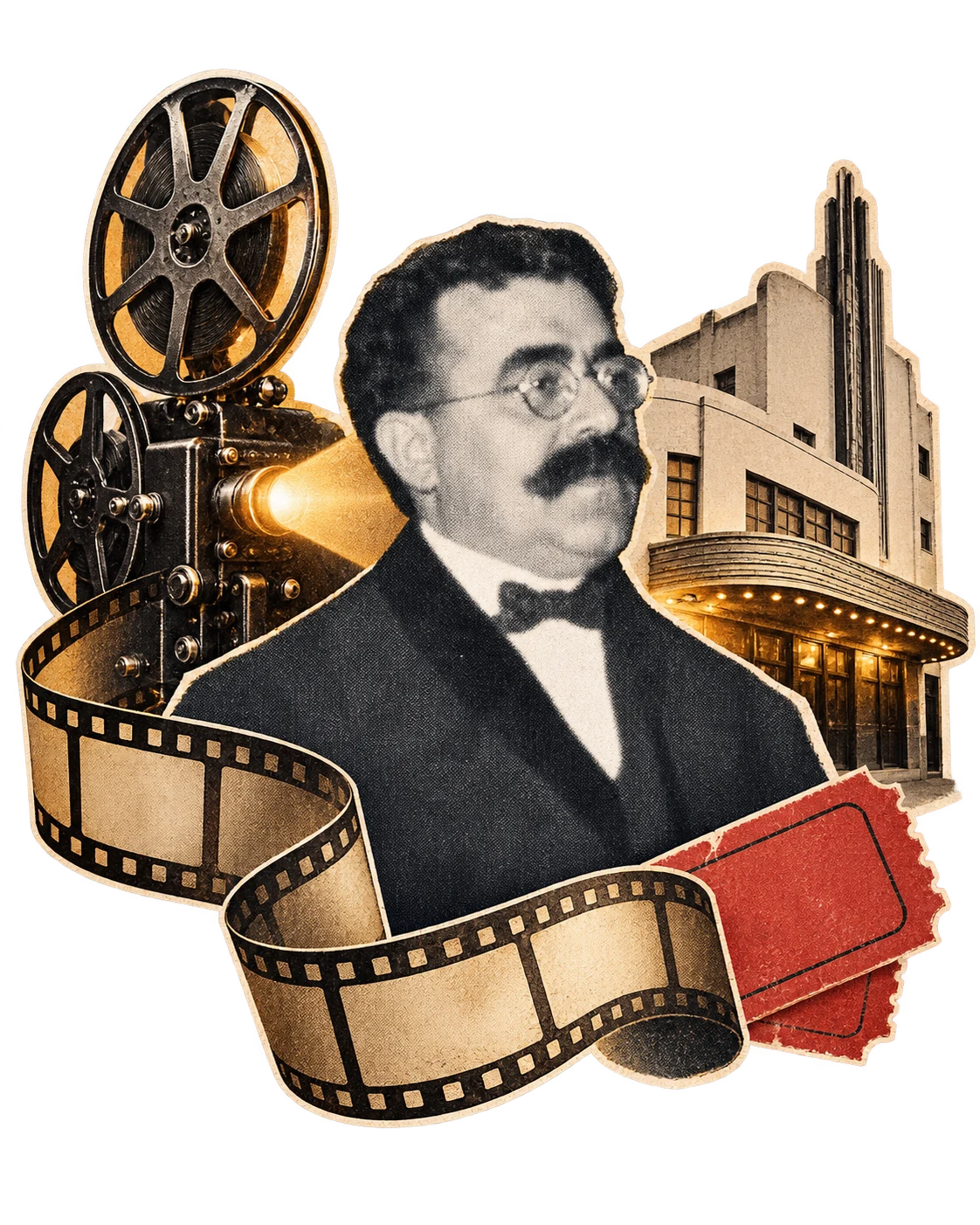
Today, most of us read and watch videos on our phones. This time, let us travel back to the era before telephones and tell the story of silent films in the Land of Israel, and of the entrepreneur who brought cinema to the country.
Moshe Abarbanel
The Fight for the First Cinema
The year is 1913. Tel Aviv is still a small neighborhood, just four years old. It has only about 2,000 residents, but already has a strong committee and big ambitions. A new immigrant approaches the committee table with a bold proposal: to set up a "cinematograph," or, as it was more commonly known, a silent-film projector. This was eight years after the first movie theater was established in Pittsburgh, Pennsylvania.
The committee, headed by Meir Dizengoff, found itself facing a real dilemma. On the one hand, there was considerable fear: Tel Aviv had been founded as an upscale, quiet alternative to noisy, dirty Jaffa, and residents worried that a movie theater would become a source of raucous crowds. It is worth remembering that in those days the city still had no electricity, which meant the machines would have to run on an especially noisy generator.
Beyond the noise, there were moral concerns, too. Some feared that the young people would be "corrupted" and, instead of studying, would waste their time in a dark hall before a flickering screen, perhaps even being exposed to inappropriate content or the desecration of the Sabbath. Dizengoff found himself torn: he wanted to bring culture to the neighborhood (which at the time consisted largely of Moshe Hoppenko playing the violin in his window for the enjoyment of passersby), but at the same time he worried about the character of the new neighborhood.
The opposition came from an unexpected quarter: the Jaffa Municipality. The people of Jaffa saw the silent-film theater as economic competition for Café Lorenz in the Templar colony (where films had been screened since 1909), and the Turks even claimed that the generator posed a security threat. It was Jaffa's opposition that finally gave Dizengoff the push he needed. He realized that opening a silent-film theater was an opportunity to prove that Tel Aviv was not merely a Jaffa bedroom suburb, but a cultural, European, and progressive center that surpassed anything its southern neighbor had to offer.
Moshe Abarbanel and His Family
The story of Moshe Abarbanel and the establishment of Tel Aviv's first silent-film theater is a fascinating blend of deep Hasidic roots and modern urban vision. Abarbanel was born in February 1882 in Liozna (now in Belarus), a town that was the cradle of Chabad Hasidism. His merchant father belonged to a distinguished family descended from Don Isaac Abarbanel, one of the Jews expelled from Spain, while his mother came from the family of Rabbi Shneur Zalman of Liadi, the founder of Chabad Hasidism. As a young boy, Moshe studied in a heder, a traditional Jewish elementary school, and when he grew up he followed in his father's footsteps, becoming a successful textile merchant. Though learned in Torah, Abarbanel was also a well-educated man with broad interests and a love of music. He organized cantorial and instrumental concerts and even founded a Jewish theater troupe.
Family tradition adds a broader historical dimension to the family's wanderings: it is said that in 1812, when Emperor Napoleon I set out from France at the head of the "Grande Armée" to conquer Russia, one of the Abarbanels accompanied his forces. This family member reached the city of Kovno (Kaunas) in Lithuania, where he settled. Several generations later, the family moved to Kremenchuk in Ukraine, where Moshe's father was born and raised.
The family's connection to the Land of Israel began with the numerus clausus (fixed quota) policy in the Russian Empire, which limited the number of Jews allowed into educational institutions. Moshe Abarbanel, a Jew with a strong national attachment, decided to send his sons, Haim and Ze'ev, to study at the Herzliya Hebrew Gymnasium. In August 1911, he brought the boys to the country, and the following summer their mother, Haya Abarbanel, came to visit them with their three daughters. Haya, an educated woman who spoke several languages and was a lover of Zion, was impressed by the country and decided to settle there. She urged her husband to wind up his businesses in the Diaspora and immigrate. In 1913, Moshe Abarbanel immigrated to the Land of Israel.
From the Tram to the Eden Cinema
After arriving, Abarbanel began looking for a business that would support his family and contribute to building the country. Moshe Abarbanel, who envisioned a great metropolis, initially came up with the idea of establishing a network of electric trams to transport passengers comfortably and replace the polluting Arab carriages.
It was here that his path crossed with that of committee head Meir Dizengoff, who liked Abarbanel but explained that a tram network would not be a viable business on the neighborhood's narrow streets. Instead, Dizengoff suggested establishing a cultural and meeting center for assemblies, lectures, concerts, and plays. Abarbanel considered the offer and agreed, on the condition that he be allowed to install a cinematograph there as well - a silent-film projector that would operate when the hall was not being used for other activities. Dizengoff, who recognized the importance of Jewish film and supported its development, gave his blessing. Thus, despite the fact that similar proposals had been submitted, it was Moshe Abarbanel who received the concession and made the silent-film theater his first undertaking in the Land of Israel.
To obtain the coveted concession, Abarbanel had to meet a series of strict conditions: no events on the Sabbath, all activity to end by 11:00 p.m. each day, and every film to be approved by a strict censorship committee. With keen business instincts, Moshe turned this oversight to his advantage. He branded the silent-film theater as a supervised educational institution, supposedly unlike Jaffa's "depraved" entertainment venues. It was a brilliant political tool intended to show the authorities that order and the law were upheld far better in the Hebrew neighborhood than in the big city.
Moreover, one argument put forward in support of the venture was that the silent-film theater should be allowed to open so that Tel Aviv residents would not have to "wander to Jaffa and spend time in cafés that are not fitting for our dignity." The establishment of the Eden silent-film theater was not merely a business venture - it was an act of cultural separation from Jaffa.
The original concession agreement read:
"Mr. Abarbanel undertakes to build, on the committee's lot on Lilienblum Street, a building containing a large hall and all the other rooms to be used for a cinematograph, as well as for balls, Hebrew stage productions, and the like. The hall will seat 600. Mr. Abarbanel undertakes to open a silent-film theater in the said building at his own expense and to furnish it attractively with fine furniture and well-arranged electric lighting... The Tel Aviv Committee grants Mr. Abarbanel a monopoly on silent-film screenings within Tel Aviv for thirteen years, and no one else may operate another silent-film theater within Tel Aviv... In return for this monopoly, Mr. Abarbanel will pay the Tel Aviv Committee one thousand francs a year."
The committee's control over the content was absolute, as the document went on to specify:
"Throughout the term of the contract, the programs of the silent-film theater will be reviewed and examined by a committee appointed by the committee, and Mr. Abarbanel shall not be permitted to screen any picture [film] without its review."
Once he had the concession in hand, Abarbanel threw himself into the work. The investment was substantial - between 20,000 and 25,000 gold francs, equivalent to about $600,000 today. Given the high financial risk, he looked for a partner who would not only bring capital, but would also be a practical man, long established in the country, familiar with the intricacies of Ottoman bureaucracy and able to get things done with the officials. That was how he found Mordechai Weisser. Mordechai had immigrated from Ukraine in 1905 with his wife, Hannah, and their three sons, and was one of the 60 founders of Ahuzat Bayit. He was a shrewd businessman with an impressive track record, from a wine-barrel factory to a partnership in purchasing land and building a neighborhood that would later become Allenby Street, alongside figures such as Akiva Aryeh Weiss and Bezalel Yaffe. Beyond his business acumen, Mordechai was known as an honest, decent, and affable man. Moshe and Mordechai hit it off immediately. They became partners and close friends, and even lived near each other on Lilienblum Street. In January 1914, they signed their partnership agreement, each investing 11,000 gold francs.
In February 1914, Richard Michel, a world-renowned expert in building silent-film theaters, arrived in the country and was put in charge of the design. Michel, who that same year also won the competition to design the Great Synagogue, drew up the plans in just one month. The contractor selected for the job was Akiva Aryeh Weiss, who wrote in his memoirs: "A building such as had never before been seen in the Land of Israel, both in terms of its construction and its economy."
The result was spectacular: a cinema consisting of two halls, an open-air summer hall under the sky and an enclosed winter hall, each with 800 seats. In the private boxes at the front of the balcony were luxurious wicker armchairs brought specially from Vienna, and above the screen hung the moving inscription: "May there be peace within your walls, tranquility in your palaces."
As it was one of the few performance halls in little Tel Aviv, the venue often hosted opera and theater performances as well. The facade was decorated in an impressive Art Deco style, and above the ticket windows was the name chosen by the writer S. Ben-Zion (Nahum Gutman's father): Eden.
The Grand Opening of the Eden
Preparations for the grand opening were in full swing. In July 1914, Abarbanel went on a crucial mission to Egypt. He had two clear objectives: to sign a long-term contract with an agent for the supply of films, and to purchase a French projector and a German generator. At the time, this generator was Tel Aviv's only source of electricity, and it also powered the nearby streetlamps. By the end of the month, the gleaming machines had arrived at the port of Jaffa.
As the opening drew nearer, excitement in the small community reached a peak, and newspaper advertisements began preparing the public for the wonder about to unfold. The following advertisement appeared in the weekly Hapoel Hatzair: "We are pleased to announce to the esteemed public that in a few days we will open our great theater-cinema, named Eden, on Lilienblum Street in Tel Aviv. The theater was built by expert architects according to the latest plans for European theaters. A first-class refreshment bar will be set up alongside the theater."
Three days later, a festive announcement appeared in the newspaper HaHerut:
"We are pleased to announce to the esteemed public that we have opened a new silent-film theater named Eden. To give the public the opportunity to enjoy a truly aesthetic experience, we spared neither effort nor expense, and arranged our Eden silent-film theater according to the latest plans for a European theater. We have also made arrangements with the finest and most well-stocked firms to obtain pictures: historical pictures, biblical visions, nature, and scenes from everyday life."
The advertisement also listed the prices, with an emphasis on making culture accessible to the younger generation: "Children and students pay half price... Schools receive a generous discount."
The schedule, too, was full and inviting:
"A new program every three days. Children's matinees every Sunday and Tuesday at three in the afternoon. Special screenings for women and children every Friday at three in the afternoon."
To round things off, a full European experience was promised, including food and live music:
"A modern, first-class refreshment bar is open beside the theater every day from 9 a.m. until after the performances... The films are accompanied by piano and violin. We hope the esteemed public will be satisfied with our wonderful and most interesting performances."
In August 1914, the Eden silent-film theater opened and immediately became a historic hit, drawing neighborhood residents as well as people from nearby Jaffa. The man responsible for the technical magic was the first film projectionist, Willy Milnes - a non-Jewish Belgian circus performer who had made his way to the country and become one of the pioneers of film projection in the Land of Israel. On August 22, 1914, before an audience of city dignitaries, consuls, and senior Ottoman officials, he threaded the celluloid strip into the machine, and the Eden silent-film theater officially opened with the film The Last Days of Pompeii. The audience of the time was not used to the cinematic illusion, which led to amusing (or dangerous, depending on how you look at it) situations. The Tel Aviv Municipality's city archive website features the following story: "At one of the first screenings at the Eden Cinema in Tel Aviv, a policeman was sitting in the hall. When he saw robbers holding up a mail train, he rushed to help, drew his pistol, and shot at the screen."
But World War I brought the celebrations to an end. In April 1917, military governor Jamal Pasha ordered Tel Aviv's residents to be evacuated, fearing that the Jews would aid the British enemy. About 10,000 people were expelled from Jaffa and Tel Aviv. The city emptied, the machines fell silent, and the deportees made their way to the Galilee and Jerusalem under harsh conditions of hunger and disease. At the end of 1918, with the British conquest, the deportees returned to their homes.
During that difficult year, Mordechai Weisser, Moshe Abarbanel's partner and friend, died. He left behind his young widow, Hannah, who had small children to care for. Shmuel Wilson, a well-known Tel Aviv building contractor, approached the widowed Hannah and offered to buy her share in the silent-film theater partnership. Abarbanel persuaded her not to sell and promised her a share of the profits. He also relieved her of all duties and granted her the right to oversee the business's management. They agreed that once her son Moshe finished his studies at the Gymnasium, he would take his father's place in managing the business. Hannah Weisser accepted the offer, and when the cinema resumed operations after the war, she could occasionally be found working as a cashier and keeping the flame alive at Tel Aviv's first cultural institution.
After the war, an especially exciting innovation came to Tel Aviv: Hebrew translations. The person responsible was a versatile man named Yerushalayim Segal, a pioneer and agricultural laborer in the Galilee colonies.
The Golden Age and the End of the Eden
The success of the Eden Cinema was so great that 13 years after the building's inauguration (1927), it was decided to expand. The summer hall, the second hall, opened next to the winter hall under the open sky and became known as the Summer Eden. It was designed by the architect Dov Hershkovitz. The new hall had 1,000 seats and became a major attraction during the hot summer months. The venue quickly became a leading cultural and even political center. The Eden Cinema hosted grand receptions for General Allenby, who had conquered the country from the Turks, Herbert Samuel, the first British High Commissioner in the Land of Israel, Lord Balfour, and Lord Amery.
The Eden Cinema was not just a movie theater, but a vibrant cultural center that served as the first home of both the Eretz Israel Theater and the Israeli Opera, conducted by Mordechai Golinkin. Its halls hosted the most glamorous events of the period, including Purim balls and beauty pageant ceremonies organized by the bohemian artist, painter, and dancer Baruch Agadati.
In 1930, the silent-film era at the Eden came to an end. The owners, Weisser and Abarbanel, brought the "talkies" to the country. The first film screened was The Jazz Singer, starring Al Jolson, a work that changed the art of cinema forever and turned silent-film theaters into cinemas as we know them.
The family story behind the institution is no less fascinating. Between 1924 and 1936, the partnership expanded, and the Abarbanel and Weisser company also managed the legendary Galey Aviv casino, which stood on the city's seafront. At the time, the division of responsibilities was clear: Moshe Weisser took charge of managing the cinema, while Ze'ev, Moshe Abarbanel's son, managed the casino. Both worked under the devoted supervision of Moshe Abarbanel.
The Eden Cinema closed in July 1974, with a screening of the film On Shmil the Fighter, and became the property of Bank Leumi. The cinema stood deserted from the 1970s onward, but recently it seems a new chapter may be beginning, with plans to turn it into a boutique hotel with 75 rooms.
Moshe Abarbanel, the driving force behind this enterprise, died in August 1961 at the age of 79 and was buried at Kiryat Shaul Cemetery in Tel Aviv.
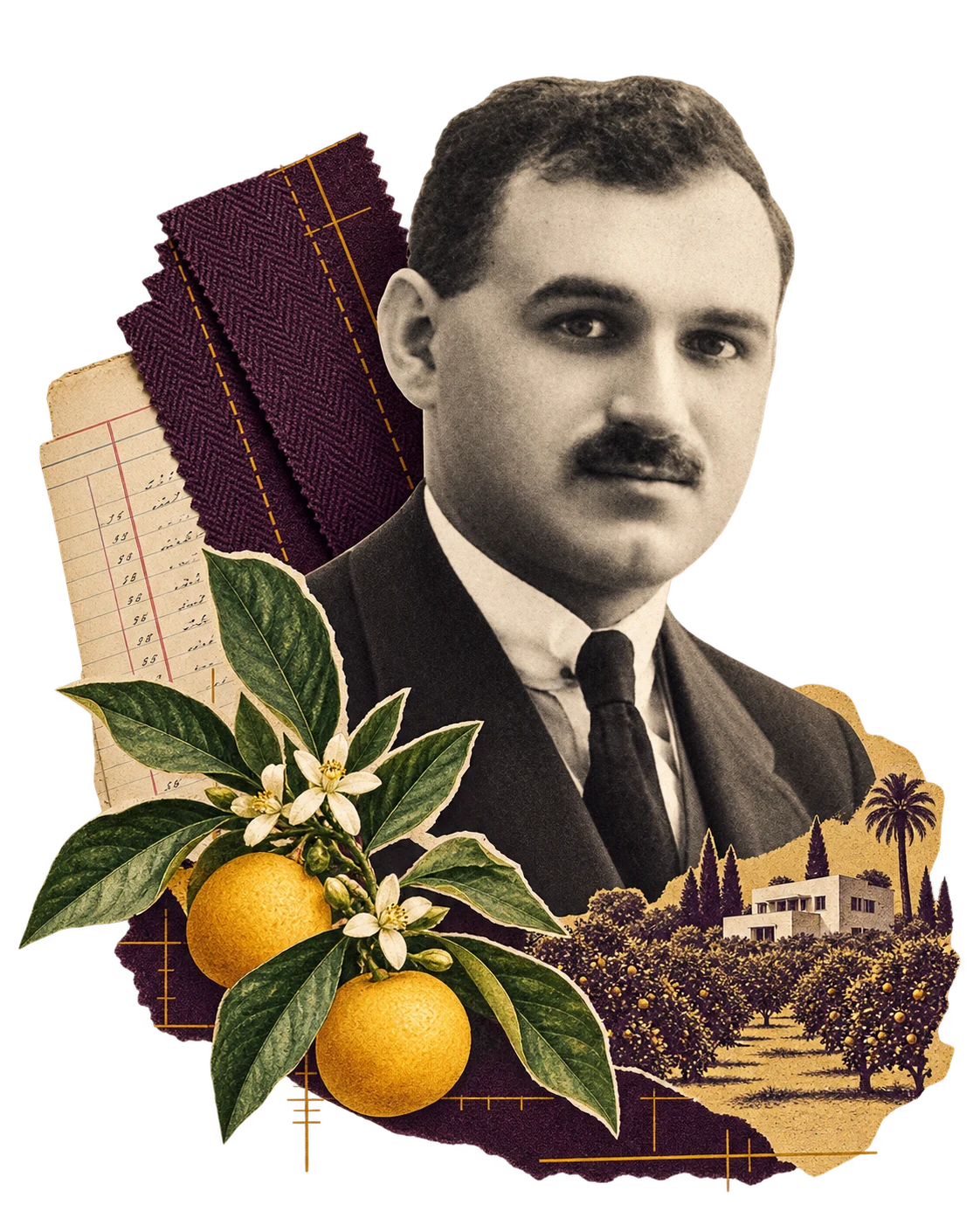
One of his grandchildren is Oded Abarbanel, one of the early members of the Israeli Air Force and a senior El Al pilot, best known for his role as captain of El Al Flight 426, which was hijacked to Algeria on July 23, 1968. Pictured: Moshe Abarbanel (wearing a bow tie) and Mordechai Weisser (the man wearing a tie). Photographer: Shimon Korbman, Abarbanel Family Collection, Israel Revealed, Tel Aviv-Yafo, Yad Ben-Zvi.

תגובות
עדיין אין תגובות.