
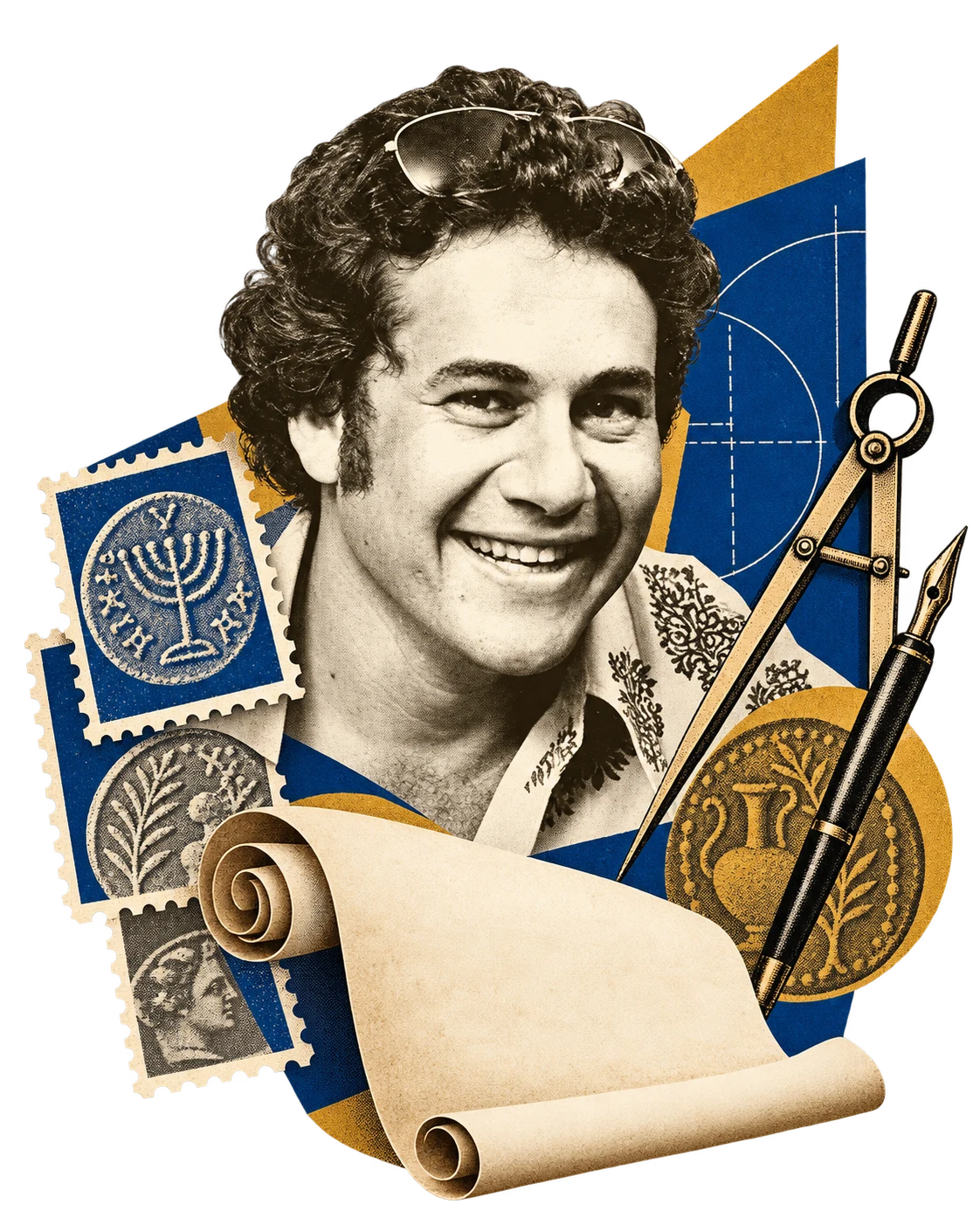
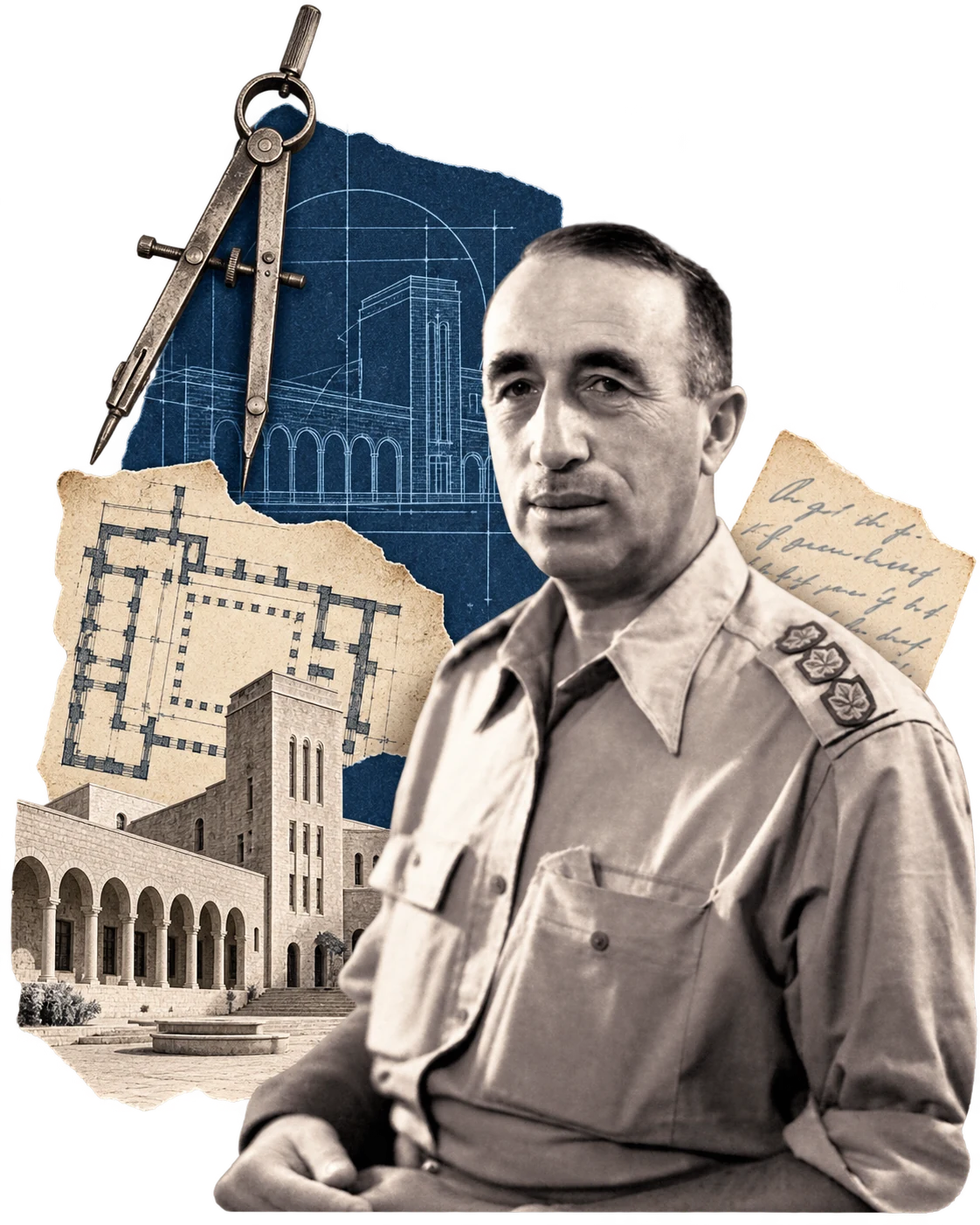
The designer who accompanied the state at its birth, whose work every Israeli knows, yet while his creations became famous, he himself remained anonymous.
The Secret Stamp Operation
"An air of tense secrecy surrounded the work in the hut’s cramped room. The movement of people, their whispers from ear to ear, the muffled ticking of machines, and the place itself, somewhat removed from the city, heightened the sense of secrecy, which no one tried to break - not by a confident stride, a raised voice, or an unnecessary gesture. The faint light that barely filtered through the room's single window, whose panes had not been cleaned for some time, also cast a conspiratorial gloom inside. Indeed, something was happening here, something important and quite extraordinary." This is how the journalist P. Azai (Pinchas Lander) described the immense tension and the magnitude of the task facing those engaged in secret and important work, in Haaretz on May 14, 1948. A few hours later, David Ben-Gurion declared the establishment of the state.
That secret and important work was printing the first series of stamps for the State of Israel. The person who had not read the newspaper that morning was none other than Otte Wallish, the man responsible for designing the stamps. That very morning, his next task was already awaiting him. In his article, Azai tried to convey the excitement that had taken hold of him: "A strange feeling passed through me when I both heard and saw this stamp... I felt my heart beating faster within me, and perhaps my gaze was strangely lit, perhaps with longing, perhaps with the discovery of an ancient secret, for a man sitting at a table covered with many sheets began to look at me." He described the secret printing press's location as follows: "In a place not far from Tel Aviv, whose thickly foliaged trees shelter lovely town and country houses and lend them something of the tranquility and beauty of the Sharon countryside." But some knew that he meant the German colony of Sarona, and that the printing press was in the home of Gotthelf Wagner, the colony's leader. His two sons had grown up in the Land of Israel and enlisted in the German army during World War II. Two years before the stamps were printed, members of the Resistance Movement in Tel Aviv assassinated him. In his home, they found portraits of Hitler adorning the walls, a Nazi Party membership card, a personal greeting from Hitler on the birth of his son, and a large swastika on the living-room wall.
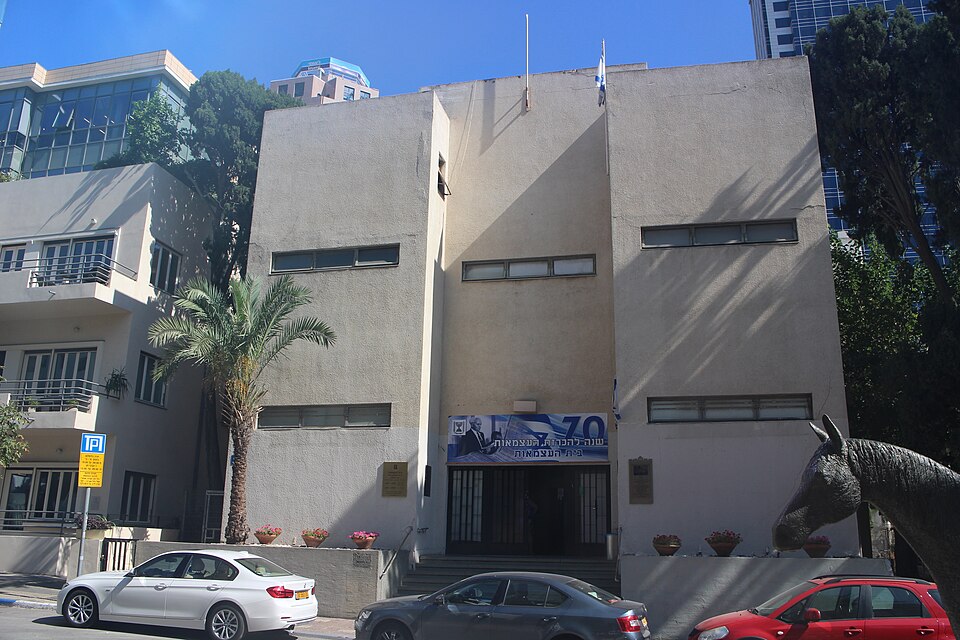
Time was short, and an hour after the first series of stamps was issued, David Remez, who a few hours later would be appointed transport and postal minister of the Hebrew state, presented the series and announced the establishment of the "Hebrew Postal Service."
Otte designed nine stamps under underground conditions and in complete secrecy. The first sketches were submitted in early April and included three stamps. The stamps in their final designs were ready a month later, bearing the words "Hebrew Post." The name "Israel" was not included because until the moment of the declaration at 2:30 p.m., no one knew what the new state would be called. The names proposed included "Zion," "Ever," "Canaan," "State of the Jews," "Judea," and others.
In the 1970s, Otte Wallish began writing his memoirs: "During the period of our people's independence in the past, we had no visual national symbols. Independence was expressed through the coins minted at that time. I therefore chose symbols that had appeared on Jewish coins some two thousand years ago. I am convinced that on the day the stamps appear, we will be at war with the neighboring Arab countries. For this reason, I chose coins from the period of the Jewish War and the Bar Kokhba revolt for our stamps." This was the first time a coin had appeared on a stamp. In all, Otte Wallish designed about 100 stamps for the philatelic service.
Preparations for Declaration Day
Two days before the declaration, David Ben-Gurion held a vote on the name of the state, and the chosen name was kept secret. On the day of the declaration, after the gavel was struck and "Hatikvah" was sung, David Ben-Gurion delivered his historic speech: "I shall read before you the founding charter of the State of Israel, which was approved in its first reading by the People's Council," and declared: "Therefore, we, members of the People's Council, representatives of the Hebrew Yishuv and the Zionist Movement, having met on the day of the termination of the British Mandate over the Land of Israel, and by virtue of our natural and historic right and on the basis of the resolution of the United Nations General Assembly, hereby declare the establishment of a Jewish state in the Land of Israel, to be known as the State of Israel." Thunderous applause rang out as the state's name, "Israel," was revealed. A year later, that same first series of stamps was issued, but this time the word "Israel" was printed on them instead of "Hebrew Post."
On May 13, at seven in the morning, after the work on the stamps was finished, Otte Wallish returned home to rest. At 11:00 a.m., he went back to his office and found a note on his desk: "Come immediately to Sharf at the Agency" (Sharf was the acting secretary of the People's Administration). As Otte told Nathan Dunvitz of Haaretz, the meeting lasted only a few minutes: "He told me that the next day there would be a ceremony declaring the state's establishment at the Tel Aviv Museum, and that I had to make all the technical arrangements necessary for it." In other words, he had to design the hall in which the state would be declared. He added: "He warned me that this was a great secret and forbade me to tell anyone." Otte Wallish first planned the decor for the historic occasion: a formal platform, with a portrait of Theodor Herzl above it, and two flags hanging over pleated curtains, as they had at the 21st Zionist Congress in Geneva - a design that closely echoed the Zionist past. After completing the design, he got to work, accompanied by the carpenter Israel Diamant and the decorator-painter Shlomo Shyovitz. For the state's tenth-anniversary celebrations, the three were asked to recreate the same design in the same hall. "I encountered certain difficulties," Otte Wallish recalled, by then chairman of the Israeli Advertising Association. "For instance, some pictures hanging on the walls were unsuitable for the declaration ceremony, such as portraits of naked women. At the museum entrance stood a woman's torso, and I immediately decided to cover it with a piece of fabric." He explained his choice of gray fabric: "I chose gray because I didn't want bright colors to stand out at such a solemn ceremony. Gray also went with the light blue and white of the Israeli flag." There was no time to find a portrait of Herzl large enough, so Wallish pasted it onto a larger backing, "and with the frame, the picture became as large as we wanted it to be." Fearing that Tel Aviv might be attacked from the air immediately after independence was declared, Wallish blacked out all the windows, and by 11 in the morning the hall was ready to receive the guests.
Still recovering from a long night spent printing the stamp series and a busy morning preparing the hall for the declaration of independence, and in the midst of shopping, borrowing items, and dealing with difficulties, he was urgently summoned once again to Sharf, this time for another important task - designing and preparing the Declaration of Independence. Otte ran to the Engineers' House to examine different kinds of parchment. The design was ready, but the text had not yet been finalized, and the final wording of the declaration was settled only minutes before it went to print. It was typed on a typewriter, and there was no time to copy it onto the parchment. So the paper was attached to the parchment, and the members of the People's Council signed directly on the parchment, which Moshe Sharett was holding. At the end of the ceremony, which lasted thirty-two minutes and included just one speech, Shlomo Keder took the parchment bearing the signatures, with the text attached to it, and deposited it at the Afek Bank on Herzl Street. A few months later, the Chief Rabbinate recommended a scribe to transfer the text onto the parchment. The attempt was unsuccessful, and the work was handed over to Otte Wallish. Together with his assistant Rudi Sidner, he chose an attractive, legible, slanted Sephardic script. Emphasis was added by using a large letter at the beginning of each paragraph. The work took several weeks, at the end of which the three pieces of parchment were sewn together. The declaration was placed in a case, and at the end of July that year, the state seal and cord were added. The document was transferred for safekeeping to the State Archives, where it has been preserved under controlled conditions to this day.
The photograph of David Ben-Gurion reading the Declaration of Independence has become part of the canon of Israeli photography and is etched in the memories of many Israelis. In the picture, Ben-Gurion stands at the center of the platform, with a portrait of Herzl above him and Israeli flags unfurled on either side. Many people do not know that the flags displayed at the event were, in fact, "illegal." The Flag Law, passed several months later, stipulated that the bases of the triangles in the Star of David must be "parallel to the two blue stripes running along the flag." This meant that its points had to face the stripes, which was not the case at the historic ceremony.
Otte Wallish submitted several proposals for the design of the Israeli flag. One proposal was a flag with a white upper half and a blue lower half, with seven yellow Stars of David arranged along the line separating the colors, recalling Herzl's proposal. Another proposal was a flag that looked exactly as it does today, with one difference: a yellow Star of David, resembling a patch, in memory of the Holocaust's victims. The committee initially chose this design, but in the end adopted the current flag - "the flag of the Zionist Organization" - which David Wolffsohn had proposed at the First Zionist Congress in 1897, mainly because it had already become very popular among the Jewish public.
The Road to Tel Aviv
Otte Wallish was born in 1906 to a Jewish family living in the town of Znojmo, on the border between Austria and Moravia (today in the Czech Republic). His talent was evident from a young age, and he was sent to an art class. As he grew older, he began working as a graphic artist in Prague, where he earned a reputation as an excellent professional. After his military service, he went on to study art at the University of Vienna. Otte was a Zionist, but at the time Zionists worked in agriculture, so he abandoned his art studies and began studying agriculture. Early in his career, he published leaflets and printed materials for the Blue and White youth movement in Czechoslovakia. At the age of 23, the Jewish National Fund called on him to do graphic work for publicity and organizational purposes in Berlin and Prague.
Otte felt that at last he was taking part in the Zionist effort, even though he was not a farmer. He married his beloved Heli, and in 1934, shortly before Hitler came to power, he immigrated to the Land of Israel alone, as part of the Fifth Aliyah. A year later, his wife joined him, and they moved to Herzliya, where they had a son and a daughter who later featured in various advertisements and posters. (The blond baby in the 1945 Tnuva cornflour advertisement was his son Ari.)
Otte Wallish discovered that there was great demand in the country for experience and talent in advertising and graphic design, and in 1934 he opened an advertising agency in Tel Aviv. Two years later, he set up a graphic design studio on Nahalat Binyamin Street. "Dad worked all the time," his son Ari recalled. "He would go to people and show them sketches, come home and work, and then in the morning show them the sketches he had made the previous evening." He also said that his father's prolific work designing the Zionist vision affected life at home: "In those days it was unusual for people to bring work home; it wasn't customary to work after leaving the office... But Dad served the Zionist ideology. He felt that if he didn't do it, no one would, and that everyone had to contribute to establishing the state. Design was his part, so he devoted as much time to it as he could - beyond working hours. He had a sense of mission."
Banknotes and Paper Currency
A year before the state was established, the scale of the catastrophe the Holocaust had left in its wake among the Jewish people was already clear. At the time, Keren Hayesod and the Jewish National Fund launched a major fundraising campaign. To support it, the leaders of the two organizations decided to publish a lavish booklet showcasing the achievements of the Jewish Yishuv, with their support, in the decades leading up to the state's establishment. The studio chosen for this important task was Wallish-Machner. The beautifully designed booklet by Otte Wallish fulfilled its purpose, and a considerable sum was raised for the state in the making.
Immigration, security, and the economy were major concerns for the leaders of the state in the making. It was clear that the state to be established would need banknotes and coins, which mattered not only for trade but were also among the clearest symbols of sovereignty. In a state that had not yet been established, there was no one with experience in producing and printing banknotes, so the Yishuv's leaders entrusted the task to the Anglo-Palestine Bank, which had operated in the country since 1901. According to Theodor Herzl's vision, the bank was the financial arm of the Zionist Movement. The short time available forced the Yishuv's leaders to act on an emergency footing, and the production of the banknotes was conducted like a secret military operation. There is not room here to recount the whole story, so we will only say that the banknotes were printed on one side only. None of them entered circulation, and they were destroyed, except for a small number that are now held by museums and a few collectors and are highly valuable.
Alongside these banknotes, two more notes were issued, known as "paper money," to serve as a substitute for coins. At the time, the value of the metal was high, meaning that producing a 50-mil coin cost more than 50 mil. In addition, the metal was needed to make weapons and ammunition. The first finance minister, Eliezer Kaplan, therefore decided to print "paper money" for the public to use instead of coins. Otte Wallish designed the notes, which were printed at the Levin-Epstein press in Tel Aviv and issued in October 1948. Their design resembled a carpet, which is why they were also called "carpets." They came in two denominations, 50 mil and 100 mil, and featured an illustration of the mosaic floor of the ancient synagogue at Beit Alfa. This paper money was in use until 1952 and served as legal tender. It was abolished in 1980, when the shekel became the official currency.
The Graphic Signature of Israel
In addition to designing stamps, the Declaration of Independence, and banknotes, Otte Wallish also created the look of major organizations and companies such as the Jewish National Fund, Keren Hayesod, the Zionist congresses, Tnuva, Osem, ZIM, and others. He designed Rosh Hashanah greeting cards (what many people called "good-year cards"), the police emblem, and the State of Israel's first official medal, the medal commemorating ten years of Israel’s freedom. He designed posters and newspaper advertisements, and organized official and state exhibitions. He was an entire team in one person: the entrepreneur, the thinker, the artist, the producer, the executor, and the one who prepared the work for printing - all before the computer age, all by hand.
Otte Wallish left a graphic imprint on Israeli history. He was fortunate to take part in the country's great moments, bringing great talent, creative joy, diligence, and love to his work.
At the exhibition "Faces of a People and a Land," shown at the Tel Aviv Museum in May 2015, visitors saw a selection of posters from the museum's collection and items from the collection of his son, Ari Wallish. Curator Emmanuel Kalo aptly described him: "Wallish's contribution to shaping the visual culture that developed in Israel is one of the most fascinating stories of the period. It has not yet been sufficiently brought to light, and one can hope that it will receive its rightful place in Israel's cultural pantheon."
He did not live to finish writing his memoirs. In 1977, the day after Israel's 29th Independence Day, Otte Wallish died at the age of 71. In February 2023, the Otte Wallish Path was inaugurated in Herzliya, recognizing his work designing the city's emblem and the State of Israel's first stamps.
תגובות
עדיין אין תגובות.