
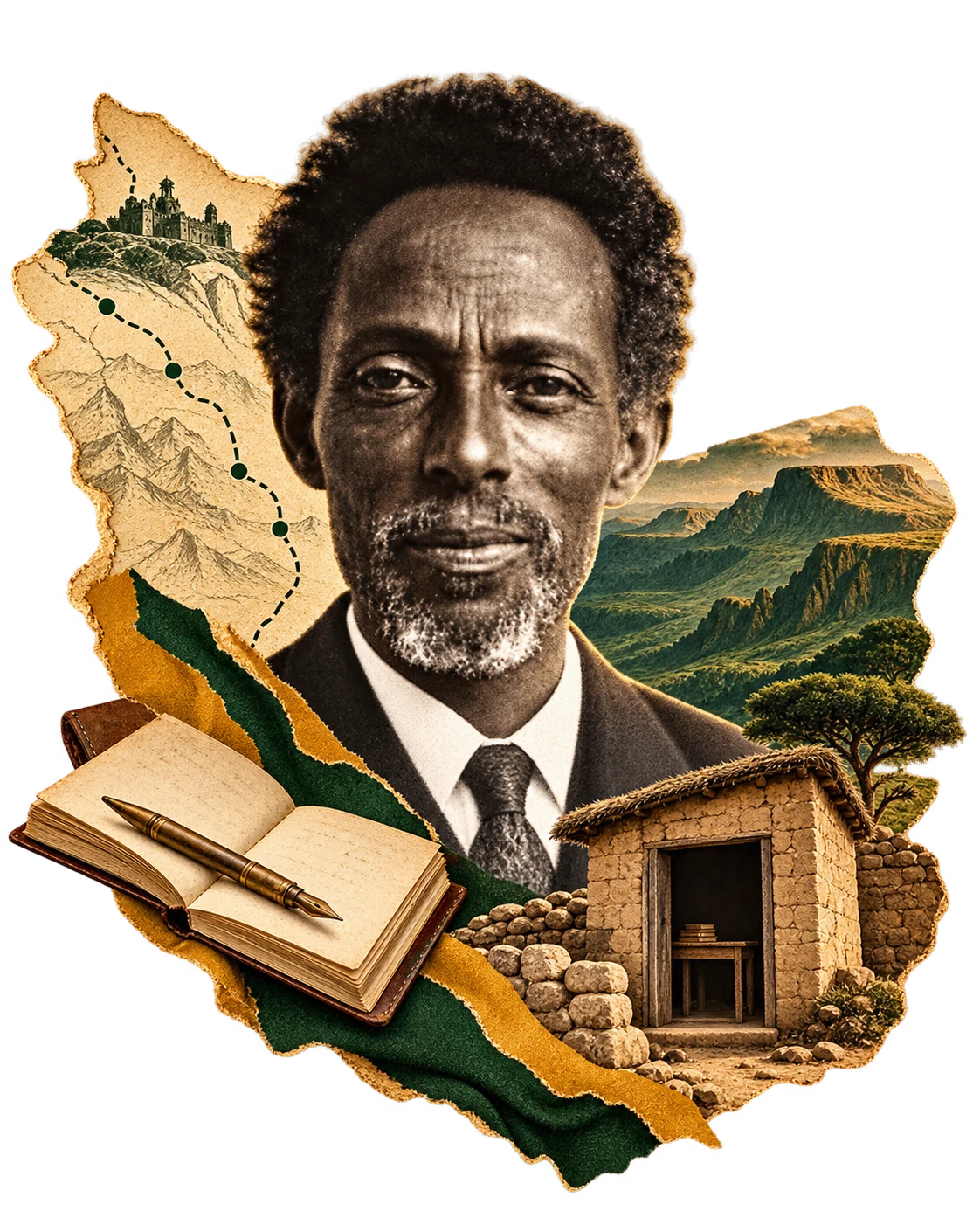
The unbelievable story of a gifted boy born in a remote village to a Jewish family that had converted to Christianity, who returned to Judaism, served as an aide to Emperor Haile Selassie, and was among the first to envision bringing Ethiopian Jews to Israel.
Tamrat Emmanuel When Jacob Noah Faitlovitch was born in Lodz, Poland, no one could have imagined that he would devote most of his talent and energy to a community virtually unknown among Polish Jews. Jacob Noah had an exceptional aptitude for languages, and as a young man studied Oriental studies and Semitic languages at the Sorbonne in Paris. Before long, he had mastered several Semitic and European languages. After completing his studies in Paris, he moved to Lausanne, Switzerland, where he earned his doctorate. One of Dr. Faitlovitch's teachers was Professor Joseph Halévy, a reviver of the Hebrew language who preceded Eliezer Ben-Yehuda, as well as a poet, biblical scholar, linguist, Orientalist, archaeologist, and renowned traveler. Joseph Halévy was among the first to recognize the Jewishness of Ethiopian Jews, and as early as 1867, after visiting them, he believed they should be settled in the Land of Israel. Dr. Jacob Noah Faitlovitch was captivated by Professor Joseph Halévy's stories and decided to study the Ethiopian Jewish community, to which he would devote his life. He set out on his first journey in 1904, funded by Baron de Rothschild.
Faitlovitch and Tamrat's Journey
Dr. Jacob Noah Faitlovitch did more than conduct research or document what he saw. He immersed himself in the world of Ethiopian Jewry and made enormous efforts to advance the Beta Israel community and prevent its members from converting to Christianity. He understood that strengthening the community required investment in education, so he devoted himself to training teachers. Some of them later established schools in Ethiopia, while others joined him in working to bring the community to the Land of Israel. Their descendants still live in Israel today.
There is no doubt that in 1904 Tamrat Emmanuel attracted considerable attention at the Alliance Israélite Universelle (AIU) Jewish teachers' seminary in Paris. Dark-skinned, speaking Amharic, Tigrinya, Italian, and French, he was a Christian who had returned to Judaism and planned to go on to rabbinical studies. Everyone at the seminary knew that Tamrat had come to Paris with Dr. Faitlovitch.
He was born in 1888 in a small farming village near Gondar, the former capital of Abyssinia (today, Abyssinia is part of Ethiopia and lies in the north of the country), into a family from among the most disadvantaged and oppressed strata of society. His parents were Jewish but converted under the influence of missionaries, and he was baptized as a Christian at birth. The name Tamrat means "miracle." He was given this name because he was the first boy born after several girls. From an early age, it was easy to see that he was quick to learn, and he was sent to the Swedish mission in Asmara. In 1904, Dr. Faitlovitch arrived at the mission. When he discovered that some of the boys were children from Jewish families who had converted to Christianity, he began working to get them out of there. Tamrat Emmanuel was almost 16, and in addition to his native Amharic, he spoke Tigrinya and Italian. When Tamrat learned that he was Jewish, he severed his ties with the mission, returned to Judaism, and went to study in Paris. From Paris he moved to Florence, where he completed his studies at the rabbinical seminary of Rabbi Dr. Samuel Zvi Margaliot.
At the age of 32, he returned to Abyssinia with Dr. Faitlovitch, intending to teach the younger generation of the Jewish community. A year later, he visited Jerusalem, which until then had been, to him, a mythical city existing only in legends.
Tamrat aroused great interest among the Jews of the Land of Israel at the time. Few had heard of Abyssinian Jewry, and only a handful had seen a dark-skinned Jew praying in Hebrew and knowing the Bible and Jewish laws as they did. For three years, Tamrat deepened his knowledge of Judaism and understood the magnitude of the mission entrusted to him, and how fortunate he was. Shortly after he left the Land of Israel and returned to Ethiopia, Ras Tafari, known as Haile Selassie, the Emperor of Ethiopia, arrived in Jerusalem.
The School in Addis Ababa
In the spring of 1923, the happiest period of Tamrat's life began. That Passover, he established a teachers' seminary in Addis Ababa, with a boarding school for children of the Falash Mura (members of the Ethiopian Jewish community who had converted to Christianity). During the thirteen years he directed the seminary, Tamrat felt that at last he was fulfilling his purpose. The school, considered unique in Ethiopia, produced the community's future leaders. A synagogue was built at the school, and on holidays European Jews living in the capital at the time would gather there. When he realized that the school lacked teaching materials, he began writing books for its students. Among other things, he wrote books on Ethiopian history, Amharic grammar, and the history of the Land of Israel. The institution received coverage in newspapers serving Jewish communities in the diaspora and attracted considerable interest. He was widely praised for his work. Everyone understood how important the institution was to young Falashas as they took their first steps toward a better future. In this way, it became a source of pride for the tribe and the community.
Tamrat Emmanuel was one of the seven founders of the Capital's Jewish Committee, which handled Jewish affairs. Alongside running the institution, he wrote articles and translated the Bible into Amharic. He appeared before Emperor Haile Selassie as the Jews' leader. The Emperor took a keen interest in his Bible translations and also donated money to the school's work.
During this period, he received enticing job offers from both the Austrian consulate in Abyssinia and the French embassy, but turned them down because, in his eyes, nothing could compare with the sacred work he loved and devoted himself to. A chain of events that began in Italy led to the school's closure. Benito Mussolini came to power and established a fascist regime in the country. His imperialist ambitions led to the occupation of Addis Ababa in the run-up to Passover 1936.
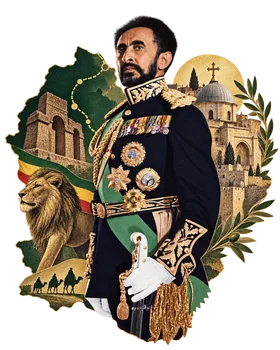
When Tamrat Emmanuel realized the school was in danger, he moved the students to Gondar. He leased land east of the city and founded the villages of Ambo-Ber and Wuzaba, which became the main centers of Beta Israel. He equipped them with about 200 rifles and ammunition for self-defense. Emperor Haile Selassie fled to Jerusalem and, three months later, moved on to London.
After hearing about the dire situation of Ethiopia's Jews, the Union of Jewish Communities in Ethiopia sent the lawyer and journalist Carlo Alberto Viterbo to make contact with them and assist them. Tamrat Emmanuel accompanied him on all his tours and worked to have the Beta Israel community recognized as part of Italian Jewry. Viterbo took many photographs of these communities. His collection is now kept in the Central Zionist Archives and provides a fascinating record of Jewish life at the time.
In February 1937, an attempt was made on the life of the governor of Italian East Africa, Field Marshal Rodolfo Graziani. In response, Graziani and his men ruthlessly massacred the civilian population of Addis Ababa and Beta Israel. The massacre is remembered in Ethiopian history as the "12 Yekatit Massacre," and Ethiopian intellectuals and members of Beta Israel were arrested.
Exile, Return and Farewell
Tamrat Emmanuel decided not to tempt fate and fled to Egypt. A year later, he became chairman of the Organization of Ethiopian Refugees. He taught Jewish refugees who had arrived in Egypt from Germany, and it was there that he conceived the idea of bringing members of the community to the Land of Israel. In the lead-up to 1939, he left Egypt and joined Haile Selassie, the ruler in exile, in London.
Numerous Israeli Jews had a hand in liberating Ethiopia from the Italians. The best known was Avraham Akavia, who commanded the Gideon Force under Orde Charles Wingate. The defining image of victory is undoubtedly the procession on May 5, 1941, when Emperor Haile Selassie entered the capital, Addis Ababa. Among the members of his entourage walking beside him was Tamrat Emmanuel, who had returned to Ethiopia with him. Tamrat expected that, in view of the Jews' support for the Emperor, he would receive permission to reopen the school. Sadly, permission was not granted, causing him great distress.
Tamrat served Emperor Selassie for sixteen years and later served his son and heir as well. Among his other roles, Tamrat served as president of the Council for Public Education, cultural attaché at the Ethiopian Embassy in Paris, and head of a major project to compile an Amharic dictionary. Throughout all those years, he maintained ties with members of the community and with Israel. Then his path and the Emperor's began to diverge... The land reforms the Emperor had promised him were delayed and never implemented. Tamrat mocked the Emperor's royal pomp, and in 1952, when the British left Eritrea, it was clear to him that it was only a matter of time before the Emperor annexed it to Ethiopia. In 1957, Tamrat Emmanuel moved to Israel. Despite his opposition to the Emperor's conduct, the attempted coup in Ethiopia in late 1960 caused him great sorrow, and he suffered a heart attack. Tamrat burned all his books and left nothing behind, neither a family nor an intellectual legacy.
Throughout his life, he was occupied with attempts to solve the "Falasha problem" and insisted: "Give the Falashas a school and literature, and you will have completely solved the problem of how to revive this brave tribe." Dr. Faitlovitch wrote of him: "This young man will be a precious instrument in the revival of Jewry in Abyssinia. And indeed, that spark ignited an awakening that would revive the Jewish tribe in Abyssinia. A remarkable revival whose first steps toward full realization we are witnessing with our own eyes today. He rightly earned the title 'Herald of the Revival of Ethiopian Jewry.'"
On the last day of 1963, a cold winter's day in Jerusalem, Tamrat Emmanuel died in obscurity at the age of 75. He was buried at Har HaMenuchot cemetery in Jerusalem.

תגובות
עדיין אין תגובות.