
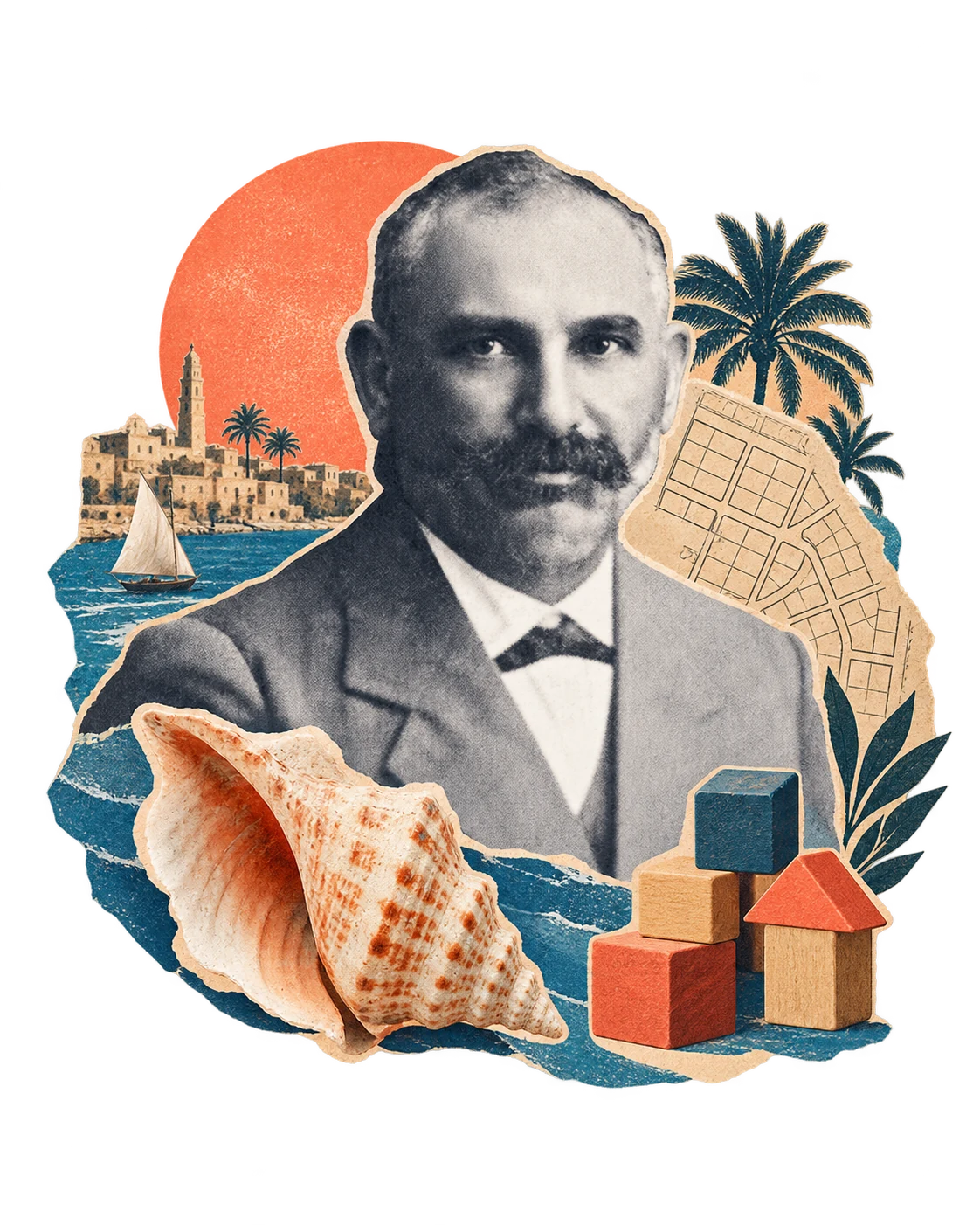
He founded the first Hebrew kindergarten in Jaffa, was among the first residents of the Ahuzat Bayit neighborhood, a founder of the General Federation of the Hebrew Community in the Land of Israel, and one of the first to give up his Diaspora surname.
The Suchowolski Family in Bialystok
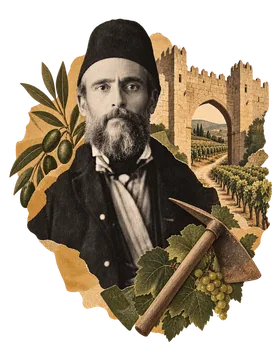
The story of this pioneer family begins in the town of Suchowola in northeastern Poland, about 60 kilometers north of the city of Bialystok. In the winter of 1843, Avraham Ze'ev Suchowolski was born. He received the traditional education of the local Jews, studying religious texts at a yeshiva. When he came of age, he married Esther, whom he affectionately called Atke, and together they moved to the great city of Bialystok.
Avraham began trading in grain and flour. At first he did so modestly, but he quickly earned a reputation as an honest merchant who made only a small profit, just enough to live with dignity. Gradually, his business grew. He began importing grain and legumes from far-flung parts of the vast Russian Empire and supplying them wholesale to merchants in Bialystok. Every few months, he traveled across Russia himself, buying wheat and barley, pumpkin and sunflower seeds, poppy seeds and millet, and transporting them by rail to Bialystok. His wife, Atke, received the shipments and managed the business there.
When the price of goods rose, he acted unlike other merchants: he sold his stock at its previous price, out of a sense of fairness rather than greed. The porters and workers in his warehouses held him in high regard. He treated them as friends and, after work, invited them to his home for tea and a light meal. Avraham Ze'ev made sure to set aside time for Torah study, and whenever he completed all six orders of the Mishnah, he held a festive meal at his home.
He became known as a generous-hearted philanthropist who warmly welcomed every guest from the village who came to the big city, as well as the shadarim (rabbinical emissaries) who came from the Land of Israel to collect donations. Among these emissaries was Rabbi Yehoshua Yellin of Jerusalem, who stayed at Avraham's home for a full year when he came to Russia to raise funds for the settlement of Motza near Jerusalem, which he had helped establish. Years later, Avraham's son Yehezkel, who was also active in the settlement of Motza, married Rachel, Rabbi Yellin's daughter.
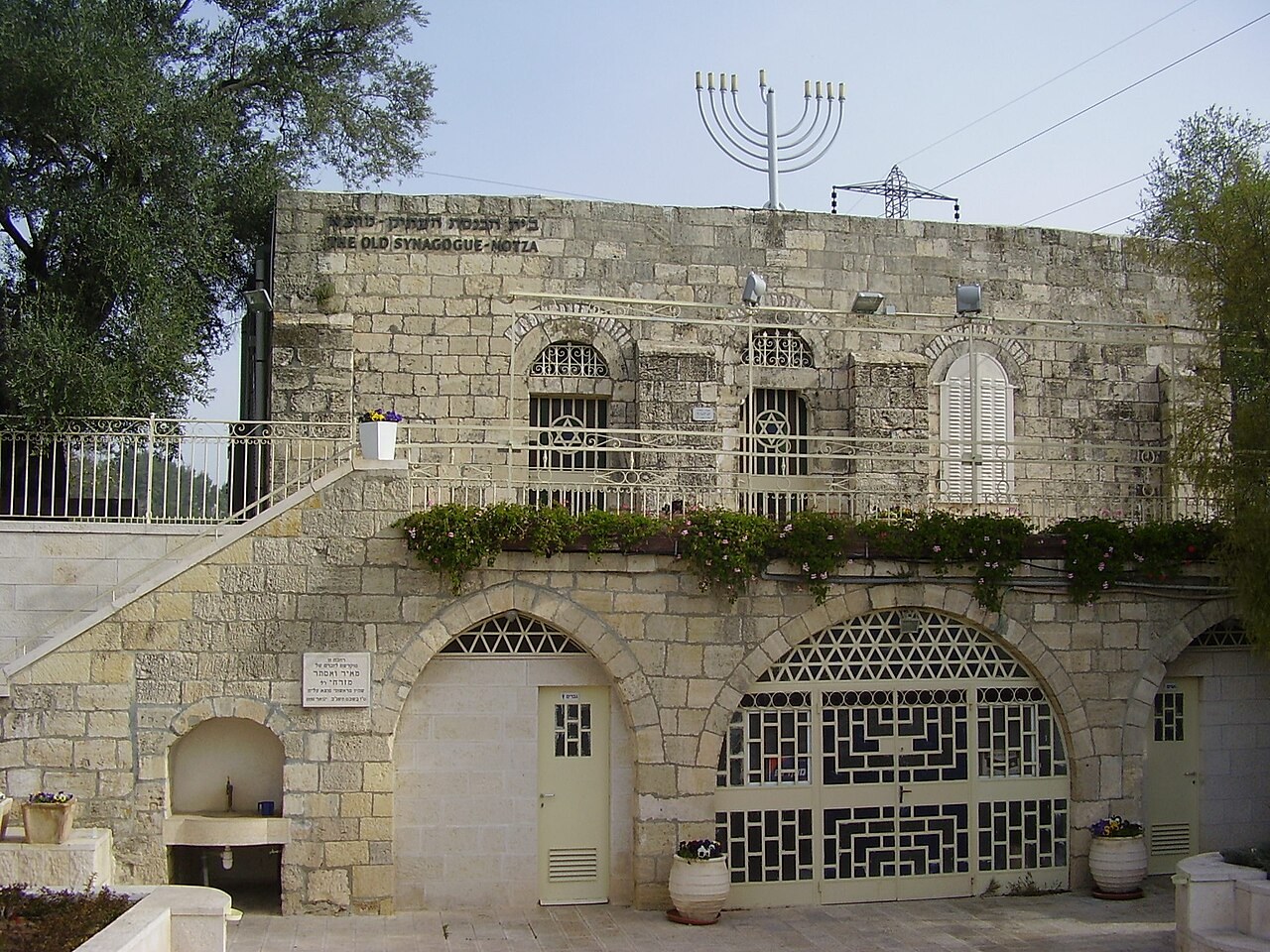
Avraham and Atke raised their children to love the Land of Israel and to trade honestly and fairly. Some of their descendants became true pioneers. Their son Tzvi immigrated to the Land of Israel and became a member of the Kfar Bilu moshav. Their daughter Temima also immigrated and was among the first kindergarten teachers in the Land of Israel. She was one of the founders of Hapoel Hatzair and a member of the Haganah. Their son Moshe became the owner of a printing press in Haifa, and their daughter Masha immigrated to the Land of Israel. Their eldest son, David, served as secretary and right-hand man to Rabbi Shmuel Mohilever, the rabbi of Bialystok and a forerunner of religious Zionism. Rabbi Mohilever ran a farm, and David followed in his footsteps. He himself aspired to immigrate to the Land of Israel, but never got the chance. His youngest son, Yosef, fulfilled the dream in his place, immigrating to the Land of Israel and joining Kibbutz Degania Bet.
In 1907, Avraham Ze'ev decided to wind up his businesses and immigrate to the Land of Israel with his wife, Atke. The two settled in the Neve Shalom neighborhood, which had been built outside Jaffa.
Yehezkel Danin at the Start of His Path in the Land
Yehezkel Danin, who immigrated to the Land of Israel at the age of 18, was a pioneer in many fields: he helped establish the first Hebrew kindergarten in Jaffa, was one of the founders of the Ezra school in Jaffa, and helped found the General Federation of the Hebrew Community in the Land of Israel. He was also one of the first five initiators of the Ahuzat Bayit building company in Jaffa, which later established the Ahuzat Bayit neighborhood that became the city of Tel Aviv. And that was only a small part of all he accomplished. Yehezkel, formerly known as Suchowolski, was also among the first to give up his Diaspora surname. He changed his name to Danin, after the tribe of Dan.
Yehezkel was born in 1867 in the city of Bialystok. As a teenager, he worked as an assistant to his merchant father and learned trade and entrepreneurial skills at his side. More than anything, however, his education directed him toward realizing the Zionist dream: immigrating to the Land of Israel and working the land, rather than engaging in commerce. So, at just 18, as soon as he arrived at the port of Jaffa, he hurried to Rishon LeZion and joined the vineyard workers. He was immeasurably happy as his sweat fell on the soil he had dreamed of and longed to make fertile with his own hands. He joined the first workers' association in the Land of Israel and became an active member. His fellow members, deeply impressed by him, appointed him the association's secretary, a role he filled for many years entirely as a volunteer.
From Rishon LeZion he moved to Jaffa, where he opened a grocery store in the fish market. Before long, he expanded into exporting and marketing products from Hebrew farms, including almonds, olive oil, honey, and grapes. He was the first to bring sulfur and sulfur-dusting equipment for citrus orchards to the Land of Israel, thereby helping advance the emerging citrus industry.
In the Land of Israel, he linked his life with the Yellin family, one of the oldest and most respected families in the country, and married Rachel, the daughter of Yehoshua Yellin, one of the founders of Motza and the Nahalat Shiva neighborhood in Jerusalem. Rachel's brother, David Yellin, was a teacher and Hebrew scholar, and founded the David Yellin College, named after him. David Yellin was one of the founders of the Teachers' Association and the Hebrew Language Committee, chairman of the National Council, and one of the founders of the Zikhron Moshe neighborhood in Jerusalem. Yehezkel Danin, an entrepreneur by nature, became part of this family of pioneers and entrepreneurs.
The Store and the Public Enterprises
As a Zionist pioneer, Yehezkel Danin spoke Hebrew at home. The family home served as a kind of information bureau for new immigrants, and his store became a gathering place for farmers and workers from the settlements of Judea. In the store, behind its walls, lively discussions were held on issues concerning the settlement, and plans and initiatives for building the land took shape.
David Smilansky told this story about the store: "When I immigrated to the Land of Israel for the second time, in the spring of 1906, my uncle Moshe Smilansky advised me to consult his boyhood friend Yehezkel Suchowolski about urban settlement. He had great regard for his honesty, his convictions, and his candor. I tried several times to visit him at his home on Bustros Street in Jaffa, but to no avail. Each time, his wife would answer me in flawless Hebrew that her husband was a 'guest for an hour' in the family circle, and that if he wasn't at the store, he was surely at some meeting of activists. It was very hard to catch him at the store for a conversation. Visitors from the settlements were always surrounding him, coming to see their friend to hear 'what is happening in the world,' to listen and to share their own news. And every so often, new immigrants, fresh off the boat at the port of Jaffa, joined the older regulars at the Suchowolski club. I would sometimes stand there and wonder: where did this Jew, so modest in his everyday life, find so much energy, perseverance, and patience to work day and night?"
Later, David Smilansky himself became Yehezkel's partner: "Our first joint venture was at L. Stein & Co.'s iron and copper foundry, metalworking, and machine-building factory in Jaffa, which employed 120 Jewish workers. Suchowolski and I invested several tens of thousands of gold francs in this factory. After four years of strenuous work (1906-1910), we lost our money, like all the other partners, and 'came away empty-handed.'" Yehezkel did not see failure as a reason to stop. At most, he saw it as a slight delay that neither deterred him nor weakened his spirit. On the contrary, he continued working with firm faith in the future of Hebrew industry in the Land of Israel. In the same spirit, he invested considerable sums in the oil industry of the Breslav brothers and in a red-brick factory in Motza. These factories laid the foundations for new industries that we continue to benefit from today.
In Jaffa, alongside his business activities, Yehezkel was an active participant in public life. Together with Shimon Rokach, he founded the Sha'arei Zion library and the city's first Hebrew hospital. He also helped establish the B'nai B'rith lodge and served as the organization's president for many years.
As early as 1896, Yehezkel proposed establishing a modern Hebrew neighborhood outside Jaffa. His proposal stemmed both from the severe overcrowding in which the city's Jews lived and from the inspiration he drew from the German settlers' neighborhoods, where spacious, green homes had been built on the outskirts of the city. Above all, however, he was influenced by his father-in-law, Yehoshua Yellin, and his brother-in-law, David Yellin, who had helped found Motza and Nahalat Shiva, a neighborhood that was already celebrating almost thirty successful years of existence that year. At the time, Yehezkel was busy establishing the first Hebrew kindergarten and participating in the council working to establish Hebrew as the language of the Land of Israel.
With the founding of the Zionist movement, Benjamin Ze'ev Herzl introduced the Zionist shekel, a symbolic tax that served as the basis for determining the number of delegates at each Zionist Congress. The number of shekels sold in each country determined how many delegates it was entitled to. When a person paid the shekel, they received a certificate or receipt bearing Zionist symbols and sometimes even a photograph of an ancient coin from the Land of Israel - a tribute to the idea of national revival. The Zionist shekel expressed every Jew's free will to take part in the fate of their people. In 1902, Herzl appointed Yehezkel to oversee the distribution of the Zionist shekel and the marketing of shares in the Jewish Colonial Trust in the Land of Israel.
In 1906, Yehezkel was among the first five entrepreneurs behind the Ahuzat Bayit housing company in Jaffa, and served for several years on the company's committee. When construction began in the neighborhood, Yehezkel was among the first ten pioneers to build their homes there. His wife Rachel threw herself into the undertaking with enthusiasm and dedication, and in 1910 the two built their home at 24 Lilienblum Street, on the corner of Herzl Street (14 Herzl Street).
The Danin House and Family Life
In her memoir The Story of One Family, Rivka Alper describes the construction of the house. Rachel Yellin-Danin recalled: "What would the houses be built from? Jaffa stone, which the Arabs used for their buildings, or cement blocks, as the recently established Arber factory had proposed? Some saw cement blocks as a new method that could make building easier and was also attractive. Others maintained that only stone, kurkar stone, was suited to the country's climate. Yehezkel insisted that the houses be built with Hebrew labor. Others argued that Jaffa had no skilled Hebrew builders, and bringing them from Jerusalem would be very expensive. The Arabs were also more experienced builders. Our house was built of stone by Hebrew hands. The construction was indeed flawed because the Hebrew workers lacked experience, and cracks and fissures soon appeared in the building, so we had to repair it constantly. The construction also cost us more than it cost others. But Yehezkel was always proud that the Jewish worker's sweat had laid the foundation, and that his hands had set each brick in place." Rachel Danin went on to describe the original house after it was built: "It was a spacious apartment. A room for Yehezkel, rooms for the children where they could do their lessons without being disturbed, a guest room, a large kitchen, a separate washroom, a bathtub and a sheet-metal boiler for heating water, and two broad balconies, one facing Herzl Street and the other, glassed-in, facing Lilienblum Street."
In this home, they made a point of speaking Hebrew with Sephardic pronunciation. Their housekeeper, Masauda, played a major part in this. It was a rare combination: fluent, living Hebrew, spoken with beautiful, Eastern intonation in the home of the 'merchant from Bialystok.' He educated his five sons and five daughters in Hebrew schools in Jaffa and Tel Aviv. Many others, including some of the 'good Jews,' chose to educate their sons and daughters in foreign schools. Their youngest son, Aharon, was the first child born in the first Hebrew city, Tel Aviv. In her memoir, Rachel Danin recounted that when she moved into her new apartment, she was in the final days of her pregnancy, and in the neighborhood she gave birth to her tenth child. He was named Aharon so he would be the last. She noted: "There was great rejoicing - the first boy in the neighborhood!"
The best-known son of Yehezkel and Rachel Danin was Ezra Danin (1903-1984), known for accompanying Golda Meir on her secret trip in 1947 to visit Jordan's King Abdullah I.
The original house Rachel Danin described was demolished in 1925, and the structure that still stands today was built on its site. That year, the municipal technical committee received a handwritten request from Rachel Danin: "I hereby ask you to let me open the fence at the corner of Herzl and Lilienblum Streets so that I can set up a table for serving soda, for which I already have a permit. I want to pave the corner. It will improve it and will not inconvenience anyone - on the contrary, it will give passersby a breath of fresh air." From the reopening of Beit Danin until almost the establishment of the State of Israel, the ground floor, in the wing facing Herzl Street, was home to the Mehudar family pharmacy. In the wing facing Lilienblum Street was the cafe that served its loyal customers for more than 50 years: Cafe Shor. After the establishment of the state, a branch of Bank Zerubavel moved into the building and remained there until the entire building was purchased by Bank Hapoalim in 1971. Today, a Bank Hapoalim branch occupies the part of the building facing Herzl Street.
Land Registration and His Final Years
Yehezkel Danin was among the first to give up his Russian citizenship and accept Ottoman citizenship. This step enabled him to purchase land in the Land of Israel in his own name - an important advantage at a time when foreign nationals were not allowed to register land in their own names. Many plots of land were therefore registered in his name, including the Geula land in Tel Aviv and land in Rishon LeZion, Rehovot, and Hadera, whose actual owners were unable to register it in their own names because of citizenship restrictions.
After the British conquest, when the Mandate authorities took control of the government institutions, Yehezkel worked to transfer ownership of the lands, plots, houses, vineyards, and orchards registered in his name to their lawful owners. He did so through the government's Land Registry Office, and whenever he signed a transfer of ownership, he would add with a wink the blessing: "Blessed is He who has freed me from this one's punishment." Under Ottoman rule, government officials regarded Danin as a wealthy man with extensive property - a reputation based on the many tracts of land registered in his name.
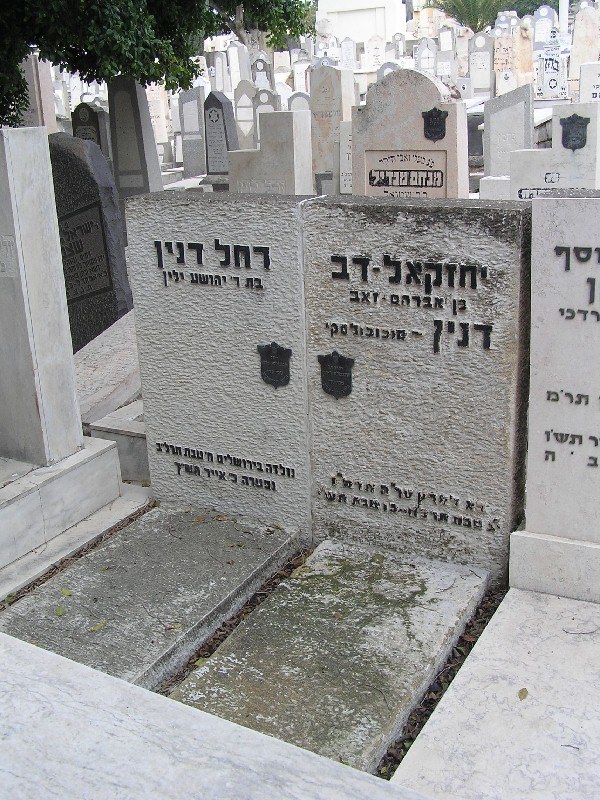
Yehezkel died in Tel Aviv in 1945, shortly before his 78th birthday. He and his wife Rachel are buried in the city's old cemetery on Trumpeldor Street. Danin Street in the Tzameret neighborhood in northern Tel Aviv is named after him.
תגובות
עדיין אין תגובות.