
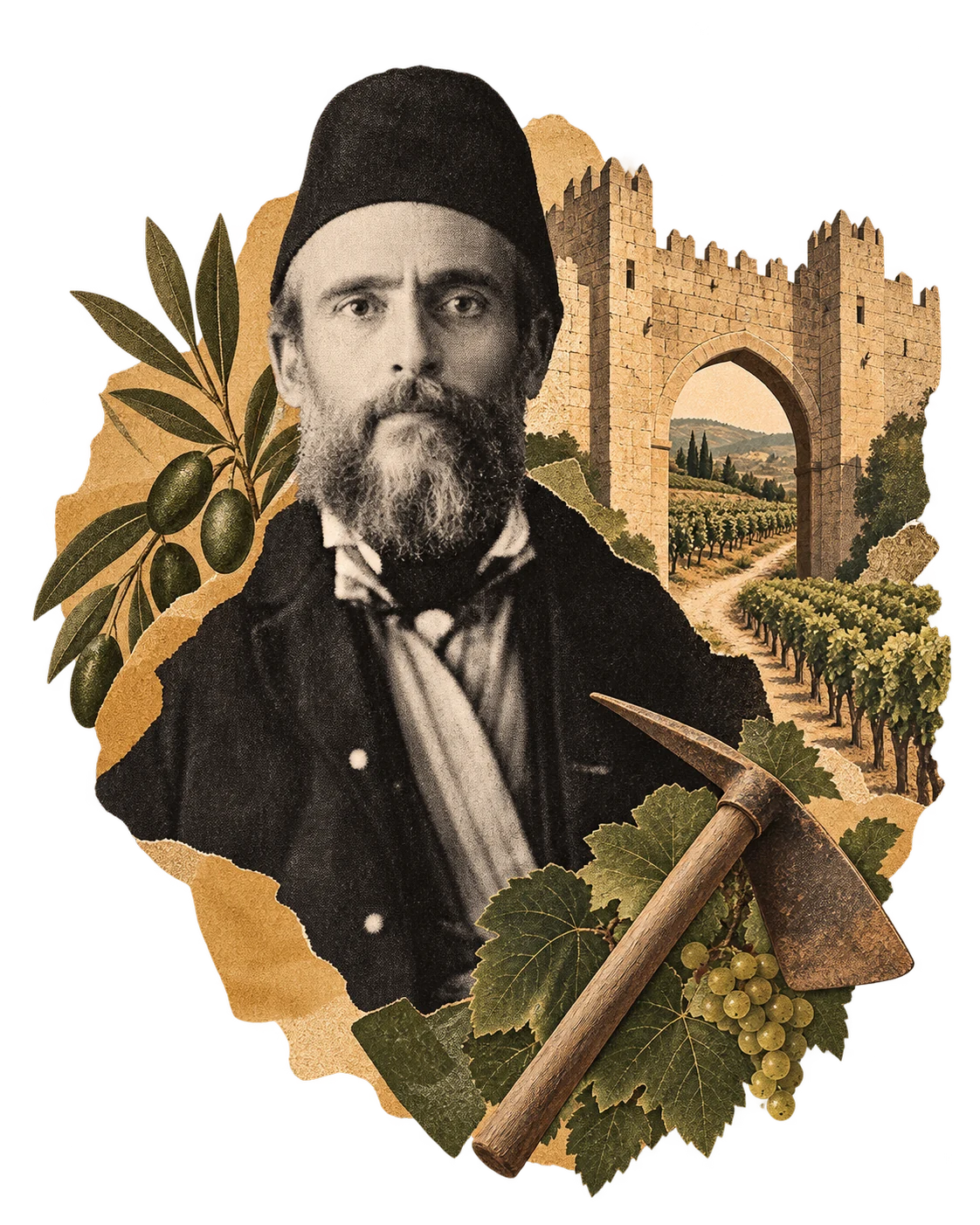
While everyone else huddled behind the city walls, they established a colony. They struggled for the revival of the Hebrew language, and did not merely dream of a new land - they shaped it with their bare hands and unwavering faith.
The Yellin Family and the Story of the Motza Colony
The Yellin family and the story of the colony of Motza
In the early summer of 1853, Jerusalem had few events to speak of, so the city's elders often recounted with wonder the magnificent sight of the long procession approaching the city. Jews and Arabs alike came out to greet it. The procession included dozens of cooks, servants, and guards, followed by scores of horses, mules, and camels, their humps covered with precious rugs and fine embroideries, and chests crammed with clothes. Even coops full of poultry could be seen in this remarkable procession. It was a sight the city had never seen before.
Everyone had heard about the procession that had traveled for forty days through the desert, from Baghdad to Jerusalem, carrying Baghdad's wealthiest Jew, Rabbi Shlomo Yehezkel Yehuda. His father, Yehezkel Yehuda, was well known in Jerusalem, where an important yeshiva had been built with his money. Upon arriving in Jerusalem, Rabbi Shlomo Yehezkel Yehuda began overseeing the yeshiva and soon became one of the leaders of the city's Sephardi community in general, and of the Iraqi immigrant community in particular. Six years after moving to the Land of Israel, his father died, and he inherited extensive holdings in India and Iraq. This allowed him to live in Jerusalem, devote himself to Torah study in comfort, wealth, and honor, and give generously to Torah institutions and those in need.
Nineteen years before Rabbi Shlomo Yehezkel Yehuda came from Iraq, Rabbi David Yellin (the first) arrived in the Land of Israel from Poland. He came from the town of Lomza in eastern Poland with his wife, Libe, their daughter, and their infant son, who was the main reason the family had made the journey. After their daughter Hava was born, the couple tried unsuccessfully to have another child. David then vowed that if he were blessed with a son, he would move to the Land of Israel. And so, after twenty years of infertility, a miracle occurred: Libe became pregnant and in 1842 gave birth to a son named Yehoshua, after Rabbi David Yellin the first's father. The family came to the Land of Israel with their daughter and son in 1834. There, they adopted an orphan, Aryeh Leib Horowitz. The family settled in Jerusalem and joined the city's Ashkenazi Perushim community. In the Land of Israel, David Yellin changed his family name to Tavia, which means "deer" in Aramaic, also the meaning of the name Lin in Polish. Nevertheless, the people of the city continued to call him Rabbi David of Lomza, after his hometown. David Yellin the first was an entrepreneur and trader at heart. He established a joint-stock trading association and also founded and managed the Jerusalem Bank, considered one of the first private banks in Jerusalem.
At the time, the Jewish community was concentrated within the walls of the Old City, and Yellin was among the first to advocate moving beyond them. He also personally bought land outside the walls. His purchases included land in the village of Artas, near Bethlehem, and land in the Avraham neighborhood. Like Rabbi Shlomo Yehezkel Yehuda, Rabbi David Yellin also ran an institution for Torah study, the Warsaw-Poland kollel.
The Match Between Sarah and Yehoshua
In 1856, Rabbi Shlomo Yehezkel Yehuda went, as he often did, to the tomb of the Prophet Samuel. After finishing his prayers and stepping outside, he gazed at Jerusalem spread out before him and began humming to himself the song, "It shall yet be heard in the towns of Judah and in the streets of Jerusalem, the sound of joy and gladness, the voice of bridegroom and bride." At that moment he remembered his daughter Sarah, who had celebrated her bat mitzvah that year and had yet to find a husband.
At that very moment, as if by a miracle, his son Shaul appeared and told him about an interesting encounter he had had with an educated, clever young man of keen insight and good manners. Shaul thought he might make a suitable husband for his sister Sarah, but the young man was Ashkenazi - the only "problem." At the time, marriages between Ashkenazim and Sephardim were uncommon. The two communities had different prayer customs and foods, and even pronounced Hebrew differently. None of this, however, was an obstacle for Shlomo Yehuda. He gave his blessing to the match, and Shaul immediately went to bring the young man.
A short while later, Shaul returned to his father accompanied by a boy of about fourteen and an older man with a white beard and a radiant face. The older man introduced himself as David Yellin, and the boy as his son Yehoshua. To everyone's surprise, the two families quickly found common ground. David and Shlomo already knew each other. Both were merchants, both ran educational institutions, and both believed in settling the Land of Israel, moving beyond the walls, and working the land, each in his own way. Each had thought his views were unusual, and they were delighted to discover that they shared the same convictions and vision. And so, before long, the two agreed on the match.
News of the match caused a huge commotion in Jerusalem. The women gossiped, and the men placed bets on the size of the dowry. Yehoshua Yellin married Sarah. Since the couple was still young, they decided that they would live in Yehuda's home until Yehoshua could support himself. Yehoshua lived with his father-in-law for six years, learned the customs of Iraqi Jews, got used to spicy food, wore a fez, and dressed in a cloth robe. He and his two brothers-in-law, Binyamin and Shaul, became as close as real brothers.
Rabbi David Yellin (the first) observed even the least and most demanding commandments with care. One day, during the intermediate days of Passover, as he walked around the walls of Jerusalem, following an ancient custom based on the verse, "Walk about Zion and go around her," he tripped over a stone and fell face down. As a result of the fall, he contracted erysipelas and died. He was buried in Jerusalem in 1863, at the age of sixty.
Kalonia and Motza
Four years after the wedding, in 1860, the brothers-in-law Yehoshua Yellin and Shaul Yehezkel Yehuda wagered their entire dowries. Their passion for pioneering settlement had been passed down to them by both their grandfather David Yellin and their grandfather Shlomo Yehezkel Yehuda. The two bought an olive grove in the Arab village of Qalunya. A cave had been carved into the rock in the grove, and a spring flowed from it. To them, it was a dream of fresh air and a spring, far from the suffocation of the Jewish Quarter and its water shortage. They also noted that the site lay on the main route between Jerusalem and Jaffa. For the purchase, they enlisted the help of the British consul, James Finn, who used his connections with the Ottoman authorities to allow the land to be sold to Jews. Yehoshua, the Ashkenazi who had learned Arabic, developed good relations with Sheikh Hajj Mustafa Abu Ghosh of the Arab village of Abu Ghosh. He later wrote that the sheikh "ruled over all the inhabitants of the villages north of Jerusalem, turned a blind eye, and did not interfere with our activities."
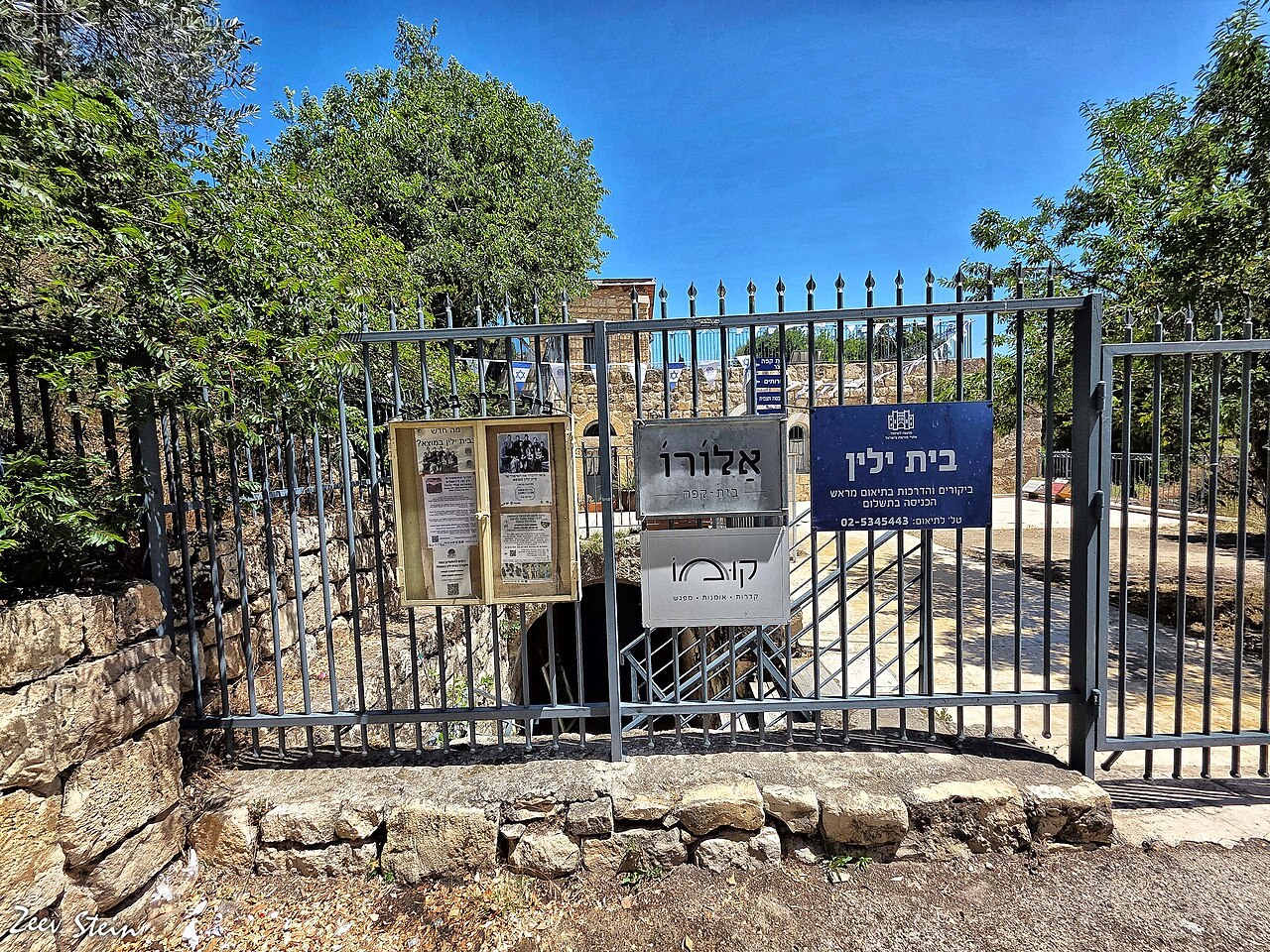
Ten years after the purchase, in 1871, Yellin built a khan on the plot, and two houses were also built for Shaul and Yehoshua. The khan now serves as the synagogue of Motza. The khan was an immediate success, serving the caravans traveling between Jaffa and Jerusalem; Mustafa Abu Ghosh also shared in the profits. The brothers-in-law recognized the site as the place where people used to go down to gather willow branches for the Sukkot holiday when the Temple stood, and so they called it Motza. But just when everything seemed to be going smoothly - or, more precisely, flowing smoothly at Motza - matters began to get complicated. Consul Finn was forced to leave the country on suspicion of criminal activity, their neighbors from Abu Ghosh demanded protection money they could not afford, and at the same time the business affairs of the Yehuda family ran into financial difficulties. Their hopes were dashed. Shaul Yehuda died of malaria at just twenty-four, and Yehoshua Yellin returned to Jerusalem.
Despite the series of disasters and the loss of Shaul, who had been so close to him, Yehoshua's spirit was not broken. Around that time, Sarah and Yehoshua had a son, David Yellin (the second, born in 1864), named after his grandfather. When David turned five, Yehoshua decided to join a group of entrepreneurs from the Ashkenazi community, and became one of the founders of the Nahalat Shiv'a neighborhood, named after its seven founders. After buying the land, they had no money left. In a gesture of solidarity and mutual responsibility, they decided to build one house first and only then build the next, and so on. It was the third neighborhood established outside the Old City walls, after Mishkenot Sha'ananim and Mahane Israel.
Motza Comes Back to Life
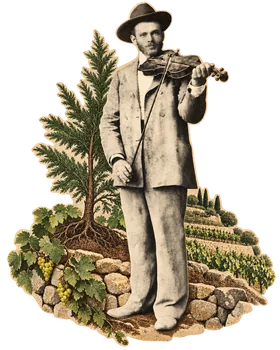
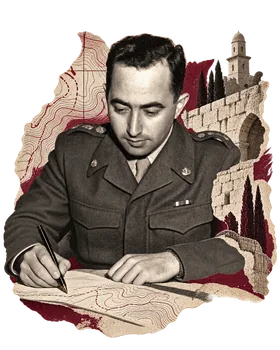
Yehoshua never forgot his dream of an agricultural colony. In 1890, he bought an additional 184 dunams in Motza and sold half of them to Hovevei Zion and to a society called Hibbat Ha'aretz. Three years later, the Jerusalem branch of the Jewish organization B'nai B'rith bought the land and decided to establish a colony there, settling it with outstanding farmers who had proven their abilities. The following year, the remaining land was purchased, and the colony came back to life. Among the first settlers were Yitzhak and Leah Cohen, about whom Rivka Alper wrote the book The Settlers on the Mountain; Shmuel Broza, on whose plot Herzl planted a cedar, where a convalescent home for pioneers called Arza was later built; and the Makleff family, including the parents of Mordechai Makleff, later the third chief of staff of the IDF. A small house was built there, where the writer and scholar Moshe David Gaon, father of Benny Gaon and singer Yehoram Gaon, taught.
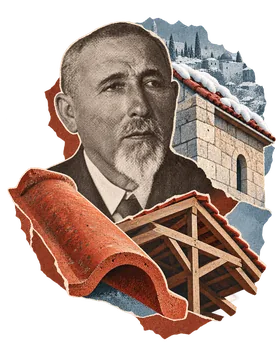
In 1905, the entrepreneur Mikhel Steinberg, a Jew of Russian origin, arrived in the colony. He discovered clay on the land he had bought and decided to seek investors to build a large roof-tile factory. In 1923, the English joint-stock company Jerusalem Brick and Tile Company Ltd. - Motza near Jerusalem was founded for this purpose. Construction of the factory took about two years. When it was finished, it produced tiles bearing a bilingual inscription: "בית מ. שטיינברג מוצא M. Steinberg, Motza". The factory, known as the "Red House," was among the first in the field of ceramics in the Land of Israel and supplied roof tiles and bricks for construction in Jerusalem and the surrounding area. Leah, the daughter of Yehiel, married Simcha Ambash, whose initials stand for "I believe with complete faith." The couple had two daughters, Ora and Suzy. In time, Ora married Chaim Herzog, the country's sixth president, and Suzy married Abba Eban, who served, among other roles, as foreign minister. Near the factory, Mikhel's brother, Yerachmiel Steinberg, known as "the righteous man of Motza," established a small winery called Steinberg Winery, producing local agricultural goods.
Yehoshua's dream of settlement took shape, but his ambition knew no bounds. He was among the builders of new neighborhoods established outside Jerusalem's walls, including Mea Shearim and Even Yisrael, and continued to dream of another colony based on Jewish agricultural workers. In 1872, he made another attempt in this direction. Along with friends, he tried to buy land in Jericho and establish the colony of Petah Tikva there, but the plan never came to fruition. That same year, his daughter Rachel Mas'uda was born. Two years later, after his partners withdrew, he too withdrew from the agricultural venture, but continued to maintain good relations with the Bedouins of the area. Despite the failed attempt in Jericho, Yehoshua's pioneering spirit ultimately led to the founding of the mother of the colonies, even though he himself continued to live in Jerusalem.
Between Commerce and Excommunication
In 1881, Yehoshua Yellin traveled to India to visit his wife's wealthy relatives, the David Sassoon family. When he returned to Jerusalem, he went into business with Naftali Leon, and together they established a successful money-changing and tobacco-selling business. He also traded in hides for several years. At the same time, Yehoshua served as the British consul's representative at the Ottoman government's commercial court.
Yehoshua Yellin's spirit of innovation and daring would not let him rest. In the late nineteenth century, when Jerusalem was still a city of ancient traditions and religious tensions, he found himself at the center of an enormous uproar - a head-on clash with the ultra-Orthodox community that swept through the entire city.
In 1882, the Alliance school, Kol Yisrael Haverim, was established by Nissim Behar. This revolutionary institution dared to combine religious studies with vocational training. In Yehoshua's eyes, it was a step toward a future of educated Jews and skilled tradespeople. But in the eyes of the ultra-Orthodox, led by the Rebbetzin of Brisk, the wife of Rabbi Yehoshua Leib Diskin, it posed a grave danger to the preservation of tradition.
The ultra-Orthodox attack soon followed. They scornfully called the school "Esh-Kula," a mocking distortion of the English word "school," and burst into harsh cries in the streets: "Alas! A ban is in your midst, Israel!"
Yehoshua was undeterred. He stood proudly in the face of the storm and enrolled his son in the new school. In doing so, he himself became a symbol of the struggle between progress and tradition. The ultra-Orthodox community saw this as betrayal. After all, his father, David of Lomza, had once joined a boycott of another educational initiative. Now, they claimed: "If the flame has fallen among the cedars, what will become of the shrubs?" Their declaration was unequivocal: "A disgrace has been committed in Israel - boycott him, fine him, pursue him relentlessly!"
Two days later, in the middle of the Sabbath service at the central synagogue, the Hurva, two young men rushed to the bimah and stopped the prayers. In front of the congregation, a personal ban on David Yellin and all his supporters was read aloud. It was signed by Rabbi Diskin. Trade with the Yellin family was also forbidden. The angry congregation, taken by surprise when the service was interrupted, nearly erupted into a physical brawl. Only the intervention of the community elders prevented a serious confrontation in the synagogue.
The next morning, Yehoshua arrived at his shop and found two zealots posted at the entrance, warning passersby not to go in. Some laughed scornfully, but others were deterred, afraid of being struck from the charity lists. Even those who made a purchase were required to return the item. Yehoshua, with great dignity, did not argue. He accepted the goods and returned the money without humiliating anyone.
The persecution did not stop. Many boycotted him and failed to repay their debts. But he remained steadfast. Once, on his way to afternoon prayers on the eve of the Sabbath, he met Rabbi Moshe Nahum Wallenstein. Wallenstein took him to the study hall of Rabbi Salant, where he included him in the prayer quorum, but immediately afterward he changed his mind and apologized: "I forgot that I am not allowed to count you in."
The events shook Yehoshua but did not break him. He turned to the scholars of the community, the Sephardi rabbis, and asked for their opinion. Their answer was clear and unequivocal: "There is no prohibition; more than that, we grant him permission under Torah law!" The document was signed by the leading sages of the generation: the Hakham Bashi, Rabbi Raphael Meir Panigel, and Rabbi Yaakov Shaul Elyashar. Yehoshua Yellin was the first Ashkenazi to serve as a member of the Jerusalem municipality (1897). In his later years, he began gathering his memories into a moving book called Memories of a Jerusalemite, a living testament to a turbulent era and a life full of activity. He died in 1924.
David Yellin and the Struggle for Hebrew
David Yellin (the second) showed remarkable talent from the age of fourteen. By then, he had mastered five different languages and had already edited his own newspaper, called Mount Zion. As noted, his parents wanted to give their children an excellent education, so David was sent to the Alliance school of Kol Yisrael Haverim, the most advanced educational institution in Jerusalem at the time. The school's founder and first principal was Nissim Behar. David's sister Fortuna also ran an educational institution for girls, and from time to time the two schools held joint events. The aim of these gatherings was to hear lectures by scholars, but their high point was the dances, where, as malicious tongues claimed, young men and women danced together. The young David Yellin arrived at one of these balls feeling rather embarrassed, since he did not know how to dance. When the dancing began, he sat to one side and noticed a modest, beautiful young woman. They began talking, and David discovered that she was Ita, the daughter of the head of the Montefiore Fund, Rabbi Yehiel Mikhel Pines, whose name was known in almost every neighborhood in Jerusalem. Love blossomed between them, and Ita and David Yellin married. A few years later, Pines worked to buy land in Motza and realize his father-in-law's long-held vision.
David Yellin returned to Alliance as a teacher, alongside prominent figures such as Eliezer Ben-Yehuda, Dr. Aharon Mazie, and Yosef Meyuhas. This lively group of scholars established the Hebrew Language Committee, whose aim was to make Hebrew the main spoken language in the Land of Israel.
David Yellin built his home opposite the Lemel School, run by the German Ezra Society. He transferred to the Lemel School after about a decade at Alliance, following a dispute with Behar. The principal, Ephraim Cohen-Reiss, lived across the street. When David was appointed his deputy, a bitter dispute broke out between them over the school's language of instruction: Reiss supported German, while Yellin insisted on Hebrew. My teacher and mentor Chaim Be'er told me that the two intellectuals used to argue loudly and sometimes even curse each other from the balconies of their homes. As a result of the Language War, David left the Ezra teachers' seminary at Lemel and founded the Hebrew Teachers' Seminary, which became the college now named after him.
By the end of World War I, David Yellin was one of the country's most prominent figures. He was involved in the founding of Tel Aviv, served as head of the Jewish Committee of Jerusalem, and represented the Jewish community at the Versailles Peace Conference. Eventually, he headed the National Council, the most important body in the Jewish community at the time.
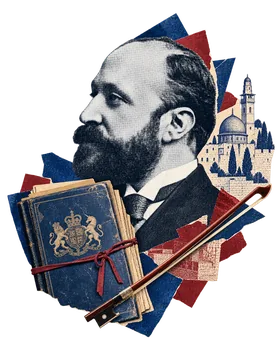
In 1924, David Yellin was among the founders of the Rehavia neighborhood in Jerusalem. A year later, he was appointed professor of medieval Hebrew poetry at the Hebrew University. At his recommendation, all the neighborhood's streets were named in honor of the poets of Spain's Golden Age. David Yellin died in 1941 at the age of 77. David Yellin's son was a prolific engineer who built many houses in Jerusalem. David's wife, Thelma Yellin, née Bentwich, was renowned as a gifted cellist and as an educator who cultivated a generation of musical learning in Israel.
David Yellin (the second) was not the only member of the family involved in developing the country. In 1887, his sister Rachel married Yehezkel Danin (Suchovolsky), and together they were among the founders of Ahuzat Bayit, which became Tel Aviv.
תגובות
עדיין אין תגובות.