

In 1981, an article appeared in the newspaper Yedioth Ahronoth under the headline "The Most Beautiful Woman in the World." It described her this way: "A strange figure, half-mad yet admired and poetically marvelous, a kind of wild treasure."
The Bond with Zelda
It was Azah Tsvi (daughter of Rafael Tsvi, one of the founders of Habima) who, in 1965, introduced Zelda and Yona Wallach, two poets who were unknown at the time. After reading Zelda's poems, which had been written on scraps of paper, Wallach said: "Why are these things just rolling around like this? They need to be gathered up and put in a box. They need to be typed up and published as a book!"
Before she had published any poems of her own, 23-year-old Yona Wallach, 30 years younger than Zelda, took it upon herself to publish Zelda's poems. A few days after that meeting, Azah Tsvi gathered up all the notes on which the poems had been written and printed them on the printer Yona Wallach had sent her.
Yona Wallach and Zelda were opposites. Wallach heard in Zelda's poetry "the sweet voice of God," and when Zelda's collection of poems was published, she sent Wallach a copy with the words: "To Yona, angel of fire." Wallach replied in a letter: "You create a world, Zelda. That's the ultimate thing a poet can do. And this world makes me better, and the beauty you bring leaves me yearning, awestruck, longing, and I remember so clearly that I am Jewish."
This strange friendship between the two poets, one religious and older, the other young and anarchic, led to several joint poetry-reading evenings. As time went by, Yona Wallach grew more turbulent and defiant, and her writing stood out for its clear, explicit sexual language, with no hints or metaphors.
The rift between the two came in 1982, after Yona published the poem "Tefillin" in the magazine Iton 77:
Come to me / Don't let me do anything / You do it for me... I'll put on tefillin / I'll pray... / You put on the tefillin for me too Wrap them around my arms / Play with them on me / Run them gently over my body Rub them against me thoroughly / Tease me everywhere / Make me faint with sensation Run them over my clitoris / Tie my waist with them / So I can come quickly
Miriam Glazer-Ta'assa, who had been Deputy Minister of Education and Culture, said of her: "Wallach is simply deranged. A rutting beast who writes a poem like that and even publishes it... It's a murky tide... Anarchy." But the sharper the barbs, the more immune Wallach became. She knew she caused scandals and even enjoyed it.
In February 1965, 21-year-old Yona Wallach crossed the iron gates of a psychiatric hospital for the first time, of her own free will. "I want to understand what madness is," she told her friends. Dr. Marcel Asael, the psychiatrist who admitted Wallach to the institution, was fascinated by her. He became absorbed in conversations with her about art and painting, arranged special conditions and a room where she could write, and even gave her an experimental treatment using the drug LSD, which was later found to be dangerous. The psychiatrist later wrote: "I gave her the drug to help her... She wanted to go mad, after all. She asked for it."
Later, following her experience with the drug, Wallach wrote the poem "If You Go on an LSD Trip":
If you go on an LSD trip / remember me / I never came back from there / I'm still there / by the window / the red guillotine is visible from it / my head is about to be cut off / I'm still there / waiting for the next moment / the terror of all existence / descends on me like a knife.
Childhood in Kfar Ono
Yona Wallach was born in 1944 in Kfar Ono. Her parents, Esther and Michael, came to the country as pioneers in the early 1930s and were among the founders of the village, then a lone agricultural settlement surrounded by an Arab population. Yona lived for most of her life at 24 Michael Wallach Street, a street named after her father, who was killed in the Battle of Qula, one of the brutal battles of the War of Independence. After the battle, some of the bodies were found bearing signs of severe abuse. She later said: "I know that ever since I was little he has been calling me. Once, in the garden, when I was little, I used to sleepwalk, and I saw a sort of misty cloud that I was swallowed up in, and then I came back home. And all those years there was a voice calling me in my sleep: Yona, Yona, Yona, all those years."
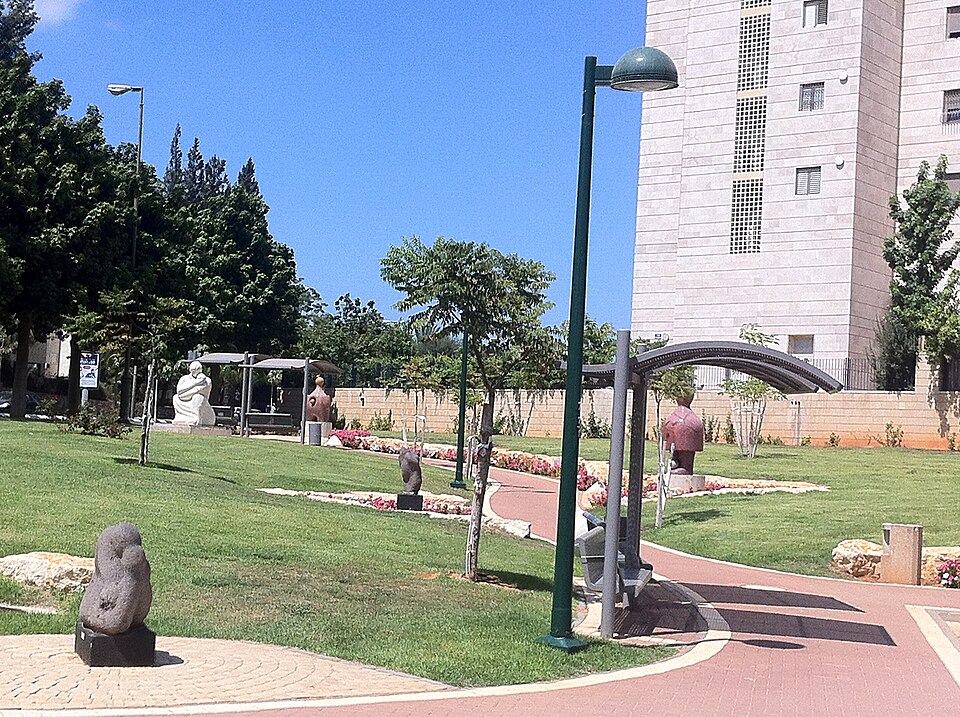
Yona lived with her mother and sister. She began writing poems at the age of eight. About her mother she wrote: "A grizzly bear raised me / milk of stars was my main food..." Perhaps the desire to break free from her mother's bear hug turned Yona from an outstanding elementary school student into a rebellious teenager. The village's long-established community began to shun her as an outcast. After her death, that same community established a sculpture garden in her name, featuring works by artists from Kiryat Ono. Quotations from her poems are engraved on metal plaques throughout the garden, including "A person accumulates memories" and, of course, "Quiet."
Yona Wallach attended the prestigious Tichon Hadash high school, but she was an outsider. An intellectual girl, curious and intensely eager to know everything, she was also bored in class and missed many of her lessons. At the end of tenth grade, she was expelled. She spent her time at the family business, the Or-On cinema, and occasionally worked at the box office.
She never attended university, but continued to educate herself. She voraciously read a wide range of poetry and prose, both Hebrew literature and translated works. At 17, she enrolled at the Avni Institute art school, but again struggled to stick with it. She did, however, manage to connect with the rebellious poets of the time, including Roni Someck, whom she loved and admired. Of Yehuda Amichai she said: "He died before I was born," and of Meir Wieseltier: "He's awful, a terrible poet you shouldn't read a single word of." Nevertheless, she drew from them the courage to write openly and freely.
At a young age, she was already playing around with words, writing from a man's point of view, as she did in her poem "Strawberries":
When you come to bed with me / wear a black dress / decorated with strawberries / and a black hat adorned with strawberries / and hold a basket of strawberries / and sell me strawberries / say in a thin, sweet voice strawberries strawberries / who wants strawberries / wear nothing under the dress / then threads will lift you up / invisible or visible / and bring you down / straight onto my cock. Her book Last Poems includes a series of poems that begin with the words "When you come to bed with me." In this series, Wallach describes sexual encounters with a policeman, a judge, someone who had returned to religious observance, God, and even someone who will pretend to be her father.
Fame and Hospitalizations
In 1964, her first poem appeared in the literary supplement of Yedioth Ahronoth. It was an untitled poem that began with the words "Stones slope down to the river." Wallach did not send the poem to the editor; her friend, the poet Yair Hurvitz, did. A month later, her poem "Absalom" was published. As success began to come her way, Yona's decline began, and she went through many experiences, some of them difficult, with sex, drugs, and madness.
Her later hospitalizations were involuntary. Between hospitalizations, she lived at a frantic, intense pace and befriended people on the margins of society: criminals, prostitutes, and drug addicts. The young poets of the time saw her as a brave poet who wanted to experience life, take risks, and turn those experiences into poetry.
She wrote about her sexual experiences in "My Pre-Sleep Poem," better known by the title "Different Sex," which may have expressed her frustration:
They hint to us that there's different sex / good that someone knows about it / if there's different sex / bring it here and we'll know it, we'll talk frankly / is there or isn't there. We're already very tired / of our virgin wives / and all the time they show us in pictures there's something else / we feel there's something to it. And if there's different sex / in another world / new women who know what they're doing / why don't they bring a few in to teach our weary wives / we're already so tired...
After one of her hospitalizations, she wrote her famous poem "I Couldn't Do Anything":
I COULDN'T DO ANYTHING WITH IT / YOU HEAR, I COULDN'T DO ANYTHING ABOUT IT / IT WAS IN MY HANDS / AND I COULDN'T DO ANYTHING WITH IT / AND I COULDN'T MAKE ANYTHING OF IT / YOU HEAR, I COULD STAMMER / WHAT WAS I TRYING TO SAY / I COULD FEEL AS BAD AS IT'S POSSIBLE TO FEEL / AND SUDDENLY YOU'RE STANDING THERE LIKE A LITTLE BOY / WITH A BIB AROUND YOUR NECK, REPEATING THE QUESTION / WHAT DID YOU DO WITH IT, THEY ASK / WHERE DID YOU WASTE IT ALL, YOU HAD A CHANCE / AND NOW YOU'LL HAVE TO START ALL OVER AGAIN
Only in mid-1976, with the publication of a selection of her poems, did she win recognition from the literary establishment. At the time, Wallach lived in Tel Aviv, on the corner of Ben Yehuda Street and Gordon Street. During 1978-1977, she won three literary prizes.
During that period, some of her poems were set to music and performed by well-known singers, including Dorit Reuveni, Gidi Gov, and Nurit Galron. Some became part of the soundtrack of a generation: "A Person Accumulates Memories," "I'm Falling in Love Again," "It's the Rain," "This Isn't It," "My Pre-Sleep Poem" (known as "Different Sex"), "I Couldn't Do Anything," "Quiet" (known as "Send Me Quiet"), and others.
The Final Years
In 1981, an article appeared in Yedioth Ahronoth under the headline "The Most Beautiful Woman in the World," summing up Yona Wallach's public image: "A strange figure, half-mad yet admired and poetically marvelous, a kind of wild treasure." That same year, she also published the poem "Tefillin." In the summer, at the age of 38, she developed breast cancer but chose to ignore the illness, claiming that by squeezing her nipple she was getting the cancer out. A year later, she decided to undergo treatment. Around that time, she met Yuval Rivlin, a 22-year-old keyboard player (keyboardist in the band Atmosphere) from Kiryat Ono. Yuval loved Yona passionately, and they lived together for about four years.
Yona Wallach died in September 1985, aged 41. Yuval Rivlin became religious and forbade the publication of her poems. Later, he softened his position, and many previously unknown poems came to light. One of them is "Wednesday":
Do they not feel the footsteps of death drawing quietly near / and how do they stop their fear / or do they not feel it at all. And the injection against pain / I feel it / like a bride on her wedding day / all attention / will the footsteps of the redeemer come. To weep from love / sour candies Vivian buys me / to weep in love with our people / the black storm. The one who remembers who sings of the days of the Messiah / here at Tel Hashomer / lighting candles in front of the windows / gathering glimmers in terror.


תגובות
עדיין אין תגובות.