
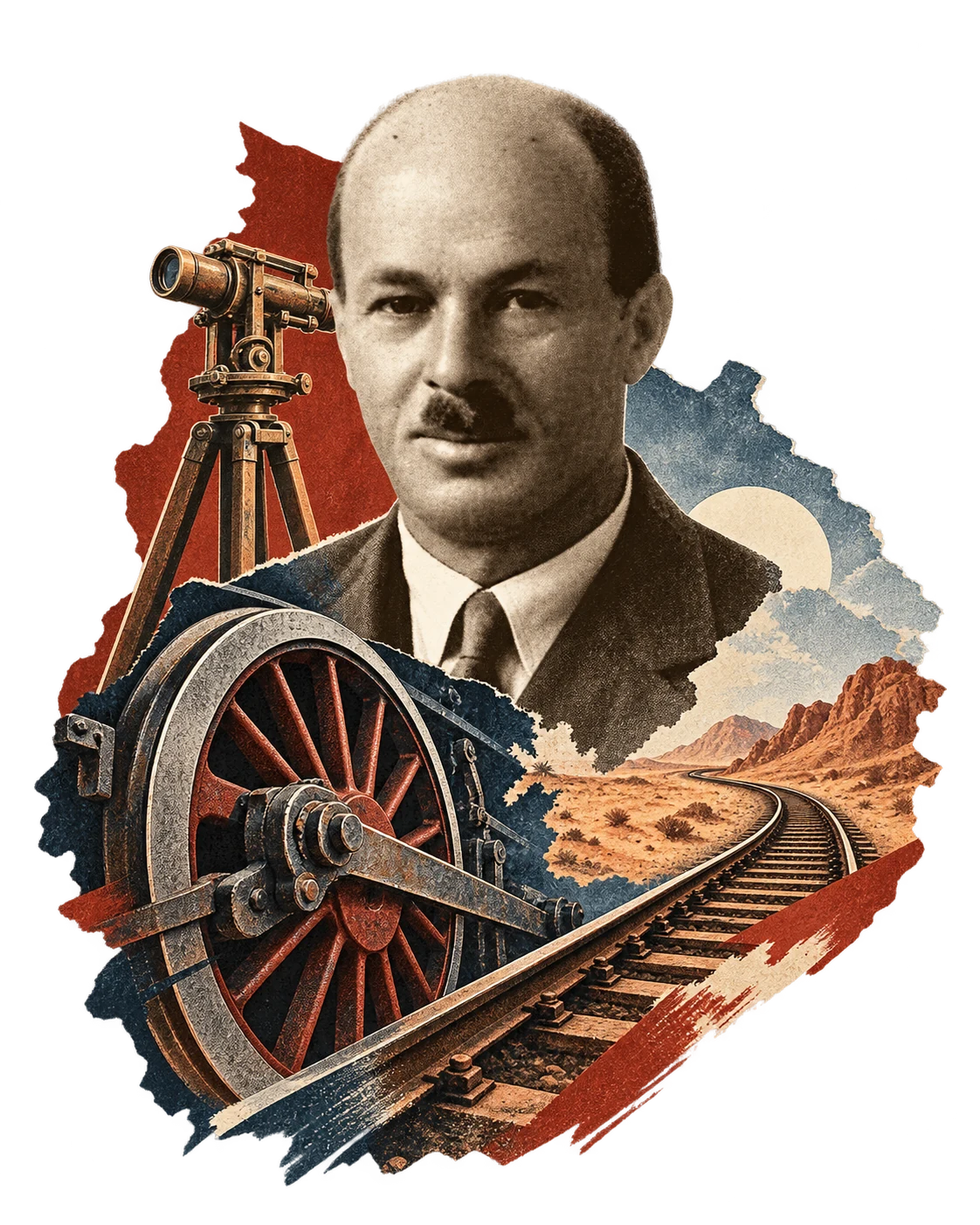
He was one of the most colorful figures of his era, and his story is intertwined with a secret society and the Land of Israel between the two world wars, a connection reflected in Jerusalem's beautiful buildings.
Baruch Katinka and the Country's Railways
In 1916, Baruch Katinka worked as an engineer and chief technical inspector for the Hejaz Railway in the country. The railway connected Damascus to Medina in the Hejaz and carried pilgrims to Mecca. A branch of the railway reached Haifa and became known as the Valley Railway.
In 1914, the Bavarian 304th Squadron arrived from Germany to help its Turkish allies in their war against the British, and was stationed near Merhavia. The pilots' main missions were aerial photography and bombing. To make supplying them easier, a railway line was built in Afula. The squadron suffered heavy losses, and the pilots sought comfort in good food, music, wine, and women. They found it in the German Templer Colony in Haifa, where their language was spoken, the food was familiar and delicious, like homemade strudel, there was a beautiful beach, and there were... women. To get to town, the pilots took an open railcar, set up a mast on it, stretched a sail, and tried to sail it to Haifa - naming it the Phoenician Express. The problem was that the wind blew only in the direction of Haifa, so they could not return to base in the railcar. The pilots appealed to the high command, which ordered Baruch Katinka to build small motorized railcars for their use. He approached the railway's central administration to ask for engines, but they said they had none of that kind and he would have to get them himself. "An order from the high command was a decree that could not be refused," he wrote in his book From Then Until Now. He went to his friends in the squadron to ask if they had an engine, and they showed him a plane that had crashed not far away. Its wings were broken, "but its fuselage and propeller were intact... I was astonished by the size of the engine. Its power was about 160 horsepower, whereas a tenth, even a twentieth, of that would have been enough for a motorized railcar."
Baruch Katinka attached the engine to a wheeled platform and set it on the tracks. He called one of the pilots to join him. "A short while later, a pilot came, sat in the airplane seat, and offered me the seat beside him, where the bombardier sat. We put on special flying caps and the pilot started the engine," he recounted. "The propeller began to spin rapidly. I released the railcar's handbrake, and suddenly it started moving forward, making a terrible noise as its speed increased. Halfway from Afula to Haifa, when I realized the speed was exceeding the limit, I signaled to the pilot to stop. We wanted to return to Afula, but how could we? The propeller could not turn backward. I decided to continue to Haifa, even though trains were forbidden to travel between Afula and Haifa because of the risk of British shelling. We reached Haifa, where there was a turntable designed to reverse the direction of the locomotive placed on it. We went onto the turntable, turned the railcar around, and pointed the propeller toward Afula. We flew back to Afula, my hand on the brake to slow the railcar as much as possible. We reached Afula without a hitch." The quiet valley, accustomed until then to the slow movement of trains, was suddenly shaken by the tremendous roar of a train speeding at 85 kilometers per hour. After that "flight ride," Katinka offered to build the pilots similar cars. This time, though, after the first ride, he also installed a handbrake. He added railway sleepers to the floor of the car to increase its weight, and installed two benches and a railing, which were painted "a splendid green," as he described it. After two days of work, he invited the German commander to the cars' inauguration. "The commander, his fellow pilots, and I sat in this strange motorized railcar and made our way to Haifa and back... The pilots' joy knew no bounds. They had a useful vehicle they were accustomed to. They thanked me from the bottom of their hearts."
So, instead of a sail-powered railcar, they got an airplane-powered one. Quite a few jokes were made about the speed of the Valley Railway, which traveled at 16 kilometers per hour. One was about a man who wanted to commit suicide, lay down on the tracks, and died of hunger...
For months, Professor Didi Lin of Kinneret College, Ziv Ofir, the college's vice president, and Avi Beltner, owner of a metalworking shop in the colony of Menahemia, worked on building a model of the railcar. In April 2022, it was installed at the Tzemah railway station.
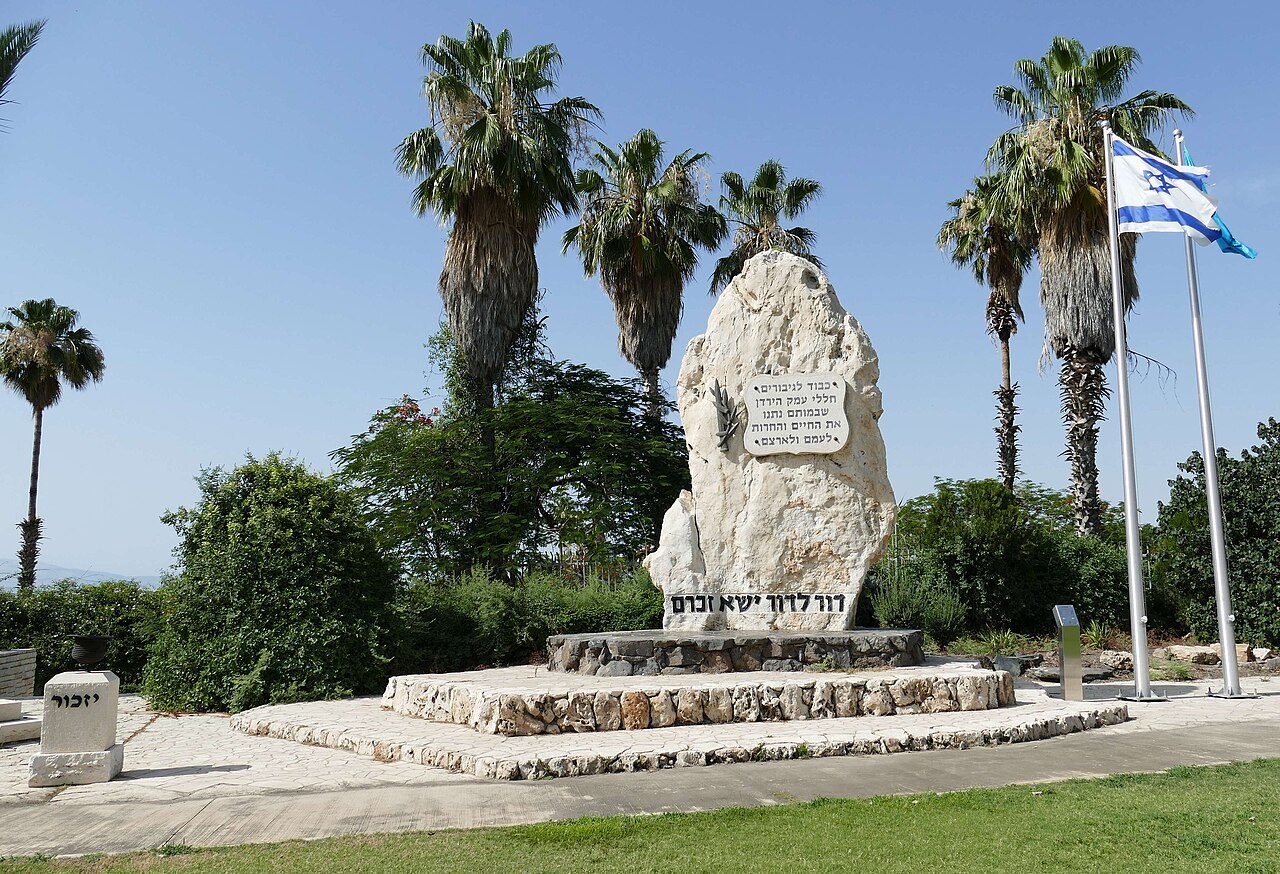
The same motorized railcar that had carried the Germans to their moments of revelry in Haifa also served the new occupiers. In late 1917, Australian soldiers began using the railcar too - for exactly the same purpose. The Australians heard that German soldiers had left a treasure of wine bottles inside a cave near their military camp in Jenin. They "flew" in the railcar from Haifa to Jenin, found the cave, and loaded their haul of wine bottles onto the car. On their way back toward Nablus, the speeding railcar overturned, and most of their wine spilled.
Not everyone liked that fast motorized railcar. Baruch Katinka said that even the railway director himself was unimpressed by it: "He berated me for my laziness and asked how a person could be so lazy as to make such a monster." Even the enthusiastic pilots' explanations failed to persuade the director, who announced that from that day on the airplane car would be called "Katinkas Faulheit" ("Katinka's laziness"). Baruch Katinka, for his part, was pleased with his invention and wrote: "I was fortunate, and whenever I needed to make a quick, urgent trip, I would call the pilots, and they would put the motorized railcar and a pilot at my disposal. In this way I often took many of my friends from Afula to Haifa and back."
The Palace Hotel and the Struggle in Jerusalem
Upon his appointment as High Commissioner, the Jewish Herbert Samuel decided to grant a pardon to Hajj Amin al-Husseini, who had been sentenced to ten years in prison after leading a mob that rioted against Jews during the 1920 disturbances. Al-Husseini was one of the candidates for the post of mufti, which the British had transformed from a religious office into a political one with considerable economic power. On his release from prison, Governor Ronald Storrs chose al-Husseini for the post of mufti, despite his being the youngest candidate and having very little religious education. Gad Frumkin, who served as Ronald Storrs's interpreter, said that one Sabbath evening al-Husseini told him about his appointment as mufti: "During the days of mourning for my brother Kamil, Sir Herbert Samuel visited our home. We had a frank conversation, and I shared my views and aims with him. I asked him: 'Whom do you prefer, an open adversary or a disguised enemy?' And he answered me: 'An open adversary.' And on that basis I was appointed Mufti of Jerusalem." Contrary to expectations, the mufti's views did not moderate, and he continued to incite against the Jewish community (later, he even met with Hitler). As part of his actions against the Jews, al-Husseini decided to build the Palace Hotel in western Jerusalem, a show of strength in the face of the rapid construction of Jewish neighborhoods. In 1927, he issued a tender for the construction of the hotel on Waqf land.
At the beginning of 1928, the contracting company Albina, Dunya and Katinka was established. Its controlling owner was the Arab Christian businessman Joseph Pascal Albina, while Baruch Katinka and Tuvia Dunya (Chaim Weizmann's brother-in-law) joined him as partners. When the tender for the construction of the Palace Hotel was announced, they feared they would lose it because they were Jewish. But they won after approaching the Muslim contractor Awad, who registered in place of Albina, and submitting their bid under his prominently displayed name. The mufti often tried to draw Dunya into political arguments, and Dunya would answer him: "Weizmann and I have an agreement - he doesn't get involved in construction work and contracting, and I don't get involved in politics." The hotel was completed in 1929, and the same company also built the mufti's home (later the Shepherd Hotel) in the Sheikh Jarrah neighborhood.
One of the mufti's opponents was Raghib al-Nashashibi, then mayor of Jerusalem, who refused to connect the hotel to the sewer system. Baruch Katinka did not give up. He built a system to pump and purify the water, and channel it from the hotel to the cemetery grounds. The hotel did close in 1934 because it could not compete with the King David Hotel, but Hajj Amin al-Husseini continued to maintain an office there. After it closed, the hotel was leased by the British administration and used as an office building. On March 30, 1936, the Kol Yerushalayim radio station also began broadcasting from the building, for three years (today, the building forms the central wing of the Waldorf Astoria Jerusalem).
In 1936, the Peel Commission, established to investigate the disturbances (1939-1936), made the hotel its headquarters. Leaders of the Jewish community who wanted to hear the commission's proceedings approached Baruch Katinka and asked him to install listening devices in the meeting room. Katinka turned to Yeshayahu Pinesod, the hotel's electrical engineer, who agreed and installed hidden microphones inside the electric light fixtures above the meeting table. In this way, the content of the proceedings was passed on each day to representatives of the national institutions.
From His Youth to the First World War
Baruch Katinka was born in 1887 in Bialystok, Poland (then Russia). His father, Shmuel Menashe, was descended from the family of Menasseh ben Israel, whose family originated in the Netherlands. As a young boy, he studied in a heder, but religious studies did not interest him. As early as the age of three, his feverish, creative mind turned an umbrella into a rifle, and by the age of six he had already built a windmill and a steam engine. As he grew older, he studied for about a year and a half at the Volozhin Yeshiva, headed by an anti-Zionist rabbi. Baruch and ten other enthusiastic students ran away from the yeshiva after hearing about Herzl and his plans to establish a Jewish state in the Land of Israel. They met with Herzl and brought him a letter of support from the yeshiva students. Baruch Katinka was among the first to register as a member of the Zionist movement in his city, the Bialystok Poale Zion. He went on to study at the polytechnic in the German city of Mittweida, and at the age of 21 qualified as a mechanical and electrical engineer. At the polytechnic, he founded the Hebrew-speaking student association Hatikvah.
In 1908, he immigrated to the Land of Israel with his mother and three sisters. Together with his friend Yosef Miller, he set up an engineering and technical office in Haifa, while also working as an engineer at the Atid (Shemen) factory in Haifa. At that time the country was under Turkish rule, and Baruch Katinka decided to "become Ottoman" and enlist in the army. Because he was Jewish, they were reluctant to enlist him, but in 1911, after the outbreak of the Turkish-Bulgarian War, he was invited to help the Ottoman Railway Company build the Hejaz Railway line, which would run from Damascus parallel to the French line. At first, he served as an adviser to a German director who hated Jews and agreed to employ him, but initially without pay. During World War I, he was appointed an inspector for the railway company in the Land of Israel, and for this purpose he took an examination to obtain a locomotive driver's license. In this way, he became the only Jew licensed to drive a locomotive, and was even entitled to free travel on all the trains of the Ottoman Empire. Building railway lines in the region required a large workforce. On one occasion, he was given a large group of about 500 Armenian prisoners who had been deported from their homeland to support the Turkish war effort. Baruch Katinka said that the Turkish army's chief medical officer ordered him to convert the prisoners to Islam, and so he was required to circumcise them and distribute the women prisoners among the Bedouin sheikhs to serve as their slaves and concubines. Baruch Katinka, appalled by the request, asked for the order to be reversed and informed the general staff that railway traffic would be suspended for a week because the Armenians would be unable to work after the circumcision. The general staff was persuaded and rescinded the order.
The British, who had arrived from Egypt, forced the Turks to retreat, and contact with Baruch Katinka was cut off. He was suspected of collaborating with the British, tried in absentia, and found guilty. He was sentenced to death and ordered to report to Damascus for his sentence to be carried out. Baruch did travel to Damascus and was acquitted after showing the judge the letters of appreciation and commendations he had received for his work. As he left the courthouse, he saw three gallows in the main square. He asked the guard accompanying him who was to be hanged, and the guard replied: "Tomorrow, three people are to be hanged here - Yosef Lishansky, Naaman Belkind, and Baruch Katinka."
When he returned to the country as a senior officer in the Turkish army, he was captured by the British along with 81 other officers. They were taken to the prison in Es-Salt, in Transjordan, and from there to Jerusalem. He managed to escape and hide in the cemetery on the Mount of Olives, and toward evening he managed to get back to the city.
Engineer and Contractor in Jerusalem
Baruch Katinka began a new chapter in his life and started providing engineering and building-construction services through the company he co-owned, Albina, Dunya and Katinka - Contractors and Engineers. He was one of the first ten engineers in the country and among those who set out the electrical plans for Pinhas Rutenberg. Later, he built the Palace Hotel, the YMCA building, the airport in Lod, and the Tegart forts. In 1918, he founded the Association of Engineers in the Land of Israel and served on the Water Committee alongside Shmuel Slouschz and its chairman, Dr. Meir Gurevich. A year later, his name was already on the list of founders of the Bat Galim neighborhood in Haifa, and he was among the heads of the Hadar HaCarmel neighborhood committee in the city. Baruch Katinka was among the first members and founders of the Haganah organization, served as its procurement officer, and attained senior command ranks. After the establishment of the state, he enlisted in the IDF as an engineer and served until he turned 62.
In 1908, Baruch left Haifa by ship on his way to Jaffa. When it reached Jaffa, the rough sea prevented it from entering the port, and after several days the ship's captain announced that there was no choice but to continue to Alexandria. Baruch was delighted by the news, since he had never been to Egypt. He shared a cabin on the ship with a Greek young man who confessed that he was wanted in Alexandria and would be imprisoned on arrival until the ship sailed back to Jaffa. He asked Baruch to look after his suitcase. When they went ashore, the Greek was arrested, and Baruch took the suitcase and accompanied him. On the way, two elegantly dressed men passed them, exchanged a few signals with the Greek, and walked on. By the time they reached the police station, the two men were already waiting there and asked Baruch to wait with them. A few minutes later, the Greek was released. Baruch was astonished. "How did that happen?" he asked, and the Greek explained that he belonged to the Freemasons, and that the two men, also members of the order and bound to help one another, had realized he was in trouble, hurried to the police station, and posted bail for his release. Baruch Katinka was captivated and decided that very day to join the Freemasons. This order is a kind of international secret society that upholds three main principles: freedom, brotherhood, and equality among the "brothers" who belong to the order and among human beings. It is an originally ethical organization, intended to provide mutual assistance.
The YMCA building in Jerusalem was named after the organization of the same name (YMCA), which was the Young Men's Christian Association in the United States. The organization set itself the goal of fostering relations among Christians, Muslims, and Jews through shared cultural and sporting activities. After the American millionaire James Jarvie pledged to donate money for the construction of a permanent YMCA building in Israel, it was decided to issue a tender. At the time, Baruch's company, Albina, Dunya and Katinka, was already well known and well connected because it had won the tender for the Palace Hotel. Thus, although their bid was not the lowest, they won the YMCA contract. The building, considered the most beautiful YMCA building in the world, was inaugurated with great pomp in 1933 by General Allenby, who said in his speech: "In Jerusalem, a city revered by all, in the heart of the Land of Israel, a land that from ancient times until today has witnessed constant wars, a monument to peace and brotherhood is being erected." The building was designed by Arthur Loomis Harmon, who was also designing the Empire State Building at the time, and similarities can be seen between the two buildings.
The Freemasons and Zedekiah's Cave
As with any secret society, quite a few conspiracy theories became associated with this order, including the claim that Mozart was murdered because he revealed some of the order's secrets in his opera The Magic Flute, and an attempted assassination of the Pope, among others. The Freemasons regard King Solomon as the founder and first president of the order. Solomon enlisted the help of a craftsman named Hiram of Tyre (not the king), and among the items Hiram made for Solomon's Temple were two magnificent pillars called Jachin and Boaz. According to an ancient tradition, the stones for Solomon's Temple were quarried from Zedekiah's Cave. Since its rediscovery in the mid-19th century, the cave has been known as King Solomon's Quarries. It was because of this association that the Freemasons in Israel were founded specifically in Zedekiah's Cave. One of Baruch Katinka's first jobs as an engineer in the country was mapping the cave, and graffiti bearing his name can still be found there. The central chamber is called the Freemasons' Hall, and ceremonies are held there. Ceremonies were held in the cave even during the Jordanian rule in Jerusalem, and the most famous Jordanian Freemason was King Hussein. The last use of stones from the cave was during the construction of the YMCA building. Baruch Katinka established a "meditation room" at the top of the tower, its walls clad with stones from Zedekiah's Cave. In his memoirs, Baruch said that when building the room, he suggested that the architect Adamson ask the Department of Antiquities for permission to take "stones from King Solomon's Quarries (Zedekiah's Cave), which, according to tradition, he used to build the Temple... We found large, ancient stones, already quarried and ready, which we were permitted to remove and use." Katinka also recounted the construction of the altar in the YMCA building's prayer hall: "I had to collect 12 fieldstones and arrange them as an altar, without breaking or shaping any of them. I suggested to Adamson that we go with a few workers to nearby Beit El, near Jerusalem, where the first altar was built, and look there for stones for our altar. Who knows, perhaps by chance we might find one of the ancient altar stones as well. Adamson took to the idea, and together we spent almost two days in the fields of Beit El until we managed to collect 12 stones that met his requirements."
In every Freemason lodge there is an altar, a fieldstone (a stone in its natural state, untouched by iron), and a hewn stone. Fieldstones were intended for building an altar: "If you make me an altar of stones, you shall not build it of hewn stones" (Exodus 20:21), while the magnificent hewn stones were used for Solomon's Temple: "The king commanded them to quarry great and costly stones, to lay the foundation of the house with hewn stones" (1 Kings 5:31).
Among the craftspeople employed in constructing the building were Bezalel artists Meir Gur-Arie, Batya Lishansky, Yehia Yemini, Shmuel Melnik, and Ze'ev Raban, who was himself a member of the order. Ze'ev Raban's illustrations still adorn many of the symbols of Freemason lodges in Israel, and their symbols are evident in his paintings. One of his paintings features a figure resembling the five-meter-tall seraph carved on the facade of the YMCA tower and based on the description in Isaiah 6. In October 1953, the Grand Lodge of the State of Israel was founded in the YMCA building, bringing together all the Freemason lodges in the country.
The Freemasons boast an impressive list of famous members, including the intellectuals Voltaire, Mozart, Goethe, and Pushkin, as well as leaders Churchill, George Washington, the first president of the United States, and Theodore Roosevelt, its 26th president. Its Jewish members include Moses Montefiore, the Rothschild family, members of the Yellin and Rivlin families, the poet Avigdor Hameiri, Ze'ev Jabotinsky, Yosef Feinberg, David Yudilovitch, David Tidhar, and others. Yudilovitch, Tidhar, and Ben-Zion Ayalon also published books about the order and its history in the country.
During World War II, tens of thousands of Freemasons were murdered in Europe, accused of collaborating with the Jews. Almost all of them were Christians.
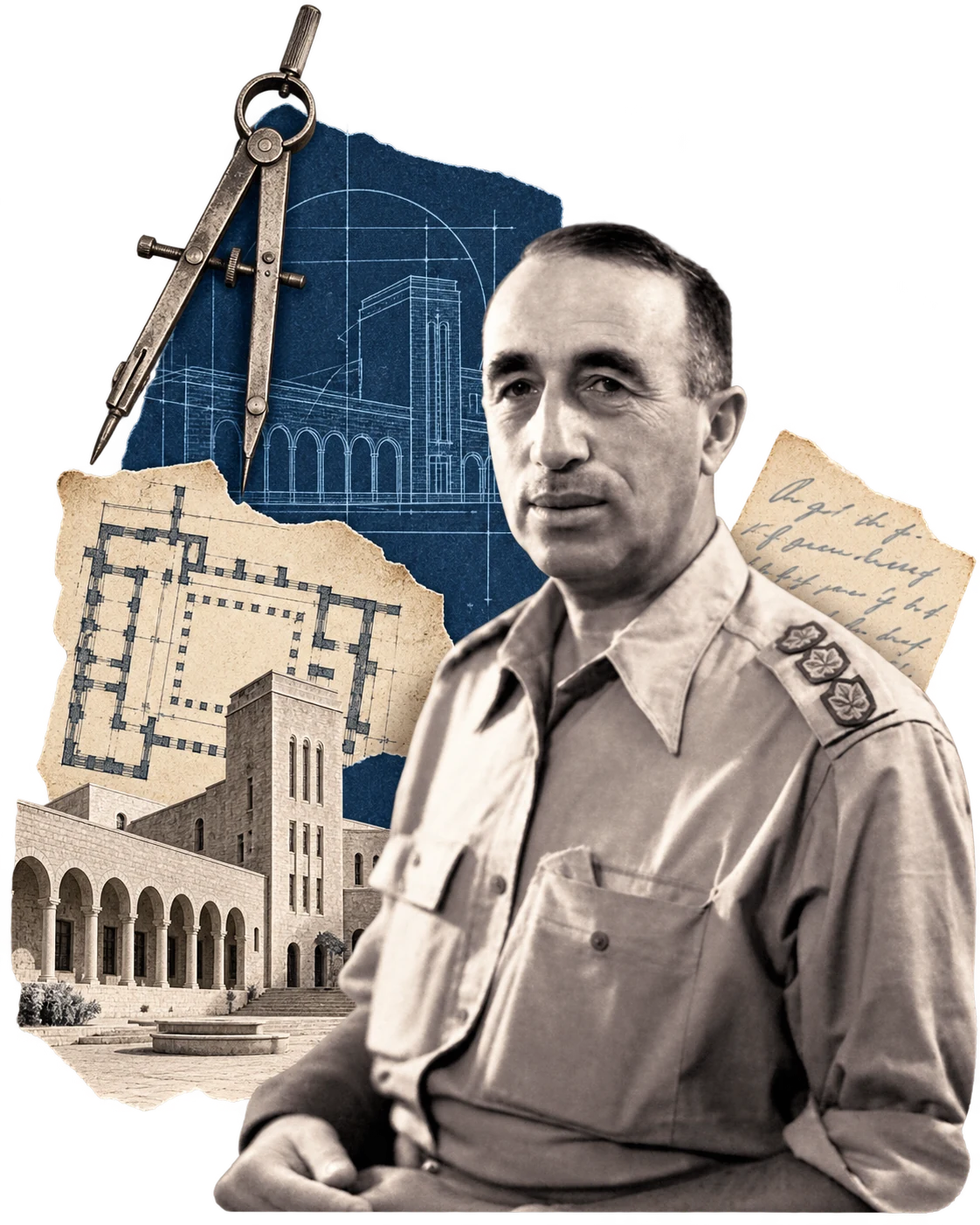
Baruch Katinka died in Tel HaShomer in 1965 at the age of 78. Despite his important contributions to Haifa and Jerusalem, neither city thought to commemorate his name and achievements. It was the city of Beersheba, of all places, that named a street after him.
תגובות
עדיין אין תגובות.