
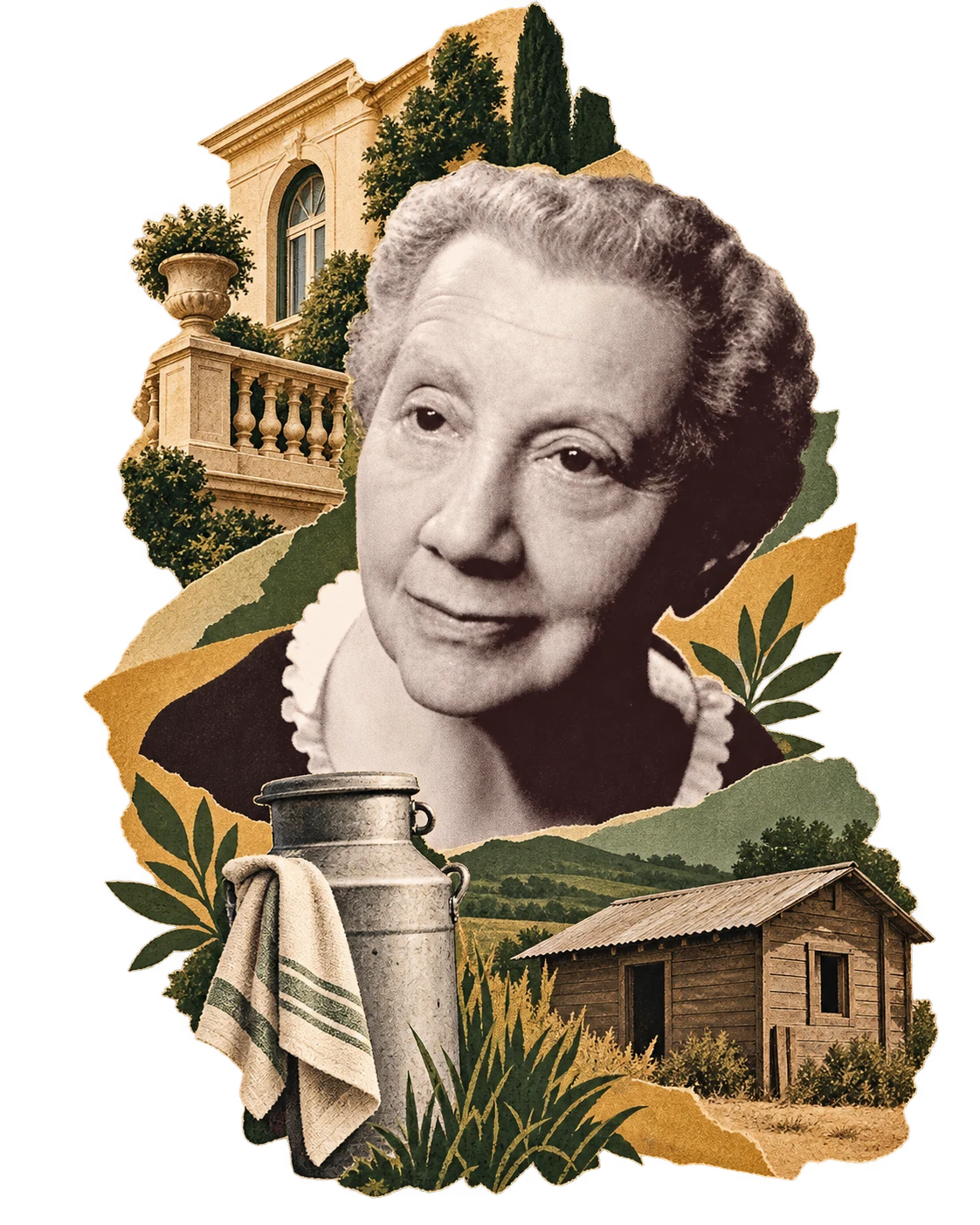
The stammering girl who became a sought-after speaker. A pampered girl raised on an estate who moved into a small shack. A strong-minded woman and active Zionist.
Irma's Bond with Settlement
"For eight kilometers, this narrow, primitively paved road winds its way between towering hills, until suddenly, before your eyes, a cluster of white houses appears atop one of them... Ein HaShofet. Here, among the spurs of the Ephraim hills, young men and women of Israel from across the sea, from America, came and settled in recent years. They came from America and Poland, and included a native-born Jew. The place was named after the great Jewish judge across the ocean... And here, among the desolate, wild mountains, through the narrow, fearsome passes and along paths that have more than once been stained with blood, the settlers built a road with their own hands. They cleared stones from the hills and valleys, planted trees and vegetable seedlings, and sowed wheat, barley, and lentils... Their faces and the gleam in their eyes testify to the joy of creation in their hearts; their roots, too, found what they sought in soil enriched by generations of ancestors with their blood and the souls of the children of this place. The new sons of Ephraim." This is how the writer Moshe Smilansky, a member of the First Aliyah, enthusiastically described his visit to Kibbutz Ein HaShofet, named after Justice Louis Brandeis in recognition of his great contribution to the establishment of the settlement. Justice Brandeis's commitment to the kibbutz can be understood from the words of Yehoshua Leibner, a kibbutz member who was on an assignment in the United States and recounted: "I just met with Brandeis. Every so often I drop in on him, even if only for a brief chat, to bring him closer to us. I have the impression that the American kibbutz has become so dear to him that there is no need to worry about the future. I am sure that in any time of trouble, we can turn to him." The person who enlisted Justice Brandeis on behalf of the kibbutz was Irma Lindheim.
The thirty young Americans who arrived in 1932 at Mishmar HaEmek seemed enthusiastic. They planned to acquire a plot of land and establish a settlement there. Irma Lindheim, already a well-known figure at the time - she headed the worldwide Hadassah organization, the Women's Zionist Organization of America - took on the task of raising funds. The fundraising effort failed, and she returned and was accepted as a member of Kibbutz Mishmar HaEmek. Two years later, the Americans moved to a training farm in Hadera, together with a group of members of Hashomer Hatzair from Poland. They were an exceptional group. Yiddish journalist Abraham Rabotsky met them and described their pioneering spirit. The women and men were all university graduates who could have found a place in the American economy, but they chose to leave behind the abundance in which they had grown up and help establish the Jewish state. To prepare, they trained in agriculture. After five years, they were ready for "the great test." In 1936, the settlement institutions in the country decided that Kibbutz America-BaNir would move to Jue'ra. On July 4, 1937, American Independence Day, the American group loaded tools and building materials onto four trucks and went to Kibbutz Mishmar HaEmek for final preparations. Abraham Herzfeld, who came to the gathering, encouraged them and ended his remarks with the song, "Look and see how great this day is..."
The group faced many difficulties. The permanent settlement was established a little farther west. At the end of that year, the foundations were laid for the children's house, a clear message of "We are not moving from here, and here we will raise the next generations." The kibbutz was planned by Noah, Irma Lindheim's son, and the hill they ascended was named after him - Givat Noah (Jue'ra). The vacated site became home to the Haganah's advanced military school. In time, the place was nicknamed "the school for chiefs of staff" because so many senior IDF officers received their initial training there. At that same site, Moshe Bar-Tikva (Mundek Pasternak) also designed the emblem of a sword and olive branch, which became the platoon commanders' pin awarded to graduates of the IDF officers' course to this day.
This was not Irma Lindheim's first mark on the country. She first visited in the summer of 1925 with her niece, Bertha Guggenheimer, from Virginia. The two were invited to the Hebrew University's inauguration ceremony and took the opportunity to travel around the country. They spent six weeks riding on horseback on a tour arranged by their friend Mania Shochat, and in doing so they saw the difficult conditions of children wandering the streets with nothing to do. They decided to establish playgrounds for children, now known as "Guggenheimer playgrounds." The first, known as Mount Zion, was inaugurated in the Jewish Quarter in September 1925 and was managed by Lillian Kornfeld, one of the pioneers of cookbook writing in Israel. More playgrounds were later established in Tel Aviv, Rehovot, Haifa, and Safed, as well as in moshavim and kibbutzim. By 1947, around 40 playgrounds were operating, serving some 700,000 children who enjoyed a range of activities, some of them run by Rachel Schwartz, mother of Ruth Dayan and Rauma Weizmann. Some of the playgrounds hosted joint activities for Jewish and Arab children, secular and religious alike. It could be said that the Guggenheimer playgrounds laid the foundations for informal education in the country.
From New York to Zionism
Irma Lindheim was born in New York at the end of 1886 to a wealthy, secular, assimilated family. In her biography, she wrote that even as a child she felt rootless. She also said that the severe stammer she suffered from left her lonely, so she devoted all her energy to her studies. At 21, she married her sweetheart, Norvin Lindheim, and they had five children. Ten years after they married, World War I broke out, and Irma enlisted in the US Army as a driver in the transportation corps, along with her Cadillac. She went down in history as the first Jewish woman to attain the rank of lieutenant in the US transportation corps. That same year, following the Balfour Declaration, she committed herself to the Zionist vision. She began drawing closer to Judaism, and in 1922 enrolled at the Jewish Institute of Religion in New York, becoming the first woman to study at the institution. Irma decided to pursue the rabbinical course, even though it was intended for men only. It was only after her petition that the institution opened its doors equally to women and men.
In 1920, her husband Norvin was accused of trading with German companies during World War I. He was tried and imprisoned for two years, and his innocence was not proven until 1928. In 1939, Irma lost her husband, but that was not the end of her tragedies. Her son Noah (Norvin) died of kidney disease while preparing to build the Eretz Israel pavilion for the World's Fair in New York, and in 1945 she lost her son Donald in Germany during World War II.
The Mission to Preserve Jewish Identity
After the brutal Second World War, Jews were divided over the existence of God. Among those who lost their faith were some who came to the United States and assimilated. Irma said that on one Shabbat evening toward the end of 1964, she experienced a revelation like Abraham, to whom God appeared and commanded him to leave his country for the Promised Land. But unlike Abraham, Irma was commanded to stop assimilation among American Jews.
Irma established the project "Operation Jewish Survival," a program intended to pass information from grandparents to their descendants, especially concerning the idea of "being Jewish." The project also came to be nicknamed the "Grandmothers Project."
In 1926, Irma Lindheim became the third president of Hadassah and, at the same time, vice chair of the Zionist Organization of America. Her main task was to promote immigration to Eretz Israel, unlike her predecessors, who had focused solely on education and health. After her husband's death, she decided to set an example and immigrated to Eretz Israel with her children. She traded her enormous estate on Long Island for a small shack in Kibbutz Mishmar HaEmek, known as "Rama's shack." She was an older pioneer, enthusiastic and energetic, who turned up for all the farm work in carefully chosen clothes that reflected how seriously she took the work. At the same time, she continued raising funds and helped establish the first American kibbutz, Ein HaShofet, and the printing press at Kibbutz Merhavia. In the Israeli media, she became known as "the grandmother of the kibbutzim."
Irma Lindheim received Israeli citizenship after the War of Independence. She published her life story in the book Parallel Quest: A Search of a Person and People, and toward the end of her life returned to the United States, where she died at the age of 91 in 1978. At her request, her ashes were buried beside those of her husband, her son Noah, and his wife Helen, who had died in a plane crash in the late 1930s, at Kibbutz Mishmar HaEmek.
"Rama's shack" at Kibbutz Mishmar HaEmek has been preserved as a memorial site.
תגובות
עדיין אין תגובות.