
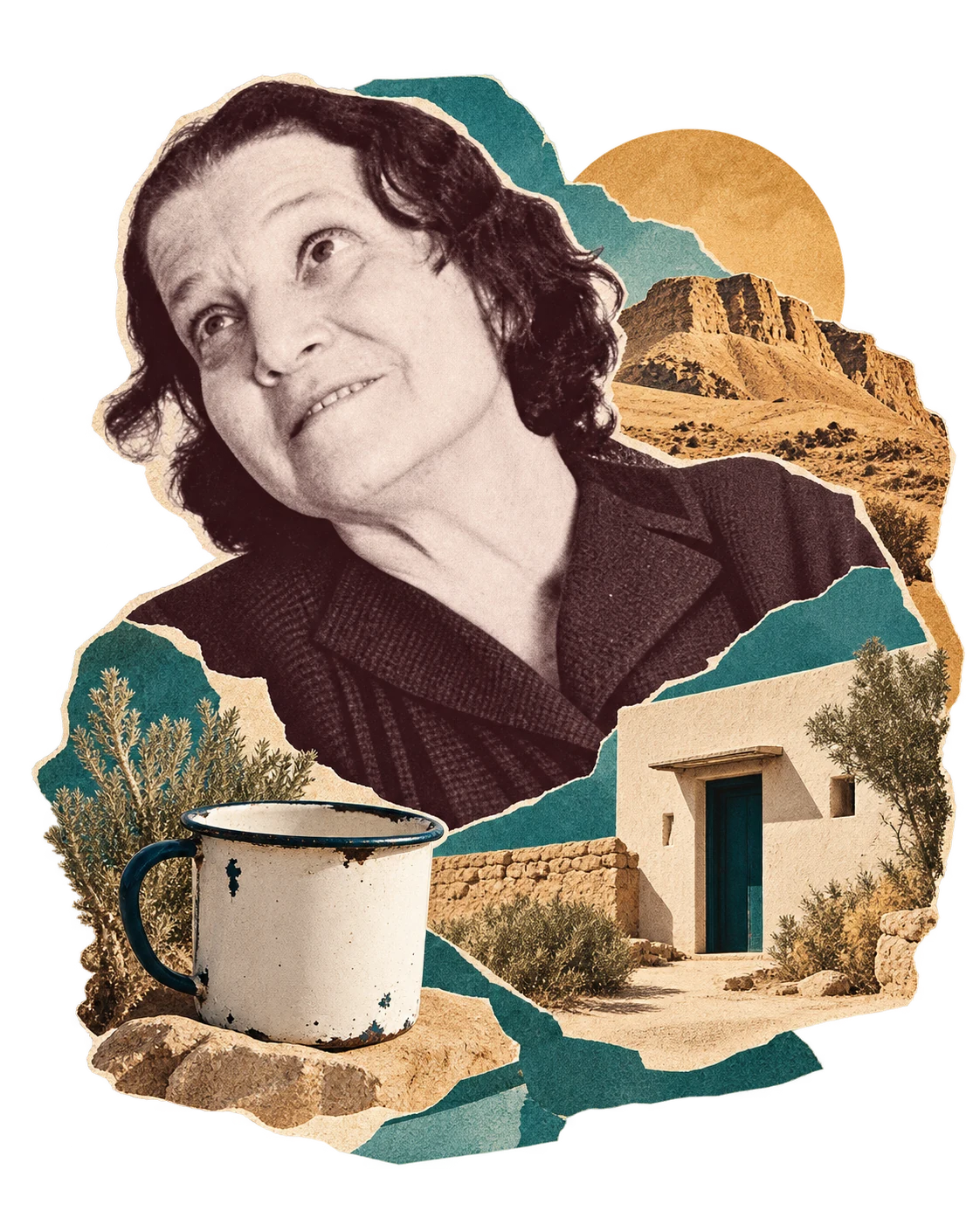
The first "First Lady," whose husband was dubbed "the husband of the Prime Minister's wife."
Meeting in a New York Library
They met in a public library in New York. David Ben-Gurion and Yitzhak Ben-Zvi had been exiled there, and both were working to revive the HeHalutz movement, which organized the immigration of young people to the Land of Israel. At the time, Ben-Gurion was living in the home of a Jewish doctor, where Paulina Munweis also lived. She had immigrated with her parents from Minsk to America at the age of 13. Years later, Ben-Gurion described their first meeting: "She was an extraordinary woman. She wasn't a Zionist, she hardly felt Jewish, she was an American, she was an anarchist." In those days, all progressive young people were anarchists. Her heroine was the anarchist Emma Goldman. She was the greatest person Paulina had ever known. She had no interest in Israel; she didn't know what was happening there. "The United States is a better place. Why do we need the Land of Israel?" Paulina enrolled in medical school, but when her father died, she ran out of money and switched to nursing. In the quiet library, a passionate love flared up, one that knew its ups and downs and entered the Zionist pantheon. He called her "Paula" and by the pet name "Polia," but asked her to Hebraize her name and call herself "Penina." About a year later, Ben-Gurion proposed to her, but made one condition: he would return to the Land of Israel as soon as he could, and she would join him, knowing that she was going to a primitive land without electricity or cars, where homes were lit only by kerosene lamps. She agreed.
In an interview with journalist Mira Avrech, Paula described how their love story began: "I met Ben-Gurion in 1915, when he came to New York... When I met Ben-Gurion, I was a chief nurse in an operating room... He asked me to come with him to the Public Library to help him. I had beautiful handwriting! He was kind and intelligent, he had a warm heart, and that's what won me over... I think I was a bit of an anarchist then... What did I know about Zionism? My family was terribly opposed to Ben-Gurion... But he had an immediate effect on me. He made me a Zionist right away..." Elsewhere, she spoke about their first meeting: "If only you had seen what he looked like [... ] His eyes were bleary, his clothes were worn out, but as soon as he opened his mouth, you could see he was a great man."
Paula and David married at the end of 1917 in a civil ceremony at New York City Hall. They were never married in a religious ceremony. After the brief ceremony, Paula returned to work, and David went back to the room he shared with Yitzhak Ben-Zvi, later the president of Israel, to carry on with his work. The couple treated the ceremony as a task to be completed. Years later, David wrote to Paula about what he thought of it: "There was a celebration here two days ago. Ben-Zvi got married! You see, I'm not the only one capable of such foolishness... I'm afraid I'm partly to blame for this, you know, setting a bad example..."
Four months after the wedding, Ben-Gurion left America to help establish the Jewish Legion, leaving Paula behind while she was pregnant. During his service, the Jewish Legion moved from Britain to Egypt, where he received a telegram from his wife saying that she had given birth to a daughter and named her Geula. When he returned to the Land of Israel, he wrote to them:
"Ekron, 15 Nisan 5679, 15.4.1919
My dear Polia and Geula,
I read your letters and look at the two faces photographed on the paper, and my heart surges toward you, and it seems to me that it is dying of longing. I don't know what's happening to me; never in my life have I felt such anxiety. Is this a new weakness developing in me?
Do you remember those few moments in the morning, when I would come to you, with work waiting for me, and how many times I found you asleep after sleepless nights of work, and woke you with a kiss and an embrace of your bare arms, and your eyes pleaded with me to stay a little longer. And more than your eyes, my heart cried: Stay, stay - and we both counted the few moments, which passed so quickly. And how much joy and happiness they brought us. Dear Polia, how much I would give now for a moment like that, for one second, for just one fleeting glance! Once again, like a little boy, like a foolish boy, I feel as if I'm in love with you for the first time, and I search for your lips, your arms, and I want to pull you close to me, embrace you with burning arms, stand beside your bed, bend over you, cling to you and surrender to your arms and forget everything but you, as I did then, and be happy in your nearness and love - together, arm in arm, lip to lip, heart to heart, in your bed of youth, which was so sacred to me.
Our love flared up so quickly, we surrendered to one another so quickly - and our life together was so brief, we had to part so soon. We have spent more time apart than together, and the very same flame still burns in my heart, and the very same love; no, Polia, not the same - deeper, stronger, warmer, and more sacred! Love for you, for our dear, dear child, for my one and only Polia, my one and only dear Polia. I miss you so much; there is so much burning love in my heart, so much. When will I be able to give you all my love in person? When will I be able to be with you again?
Their Return to the Land and the Home
Paula and Geula arrived in the Land of Israel toward the end of 1919, and Ben-Gurion met his eldest daughter after 18 months. They later had two more children, Amos (1920) and Renana (1925). Ben-Gurion made his way up through the ranks. He first served as secretary of the Ahdut HaAvoda party, was later appointed secretary-general of the Histadrut, and went on to be elected chairman of the executive of the Jewish Agency. When Paula realized she might become the Prime Minister's wife, she chose the poet Rachel to teach her Hebrew. Paula stopped the lessons after three months when Rachel fell ill with tuberculosis. "I was afraid the children might catch it," Paula explained. To her dying day, her Hebrew was never very good, as her friend Rachel Yanait Ben-Zvi, herself the future wife of a president, described: "Paula didn't know Hebrew and knew nothing about Zionism; she was a stranger in our society. None of us took an interest in her."
The journalist Mira Avrech, who later wrote a book about Paula, was well placed to describe the contrasts between them: "It would have been hard to find a greater contrast than Paula and David... He was an introvert, a withdrawn type. She was an extrovert, an open and receptive type. He liked to be alone. She liked company. He immersed himself in books on science and philosophy. She liked light reading. He carefully considered every word he said. She always spoke plainly and frankly, saying whatever was on her mind... He tended to trust people without taking the time to assess them. Even then, she had a keen sense of who people really were."
Ben-Gurion devoted his life to the state in the making, and Paula, who understood the enormity of the task, devoted her life to Ben-Gurion. Like a nurse, she looked after his hygiene and made sure he kept to regular hours for sleeping and meals; like a loving wife, she took care to spare him every burden and worry, even when they were struggling badly with money. Ben-Gurion was entirely unaware of their financial situation. "So what if Ben-Gurion is Prime Minister," she would say, "it's hard to make ends meet on his salary! I always tell him: You have no idea how much everything costs and how little money that is!"
Paula never had a permanent housekeeper, not in their official nine-room home in Jerusalem, nor in their private home in Tel Aviv, nor in their hut at Sde Boker. "I'm a socialist, like Ben-Gurion. I'm not a communist, so I believe in work. I'm the head cook at home, and I'm the cleaner too. On Ben-Gurion's salary, I can't afford permanent help... From time to time, a maid comes to me, washes the floors and does the hard work. I grew up in comfort in America, but so what? Like any other homemaker in the country, I do everything myself."
Paula had a remarkable intuition, as their daughter Geula recounted: "Only Paula knew who was for him and who was against him. She had a kind of instinct, and she was an embarrassing, direct woman who never held her tongue. She would sit with Father in his study, and people would come in. After they left, she would tell Father: I trust this one, I don't trust that one. I rely on this one, I don't rely on that one."
The Crisis of Trust
At the beginning of the 1930s, Paula began to suspect that David Ben-Gurion was having an affair, and in the summer of 1930 she wrote to him: "Dear David, your letters are becoming rarer and rarer. What's going on, have you found new attractions?" In another letter, from 1935, she wrote: "I am writing these lines to you with trembling hands. If I'm not asking too much, please come home as soon as possible, once your business in America is finished. I hope you will respect my wish. With love, Polin." By the time she wrote this letter, Paula already knew that Ben-Gurion was having an affair with Regina (Rega) Klapholz, a medical student from Vienna. Paula even met with her and gave her three photographs of herself and Ben-Gurion, taken on the shore of the Dead Sea, writing the dedication "To Rega - from Paula" on the back. When Ben-Gurion had his next affair, Paula took a different approach. She asked him to send her nursing diploma, hinting that she was thinking about divorce and an independent life. She also wrote that she was leaving her property only to their three children and asked him to "respect my wishes in this will and waive his legal rights to the property."
During the low points in their relationship (1942 and 1944), Ben-Gurion also had affairs with Doris May in England and Miriam Cohen (Taub) in the United States. Nevertheless, family was a sacred value to Ben-Gurion, and despite all the "difficulties," he never once thought about divorce. He enlisted friends to pressure Paula to stay with him, as they later testified: "We pressured her to return to him and take an interest in everything he did and in his work, so that she would win his love back."
And it worked. In time, Ben-Gurion learned how to reassure her and even began taking her along on his travels.
Her control over his health and diet was evident beyond their home and even abroad. When he traveled alone, she would dictate the menu to the chefs at his hotel. On one trip, the El Al airline informed her that borscht was not on the menu. Paula made a pot of borscht and asked one of the flight attendants to serve it to him during the flight. To another attendant she explained: "Ben-Gurion likes salted fish, but don't give him more than one. He'll ask you for more, but you shouldn't give it to him [... ] It's not good for him." A few days after the President of the United States recognized the State of Israel, the chief of staff arrived at Ben-Gurion's home to ask the Prime Minister to approve an urgent military operation. "Ben-Gurion is asleep," Paula told the astonished chief of staff. "But there's a war going on!" the officer pleaded. "I know there's a war going on, but Ben-Gurion is resting now! The war can wait."
Between Home and State
During his first term as Prime Minister, Paula showed no interest in his work. "One politician in the family is enough, and even that's too much," she said. Nevertheless, she voiced her criticism when he acted too harshly toward his rival Menachem Begin, who in her view was actually "a very nice, kind, and considerate man, a true Polish gentleman." In a letter he sent to Menachem Begin toward the end of his life, Ben-Gurion wrote: "My Paula always admired you, for some reason. I, who opposed your path - at times very strongly... have come to esteem you more in recent years, and my Paula was pleased about that."
Paula was known for her unrestrained, informal way of speaking, but she was also very charming, which captivated those she met. At a dinner at the President's Residence, Paula turned to the painter Mane Katz and asked, "Well, Don Juan, how many women have you managed to get into trouble by now?" She asked UN Secretary-General Dag Hammarskjold, a confirmed bachelor who some claim was also homosexual, "Why don't you get married? Then you'll have troubles of your own and leave us in peace." When the ambassador's wife, known as one of the most elegant women, appeared on this occasion in a magnificent Parisian creation, Paula fixed her eyes on the deep neckline and, over the howling wind outside, asked with great interest, "Aren't you cold?"
In November 1953, David Ben-Gurion announced that he intended to resign as Prime Minister and move to Sde Boker. Yitzhak Navon, who was then Ben-Gurion's secretary, said that the evening before they left, he met Paula, who asked: "Well? What do you think of him? I think he's crazy. But there's something about him. And what can I do? Is this for me? At my age? I'm an old woman, there's no maid there and there's so much dust. Who will clean the dust? There's no grocery store, no friends, no female friends. After all, I'm a grandmother. How can I go there, to the desert, when I don't even know where it is? But all my life, when Ben-Gurion says, 'Come with me,' I go with him."
The Parting and the Legacy
At the beginning of 1968, Paula Ben-Gurion died of a cerebral hemorrhage at the age of 75. Immediately after her death, Ben-Gurion returned to Sde Boker with Shimon Peres and Haim Israeli. When they arrived at the hut, Ben-Gurion told them: "Twice in my life she followed me without asking any questions - once to the Land of Israel, even though she didn't know the land or the language and had a baby to care for, and the second time here to the desert, to an isolated and remote place. Each time she left her friends and the way of life she loved and came with me. I will never forget it: the love of my youth, how you followed me into the desert, into a land not sown." Ben-Gurion also dedicated the fifth book in his series Vision and Path to her.
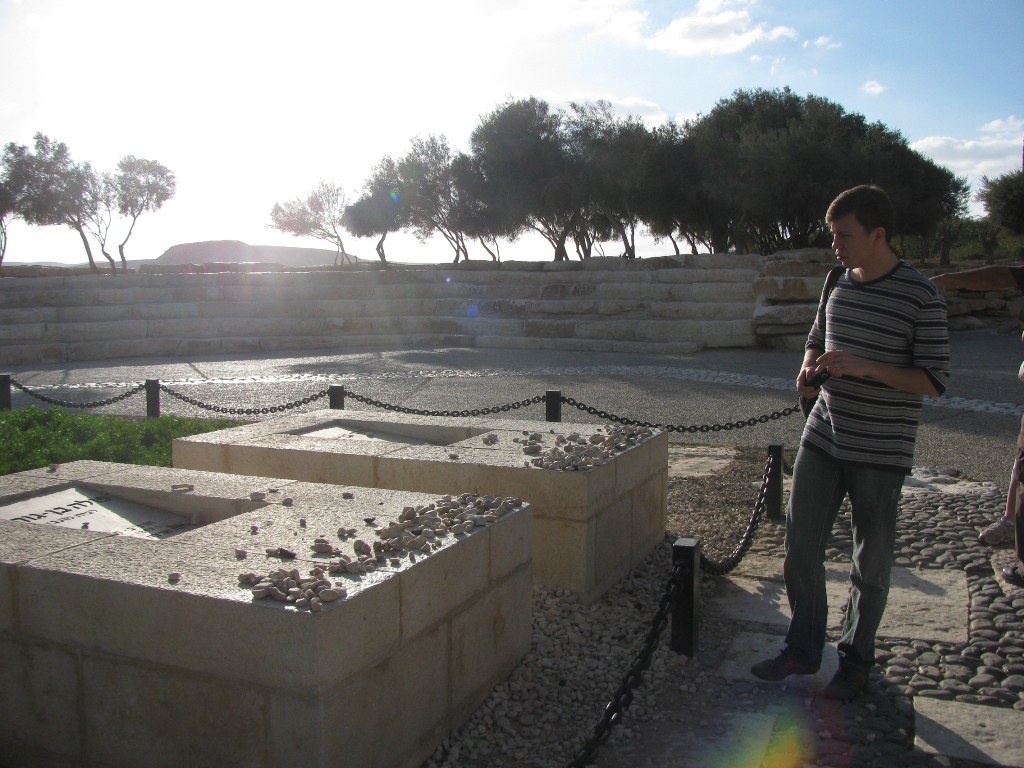
Paula Ben-Gurion was buried at an estate about 5 kilometers south of Kibbutz Sde Boker. The estate is situated on a steep cliff overlooking the Zin Valley and the Avdat Plateau. Among the public figures who attended the funeral was Menachem Begin, Ben-Gurion's former rival. Shortly after her death, Ben-Gurion gathered the letters they had sent each other, bound them together under the title Letters to Paula and the Children, and published them. In the book's introduction, he explained that the letters were primarily "a response to the loneliness suffered by a young woman who, shortly after marrying the man she loved, was left to fend for herself while pregnant, because her chosen one was a Zionist - and the work of realizing the Zionist ideal came before everything else for him." He died five years after her, at the age of 87, and was buried beside her. In 1983, for a memorial marking the tenth anniversary of his death, Mickey Gavrielov composed the song "Polia," whose lyrics are based on two love letters David Ben-Gurion had sent Paula.
תגובות
עדיין אין תגובות.