
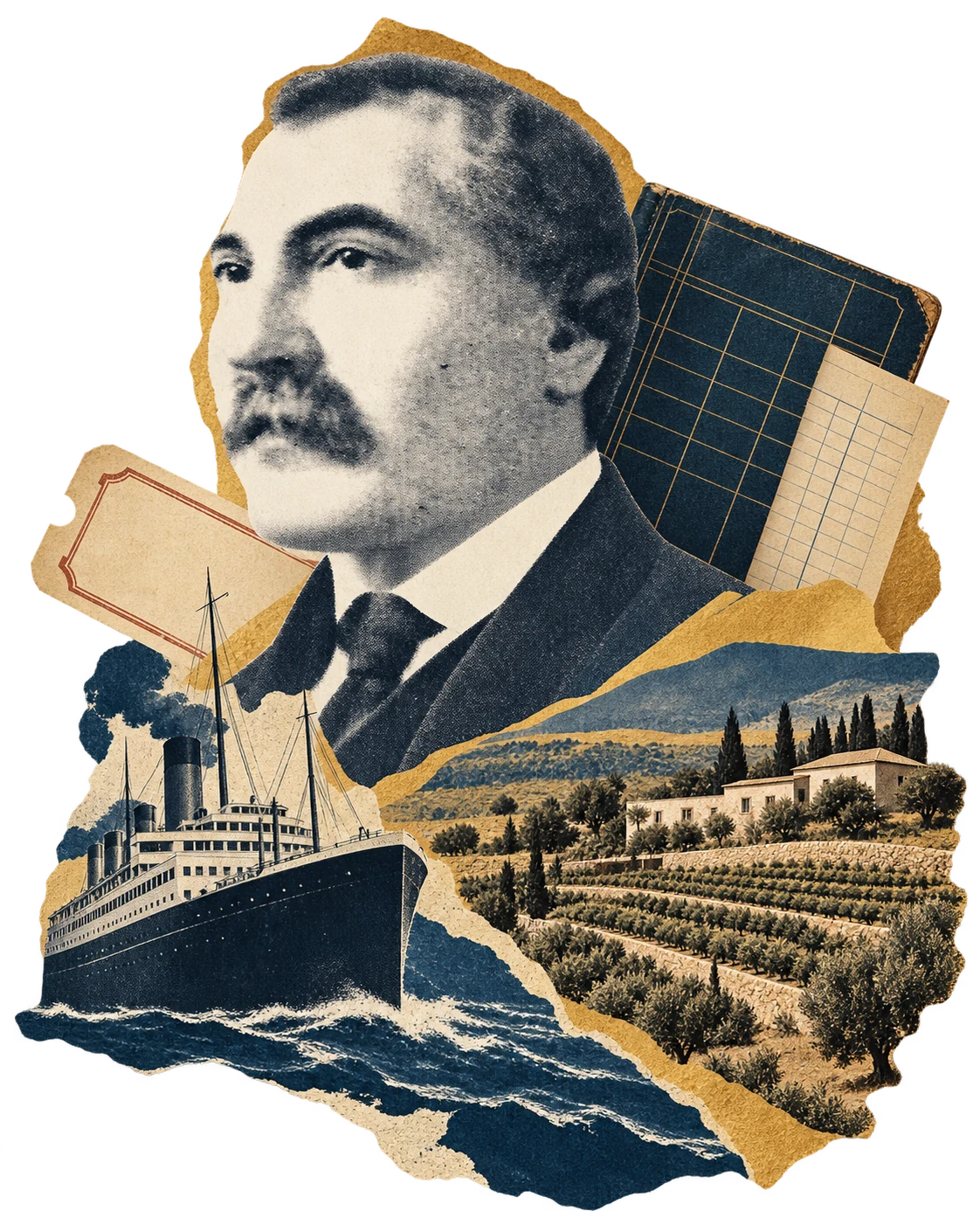
He was among the first practical Zionists and helped lay the foundations for the estate movement in the Land of Israel. A bold visionary with inexhaustible energy, he devoted his entire fortune and strength to realizing the idea of Hebrew settlement and building the Land. An unknown visionary.
The Ahuza Idea in America
In July 1912, a company called "Ahuza A New York" was founded in New York. Shimon Goldman conceived the idea. The company later founded the city of Ra'anana, whose main street, "Ahuza," reminds everyone who its founders were. In September 1933, all the public buildings, the waterworks, and the infrastructure systems registered in the founding company's name became the property of the colony. Freed from managing Ra'anana, "Ahuza A New York" turned to completing its land purchases and establishing a new colony, Gan Yavne. The colony was founded in 1932, modeled on its sister colony, Ra'anana. Its success inspired other Americans. Two years later, in 1914, a company called the "American Zion Commonwealth" was founded in the United States by the B'nai Zion Order of American Zionists, with the aim of purchasing land for Jewish settlement in the Land of Israel. The following communities arose on the land it acquired: the moshav of Balfouria, the city of Afula, Ramat Yishai, Kiryat Ata, and the city of Herzliya. What sparked the Zionist fervor among American Jews was the idea of the "estate." At the time, this idea was proposed by Shimon Goldman in St. Louis, USA, and by Dr. Arthur Ruppin in the Land of Israel. The idea was that American Jews who wanted to establish a home and a farm for themselves in the Land would send money. With this money, land would be purchased and homes built. The plots would be worked by laborers living on the farm. Only when everything was ready and the farm began to generate income would the investors come and become settlers themselves. The first estate was Poria, founded by the "St. Louis Estate Company." Following the example of the "St. Louis Estate," more than twenty such companies were established: Chicago in Sharona, London in Karkur, Bialystok in Kfar Uria. The "Moscow Estate" founded Migdal, and Ruhama was founded by the "Remnant of Israel" society from Moscow, among others. These companies shared one noble goal: settlement in the Land of Israel. To understand what moved Shimon Goldman to develop the idea of the estates, we must go back in time.
Bnei Yehuda in the Golan Heights
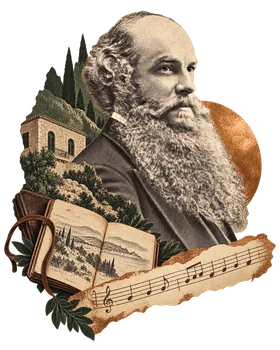
The story begins in the narrow stone alleyways of Safed. Among the old stone houses, after the afternoon prayer and before the evening prayer, a group of young scholars gathers. Their faces are solemn, their eyes pensive. They feel growing unease at the reality of their lives: the funds from the halukkah, sent from abroad, arrive in an irregular trickle and are distributed not according to need but according to how close recipients are to the community leader. They feel that life can no longer go on this way. They want only independence. No more lives of dependence and waiting for shipments from the Diaspora, but manual labor, working the land, and putting down roots in the holy soil. They already have an inspiring precedent: some of their friends have managed to establish themselves in Rosh Pina. So, in 1884, two years after Rosh Pina was founded, they form the "Beit Yehuda" society, later to be called "Bnei Yehuda." They harbor a bold vision: to establish a Hebrew settlement in the wild Golan Heights. They are led by Rabbi Shmuel Shulman, a forceful and courageous man who obtains a license to purchase land. At the end of 1885, they climb up to the Golan Heights and settle south of Quneitra, near the village of Rimsaniyeh. But when they discover that the land will not be registered in their names in the land registry, their spirits sink and the deal falls through. It is worth mentioning here the man who helped them pursue their initial dream: Laurence Oliphant, a British journalist and author, and a lover of Zion, who dreamed of establishing a genuine Jewish state on the Golan Heights. After the settlement at Rimsaniyeh fails, many members of "Bnei Yehuda" lose hope and leave. Of 52 families, only twenty remain, like twenty stubborn sparks amid harsh circumstances. A new opportunity emerges: land can be purchased in the Arab village of Bir al-Shakum in the southern Golan, near where Givat Yoav stands today.
In 1887, the purchase is completed. Twenty families, 78 people, face the mountain wind and isolation. The driving force among them is Moshe Falkiszon, a Jew with American citizenship and a man of action, who had also been a candidate for settlement at Gai-Oni, later Rosh Pina. A year later, the first five families arrive on the new land. They build mud huts, plow their fields, and toil under the blazing sun, but they do not last. The money runs out, fundraising efforts fail, and the flow of support stops. Laurence Oliphant, too, who had initially supported them enthusiastically and even offered some help, does not keep his promise to continue. At last, heavy-hearted, they all leave the place and return to Safed.
Two years pass, and the land lies deserted and silent. But in 1890 they try again. They save penny by penny from their meager income, build five modest mud-brick houses, and ten families settle there together. They give the place the longed-for name "Bnei Yehuda." As they ponder their future, the terrible news arrives: Laurence Oliphant has died (1888). Their great hope is suddenly cut short.
Around this time, Dr. Haim Hissin, a member of Bilu and one of the founders of Gedera, is sent to the Land of Israel on behalf of the Russian monthly Voskhod. His task is to describe the state of settlement. He expected things to be difficult, but what he saw left him stunned. This is what he wrote: ..."I had occasion several times to visit Bnei Yehuda in Ashkum (A-Shagum). I will describe one of those visits. I was in the southern Golan, east of the Sea of Galilee, and since it was Friday, I decided to stop at Ashkum toward evening and spend the Sabbath there. Accompanied by a Jew I had hired in Safed, I headed straight west, toward Ashkum, which, according to my calculations, was another hour's ride away. We rode through fields, without a paved road, and spurred our horses hard because the sun had already set. My companion was very worried, because the Sabbath had already begun and riding was a sin. But he had to come with me, lest he be left alone in the wilderness"... "Under the sparse canopy of a thorny Christ's-thorn tree sat eight members of 'Bnei Yehuda,' all the temporary inhabitants of Ashkum, since 'Bnei Yehuda' actually live in Safed and come here only when needed... I jumped down from my horse. The man from Safed who had accompanied me did the same, all the while casting searching glances in every direction. 'What are you looking for?' I asked. 'Where is the colony?' 'Here, this is the colony,' I replied, pointing to the thorny Christ's-thorn tree." He went on to write: "I knew all too well the dismal condition of the people of Ashkum, yet their poverty was an unpleasant surprise to me, so severe that even the lives of the Bedouins seemed luxurious by comparison. ...Why, I wondered, were these people adding to their cup of suffering, already full to the brim? If there are no houses, is it really necessary to lie beneath the open sky, without any shelter from the dew at night or the blazing sun by day... Is it essential to live on nothing but bread baked over coals, with no way to cook even a thin soup of potatoes or rice?..."
At that time, a cholera epidemic broke out in the Damascus district, and a strict quarantine was imposed on all the villages, including Bir Ashakum. For ten months the settlers lived in isolation and idleness, cut off from the world. When the quarantine ended, they all left and returned to Safed.
Word reaches them that societies abroad are looking for land to settle east of the Jordan. A glimmer of hope ignites in them. But then they hear that two of the Arab landowners in Bir al-Shakum are about to sell their plot to a wealthy Persian (Bahai) man. Alarmed that an outside party might enter the village shared by Jews and Arabs, they decide to buy the land themselves. Half the sum comes from Oliphant's widow, and the rest is promised against a promissory note.
At the end of 1894, Moshe Falkiszon sets out on a fateful journey to Paris and London. In London, he appeals to the "Lovers of Zion" society and pleads: "If this sum is not paid in the very near future, the entire first payment (paid to the seller toward the land) will be lost, and the land will once again become the property of the Muslims... I have been authorized by my friends to take every possible step. I therefore ask you to take the society under your protection and help us complete the purchase of the land and work it."
The reply is delayed for four months. Finally, at the end of 1895, Dr. Hillel Yaffe comes to visit and writes: "It is possible to transfer the lands of 'Bnei Yehuda' into the name of the 'Lovers of Zion' society in London, provided that a person entitled to purchase land in the Land of Israel is chosen. This is impossible for a Jew with Russian citizenship, and difficult for a Jew who is a British subject."
The Lovers of Zion agree to lend money on three conditions: that it be repaid over the years, that they have veto power over the sale of the land to non-Jews, and that in the meantime the colony be managed by their representative in London.
Shimon Goldman Takes the Lead
In early 1898, their representative, Shimon Goldman, arrives. He pays off the debts, renovates the houses, builds two new ones, and establishes a large courtyard surrounded by a stone wall and a stable - a kind of small Hebrew farm in the heart of an Arab village. He works there all week and returns to his family in Safed only on weekends.
Goldman devises a bold plan to establish a community of 16 families. It includes building homes and developing agricultural branches, as well as a pharmacist, a teacher, and even a boat to Tiberias. But then hope collapses: the position of the "Lovers of Zion" society in London deteriorates, the money does not arrive, and hunger and conflicts eat away at the colony. In the summer of 1901, he published a letter in the newspaper HaMagid: "With all my strength, I have tried to establish the farmers on the land in the best and most necessary ways for our country, given the state of the settlement today. I have looked after the needs of its farmers, who are content with little and do not seek grand things. I have devoted all my strength to them, invested my entire fortune in this colony, struggled against the force that pushed it backward, and fought the many obstacles in my path. I have not tired of bearing all that I was charged to bear and endure as its manager [...]. If the generous among our people do not bestir themselves to dedicate a sum equivalent to twelve thousand francs to its cause, and if the necessary assistance does not arrive by the middle of the coming Elul, then the whole colony will collapse and, God forbid, a Hebrew settlement will be destroyed [...] My brothers! Hurry to help the colony of 'Bnei Yehuda.' Do not let it suffer a fall from which it will never rise again [...] Save a Hebrew settlement from certain destruction!! Written with a grieving heart, M. S. Goldman, manager of the colony of 'Bnei Yehuda,' east of the Sea of Galilee"
But the years passed, and the dream faded. Goldman resigned sorrowfully, handing management over to David Shuv, one of the founders of Rosh Pina, who looked after the colony for only a short time. Six families managed to hold on until the First World War. In the summer of 1914, five of them left, and only the family of Haim Bernstein remained. In the spring of 1920, during the bloody riots, one of the family members went out to work in the field. Arabs from the village attacked and brutally murdered him, and also murdered the mother, Fruma. The surviving son was miraculously saved with the help of their Arab neighbors. Thus came the end of the colony of "Bnei Yehuda." But the land did not forget. In 1937, Kibbutz Ein Gev was founded nearby, and in 1967, after the Six-Day War, Moshav Givat Yoav was established as its successor. Finally, in 1972, a new communal settlement arose on the land of the first pioneers. Let us return to our hero. Shimon Goldman was born Zlotnik in 1859 to a Hasidic family in the city of Pinsk, Poland. At just 22, he caught the Zionist bug and became one of the first members of the "Hovevei Zion" movement in his city. Years later, his grandson, Muni (Shimon) Dotan, wrote of him: "Even in his youth, he was captivated by a love of Zionism, and not just an abstract Zionism. He was one of those who demanded that individuals put it into practice, insisting that they do so by settling the Land of Israel and working the land." After a period in the Netherlands, he moved to London, where he worked as a teacher and, as soon as he arrived, joined the East London branch of "Lovers of Zion." He stood out for his influence, diligence, enthusiasm, and ability to organize the city's young Jews. The London society of "Lovers of Zion" recognized in the young Shimon an energetic man capable of carrying out a Zionist mission. He was therefore sent to manage the colony of "Bnei Yehuda."
The failure of the settlement did not diminish his enthusiasm for the Zionist idea. Goldman left the Land of Israel heartbroken in 1902 and returned to London, but he did not give up on his dream.
The Founding of Poria
At the end of 1908, Goldman founded the St. Louis Estate Company. In October 1910, the company purchased a tract of land south of Tiberias from the Jewish Colonization Association (ICA). The place was called Poria, meaning "full of fruit." In the summer of 1911, work began to clear the land, build, and plant. Eliyahu Israelit was appointed work manager on behalf of the Palestine Office; Aharon Aharonson and Moshe Berman served as agricultural advisers, while Shimon Goldman himself supervised the work on site. Before long, stone houses had been built for the workers, along with a kitchen and dining room, a cowshed and sheepfold, and a work area for the animals. Construction also began on Goldman's private home, a grand house built of local basalt. A stone wall was built around the courtyard, and modest apartments for the workers were constructed inside it. A small library was established, and a school for children opened and remained in operation until the summer of 1914. After that, the children walked to Yavne'el to study every day, a five-kilometer round trip.
The planting progressed at an impressive pace. Thousands of dunams were planted with almond and olive trees, and grapevines in some places. Some of the trees began bearing fruit just two years after grafting. A hardworking community of laborers grew up around the farm: members of the Second Aliyah, people from the Old Yishuv, immigrants from Yemen, and also Arab laborers at times when there was a shortage of Jewish tradesmen in stonecutting, construction, and digging wells. Tensions over the principle of Hebrew labor were palpable; strikes and struggles took place, and eventually it was decided to reduce the employment of Arab workers as much as possible. The settlement was initially guarded by Menachem Pizem of Tiberias, and later by members of the Hashomer society, who maintained a regional base of operations at Poria. In the large Goldman family home, English was spoken alongside Hebrew, but the spirit of the place was Hebrew, hardworking, and full of movement. The house hosted leading figures of the Yishuv. In 1913, as part of the "Tour of the Colonies," also known as the "Rabbis' Tour," led by Rabbi Kook and Rabbi Yosef Haim Sonnenfeld, the group visited 26 settlements in northern Israel. The aim of the tour was to strengthen ties with the new communities. On this journey, Rabbi Kook came to the estate at Poria. After evening prayers, a kosher meal, and words of reconciliation and fellowship, the evening ended with a shared dance in the estate courtyard. That scene - a rabbi standing tall, wearing a kippah and an agal, a ceremonial sword in his hand, with the pioneers singing around him - was etched in many people's memories. Baron Rothschild's visit to the Land of Israel also marked a moment of pride for Poria: a mounted entourage stopped to see the new orchards and the square courtyard.
Then the war came. Funds from abroad were delayed and sometimes did not arrive at all. The Anglo-Palestine Bank, from which loans had been taken against a mortgage on the land, announced that it could no longer provide credit. Some of the workers went unpaid and left, and in young orchards any delay in cultivation immediately led to disease, weeds, and weakened trees. The 1915 locust plague darkened the skies and caused heavy damage. An almond capnodis infestation was also identified. The Ottoman army requisitioned horses, equipment, carts, and people for forced labor. In addition, in 1919 almond prices in Europe fell sharply, and even when the fruit was harvested, the income did not cover the costs.
His Final Years and Legacy
In March 1918, at just 49 years old, he died. His grandson Muni wrote: "Some say that Grandfather took ill from a broken heart and never recovered... The family said that before he died, he asked them to raise him from his bed so he could gaze, one last time, at the Yavne'el Valley and the Sea of Galilee." He was buried on a cliff overlooking the Sea of Galilee, and his wife Rachel was buried a year later on the Mount of Olives.
Shimon Goldman's grave and his home in Poria remain testimony to sad chapters in the history of settlement, but also to a great Zionist vision and the bold efforts of a man who invested his entire fortune and strength in building the Land. As Judge Rosenblatt of America wrote of him after his death: "We could not help but admire the determined iron will and the ideals that drove Shimon Goldman to burn all the bridges behind him and bring his family to live or die by his principles..."
The Poria Estate slowly faded. Goldman's sons tried to revive it, but eventually they left. The events of 1936 destroyed what remained of the place, and Goldman's stone house stood ruined and deserted. Muni Dotan summed it up in a lecture he gave years later: "And so my grandfather's dream came to an end. Only the ruins of the burned stone house remained, standing desolate to this day, silent testimony to my grandfather's great vision and to the life that once thrived there - a life full of hardship and great hopes."
תגובות
עדיין אין תגובות.