
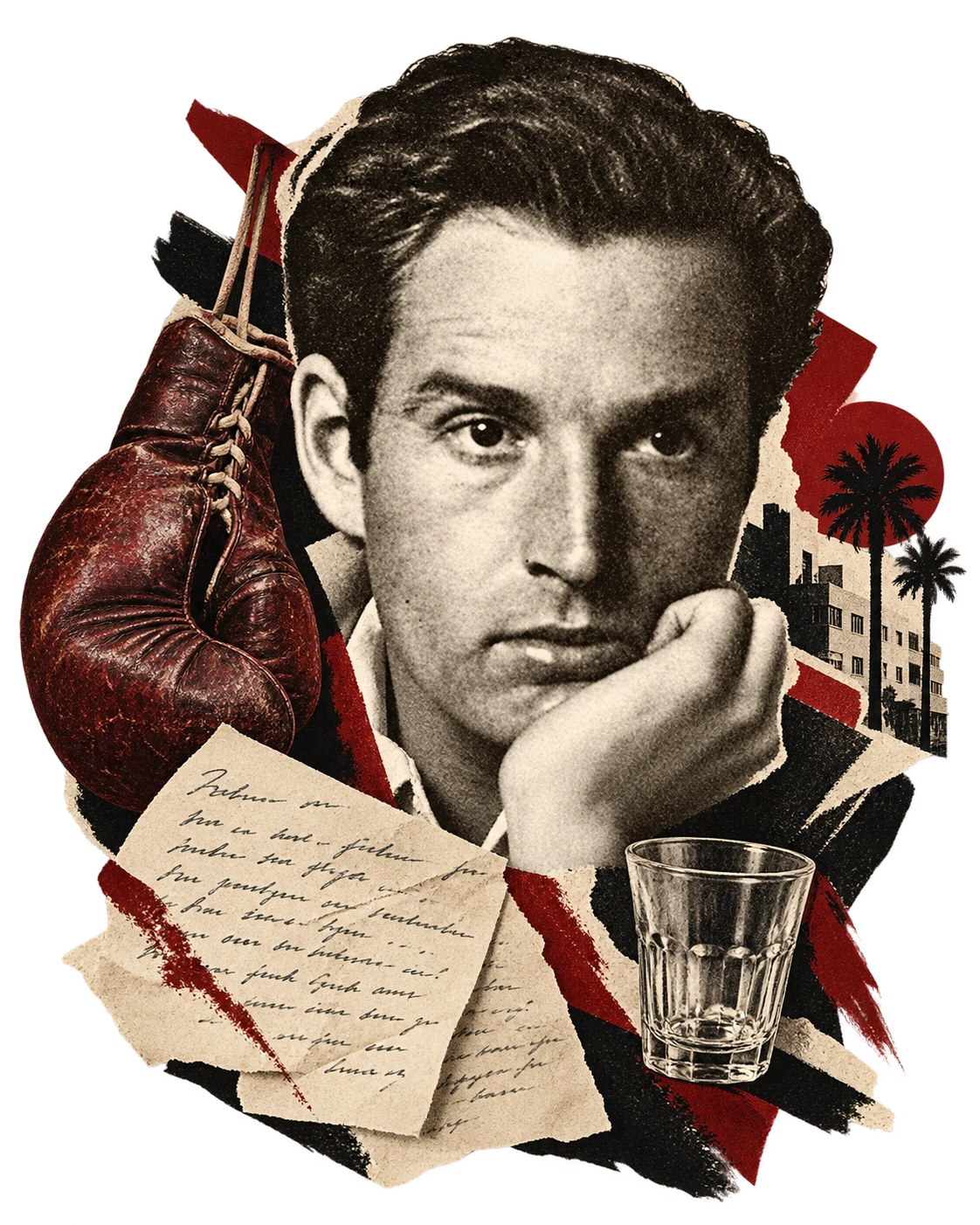
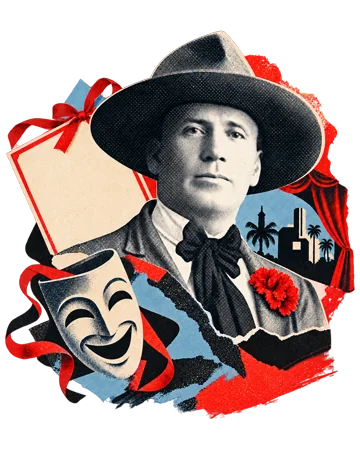
The handsome man who arrived in the country in 1927 was a blend of tough guy and aristocrat, passionate Russian communist and writer of patriotic songs for Israel, boxer who knew how to throw a punch and take one, and lover addicted to drink.
"A nobleman from head to toe, walking quietly, with long side locks, something beautiful, breathtaking," is how Haim Gouri described Alexander Penn when he arrived in the country. Alexander Penn was one of the handsomest men in the country at the time. Intelligent and shrouded in mystery, he was irresistible to all but a handful of women. He was one of the first members of Tel Aviv's bohemian scene, a man who experienced many loves. He was married twice and was the father of three daughters and one son with three different partners.
Arrival in the Land and Learning Hebrew
Alexander Penn was not a Zionist and arrived in the country without knowing Hebrew, but with a passion for writing. He found work in the orchards of Moshe Smilansky in Rehovot, where he met Bialik, who saw him as a child prodigy. Bialik taught Penn the writings of the Mishnah and the Talmud, through which he was introduced to Hebrew. After about a year, Penn already had a command of the language and wrote the poem 'Not Yet': "The sun - a roasted hell. / The soil of my bread - cactus and sand. / I tell you openly: / I cannot!... / An ancient madness gives voice to fire within me, / But I cannot... not yet!"
Later he wrote the poem 'A New Homeland': For this homeland, which I did not know, / and the fragrant breeze in the gold of the orchards - / I staked my soul, and sent it away with a cheerful laugh / to burn in the blazing sirocco. / What is life to me without revelry and thunder, / without a storm of fire, without a knife's kiss, / where a cursed sun pours out a woman in fury, / where, without snowy expanses, the heart grows old. / I love it - this place - this homeland! / For desert sands, its ruins and club..."
The Land of Israel captured Alexander Penn's heart, and he wrote the poem 'And Yet...' which ended with the words: "And then, unwittingly, a voice roars within me: / 'Worn-out and wanton, and yet - a homeland!'" He ended one of his last poems this way: "Peace to you: / Road. / Flag. / Freedom. / Love. / Much peace to you, homeland."
To supplement his income, Alexander Penn worked as a boxing coach for the Hapoel Rehovot team: "I'm a boxer not only in the ring, I'm a fighter in my poems, too." But Penn was hard to stomach, as Bialik described him: "Penn is like a bone in your throat - impossible to swallow, impossible to spit out." Avraham Shlonsky also recognized his talent and gave him a column in the newspaper Davar. Penn wrote for the paper under the pen name 'Tenu Rabbanan' and signed some of his works with the names Yitzhak Freizon, Yud-Het, and Shifra Shirer.
Over the years, some of his poems became songs and even almost anthems - like the song 'Bring Bricks': "Bring bricks, / there's no time to stand / even for a moment. / Build, builders, / fear not, nor tire. / Wall to wall we'll raise, / over every obstacle and danger. / All of us will sing, / the anthem of building our land. / In place of yesterday / we have tomorrow, / and for every wall, / as we raise our building, / our people's future will be our reward."
The Mystery of His Birth and Name
One of the mysteries surrounding Alexander Penn is where he was born. Today, there are five versions. One says that Alexander Penn was born in his grandfather's home in Siberia, on the shores of the Arctic Ocean. His mother was the daughter of a Swedish count named Jensen, who was a bear hunter, fisherman, and oceanographer. She went to Vienna to study medicine, where she fell in love with his father, a Jew descended from Rabbi Shneur Zalman of Liadi. The two married, and when she was seven months pregnant, she went to visit her father in Siberia, where she gave birth to her son Alexander. Shortly after his birth, his mother died, and his grandfather decreed, "Where he was born, there he shall grow up and be educated." When Alexander Penn was ten, his grandfather was injured on a hunting expedition and, in his final moments, gave him his father's address. The boy Alexander Penn left Siberia and wandered for four years, as the Bolshevik Revolution and the Russian Civil War raged in the background. He joined a gang of street urchins and learned from them what could be gained by force. When he found his father, he converted to Judaism. In an unfinished autobiographical novel titled 'Senka Zhid,' Penn wrote about his childhood: "Senka is new to the gang of street children. Even before joining them, he knew what wandering was; he had traveled an endless road alone, from the shores of the North Sea to central Siberia. In dog sleds, on skis, and sometimes on his own sturdy legs... They had seen much in their harsh, wandering lives. Slant-eyed Chukchi with mighty jaws, hunger, theft, sometimes even killing. They believed without reservation or doubt in the all-powerful strength of the fist." In 1966, he wrote 'A Song to Myself,' in which he described his birth: "In the beginning was my mother's cry as my life was born. / Then God created the heavens and the earth / and the silence that rings in the crystal of glacier bells / and the polar bear who would play tag with me."
His daughter heard the second version from her aunt, Penn's sister. It differs slightly from the first: Sarah, Alexander Penn's mother, was a Subbotnik governess (a member of a Russian Christian sect that observed the Sabbath) and the daughter of a Swedish count. His paternal grandfather was descended from Chabad rabbis, a poet who knew Russian and Hebrew. His father, Yosef, was qualified as a rabbi but had abandoned religion; he married Sarah after his first wife died. When she was seven months pregnant, Sarah went to visit her father in the far north, where Alexander Penn was born. When he was about two years old, his mother Sarah died of pneumonia.
The third version comes from the writer Yaakov David Abramsky, who claimed to have seen Alexander Penn's birth record in the possession of the Red Cross. According to the record, Alexander was born in southern Ukraine, where the family lived in the courtyard of Penn's maternal grandfather, whose name was David. They lived in poverty and hardship, and there were not even any beds in the house. When he was a child, the family moved to another town in the province and, some time later, went on to Siberia. "Alexander Penn was a mask with no Penn behind it. A disguise without a face. He did not search for his true identity. He wanted to lose it. He labored long to blur and erase his identity. His soul yearned to tell lies. He said: I never knew my father, and I did not know my mother. My mother was a foreigner," Abramsky wrote. He claimed that Alexander Penn came from a respectable family and that his Jewish mother had even founded a soup kitchen for Jewish refugees who arrived in Siberia, as well as a Hebrew school for their children.
The fourth version was told by Moshe Zaferman, Alexander's cousin. Zaferman said that Penn's mother's name was Sonia Zaferman, and that Alexander Penn's birth name was Avraham Papliker-Stern. The home where Penn grew up was poor, and his grandfather David taught at a cheder.
The fifth version was related by Professor Dov Sadan, who heard from S.Y. Agnon that Alexander Penn himself had told him the story of his birth and his mother's history. Agnon incorporated it into his book 'Shira' in the character of Shira's father, who was arrested for revolutionary activity, escaped to Galicia, and became a Hebrew teacher. He fell in love with one of his students and married her. When the couple returned to Russia, the young woman missed her parents and went to visit them. One day, as she sat in the city garden, a cavalry officer fell in love with her, and she went with him, but died soon afterward. Alexander Penn's name is also shrouded in mystery. One version says that his real family name was Stern, and that his father added the name Papliker. Alexander then combined the first Hebrew letter of Papliker with the last Hebrew letter of Stern to create the name Penn. Another version says that his original name was Penn, since he was the brother (or, in another version, the father) of director Arthur Penn ('Bonnie and Clyde'). Other friends remembered that Penn chose his name by removing the middle letters from the name of the poet Alexander Pushkin, whom he admired.
Youth, Marriage and Bohemian Life
It was his father who encouraged him to read poetry. The first book he gave him was a volume of poems by Mikhail Lermontov. "Lermontov's poetry enchanted the boy. He devoured the book in one sitting and walked around shaken and stirred, as if cast into an unreal, imaginary world... It was like growing up all at once," Penn recalled. When Penn began writing, he stopped wandering and left the company of the street urchins. Bella Don was Alexander Penn's first love. Her father was a Ukrainian revolutionary, and after he was murdered, Bella came to the country with her mother. She had known Alexander Penn in Ukraine, where he was a close friend of her partner at the time. When the latter went to Berlin for medical treatment, Alexander took advantage of his absence and began courting her passionately. When Bella did not respond to his advances, he threatened to kill himself. Alexander's threats of suicide and pressure on Bella worked, and in 1928, 18-year-old Bella married 22-year-old Alexander Penn. Penn wrote Bella the poem 'I Am Not the Man': "I am not the man, not I, / for whose return you have waited..." The couple's first year was filled with love. After their eldest daughter, Zrubavela, was born, they moved from Tel Aviv to Rehovot. When he struggled to support his small family on the income from his boxing lessons, Penn returned to drink. Around that time, he met Avraham Shlonsky, who supported him, and soon afterward he also met Natan Alterman.
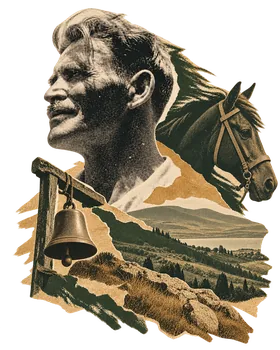
Bella did not want a second child, but Penn persuaded her to keep the baby, promising that he would find a better job and provide for them respectably. They returned to Tel Aviv, and in 1931 their son Adam was born. Alexander Penn joined the 'Trask' group, founded by Avraham Aldema (Gil Aldema's father), whose aim was to 'make merry.' At the same time, Penn began writing songs for the 'HaMatate' theater. When the group went up to the hills of Sheikh Abrek and joined Alexander Zaid, Penn saw him as a kindred spirit, since they were both sons of Subbotnik women. He fell in love with the land and the country and wrote quite a few poems there, among them 'To the Desert We Go'; 'With Cymbals and Drums'; 'At the Spring'; and 'To Yavne in Galilee' (Penn wrote his well-known song 'My Land, My Earth' in memory of Alexander Zaid, on the third anniversary of his murder by an Arab).
At Sheikh Abrek, while still married to Bella, Alexander Penn fell in love with Hanna Rovina, who was 18 years older than he was. On the way home, under a streetlamp, he kissed her. "From that first kiss, I knew I was lost for life," Rovina said. Bella begged him not to go with Habima on a tour of the Jordan Valley, but he refused to heed her pleas. There was no food at home, and Bella went out to look for some, carrying her one-and-a-half-year-old son Adam in her arms. She found a radish in the sand, cleaned it, and fed it to Adam. The toddler developed an intestinal infection and died on the way to the hospital. Bella buried the child without telling Alexander Penn. She threw Penn out of her home and burned his writings. After four years of marriage, she returned with her daughter Zrubavela to her mother's home.
Penn and Hanna Rovina's affair caused a sensation in the small country, but this great love ended in less than a year, after the birth of their daughter Ilana in 1934. In time, Ilana Rovina became an actress, singer, and model (she died in October 2020 of COVID-19).
While he was in a relationship with Hanna Rovina, Alexander Penn began an affair with Rachel Loftglas. She was the nurse who cared for Hanna Rovina after a difficult birth that nearly cost her life. Penn and Loftglas married only after their daughter was born, in October 1936, and Alexander gave her the name Sinilga (in Russian, 'daughter of the snows' or 'Snow White'). Penn continued drinking despite having diabetes and had quite a few affairs. Even so, his marriage to Rachel Loftglas lasted 36 years, until the day he died. For Rachel's 29th birthday, he wrote her the poem 'Confession': "My simple coat and a lantern on the bridge / an autumn night and my lips wet with rain / that's how you first saw me, do you remember?"
Alexander Penn and Rachel Loftglas first met at the 'HaMatate' theater, not as the poem describes. "And it was as clear to me as two and two / that I would be to you like bread and water / and like bread and water you would return to me..." Penn knew that Rachel had silently borne all his affairs and devoted her life to him: "Yes, it wasn't good, it was magnificently bad / but God, who deals out fates, is my witness / if it happens again, let it not be with another woman / only that same poor, wayward love..."
Penn also had lesser-known affairs. One was with Miriam Had Gadya (Nisenholtz), a stunningly beautiful and talented painter who immigrated from Russia in 1911 and was the only female painting student at Bezalel. She studied with Nahum Gutman, who wrote of her, "She wore her hair cropped like a boy's and was the first to start this fashion in the entire Middle East." Hemi, Nahum Gutman's son, wrote of her: "Had Gadya was the class beauty... I think everyone was a little in love with her. My father always spoke of her beauty with a warm smile." The only woman who rejected Penn and stood firm against his charms was Shoshana Borochov, daughter of Dov Borochov, one of the ideologues of the Zionist movement. Shoshana, who came to the country with her mother, was a renowned beauty with great charm, courted by many, including Alexander Penn. Shoshana rejected him because she knew about his many love affairs.
The Turn to Communism and the Boycott
In the mid-1930s, Alexander Penn abandoned lyrical poetry about love, wine, and eroticism and began writing fervent paeans to communism: "They march, they march, with the people and their sons in a tumultuous parade, they are nameless, their eyes pure. They bless salt and bread, they march, their blood upon the cloth. We are for it, we are for it..." Later, his poems became radical: "We - our banner is law and justice / We - our path is paved with Lenin / We are for it / We are the peace battalions on parade..."
The Tel Aviv bohemian community, which had embraced him and showered him with love, did not forgive him and saw him as a traitor to the Jewish people. Some saw him as a communist, others as an Israeli socialist. In 1934, Penn wrote 'The Geneva Vision,' in which he denounced the League of Nations' inaction. A year later, Penn received a notice signed by the chairman of the Hebrew Writers Association, Yaakov Fichman, and its secretary, Avraham Broides, informing him that he had been expelled from the association: "Mr. Alexander Penn, your recent works have aroused deep alarm in the hearts of writers loyal to the House of Israel. Your following the vile ways of the gentiles, alien to the national spirit of our homeland's building, poisons the literary atmosphere and makes your membership in our association burdensome to us. If until now we treated you with leniency and adopted a tolerant approach, after you printed in a dubious newspaper your poem 'Against!', which is nothing but a red challenge in the style of the Bolsheviks, may their name be erased, we have no choice but to expel you from the association."
From then on, Penn's poems were boycotted, and his songs were broadcast without his name being mentioned. He lived in poverty, lonely and ill, addicted to drink. This is what he wrote during those dark days: "Go away, go away from me, / sorrow, gloom, and thought. / For I live, I am still alive. / I will gladly drink liquor, / to your health, my beauty, my little sister... / Liquor, liquor, I'll drink today, / and tomorrow the fish will eat me. / To hell with it all!..."
Illness, Parting and Rest
Because of his diabetes, doctors had to amputate one of his legs, and later the other. In 1972, he was hospitalized at Ichilov Hospital, aware of his condition but unwilling to accept it. In his poem 'The One-Way Street of Sorrow,' he wrote: "I don't want to be nothing - I want to be something in everything: on the slopes of joy and the heights of sorrow, in the tree, in water and bread, in wine and woman, and in the dust I crush beneath my soles... I don't want to be nothing! - I want to be something in every second, because my time is not given to me on credit, without measure or limit... I want to be something, and if I'm short of time, I lie down the day before yesterday and rise yesterday, so that today I can pour and shape the face of tomorrow, because tomorrow is never born tomorrow; it is the child of yesterdays and the day before yesterdays, a wayward duel between time and me..."
As early as the late 1950s, Alexander Penn understood that the end of his life was approaching, and despite this he did not change his way of life at all. He continued to drink and smoke as if he had never been forbidden to do so. On the evening after Israel's Independence Day in 1972, his condition worsened. At his bedside in the hospital were his wife Rachel and his daughters Zrubavela and Sinilga. Suddenly he raised his hand, sat up a little, said "Goodbye," and died.
Although he remained a communist until his last day, Penn asked in his will for a Jewish funeral with no eulogies. He instructed that Kaddish be said for him and asked to be buried among his fellow writers, near the grave of the poet Avigdor Hameiri. Alexander Penn was laid to rest in Kiryat Shaul Cemetery. The words "Earth, my earth, merciful until my death" were inscribed on his grave - the opening line of his poem 'On the Hills of Sheikh Abrek,' written after Alexander Zaid was murdered.
תגובות
עדיין אין תגובות.